TLDRs; Suno seeks $100M funding at a valuation topping $2B, quadrupling its worth amid the AI music boom. Universal and Warner Music are suing Suno for copyright infringement, seeking potential damages in the billions. Settlement talks may result in licensing agreements and equity stakes, setting new industry standards for AI-generated music. Regulatory changes and royalty [...] The post Suno Targets $2B Valuation as AI Music Boom Accelerates appeared first on CoinCentral.TLDRs; Suno seeks $100M funding at a valuation topping $2B, quadrupling its worth amid the AI music boom. Universal and Warner Music are suing Suno for copyright infringement, seeking potential damages in the billions. Settlement talks may result in licensing agreements and equity stakes, setting new industry standards for AI-generated music. Regulatory changes and royalty [...] The post Suno Targets $2B Valuation as AI Music Boom Accelerates appeared first on CoinCentral.

Suno Targets $2B Valuation as AI Music Boom Accelerates

TLDRs;

  • Suno seeks $100M funding at a valuation topping $2B, quadrupling its worth amid the AI music boom.
  • Universal and Warner Music are suing Suno for copyright infringement, seeking potential damages in the billions.
  • Settlement talks may result in licensing agreements and equity stakes, setting new industry standards for AI-generated music.
  • Regulatory changes and royalty models could reshape Suno’s revenue and the entire AI music economy in the coming years.

AI music startup Suno, known for its ability to generate complete songs from text prompts, is reportedly in talks to raise over $100 million at a valuation surpassing $2 billion, according to individuals familiar with the matter.

If finalized, the deal would quadruple Suno’s previous valuation, underscoring investor appetite for creative AI tools that blur the line between art and algorithm.

The company, which already boasts annual recurring revenue (ARR) exceeding $100 million, has attracted a growing list of high-profile backers, including Lightspeed Venture Partners, Nat Friedman, Daniel Gross, Matrix Partners, and Founder Collective.

While the company’s growth track record has dazzled Silicon Valley, Suno’s rapid ascent has not been without friction. In mid-2024, major record labels  including Universal Music Group (UMG) and Warner Music Group (WMG) jointly filed lawsuits against Suno and its AI music rival, Udio, alleging copyright infringement on a massive scale.

The suits, which seek up to $150,000 per infringed work, could translate into billions in potential damages if upheld in court. Yet, despite the looming legal shadow, Suno’s discussions with investors have continued, reflecting confidence that the company will eventually strike a workable deal with the industry’s biggest players.

Insiders suggest that Suno and the record labels are exploring a settlement that could lead to formal licensing agreements and perhaps even equity stakes for the labels themselves. Such an arrangement could mark a pivotal moment in reconciling AI-generated music with traditional copyright law, effectively setting a precedent for the broader industry.

Negotiating the Future of AI Licensing

Sources close to the talks say the outcome of Suno’s settlement could reshape the economics of AI-generated audio. Terms around royalties, attribution, and per-use fees will determine how sustainable Suno’s current $100M+ ARR truly is.

If the company agrees to a model mirroring streaming-style micropayments, it could see a sharp decline in profit margins. Similar to ElevenLabs’ deal with Kobalt, where a 50/50 split and Most Favored Nation (MFN) clause apply, labels could demand similar parity, ensuring they receive the most favorable terms across all AI partnerships.

Moreover, the European Union’s AI Act, set to enforce mandatory watermarking and provenance tracking by 2026, adds another layer of compliance pressure. Suno may need to integrate new content-detection APIs to verify originality, mirroring solutions already employed by platforms like Spotify and Deezer, which have begun flagging or removing AI-generated songs in bulk.

The Broader AI Audio Gold Rush

Suno’s valuation surge reflects a broader trend sweeping through the AI-generated audio and music creation market. With user-generated content (UGC) platforms integrating generative audio tools and creators experimenting with synthetic vocals, AI is fast becoming both a creative ally and a legal minefield.

Vendors like Digimarc and SoundPatrol are developing neural fingerprinting and audio watermarking technologies that help identify AI-generated content, an innovation essential for ad networks, streaming services, and gaming studios aiming to avoid copyright violations.

Despite these challenges, the demand for AI-driven creativity continues to surge, and investors are betting that platforms like Suno can navigate the legal complexities and emerge as industry leaders. If successful, Suno’s $2B valuation could signal the dawn of a new era where music creation, licensing, and distribution are fundamentally rewritten by AI.

The post Suno Targets $2B Valuation as AI Music Boom Accelerates appeared first on CoinCentral.

Market Opportunity
null Logo
null Price(null)
--
----
USD
null (null) Live Price Chart
Disclaimer: The articles reposted on this site are sourced from public platforms and are provided for informational purposes only. They do not necessarily reflect the views of MEXC. All rights remain with the original authors. If you believe any content infringes on third-party rights, please contact [email protected] for removal. MEXC makes no guarantees regarding the accuracy, completeness, or timeliness of the content and is not responsible for any actions taken based on the information provided. The content does not constitute financial, legal, or other professional advice, nor should it be considered a recommendation or endorsement by MEXC.

You May Also Like

The Channel Factories We’ve Been Waiting For

The Channel Factories We’ve Been Waiting For

The post The Channel Factories We’ve Been Waiting For appeared on BitcoinEthereumNews.com. Visions of future technology are often prescient about the broad strokes while flubbing the details. The tablets in “2001: A Space Odyssey” do indeed look like iPads, but you never see the astronauts paying for subscriptions or wasting hours on Candy Crush.  Channel factories are one vision that arose early in the history of the Lightning Network to address some challenges that Lightning has faced from the beginning. Despite having grown to become Bitcoin’s most successful layer-2 scaling solution, with instant and low-fee payments, Lightning’s scale is limited by its reliance on payment channels. Although Lightning shifts most transactions off-chain, each payment channel still requires an on-chain transaction to open and (usually) another to close. As adoption grows, pressure on the blockchain grows with it. The need for a more scalable approach to managing channels is clear. Channel factories were supposed to meet this need, but where are they? In 2025, subnetworks are emerging that revive the impetus of channel factories with some new details that vastly increase their potential. They are natively interoperable with Lightning and achieve greater scale by allowing a group of participants to open a shared multisig UTXO and create multiple bilateral channels, which reduces the number of on-chain transactions and improves capital efficiency. Achieving greater scale by reducing complexity, Ark and Spark perform the same function as traditional channel factories with new designs and additional capabilities based on shared UTXOs.  Channel Factories 101 Channel factories have been around since the inception of Lightning. A factory is a multiparty contract where multiple users (not just two, as in a Dryja-Poon channel) cooperatively lock funds in a single multisig UTXO. They can open, close and update channels off-chain without updating the blockchain for each operation. Only when participants leave or the factory dissolves is an on-chain transaction…
Share
BitcoinEthereumNews2025/09/18 00:09
Franklin Templeton CEO Dismisses 50bps Rate Cut Ahead FOMC
Franklin Templeton CEO Dismisses 50bps Rate Cut Ahead FOMC

The post Franklin Templeton CEO Dismisses 50bps Rate Cut Ahead FOMC appeared on BitcoinEthereumNews.com. Franklin Templeton CEO Jenny Johnson has weighed in on whether the Federal Reserve should make a 25 basis points (bps) Fed rate cut or 50 bps cut. This comes ahead of the Fed decision today at today’s FOMC meeting, with the market pricing in a 25 bps cut. Bitcoin and the broader crypto market are currently trading flat ahead of the rate cut decision. Franklin Templeton CEO Weighs In On Potential FOMC Decision In a CNBC interview, Jenny Johnson said that she expects the Fed to make a 25 bps cut today instead of a 50 bps cut. She acknowledged the jobs data, which suggested that the labor market is weakening. However, she noted that this data is backward-looking, indicating that it doesn’t show the current state of the economy. She alluded to the wage growth, which she remarked is an indication of a robust labor market. She added that retail sales are up and that consumers are still spending, despite inflation being sticky at 3%, which makes a case for why the FOMC should opt against a 50-basis-point Fed rate cut. In line with this, the Franklin Templeton CEO said that she would go with a 25 bps rate cut if she were Jerome Powell. She remarked that the Fed still has the October and December FOMC meetings to make further cuts if the incoming data warrants it. Johnson also asserted that the data show a robust economy. However, she noted that there can’t be an argument for no Fed rate cut since Powell already signaled at Jackson Hole that they were likely to lower interest rates at this meeting due to concerns over a weakening labor market. Notably, her comment comes as experts argue for both sides on why the Fed should make a 25 bps cut or…
Share
BitcoinEthereumNews2025/09/18 00:36
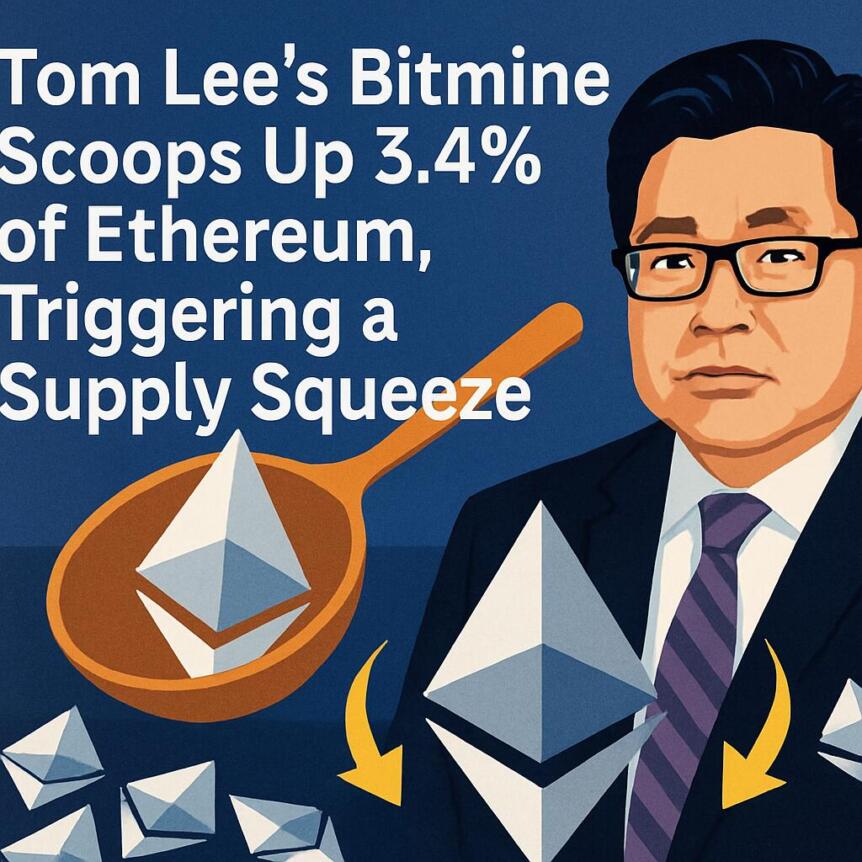
Tom Lee’s Bitmine Scoops Up 3.4% of Ethereum, Triggering a Supply Squeeze

Tom Lee’s Bitmine Scoops Up 3.4% of Ethereum, Triggering a Supply Squeeze

Bitmine Immersion now controls 3.4% of Ethereum amid shrinking exchange supply and rising institutional accumulation.
Share
Crypto Breaking News2026/01/20 16:27