The financial messaging giant handles communications for over 11,000 banks across more than 200 countries and territories. Now it wants to see if blockchain can make these processes faster and cheaper.The financial messaging giant handles communications for over 11,000 banks across more than 200 countries and territories. Now it wants to see if blockchain can make these processes faster and cheaper.

SWIFT Reportedly is Teaming Up with Ethereum Network Linea for Major Blockchain Test

2025/09/28 05:45
SWIFT Reportedly is Teaming Up with Ethereum Network Linea for Major Blockchain Test

SWIFT, the backbone of global banking, has reportedly chosen Linea, an Ethereum-based network, to test moving its messaging system onto blockchain technology. This pilot program involves more than a dozen major banks and could change how money moves around the world.

Major Banks Join the Experiment

BNP Paribas and BNY Mellon are among the big names participating in this test. A source from one participating bank called it “a major technological transformation for the international interbank payments industry.”

The project will take several months to complete, according to a source from a participating bank. Banks chose Linea after months of negotiations because it offers strong privacy features that traditional banks need.

Linea uses zero-knowledge proofs, a type of advanced encryption that lets banks test blockchain features without exposing sensitive customer data. This addresses one of the biggest concerns banks have about using public blockchain networks.

How This Changes Banking

Right now, SWIFT only sends payment instructions between banks – it doesn’t actually move money. Banks rely on older systems with multiple steps and middlemen, which critics say makes transactions slow and expensive.

The Linea pilot aims to combine messaging and settlement into one blockchain transaction. This would let all parties track payments in real-time while cutting costs.

SWIFT processes the equivalent of the world’s entire GDP roughly every three days through its network, according to the organization’s website. Moving even part of this volume to blockchain could have massive effects on global finance.

Stablecoin Plans in the Works

The pilot also explores creating a stablecoin-like settlement token for banks. This would transform SWIFT from just a messaging service into a platform that actually handles value transfer.
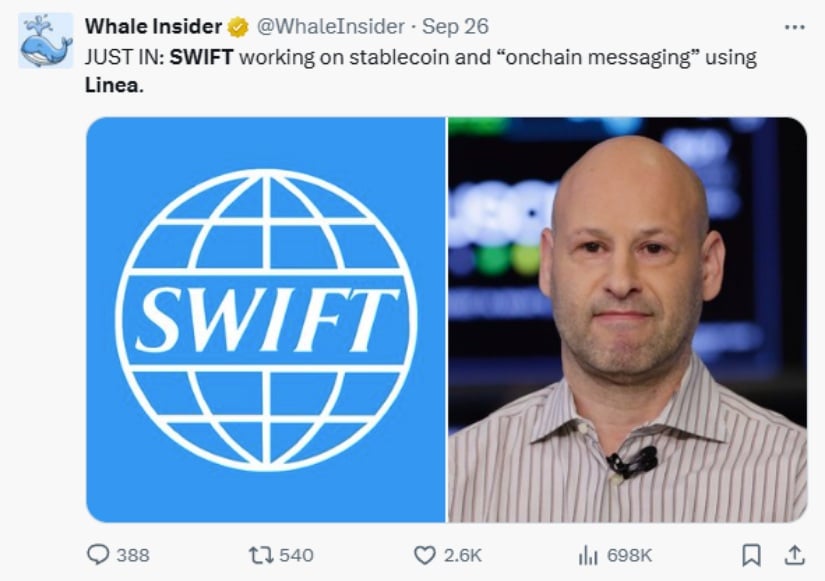
Stablecoin Plans in the Works

Source: @WhaleInsider

However, according to The Big Whale’s report, stablecoins are only “under consideration” and the interbank token project remains under review. No official releases have been confirmed.

If successful, this would put SWIFT in direct competition with blockchain payment networks like Ripple, which has long promoted itself as a faster, cheaper alternative to traditional banking rails.

Market Reacts Positively

News of the partnership sent Linea’s token price up over 14% within hours of the announcement. The token jumped from $0.02544 to $0.02814 as trading volume increased by 6%.

This follows SWIFT’s broader push into digital assets. The organization completed tokenized fund settlement tests with UBS and Chainlink in November 2024. It also launched live digital asset trials across North America, Europe, and Asia in October 2024.

The banking world is watching closely. Stablecoin markets have grown to over $295 billion, up 42% since January, according to industry data. Traditional financial institutions increasingly see digital assets as the future of money.

What This Means for the Future

This pilot represents more than just another blockchain experiment. It signals that established financial infrastructure is ready to embrace new technology while maintaining regulatory compliance.

Success could speed up regulatory approval for blockchain-based settlements worldwide. It might also encourage other major financial networks to adopt similar technology.

The pilot builds on SWIFT’s participation in the Bank for International Settlements’ Project Agora and collaboration with central bank digital currency initiatives. These efforts show the organization’s commitment to staying relevant as finance goes digital.

The Bottom Line

SWIFT’s blockchain pilot with Linea could reshape global banking if successful. The combination of established financial infrastructure with cutting-edge blockchain technology offers a path forward that satisfies both innovation and regulation.

While official confirmation is still pending, the involvement of major banks suggests this is a serious effort rather than just another proof-of-concept. The coming months will determine whether traditional finance and blockchain can work together at scale.

Disclaimer: The articles reposted on this site are sourced from public platforms and are provided for informational purposes only. They do not necessarily reflect the views of MEXC. All rights remain with the original authors. If you believe any content infringes on third-party rights, please contact [email protected] for removal. MEXC makes no guarantees regarding the accuracy, completeness, or timeliness of the content and is not responsible for any actions taken based on the information provided. The content does not constitute financial, legal, or other professional advice, nor should it be considered a recommendation or endorsement by MEXC.

You May Also Like

The Future of Secure Messaging: Why Decentralization Matters

The Future of Secure Messaging: Why Decentralization Matters

The post The Future of Secure Messaging: Why Decentralization Matters appeared on BitcoinEthereumNews.com. From encrypted chats to decentralized messaging Encrypted messengers are having a second wave. Apps like WhatsApp, iMessage and Signal made end-to-end encryption (E2EE) a default expectation. But most still hinge on phone numbers, centralized servers and a lot of metadata, such as who you talk to, when, from which IP and on which device. That is what Vitalik Buterin is aiming at in his recent X post and donation. He argues the next steps for secure messaging are permissionless account creation with no phone numbers or Know Your Customer (KYC) and much stronger metadata privacy. In that context he highlighted Session and SimpleX and sent 128 Ether (ETH) to each to keep pushing in that direction. Session is a good case study because it tries to combine E2E encryption with decentralization. There is no central message server, traffic is routed through onion paths, and user IDs are keys instead of phone numbers. Did you know? Forty-three percent of people who use public WiFi report experiencing a data breach, with man-in-the-middle attacks and packet sniffing against unencrypted traffic among the most common causes. How Session stores your messages Session is built around public key identities. When you sign up, the app generates a keypair locally and derives a Session ID from it with no phone number or email required. Messages travel through a network of service nodes using onion routing so that no single node can see both the sender and the recipient. (You can see your message’s node path in the settings.) For asynchronous delivery when you are offline, messages are stored in small groups of nodes called “swarms.” Each Session ID is mapped to a specific swarm, and your messages are stored there encrypted until your client fetches them. Historically, messages had a default time-to-live of about two weeks…
Share
BitcoinEthereumNews2025/12/08 14:40
Grayscale Files Sui Trust as 21Shares Launches First SUI ETF Amid Rising Demand

Grayscale Files Sui Trust as 21Shares Launches First SUI ETF Amid Rising Demand

The post Grayscale Files Sui Trust as 21Shares Launches First SUI ETF Amid Rising Demand appeared on BitcoinEthereumNews.com. The Grayscale Sui Trust filing and 21Shares’ launch of the first SUI ETF highlight surging interest in regulated Sui investments. These products offer investors direct exposure to the SUI token through spot-style structures, simplifying access to the Sui blockchain’s growth without direct custody needs, amid expanding altcoin ETF options. Grayscale’s spot Sui Trust seeks to track SUI price performance for long-term holders. 21Shares’ SUI ETF provides leveraged exposure, targeting traders with 2x daily returns. Early trading data shows over 4,700 shares exchanged, with volumes exceeding $24 per unit in the debut session. Explore Grayscale Sui Trust filing and 21Shares SUI ETF launch: Key developments in regulated Sui investments for 2025. Stay informed on altcoin ETF trends. What is the Grayscale Sui Trust? The Grayscale Sui Trust is a proposed spot-style investment product filed via S-1 registration with the U.S. Securities and Exchange Commission, aimed at providing investors with direct exposure to the SUI token’s price movements. This trust mirrors the performance of SUI, the native cryptocurrency of the Sui blockchain, minus applicable fees, offering a regulated avenue for long-term participation in the network’s ecosystem. By holding SUI assets on behalf of investors, it eliminates the need for individuals to manage token storage or transactions directly. ⚡ LATEST: GRAYSCALE FILES S-1 FOR $SUI TRUSTThe “Grayscale Sui Trust,” is a spot-style ETF designed to provide direct exposure to the $SUI token. Grayscale’s goal is to mirror SUI’s market performance, minus fees, giving long-term investors a regulated, hassle-free way to… pic.twitter.com/mPQMINLrYC — CryptosRus (@CryptosR_Us) December 6, 2025 How does the 21Shares SUI ETF differ from traditional funds? The 21Shares SUI ETF, launched under the ticker TXXS, introduces a leveraged approach with 2x daily exposure to SUI’s price fluctuations, utilizing derivatives for amplified returns rather than direct spot holdings. This structure appeals to short-term…
Share
BitcoinEthereumNews2025/12/08 14:20