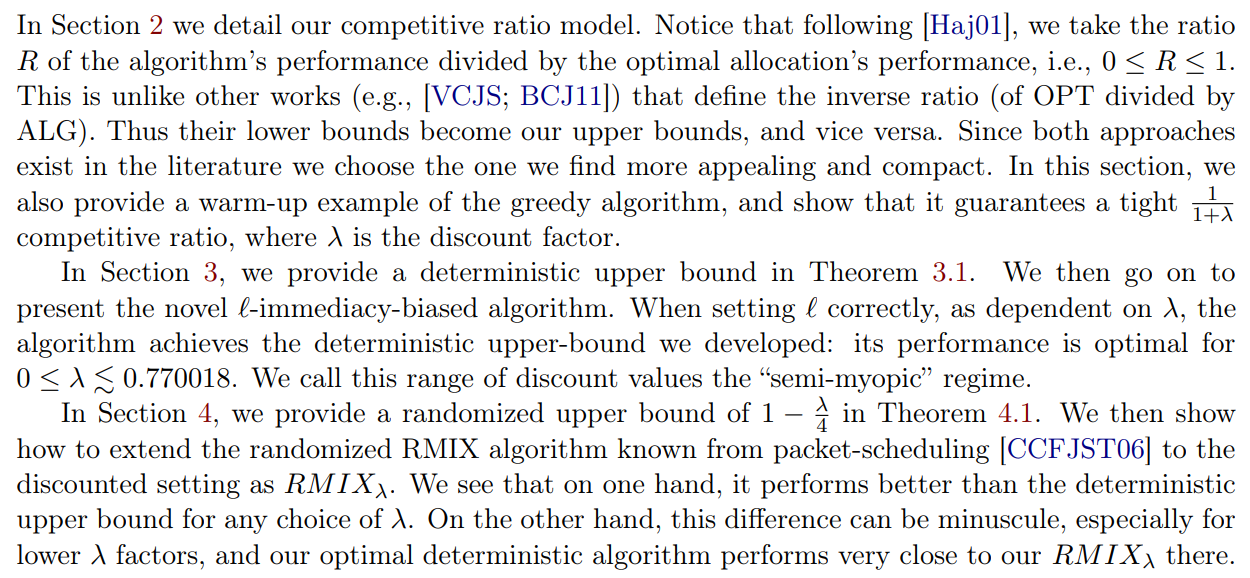
This section examines the gap in current blockchain Transaction Fee Mechanism (TFM) research, noting that most models assume myopic miners and ignore time-sensitive transactions. By introducing the concept of transaction expiry and connecting it to auction theory, packet scheduling, and real-world analogies like ride-sharing, the work expands on existing algorithms (e.g., RMIX, MG) to show how incorporating urgency and discount factors could lead to more efficient and fair blockchain fee systems.This section examines the gap in current blockchain Transaction Fee Mechanism (TFM) research, noting that most models assume myopic miners and ignore time-sensitive transactions. By introducing the concept of transaction expiry and connecting it to auction theory, packet scheduling, and real-world analogies like ride-sharing, the work expands on existing algorithms (e.g., RMIX, MG) to show how incorporating urgency and discount factors could lead to more efficient and fair blockchain fee systems.

The Algorithmic Evolution of Blockchain Fee Design

2025/10/14 03:54

Abstract and 1. Introduction

1.1 Our Approach

1.2 Our Results & Roadmap

1.3 Related Work

  1. Model and Warmup and 2.1 Blockchain Model

    2.2 The Miner

    2.3 Game Model

    2.4 Warm Up: The Greedy Allocation Function

  2. The Deterministic Case and 3.1 Deterministic Upper Bound

    3.2 The Immediacy-Biased Class Of Allocation Function

  3. The Randomized Case

  4. Discussion and References

  • A. Missing Proofs for Sections 2, 3
  • B. Missing Proofs for Section 4
  • C. Glossary

1.2 Our Results & Roadmap

1.3 Related Work

The application of auction theory to the design of TFMs was explored by a line of works [LSZ22; Yao18; BEOS19; Rou21; CS23], that focused primarily on the axiomatic aspects of the blockchain setting when considering myopic miners.

\ Considerations such as transactions with a finite time to live and non-myopic miners are outside the scope of all the above literature and is a recognized important gap in our understanding of TFMs. Although we focus on the TFM of Blockchain systems, the addition of a predefined expiry date for transactions means that the setting is related to other resource allocation under time-constraints problems. Some examples are deadline-aware job scheduling [SC16] and ride-sharing [DSSX21]. The closest model to ours is perhaps that of Fiat et al. [FGKK16], who analyze a similar framework that considers single-minded users who assign both a fee and some urgency to their requests.

\ \
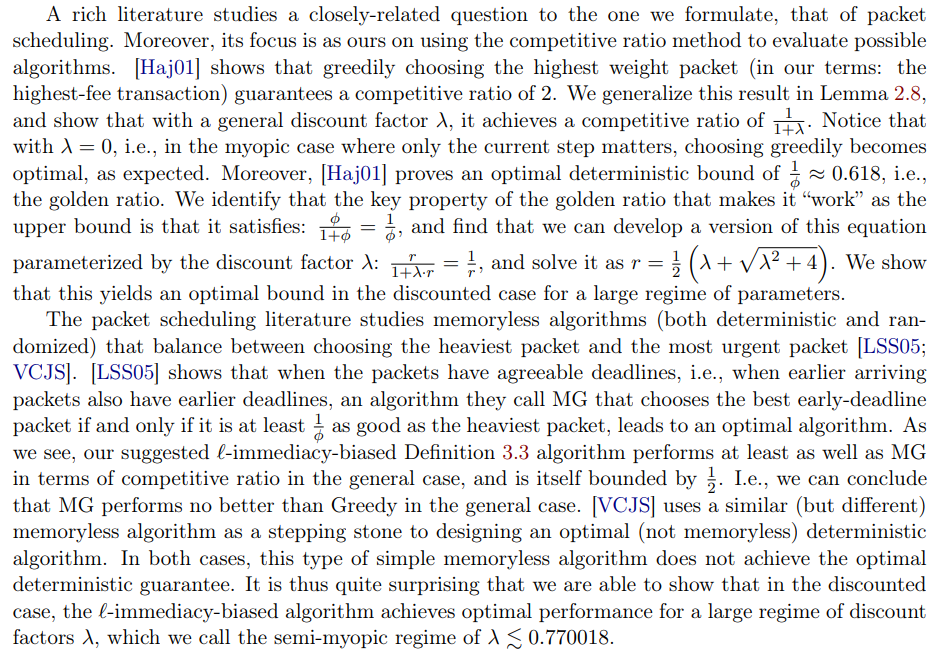
\ \ The literature of packet scheduling also considered randomized algorithms and upper bounds. [CCFJST06] suggested a randomized algorithm that works, similarly to MG, by considering the heaviest packet vs. the best early-deadline packet, but uses a randomized coefficient to determine which of them to choose. We show that [CCFJST06] can be generalized to depend on the discount factor. Our generalization is the same as RMIX when λ = 1, and the same as the greedy algorithm when λ = 0, where it achieves the optimal competitive ratio of 1. [BCJ11] extended RMIX analysis from the oblivious to the adaptive adversary, and also provided an upper bound for any randomized algorithm against the adaptive adversary. We show how to extend their construction to depend on the discount factor. An overview of the packet scheduling literature, including open problems in the field, can be found in [Ves21]. While we do not attempt to give a conclusive overview, we note that there is an alternative literature to that of packet scheduling with deadlines, that considers analysis of whether or not to accept packets to a FIFO queue, and there, a latency sensitive model was previously considered [FMN08].

\

:::info Authors:

(1) Yotam Gafni, Weizmann Institute ([email protected]);

(2) Aviv Yaish, The Hebrew University, Jerusalem ([email protected]).

:::


:::info This paper is available on arxiv under CC BY 4.0 DEED license.

:::

\

Disclaimer: The articles reposted on this site are sourced from public platforms and are provided for informational purposes only. They do not necessarily reflect the views of MEXC. All rights remain with the original authors. If you believe any content infringes on third-party rights, please contact [email protected] for removal. MEXC makes no guarantees regarding the accuracy, completeness, or timeliness of the content and is not responsible for any actions taken based on the information provided. The content does not constitute financial, legal, or other professional advice, nor should it be considered a recommendation or endorsement by MEXC.

You May Also Like

the $63M White Whale of a tale

the $63M White Whale of a tale

The post the $63M White Whale of a tale appeared on BitcoinEthereumNews.com. This weekend on crypto social media, memecoin traders spun yet another fantastic tale of leveraged trading meltdown.  According to the still-being-written legend, crypto exchange MEXC locked $3 million belonging to famed crypto trader The White Whale. As he continued to amass money from leveraged trading despite the freeze, he claimed that he’d become so wealthy that if MEXC ever unfroze the funds, he’d give away the proceeds to the community.  Then, on October 10, HyperLiquid liquidated $63 million of his then-larger assets amid a contentious pricing print from a data oracle. Though briefly devastated, MEXC eventually agreed to unlock his assets, prompting celebrations over his legendary return and, predictably, the creation of various memecoins. Smelling an opportunity, The White Whale decided to use some of his recently unlocked $3 million, earmarked for “the community,” to overtake one of these eponymous memecoins and add liquidity on its trading pairs. The White Whale of crypto Most crypto traders simply laughed as he attached cringe-worthy images of a white whale engaged in financial transactions to his trading commentary tweets. The laughter was appropriate, given how impossible it is to verify his narrative. So-called decentralized exchanges with limited know your customer requirements like HyperLiquid allow anyone to create an unlimited number of wallets and manipulate the pricing of markets across various wallets that they control.  In other words, no one except the trader knows if someone has sole claim to a single wallet and username, or whether someone is using multiple wallets in order to craft a trading history for one of many usernames. The White Whale, like the titular whale in Herman Melville’s 1851 novel, Moby Dick, has become an obsession to many on social media, thanks to the fantastic sums of money at stake, the clownish images, and the ostensibly philanthropic, Phoneix…
Share
BitcoinEthereumNews2025/12/08 21:19