Ethereum’s market performance took a breather in September, with ETH sliding 2% after two months of strong gains. Bitcoin, by comparison, rose 7%, highlighting a shift in trader sentiment. According to VanEck’s latest report, daily Ethereum transactions dropped by 8.7% to 47.2 million, down from August’s record 51.7 million but still the second-highest level ever […]Ethereum’s market performance took a breather in September, with ETH sliding 2% after two months of strong gains. Bitcoin, by comparison, rose 7%, highlighting a shift in trader sentiment. According to VanEck’s latest report, daily Ethereum transactions dropped by 8.7% to 47.2 million, down from August’s record 51.7 million but still the second-highest level ever […]

VanEck Report Shows Ethereum Cooling After Strong Summer Surge

Ethereum
  • Ethereum prepares for its December Fusaka upgrade to expand blob capacity and improve Layer-2 validation.
  • September saw ETH prices fall 2%, while BTC gained 7%, marking a slowdown after a strong summer performance.
  • Blob usage hit new highs since the Dencun upgrade, with Base and World Chain accounting for 60% of L2 data.

Ethereum’s market performance took a breather in September, with ETH sliding 2% after two months of strong gains. Bitcoin, by comparison, rose 7%, highlighting a shift in trader sentiment.

According to VanEck’s latest report, daily Ethereum transactions dropped by 8.7% to 47.2 million, down from August’s record 51.7 million but still the second-highest level ever recorded.

Decentralized exchange volumes also cooled, falling 20.3% to $111.9 billion from the previous month’s record of $140.5 billion. Despite the decline, it remained the third-largest volume month in Ethereum’s history.

Stablecoin transfers followed a similar trend, slipping 4% to $1.74 trillion but maintaining a strong 105% increase year-to-date. These figures show that Ethereum’s network activity remains robust, even amid short-term market corrections.

Also Read: Ethereum Eyes $4,750 After $2 Billion USDT Mint Sparks Rally

Fusaka Upgrade Marks Next Phase in Ethereum’s Scaling

Looking ahead, Ethereum’s upcoming upgrade, Fusaka, in December 2025, will prove significant for improving the network’s scalability. 

With this upgrade, the network is introducing Peer Data Availability Sampling (PeerDAS), which is a new mechanism that enables validators to verify blocks without downloading blob data in its entirety.
This decreases bandwidth intensity and storage pressure on nodes and makes Ethereum more efficient for Layer-2 rollup usage.

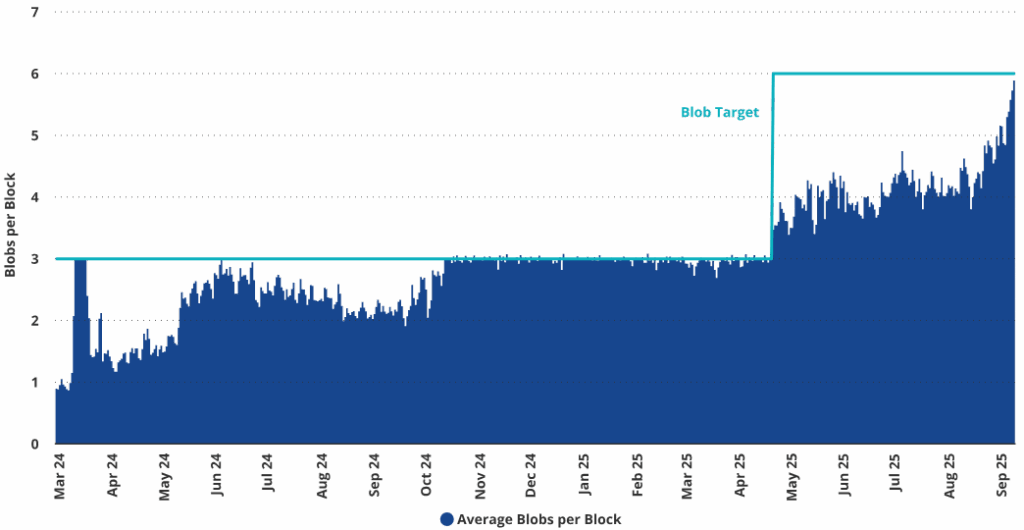
Fusaka extends the path paved by the March 2025 Dencun upgrade that originally implemented blob storage for low-cost data posting.

Developers just increased the blob cap from three to six per block after network robustness was assured, and, for the first time since Dencun was launched, average blob usage hit that six-blob mark.

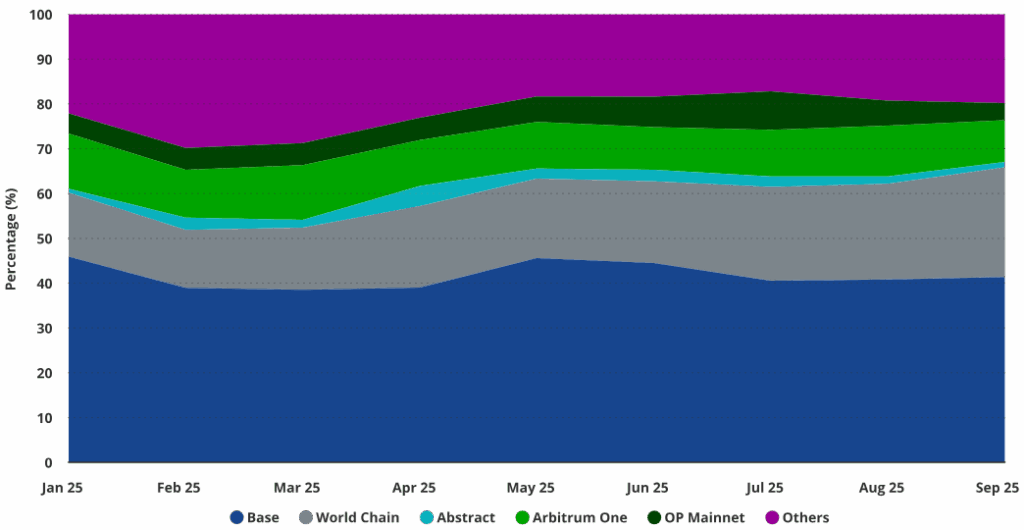
Data from Dune Analytics indicates that Base from Coinbase and World Chain from Worldcoin command up to 60% of all Layer-2 submissions of data to Ethereum, and that is rising demand for low-cost scaling.
The Long-Term Impact on Ethereum’s Economics

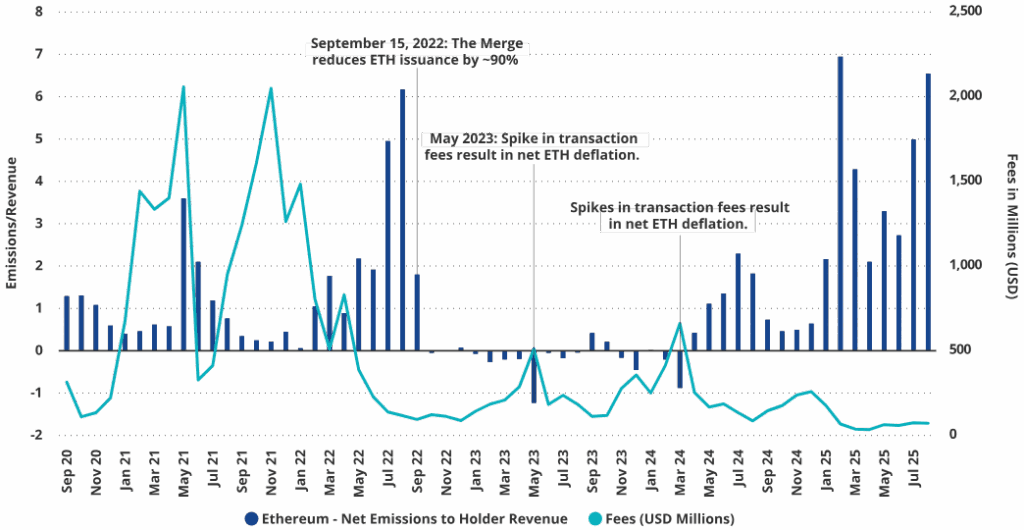
Fusaka is likely to increase blob capacity even more, reducing Layer-2 transaction fees and stimulating more on-chain usage. Although this transition may decrease direct fee burns on Ethereum’s mainnet, it solidifies ETH’s place as a monetary asset that is key to network security.

Data from Artemis.xyz shows that falling Layer-1 fees result in higher dilution for non-stakers, supported by the increasing significance of staking in ETH’s economy.
Also Read: Ethereum (ETH) Price Eyes $8,000 as Whale Accumulation Fuels Momentum


Market Opportunity
Ethereum Logo
Ethereum Price(ETH)
$3,178.27
$3,178.27$3,178.27
-0.19%
USD
Ethereum (ETH) Live Price Chart
Disclaimer: The articles reposted on this site are sourced from public platforms and are provided for informational purposes only. They do not necessarily reflect the views of MEXC. All rights remain with the original authors. If you believe any content infringes on third-party rights, please contact [email protected] for removal. MEXC makes no guarantees regarding the accuracy, completeness, or timeliness of the content and is not responsible for any actions taken based on the information provided. The content does not constitute financial, legal, or other professional advice, nor should it be considered a recommendation or endorsement by MEXC.

You May Also Like

WIF price reclaims 200-day moving average

WIF price reclaims 200-day moving average

WIF (WIF) price is entering a critical technical phase as price action reclaims the 200-day moving average, a level that often separates bearish control from bullish
Share
Crypto.news2026/01/13 23:44
China Blocks Nvidia’s RTX Pro 6000D as Local Chips Rise

China Blocks Nvidia’s RTX Pro 6000D as Local Chips Rise

The post China Blocks Nvidia’s RTX Pro 6000D as Local Chips Rise appeared on BitcoinEthereumNews.com. China Blocks Nvidia’s RTX Pro 6000D as Local Chips Rise China’s internet regulator has ordered the country’s biggest technology firms, including Alibaba and ByteDance, to stop purchasing Nvidia’s RTX Pro 6000D GPUs. According to the Financial Times, the move shuts down the last major channel for mass supplies of American chips to the Chinese market. Why Beijing Halted Nvidia Purchases Chinese companies had planned to buy tens of thousands of RTX Pro 6000D accelerators and had already begun testing them in servers. But regulators intervened, halting the purchases and signaling stricter controls than earlier measures placed on Nvidia’s H20 chip. Image: Nvidia An audit compared Huawei and Cambricon processors, along with chips developed by Alibaba and Baidu, against Nvidia’s export-approved products. Regulators concluded that Chinese chips had reached performance levels comparable to the restricted U.S. models. This assessment pushed authorities to advise firms to rely more heavily on domestic processors, further tightening Nvidia’s already limited position in China. China’s Drive Toward Tech Independence The decision highlights Beijing’s focus on import substitution — developing self-sufficient chip production to reduce reliance on U.S. supplies. “The signal is now clear: all attention is focused on building a domestic ecosystem,” said a representative of a leading Chinese tech company. Nvidia had unveiled the RTX Pro 6000D in July 2025 during CEO Jensen Huang’s visit to Beijing, in an attempt to keep a foothold in China after Washington restricted exports of its most advanced chips. But momentum is shifting. Industry sources told the Financial Times that Chinese manufacturers plan to triple AI chip production next year to meet growing demand. They believe “domestic supply will now be sufficient without Nvidia.” What It Means for the Future With Huawei, Cambricon, Alibaba, and Baidu stepping up, China is positioning itself for long-term technological independence. Nvidia, meanwhile, faces…
Share
BitcoinEthereumNews2025/09/18 01:37
Trump: Powell did a bad job.

Trump: Powell did a bad job.

PANews reported on January 13th that, according to Jinshi Data, US President Trump stated: "Federal Reserve Chairman Powell is either incompetent or dishonest.
Share
PANews2026/01/13 23:40