This article explores how advanced control theory and game-theoretic models can be applied to tokenomics for greater stability. It compares traditional PID controllers with modern methods like iLQR, AL-iLQR, and Sequential Convex Programming (SCP), showing how they optimize token supply under strict constraints. The discussion extends to strategic pricing, where token buybacks are framed as a Stackelberg game between reserves and token holders, revealing how incentive design can regulate markets and prevent inflation while ensuring equilibrium strategies.This article explores how advanced control theory and game-theoretic models can be applied to tokenomics for greater stability. It compares traditional PID controllers with modern methods like iLQR, AL-iLQR, and Sequential Convex Programming (SCP), showing how they optimize token supply under strict constraints. The discussion extends to strategic pricing, where token buybacks are framed as a Stackelberg game between reserves and token holders, revealing how incentive design can regulate markets and prevent inflation while ensuring equilibrium strategies.

Why Algorithmic Stablecoins Need Control Theory, Not Just PID Loops

2025/10/03 10:22

Abstract and 1. Introduction

  1. A Primer on Optimal Control
  2. The Token Economy as a Dynamical System
  3. Control Design Methodology
  4. Strategic Pricing: A Game-Theoretic Analysis
  5. Experiments
  6. Discussion and Future Work, and References

4 Control Design Methodology

We now illustrate methodologies that solve our formal control problem Eq. 1 by outlining techniques from nonlinear optimal control theory.

\
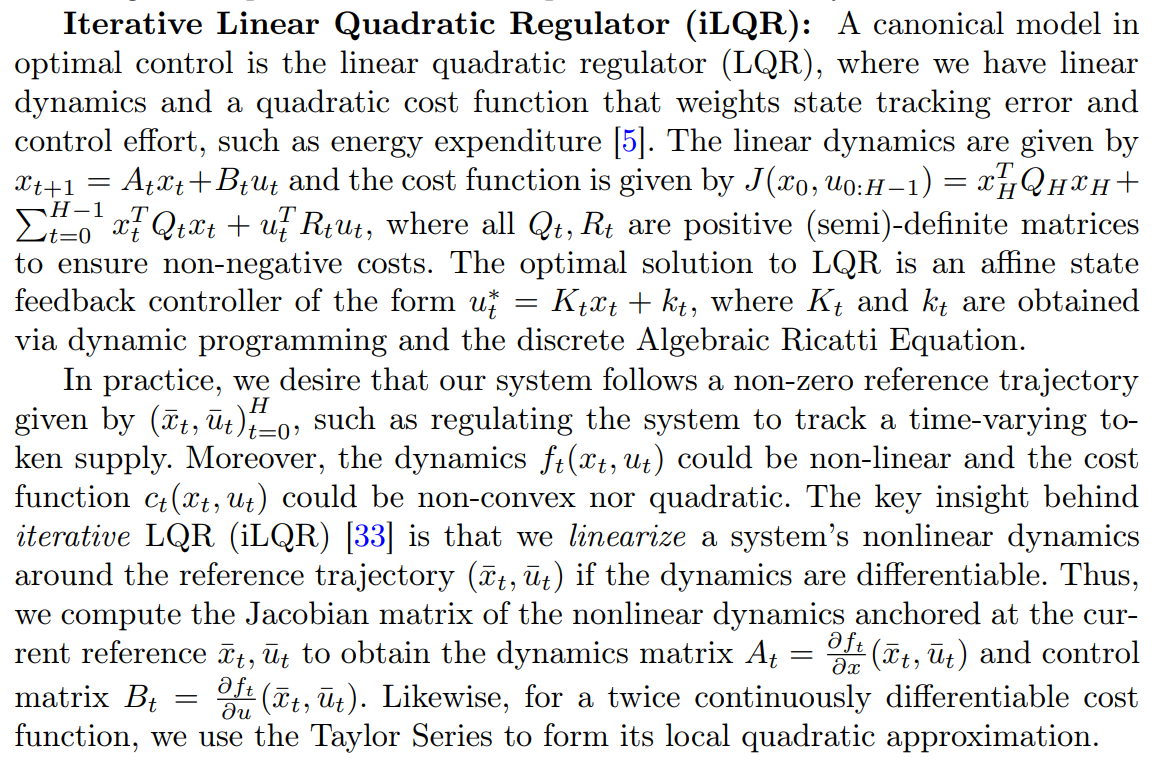
\ Given a nominal reference trajectory, linearized dynamics, and a quadratic approximation of the cost, we can simply invoke LQR to improve our nominal reference trajectory. The process repeats until the control cost converges, which is analagous to Newton’s method. We can incorporate strict state or control constraints by adding them as penalties to iLQR’s cost function using Augmented Lagrangian iLQR (AL-iLQR) methods. Crucially, AL-iLQR is our solution method of choice for tokenomics, since we have smooth nonlinear dynamics, a quadratic cost function, a well defined reference trajectory for the token price/circulating supply, and strict constraints for non-negative treasuries.

\ Sequential Convex Programming (SCP): SCP extends the core ideas behind iLQR to control problems with strict state or control constraints [8,23]. First, we linearize the dynamics around a reference trajectory, just as in iLQR. Then, we form a convex approximation of the cost function, often using a local quadratic approximation. Thus, we recover a constrained convex optimization problem, which we solve to obtain a new nominal trajectory. We then re-linearize around the updated nominal trajectory until the control cost saturates.

\
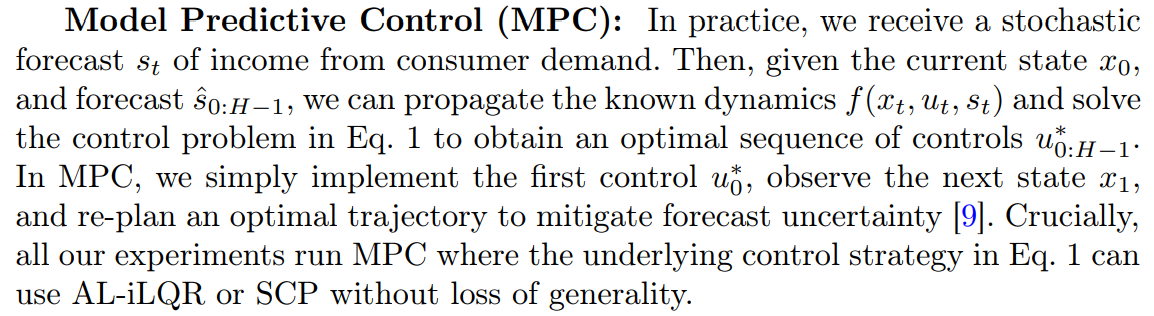
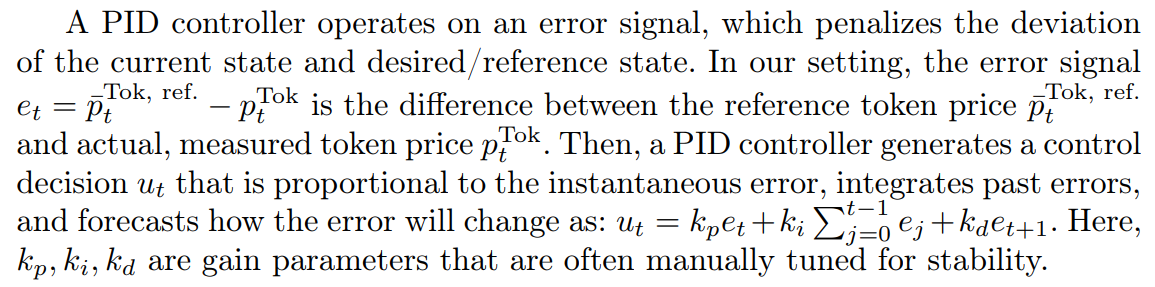
\ Proportional Integral Derivative (PID) Control: Our proposed solution uses AL-iLQR and SCP since we can model the token dynamics and explicitly desire to optimize a cost function. We compare these methods to a benchmark proportional integral derivative (PID) controller. While PID controllers achieve stability [5], they do not explicitly optimize a cost function like iLQR/SCP, and often require extensive tuning and can overshoot a reference trajectory. PID is a fitting benchmark due to its simplicity and the fact that recent algorithmic stablecoins, such as the RAI index [2], use PID.

\
\

5 Strategic Pricing: A Game-Theoretic Analysis

In our control-theoretic formulation, we assume token owners will gladly sell their tokens to the reserve when it offers to buy back tokens with an incentive price of ∆pt. However, as shown in Fig. 2, strategic token owners might only sell a fraction of their tokens for immediate revenue and retain the rest for their future expected value. As such, the reserve must offer a sufficiently high incentive ∆pt to goad token owners to sell their valuable tokens so that the circulating token supply is regulated to avoid inflation. Our key insight is that strategic pricing can be formulated as a two-player Stackelberg game (see [28]).

\ \
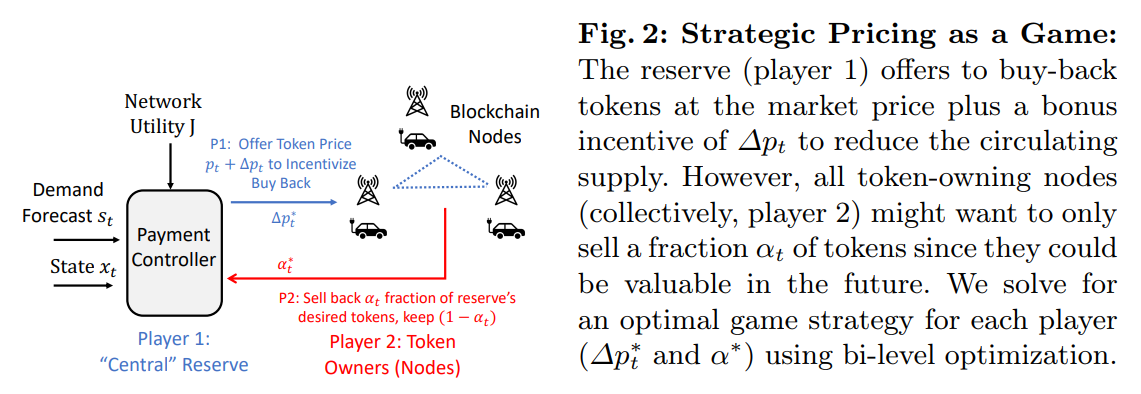
\ \ Market Dynamics The market dynamics arise from the selfish behavior of rational consumers. At each timestep, we have a two-step sequential game of complete information between the reserve’s controller (player 1) and all tokenowning nodes (player 2). The controller optimizes program (1) and the consumers seek to maximize the value of their token holdings over the time horizon. By complete information, we mean that facts about the opponent respectively are common knowledge. For example, token owners are aware of the controller’s strategy, which is encoded in smart contracts distributed across the blockchain. Likewise, each player can also perfectly observe the token price and supply.

\ \
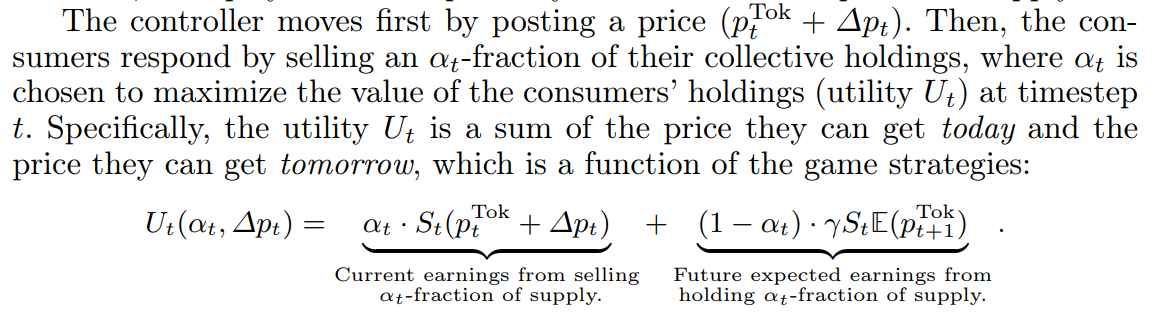
\ \ In the above, γ is a risk factor attenuating the expected future earnings from not selling. Further, the randomness in the expectation is due to forecasting noise as our controller is not randomized. Thus, for any controller-chosen incentive ∆pt, the nodes’ optimal strategy is to choose αt such that:

\ \

\ \ Moreover, due to program (7), the controller can compute the consumer strategy for any incentive price ∆pt. This means that we can transition the control problem (1) into the setting with incentives by equating the amount of tokens the controller buys back to the amount of tokens the nodes agree to sell:

\ \
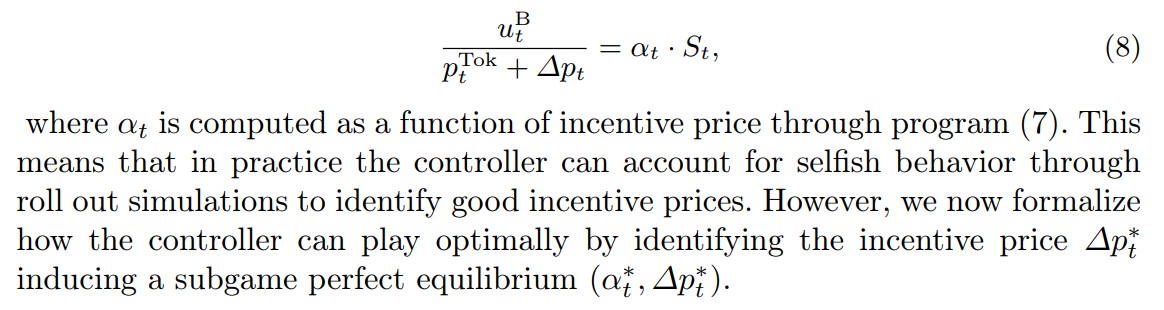
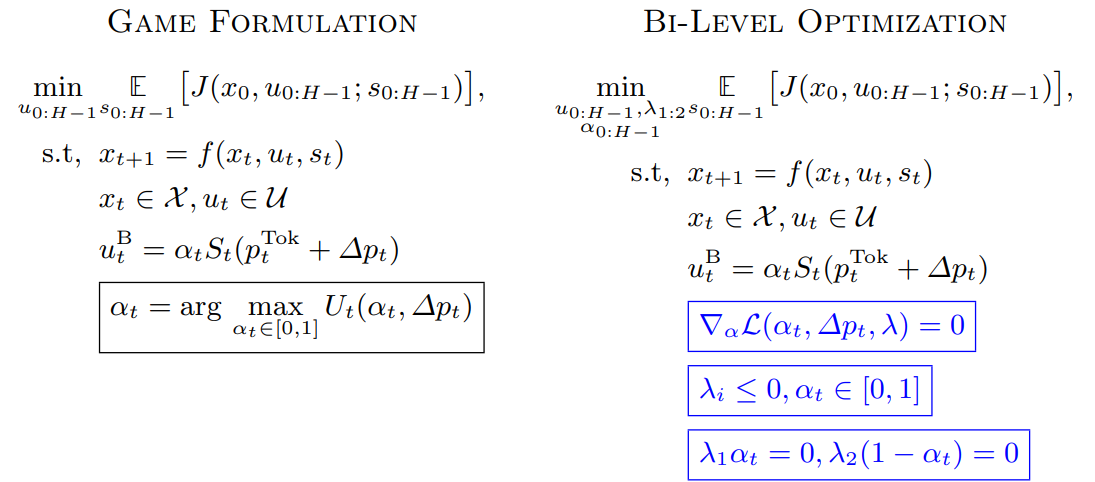
\ \ A Stackelberg Game for Strategic Pricing Since the controller first posts a price ∆pt and the nodes respond with the fraction αt of the holdings they wish to sell, we naturally have a leader-follower (Stackelberg) game. As mentioned above, we use (8) to constrain the tokens bought back by αt. Then, recalling that the node’s strategy is given by (7), the controller’s optimization problem is:

\ \
\ \ \
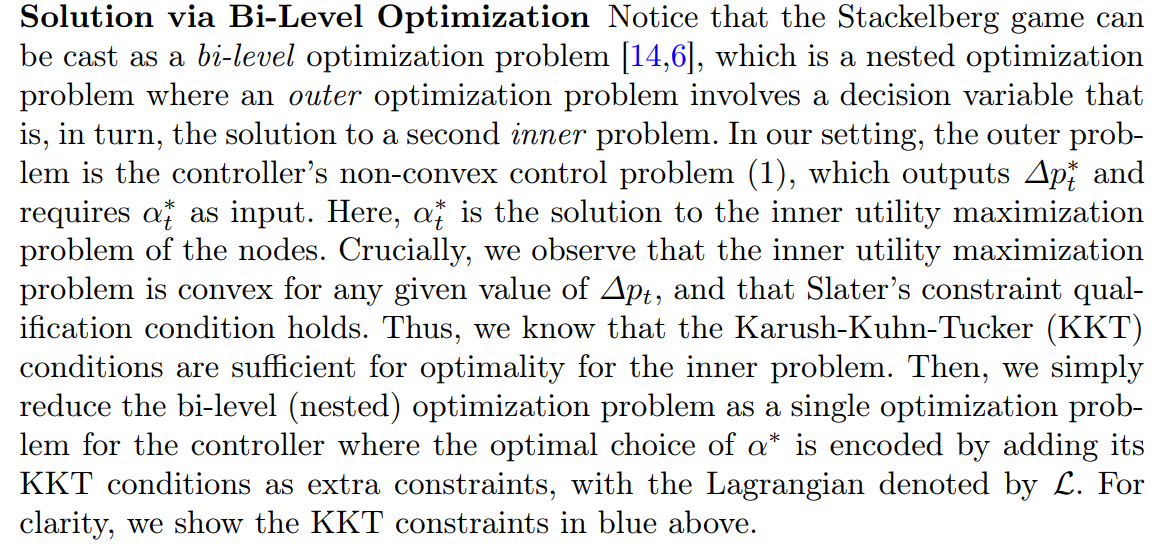
\ \ Remark 2. Since we have a Stackelberg Game, the horizon is finite and a subgame perfect equilibrium can be found via backward induction. First, the best response function of the nodes is calculated. Then, the controller picks an action maximizing its utility, anticipating the follower’s best response. For more details, see [28]. Then it is clear that our method finds a subgame perfect equilibrium since the KKT conditions of the inner problem give a certificate of optimal play on the nodes part. Encoding them as extra constraints on the part of the controller simply gives an explicit route for backward induction in this game.

\ \

:::info Authors:

(1) Oguzhan Akcin, The University of Texas at Austin ([email protected]);

(2) Robert P. Streit, The University of Texas at Austin ([email protected]);

(3) Benjamin Oommen, The University of Texas at Austin ([email protected]);

(4) Sriram Vishwanath, The University of Texas at Austin ([email protected]);

(5) Sandeep Chinchali, The University of Texas at Austin ([email protected]).

:::


:::info This paper is available on arxiv under CC BY 4.0 DEED license.

:::

\

Disclaimer: The articles reposted on this site are sourced from public platforms and are provided for informational purposes only. They do not necessarily reflect the views of MEXC. All rights remain with the original authors. If you believe any content infringes on third-party rights, please contact [email protected] for removal. MEXC makes no guarantees regarding the accuracy, completeness, or timeliness of the content and is not responsible for any actions taken based on the information provided. The content does not constitute financial, legal, or other professional advice, nor should it be considered a recommendation or endorsement by MEXC.

You May Also Like

Ripple Buyers Step In at $2.00 Floor on BTC’s Hover Above $91K

Ripple Buyers Step In at $2.00 Floor on BTC’s Hover Above $91K

The post Ripple Buyers Step In at $2.00 Floor on BTC’s Hover Above $91K appeared on BitcoinEthereumNews.com. Token breaks above key support while volume surges 251% during psychological level defense at $2.00. News Background U.S. spot XRP ETFs continue pulling in uninterrupted inflows, with cumulative demand now exceeding $1 billion since launch — the fastest early adoption pace for any altcoin ETF. Institutional participation remains strong even as retail sentiment remains muted, contributing to market conditions where large players accumulate during weakness while short-term traders hesitate to re-enter. XRP’s macro environment remains dominated by capital rotation into regulated products, with ETF demand offsetting declining open interest in derivatives markets. Technical Analysis The defining moment of the session came during the $2.03 → $2.00 flush when volume spiked to 129.7M — 251% above the 24-hour average. This confirmed heavy selling pressure but, more importantly, marked the exact moment where institutional buyers absorbed liquidity at the psychological floor. The V-shaped rebound from $2.00 back into the $2.07–$2.08 range validates active demand at this level. XRP continues to form a series of higher lows on intraday charts, signaling early trend reacceleration. However, failure to break through the $2.08–$2.11 resistance cluster shows lingering supply overhead as the market awaits a decisive catalyst. Momentum indicators show bullish divergence forming, but volume needs to expand during upside moves rather than only during downside flushes to confirm a sustainable breakout. Price Action Summary XRP traded between $2.00 and $2.08 across the 24-hour window, with a sharp selloff testing the psychological floor before immediate absorption. Three intraday advances toward $2.08 failed to clear resistance, keeping price capped despite improving structure. Consolidation near $2.06–$2.08 into the session close signals stabilization above support, though broader range compression persists. What Traders Should Know The $2.00 level remains the most important line in the sand — both technically and psychologically. Institutional accumulation beneath this threshold hints at larger players…
Share
BitcoinEthereumNews2025/12/08 13:22
UK crypto holders brace for FCA’s expanded regulatory reach

UK crypto holders brace for FCA’s expanded regulatory reach

The post UK crypto holders brace for FCA’s expanded regulatory reach appeared on BitcoinEthereumNews.com. British crypto holders may soon face a very different landscape as the Financial Conduct Authority (FCA) moves to expand its regulatory reach in the industry. A new consultation paper outlines how the watchdog intends to apply its rulebook to crypto firms, shaping everything from asset safeguarding to trading platform operation. According to the financial regulator, these proposals would translate into clearer protections for retail investors and stricter oversight of crypto firms. UK FCA plans Until now, UK crypto users mostly encountered the FCA through rules on promotions and anti-money laundering checks. The consultation paper goes much further. It proposes direct oversight of stablecoin issuers, custodians, and crypto-asset trading platforms (CATPs). For investors, that means the wallets, exchanges, and coins they rely on could soon be subject to the same governance and resilience standards as traditional financial institutions. The regulator has also clarified that firms need official authorization before serving customers. This condition should, in theory, reduce the risk of sudden platform failures or unclear accountability. David Geale, the FCA’s executive director of payments and digital finance, said the proposals are designed to strike a balance between innovation and protection. He explained: “We want to develop a sustainable and competitive crypto sector – balancing innovation, market integrity and trust.” Geale noted that while the rules will not eliminate investment risks, they will create consistent standards, helping consumers understand what to expect from registered firms. Why does this matter for crypto holders? The UK regulatory framework shift would provide safer custody of assets, better disclosure of risks, and clearer recourse if something goes wrong. However, the regulator was also frank in its submission, arguing that no rulebook can eliminate the volatility or inherent risks of holding digital assets. Instead, the focus is on ensuring that when consumers choose to invest, they do…
Share
BitcoinEthereumNews2025/09/17 23:52