As digital tools reshape the way societies organize themselves, the concept of network states is gaining attention within the crypto community. These emerging virtual communities aim to leverage blockchain technologies to create new forms of sovereignty, challenging traditional nation-states. While still in early stages, the development of these decentralized digital entities raises questions about the [...]As digital tools reshape the way societies organize themselves, the concept of network states is gaining attention within the crypto community. These emerging virtual communities aim to leverage blockchain technologies to create new forms of sovereignty, challenging traditional nation-states. While still in early stages, the development of these decentralized digital entities raises questions about the [...]

Why Network States Are the Future and the Death of the Nation-State Model
Why Network States Are The Future And The Death Of The Nation-State Model
As digital tools reshape the way societies organize themselves, the concept of network states is gaining attention within the crypto community. These emerging virtual communities aim to leverage blockchain technologies to create new forms of sovereignty, challenging traditional nation-states. While still in early stages, the development of these decentralized digital entities raises questions about the future role of traditional governance in an increasingly interconnected world.
  • Experts believe the relevance of traditional nation-states is waning amid digital innovation.
  • Blockchain tools such as cryptocurrencies, smart contracts, and DAOs enable new forms of governance and community-building.
  • Efforts like Bitnation and other micronations have attempted to establish digital states, but none have achieved full sovereignty.
  • Established governments may respond through regulation, litigation, or military actions to curb emerging network states.
  • The evolution of network states reflects the core values of decentralization, transparency, and privacy inherent in crypto culture.

The traditional nation-state, a political structure dating back nearly 380 years, faces increasing challenges from the capabilities offered by modern blockchain technology and the internet. Jarrad Hope, author of “Farewell to Westphalia” and co-founder of Logos, a project developing blockchain solutions for digital sovereignty, suggests that society’s organizational landscape is at a crossroads.

“Modern nation-states are nearly 380 years old, predating even the scientific discovery of oxygen and gravity,” Hope told it. “The internet and blockchain present new tools for organizing society that allow people to build across geographies.”

These tools include cryptocurrencies resistant to inflation, tamper-proof ledgers, smart contract platforms for automated legal and financial agreements, privacy-preserving protocols, and decentralized autonomous organizations (DAOs) that enable transparent governance. Hope emphasized:

However, Hope notes that the primary obstacle to creating fully autonomous network states lies in resistance from established nation-states and large institutions, including multinational corporations. He points to the UK Online Safety Act as an example of centralized efforts to control digital infrastructure, underscoring the ongoing tug-of-war between decentralization advocates and centralized authorities.

The idea of network states—virtual nations built on blockchain and distributed governance—remains popular within the crypto community, rooted in decentralization, transparency, equal access, and privacy. These principles echo the cypherpunk ethos that fostered the development of cryptocurrencies like Bitcoin and Ethereum.

Related: The EU’s two-tier encryption vision is digital feudalism

Network states are still in their infancy, and blockchain alone is insufficient for full sovereignty

Various attempts to establish these digital nations date back to projects like Bitnation in 2014, which aimed to create a borderless, blockchain-driven state. Yet, none of these efforts have yet succeeded in forming fully autonomous, functioning network states that operate as sovereign entities in cyberspace.

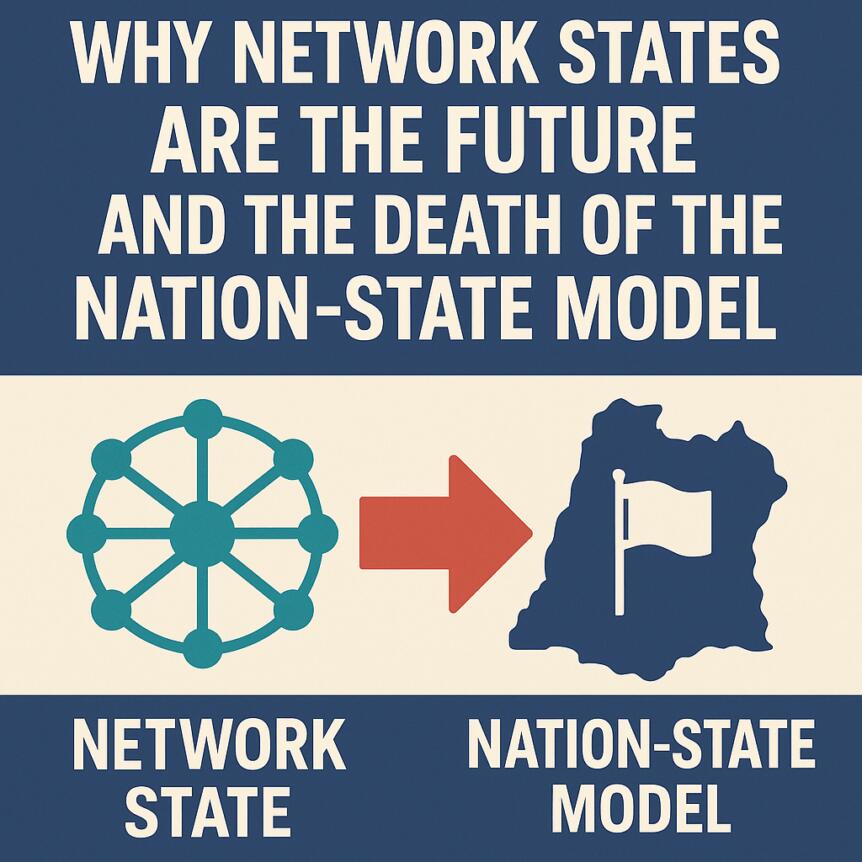
Decentralization, Privacy, Freedom, CypherpunksAn illustrated example of a network state. Source: The Network State

Experts from the crypto industry, including Hope, warn that as these digital communities evolve, existing nation-states will seek to undermine them through regulation, legal challenges, or even military means. Such measures aim to protect sovereignty and prevent the rise of competitor models that threaten the current geopolitical order.

This ongoing tension highlights the transformative potential of blockchain and crypto for governance, which continues to inspire enthusiasts and developers alike. While the journey toward fully realized network states is still underway, the core values driving this movement remain influential across digital and traditional spheres.

This article was originally published as Why Network States Are the Future and the Death of the Nation-State Model on Crypto Breaking News – your trusted source for crypto news, Bitcoin news, and blockchain updates.


Market Opportunity
WHY Logo
WHY Price(WHY)
$0.00000001308
$0.00000001308$0.00000001308
+0.53%
USD
WHY (WHY) Live Price Chart
Disclaimer: The articles reposted on this site are sourced from public platforms and are provided for informational purposes only. They do not necessarily reflect the views of MEXC. All rights remain with the original authors. If you believe any content infringes on third-party rights, please contact [email protected] for removal. MEXC makes no guarantees regarding the accuracy, completeness, or timeliness of the content and is not responsible for any actions taken based on the information provided. The content does not constitute financial, legal, or other professional advice, nor should it be considered a recommendation or endorsement by MEXC.

You May Also Like

Franklin Templeton CEO Dismisses 50bps Rate Cut Ahead FOMC

Franklin Templeton CEO Dismisses 50bps Rate Cut Ahead FOMC

The post Franklin Templeton CEO Dismisses 50bps Rate Cut Ahead FOMC appeared on BitcoinEthereumNews.com. Franklin Templeton CEO Jenny Johnson has weighed in on whether the Federal Reserve should make a 25 basis points (bps) Fed rate cut or 50 bps cut. This comes ahead of the Fed decision today at today’s FOMC meeting, with the market pricing in a 25 bps cut. Bitcoin and the broader crypto market are currently trading flat ahead of the rate cut decision. Franklin Templeton CEO Weighs In On Potential FOMC Decision In a CNBC interview, Jenny Johnson said that she expects the Fed to make a 25 bps cut today instead of a 50 bps cut. She acknowledged the jobs data, which suggested that the labor market is weakening. However, she noted that this data is backward-looking, indicating that it doesn’t show the current state of the economy. She alluded to the wage growth, which she remarked is an indication of a robust labor market. She added that retail sales are up and that consumers are still spending, despite inflation being sticky at 3%, which makes a case for why the FOMC should opt against a 50-basis-point Fed rate cut. In line with this, the Franklin Templeton CEO said that she would go with a 25 bps rate cut if she were Jerome Powell. She remarked that the Fed still has the October and December FOMC meetings to make further cuts if the incoming data warrants it. Johnson also asserted that the data show a robust economy. However, she noted that there can’t be an argument for no Fed rate cut since Powell already signaled at Jackson Hole that they were likely to lower interest rates at this meeting due to concerns over a weakening labor market. Notably, her comment comes as experts argue for both sides on why the Fed should make a 25 bps cut or…
Share
BitcoinEthereumNews2025/09/18 00:36
Academic Publishing and Fairness: A Game-Theoretic Model of Peer-Review Bias

Academic Publishing and Fairness: A Game-Theoretic Model of Peer-Review Bias

Exploring how biases in the peer-review system impact researchers' choices, showing how principles of fairness relate to the production of scientific knowledge based on topic importance and hardness.
Share
Hackernoon2025/09/17 23:15
MAXI DOGE Holders Diversify into $GGs for Fast-Growth 2025 Crypto Presale Opportunities

MAXI DOGE Holders Diversify into $GGs for Fast-Growth 2025 Crypto Presale Opportunities

Presale crypto tokens have become some of the most active areas in Web3, offering early access to projects that blend culture, finance, and technology. Investors are constantly searching for the best crypto presale to buy right now, comparing new token presales across different niches. MAXI DOGE has gained attention for its meme-driven energy, but early [...] The post MAXI DOGE Holders Diversify into $GGs for Fast-Growth 2025 Crypto Presale Opportunities appeared first on Blockonomi.
Share
Blockonomi2025/09/18 00:00