Wintermute’s latest report highlights a puzzling market divergence. Despite broad monetary easing and rate cuts by major central banks, the surge of new capital continues to bypass crypto assets. Most of this liquidity is flowing into equities and artificial intelligence instead. Stablecoins remain the sole expanding pillar within digital assets, reflecting steady but limited activity. […]Wintermute’s latest report highlights a puzzling market divergence. Despite broad monetary easing and rate cuts by major central banks, the surge of new capital continues to bypass crypto assets. Most of this liquidity is flowing into equities and artificial intelligence instead. Stablecoins remain the sole expanding pillar within digital assets, reflecting steady but limited activity. […]

Wintermute Analysis: Stablecoins Grow While ETFs and DATs Stall in Crypto Markets

Wintermute
  • Global liquidity is expanding, yet crypto remains on the sidelines.
  • Stablecoins are the only segment still demonstrating consistent growth.
  • Market performance is now driven by liquidity direction rather than supply.

Wintermute’s latest report highlights a puzzling market divergence. Despite broad monetary easing and rate cuts by major central banks, the surge of new capital continues to bypass crypto assets. Most of this liquidity is flowing into equities and artificial intelligence instead. Stablecoins remain the sole expanding pillar within digital assets, reflecting steady but limited activity.

The report suggests that the traditional four-year cycle theory has lost its relevance. Liquidity trends now dominate market movements, making past halving-based patterns increasingly obsolete.

Although leverage has been unwound and volatility subdued, the lack of new ETF or Digital Asset Trust (DAT) inflows continues to restrain momentum. The market structure appears cleaner, but price growth still depends on the return of institutional capital through these vehicles.

Also Read: Michael Selig Nominated to Lead CFTC in 2025: A New Era for Crypto Regulation?

Macro Backdrop Supports Risk Assets, but Crypto Lags

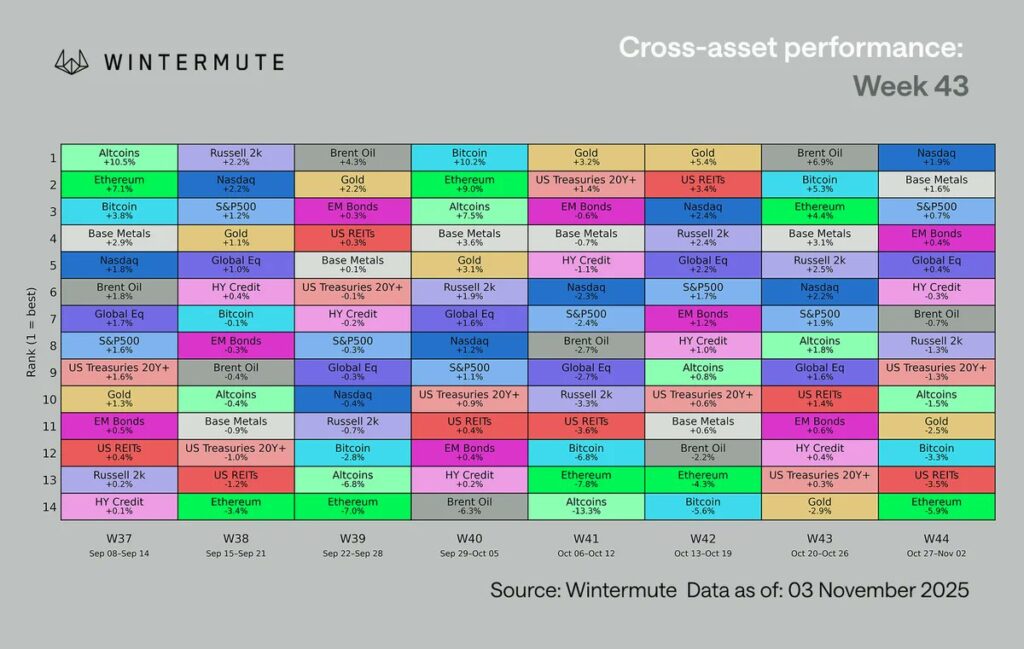
The macro environment remains favorable. The Federal Reserve’s recent 25-basis-point rate cut and the end of quantitative tightening signal a supportive stance toward risk assets. However, uncertainty surrounding future rate paths has triggered brief volatility. U.S. equities quickly stabilized, yet crypto failed to rebound in tandem, underscoring its weak connection to broader liquidity flows.
Source: @wintermute_t

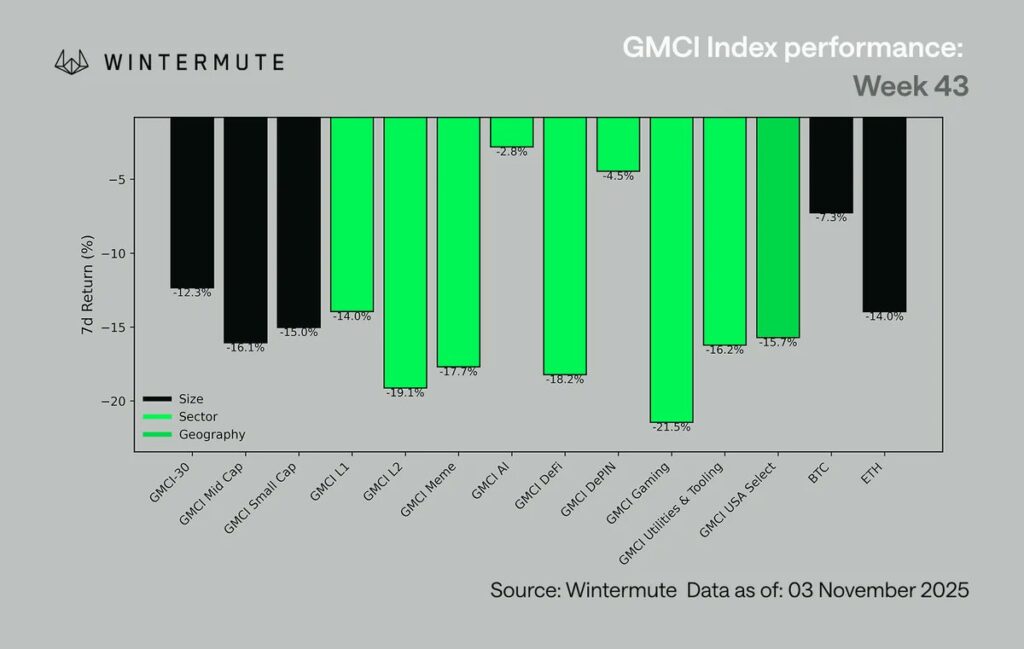
Bitcoin and Ethereum continue to trade within a tight range, hovering around $107,000 and $3,700, respectively. Altcoins continue to trend based on market-specific narratives, while market indexes such as GMCI-30 dropped sharply, falling 12% in last week’s market. Declines across assets were widespread, led by gaming and Layer 2 assets, while AI and DePIN assets noted a Relative Strength Index improvement. These trends suggest post-FOMC liquidity adjustment changes rather than structural problems.

Liquidity Allocation Defines the Next Crypto Move

The trouble at the heart of crypto’s slow growth is not a lack of liquidity but its direction. Central banks are pouring liquidity into healthy markets, but it’s just that a lot of funds are entering the stock and AI sectors rather than crypto. Stablecoin supply is up 50% in 2022, with over $100 billion of new supply, while ETFs have been experiencing slow growth in assets under management at around $150 billion, and DAT activity is nearly nonexistent because exchange volume is down.
Source: @wintermute_t

Only one of the three major inflow engines, stablecoins, is operational. ETF demand is tempered, and the DAT pipelines are dried up. Institutional and retail investors’ interest is in faster-moving equity and AI trades. Wintermute concludes that liquidity is ample but misaligned, “indicating that a crypto rebound will commence only when ETF and DAT flows restart.  Until then, stablecoins are keeping the ecosystem afloat.

Also Read: US Cracks Down on North Korea’s Crypto Crime: $3 Billion Stolen in 3 Years

Market Opportunity
Major Logo
Major Price(MAJOR)
$0.1277
$0.1277$0.1277
-0.60%
USD
Major (MAJOR) Live Price Chart
Disclaimer: The articles reposted on this site are sourced from public platforms and are provided for informational purposes only. They do not necessarily reflect the views of MEXC. All rights remain with the original authors. If you believe any content infringes on third-party rights, please contact [email protected] for removal. MEXC makes no guarantees regarding the accuracy, completeness, or timeliness of the content and is not responsible for any actions taken based on the information provided. The content does not constitute financial, legal, or other professional advice, nor should it be considered a recommendation or endorsement by MEXC.

You May Also Like

The Channel Factories We’ve Been Waiting For

The Channel Factories We’ve Been Waiting For

The post The Channel Factories We’ve Been Waiting For appeared on BitcoinEthereumNews.com. Visions of future technology are often prescient about the broad strokes while flubbing the details. The tablets in “2001: A Space Odyssey” do indeed look like iPads, but you never see the astronauts paying for subscriptions or wasting hours on Candy Crush.  Channel factories are one vision that arose early in the history of the Lightning Network to address some challenges that Lightning has faced from the beginning. Despite having grown to become Bitcoin’s most successful layer-2 scaling solution, with instant and low-fee payments, Lightning’s scale is limited by its reliance on payment channels. Although Lightning shifts most transactions off-chain, each payment channel still requires an on-chain transaction to open and (usually) another to close. As adoption grows, pressure on the blockchain grows with it. The need for a more scalable approach to managing channels is clear. Channel factories were supposed to meet this need, but where are they? In 2025, subnetworks are emerging that revive the impetus of channel factories with some new details that vastly increase their potential. They are natively interoperable with Lightning and achieve greater scale by allowing a group of participants to open a shared multisig UTXO and create multiple bilateral channels, which reduces the number of on-chain transactions and improves capital efficiency. Achieving greater scale by reducing complexity, Ark and Spark perform the same function as traditional channel factories with new designs and additional capabilities based on shared UTXOs.  Channel Factories 101 Channel factories have been around since the inception of Lightning. A factory is a multiparty contract where multiple users (not just two, as in a Dryja-Poon channel) cooperatively lock funds in a single multisig UTXO. They can open, close and update channels off-chain without updating the blockchain for each operation. Only when participants leave or the factory dissolves is an on-chain transaction…
Share
BitcoinEthereumNews2025/09/18 00:09
Markets await Fed’s first 2025 cut, experts bet “this bull market is not even close to over”

Markets await Fed’s first 2025 cut, experts bet “this bull market is not even close to over”

Will the Fed’s first rate cut of 2025 fuel another leg higher for Bitcoin and equities, or does September’s history point to caution? First rate cut of 2025 set against a fragile backdrop The Federal Reserve is widely expected to…
Share
Crypto.news2025/09/18 00:27
Buterin pushes Layer 2 interoperability as cornerstone of Ethereum’s future

Buterin pushes Layer 2 interoperability as cornerstone of Ethereum’s future

Ethereum founder, Vitalik Buterin, has unveiled new goals for the Ethereum blockchain today at the Japan Developer Conference. The plan lays out short-term, mid-term, and long-term goals touching on L2 interoperability and faster responsiveness among others. In terms of technology, he said again that he is sure that Layer 2 options are the best way […]
Share
Cryptopolitan2025/09/18 01:15