The post XAU/USD recovery stalls below $4,150 resistance  appeared on BitcoinEthereumNews.com. Gold (XAU/USD) remains practically flat on the daily chart on Wednesday, as hesitant market, as investors are reluctant to take risks ahead of the US government’s reopening. The precious metal’s recovery has stalled below $4250 resistance area, but downside attempts remain contained above $4,100 for now. The US Dollar Index, which measures the value of the Greenback against a basket of currencies, has shrugged off the negative impact of Tuesday’s employment data and is picking up from two-week lows. This is keeping bullion from appreciating higher, which leaves the pair in no-man’s land above $4,100.  Failure to break $4,150 might lead to a correction XAU/USD 4-Hour Chart The technical picture is showing a loosening upside momentum. The 4-hour Relative Strength Index (RSI) remains within positive territory, at 612.00 at the time of writing, although the Moving Average Convergence Divergence (MACD) is showing a bearish cross, suggesting some negative pressure. Failure to extend gains beyond the resistance area around the mentioned $4,150 area (October 22, 23 and 24 highs) might give bears hopes to break Tuesday’s lows at $4,090, aiming to the previous resistance area at $4,050 (October 31 highs) and  the area right below the $4,000 (November 6, 7 lows) A confirmation above $4,150 would expose the previous support area at $4,220 (October 20 lows), ahead of the all-time highs, around $4,380 (October 20, 21 highs). Gold FAQs Gold has played a key role in human’s history as it has been widely used as a store of value and medium of exchange. Currently, apart from its shine and usage for jewelry, the precious metal is widely seen as a safe-haven asset, meaning that it is considered a good investment during turbulent times. Gold is also widely seen as a hedge against inflation and against depreciating currencies as it doesn’t rely… The post XAU/USD recovery stalls below $4,150 resistance  appeared on BitcoinEthereumNews.com. Gold (XAU/USD) remains practically flat on the daily chart on Wednesday, as hesitant market, as investors are reluctant to take risks ahead of the US government’s reopening. The precious metal’s recovery has stalled below $4250 resistance area, but downside attempts remain contained above $4,100 for now. The US Dollar Index, which measures the value of the Greenback against a basket of currencies, has shrugged off the negative impact of Tuesday’s employment data and is picking up from two-week lows. This is keeping bullion from appreciating higher, which leaves the pair in no-man’s land above $4,100.  Failure to break $4,150 might lead to a correction XAU/USD 4-Hour Chart The technical picture is showing a loosening upside momentum. The 4-hour Relative Strength Index (RSI) remains within positive territory, at 612.00 at the time of writing, although the Moving Average Convergence Divergence (MACD) is showing a bearish cross, suggesting some negative pressure. Failure to extend gains beyond the resistance area around the mentioned $4,150 area (October 22, 23 and 24 highs) might give bears hopes to break Tuesday’s lows at $4,090, aiming to the previous resistance area at $4,050 (October 31 highs) and  the area right below the $4,000 (November 6, 7 lows) A confirmation above $4,150 would expose the previous support area at $4,220 (October 20 lows), ahead of the all-time highs, around $4,380 (October 20, 21 highs). Gold FAQs Gold has played a key role in human’s history as it has been widely used as a store of value and medium of exchange. Currently, apart from its shine and usage for jewelry, the precious metal is widely seen as a safe-haven asset, meaning that it is considered a good investment during turbulent times. Gold is also widely seen as a hedge against inflation and against depreciating currencies as it doesn’t rely…

XAU/USD recovery stalls below $4,150 resistance

Gold (XAU/USD) remains practically flat on the daily chart on Wednesday, as hesitant market, as investors are reluctant to take risks ahead of the US government’s reopening. The precious metal’s recovery has stalled below $4250 resistance area, but downside attempts remain contained above $4,100 for now.

The US Dollar Index, which measures the value of the Greenback against a basket of currencies, has shrugged off the negative impact of Tuesday’s employment data and is picking up from two-week lows. This is keeping bullion from appreciating higher, which leaves the pair in no-man’s land above $4,100. 

Failure to break $4,150 might lead to a correction

XAU/USD 4-Hour Chart

The technical picture is showing a loosening upside momentum. The 4-hour Relative Strength Index (RSI) remains within positive territory, at 612.00 at the time of writing, although the Moving Average Convergence Divergence (MACD) is showing a bearish cross, suggesting some negative pressure.

Failure to extend gains beyond the resistance area around the mentioned $4,150 area (October 22, 23 and 24 highs) might give bears hopes to break Tuesday’s lows at $4,090, aiming to the previous resistance area at $4,050 (October 31 highs) and  the area right below the $4,000 (November 6, 7 lows)

A confirmation above $4,150 would expose the previous support area at $4,220 (October 20 lows), ahead of the all-time highs, around $4,380 (October 20, 21 highs).

Gold FAQs

Gold has played a key role in human’s history as it has been widely used as a store of value and medium of exchange. Currently, apart from its shine and usage for jewelry, the precious metal is widely seen as a safe-haven asset, meaning that it is considered a good investment during turbulent times. Gold is also widely seen as a hedge against inflation and against depreciating currencies as it doesn’t rely on any specific issuer or government.

Central banks are the biggest Gold holders. In their aim to support their currencies in turbulent times, central banks tend to diversify their reserves and buy Gold to improve the perceived strength of the economy and the currency. High Gold reserves can be a source of trust for a country’s solvency. Central banks added 1,136 tonnes of Gold worth around $70 billion to their reserves in 2022, according to data from the World Gold Council. This is the highest yearly purchase since records began. Central banks from emerging economies such as China, India and Turkey are quickly increasing their Gold reserves.

Gold has an inverse correlation with the US Dollar and US Treasuries, which are both major reserve and safe-haven assets. When the Dollar depreciates, Gold tends to rise, enabling investors and central banks to diversify their assets in turbulent times. Gold is also inversely correlated with risk assets. A rally in the stock market tends to weaken Gold price, while sell-offs in riskier markets tend to favor the precious metal.

The price can move due to a wide range of factors. Geopolitical instability or fears of a deep recession can quickly make Gold price escalate due to its safe-haven status. As a yield-less asset, Gold tends to rise with lower interest rates, while higher cost of money usually weighs down on the yellow metal. Still, most moves depend on how the US Dollar (USD) behaves as the asset is priced in dollars (XAU/USD). A strong Dollar tends to keep the price of Gold controlled, whereas a weaker Dollar is likely to push Gold prices up.

Source: https://www.fxstreet.com/news/gold-price-forecast-xau-usd-recovery-stalls-below-4-150-resistance-202511121055


Market Opportunity
4 Logo
4 Price(4)
$0.02204
$0.02204$0.02204
-3.67%
USD
4 (4) Live Price Chart
Disclaimer: The articles reposted on this site are sourced from public platforms and are provided for informational purposes only. They do not necessarily reflect the views of MEXC. All rights remain with the original authors. If you believe any content infringes on third-party rights, please contact [email protected] for removal. MEXC makes no guarantees regarding the accuracy, completeness, or timeliness of the content and is not responsible for any actions taken based on the information provided. The content does not constitute financial, legal, or other professional advice, nor should it be considered a recommendation or endorsement by MEXC.

You May Also Like

The Channel Factories We’ve Been Waiting For

The Channel Factories We’ve Been Waiting For

The post The Channel Factories We’ve Been Waiting For appeared on BitcoinEthereumNews.com. Visions of future technology are often prescient about the broad strokes while flubbing the details. The tablets in “2001: A Space Odyssey” do indeed look like iPads, but you never see the astronauts paying for subscriptions or wasting hours on Candy Crush.  Channel factories are one vision that arose early in the history of the Lightning Network to address some challenges that Lightning has faced from the beginning. Despite having grown to become Bitcoin’s most successful layer-2 scaling solution, with instant and low-fee payments, Lightning’s scale is limited by its reliance on payment channels. Although Lightning shifts most transactions off-chain, each payment channel still requires an on-chain transaction to open and (usually) another to close. As adoption grows, pressure on the blockchain grows with it. The need for a more scalable approach to managing channels is clear. Channel factories were supposed to meet this need, but where are they? In 2025, subnetworks are emerging that revive the impetus of channel factories with some new details that vastly increase their potential. They are natively interoperable with Lightning and achieve greater scale by allowing a group of participants to open a shared multisig UTXO and create multiple bilateral channels, which reduces the number of on-chain transactions and improves capital efficiency. Achieving greater scale by reducing complexity, Ark and Spark perform the same function as traditional channel factories with new designs and additional capabilities based on shared UTXOs.  Channel Factories 101 Channel factories have been around since the inception of Lightning. A factory is a multiparty contract where multiple users (not just two, as in a Dryja-Poon channel) cooperatively lock funds in a single multisig UTXO. They can open, close and update channels off-chain without updating the blockchain for each operation. Only when participants leave or the factory dissolves is an on-chain transaction…
Share
BitcoinEthereumNews2025/09/18 00:09
Franklin Templeton CEO Dismisses 50bps Rate Cut Ahead FOMC

Franklin Templeton CEO Dismisses 50bps Rate Cut Ahead FOMC

The post Franklin Templeton CEO Dismisses 50bps Rate Cut Ahead FOMC appeared on BitcoinEthereumNews.com. Franklin Templeton CEO Jenny Johnson has weighed in on whether the Federal Reserve should make a 25 basis points (bps) Fed rate cut or 50 bps cut. This comes ahead of the Fed decision today at today’s FOMC meeting, with the market pricing in a 25 bps cut. Bitcoin and the broader crypto market are currently trading flat ahead of the rate cut decision. Franklin Templeton CEO Weighs In On Potential FOMC Decision In a CNBC interview, Jenny Johnson said that she expects the Fed to make a 25 bps cut today instead of a 50 bps cut. She acknowledged the jobs data, which suggested that the labor market is weakening. However, she noted that this data is backward-looking, indicating that it doesn’t show the current state of the economy. She alluded to the wage growth, which she remarked is an indication of a robust labor market. She added that retail sales are up and that consumers are still spending, despite inflation being sticky at 3%, which makes a case for why the FOMC should opt against a 50-basis-point Fed rate cut. In line with this, the Franklin Templeton CEO said that she would go with a 25 bps rate cut if she were Jerome Powell. She remarked that the Fed still has the October and December FOMC meetings to make further cuts if the incoming data warrants it. Johnson also asserted that the data show a robust economy. However, she noted that there can’t be an argument for no Fed rate cut since Powell already signaled at Jackson Hole that they were likely to lower interest rates at this meeting due to concerns over a weakening labor market. Notably, her comment comes as experts argue for both sides on why the Fed should make a 25 bps cut or…
Share
BitcoinEthereumNews2025/09/18 00:36
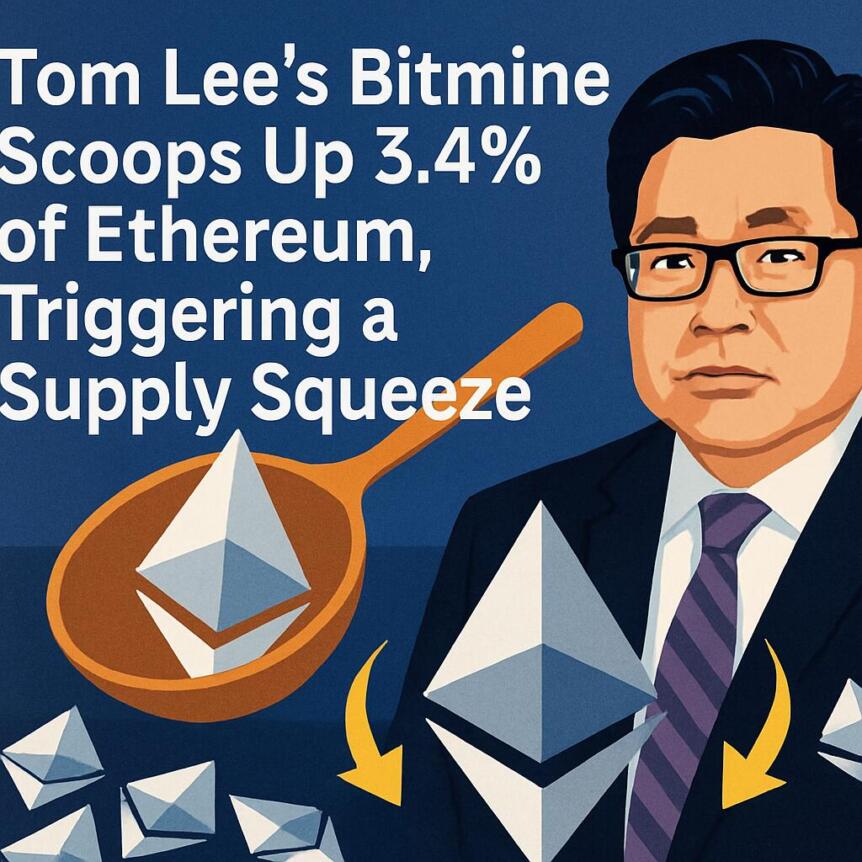
Tom Lee’s Bitmine Scoops Up 3.4% of Ethereum, Triggering a Supply Squeeze

Tom Lee’s Bitmine Scoops Up 3.4% of Ethereum, Triggering a Supply Squeeze

Bitmine Immersion now controls 3.4% of Ethereum amid shrinking exchange supply and rising institutional accumulation.
Share
Crypto Breaking News2026/01/20 16:27