Sberbank Eyes BTC, ETH and USDT for Crypto-Backed Loans
Overview
Sberbank is preparing to push crypto assets deeper into traditional banking by expanding its secured-lending framework to Bitcoin, Ether and Tether’s USDT. The plan is significant because it treats major cryptocurrencies not simply as assets customers can trade, but as collateral that could support conventional credit.
The timing is closely linked to Russia’s changing regulatory framework. New cryptocurrency rules are scheduled to take effect on September 1, 2026, while the Bank of Russia has identified Bitcoin, Ethereum and USDT as the liquid crypto assets that can be made available for public exchange trading under its proposed framework. The regulator is also developing rules that allow financial intermediaries to recognize crypto in margin and prudential calculations.
Sberbank has already tested the broader model. The bank previously completed a crypto-collateralized lending pilot with mining company Intelion, giving it practical experience with custody and digital collateral. Expanding crypto-backed loans to BTC, ETH and USDT would move the concept closer to a standardized banking product.
The development does not mean Russia has made cryptocurrencies equivalent to cash or that Sberbank is broadly offering these loans to every customer today. The more important shift is that one of the country’s largest banks is exploring how crypto can fit inside familiar secured-lending and risk-management frameworks.
Key Takeaways
- Sberbank plans to use BTC, ETH and USDT as collateral for crypto-backed loans.
- The planned expansion is linked to Russia’s new crypto regulatory framework.
- The Bank of Russia has identified BTC, ETH and USDT among assets meeting its public-trading criteria.
- Crypto collateral does not mean cryptocurrencies become ordinary domestic payment money.
- Loan-to-value ratios, volatility, custody and liquidation systems will determine whether the model can scale.
Why Is Sberbank Expanding Crypto-Backed Loans?
What Exactly Is Sberbank Planning?
Sberbank is preparing to accept Bitcoin, Ether and USDT as collateral for lending once the necessary regulatory framework and operational conditions are in place. Rather than requiring a crypto holder to sell an asset before obtaining liquidity, the bank could allow eligible customers to pledge the asset and borrow against its value.
That represents a different stage of institutional adoption from simple crypto trading. A bank accepting an asset as collateral must be able to value it, custody or control it, monitor price changes and liquidate it if the borrower no longer satisfies loan requirements.
The plan therefore suggests that crypto is beginning to be considered within established credit-risk processes. BTC and ETH bring high price volatility but deep global liquidity, while USDT introduces a different risk profile because its market value is designed to remain close to $1.
Has Sberbank Already Tested Crypto Collateral?
Yes. Sberbank previously completed a crypto-backed lending pilot involving Russian mining company Intelion. The pilot demonstrated that the bank could structure a credit transaction where digital assets served as collateral rather than being sold for fiat first.
That earlier transaction matters because the current plan is not starting from zero. Sberbank can build on operational experience involving custody, collateral control and valuation.
The move from a limited pilot toward accepting recognizable assets such as BTC, ETH and USDT would nevertheless require broader risk-management standards. A bank must determine which clients qualify, acceptable loan-to-value ratios, custody procedures and the conditions under which collateral can be sold.
Crypto-Backed Loans: How the Model Works
Does the Borrower Need to Sell Bitcoin?
No. That is the primary economic appeal of crypto-backed loans.
Suppose a borrower owns $100,000 worth of Bitcoin but needs short-term working capital. Selling BTC would create liquidity but would also end the borrower’s exposure to the asset. A secured loan can instead allow the borrower to pledge BTC and receive a smaller amount of credit.
For example, at a hypothetical 50% loan-to-value ratio, $100,000 of eligible collateral might support a loan of up to $50,000. The exact ratio would depend on the lender’s policies and the perceived risk of the collateral.
This structure is already familiar in traditional finance. Banks lend against securities, property and other valuable assets; crypto-backed loans apply similar logic to digital assets.
What Happens If BTC or ETH Falls?
The loan becomes riskier because the collateral protecting the lender is worth less.
Loan-to-value, or LTV, measures the size of the loan relative to the value of collateral. If a borrower receives $40,000 against $100,000 of BTC, the starting LTV is 40%. If Bitcoin falls and the collateral value drops to $60,000 while the loan remains $40,000, the LTV rises to about 66.7%.
A bank can manage that risk by requiring additional collateral, reducing the loan balance or liquidating part of the pledged asset. The exact thresholds would depend on the product design.
For volatile assets such as BTC and ETH, conservative LTV ratios and continuous price monitoring are likely to be essential.
Why BTC, ETH and USDT?
Why Would a Bank Prefer Highly Liquid Crypto Assets?
Liquidity allows a lender to exit collateral more reliably when risk rises. Bitcoin and Ether have deep global markets, broad price discovery and long trading histories relative to most digital assets.
Those characteristics make them easier for risk managers to model than thinly traded tokens whose market price may collapse if a large holder tries to sell.
The Bank of Russia has similarly emphasized liquidity, market capitalization, average daily trading volume and price history when determining which cryptocurrencies can be made available to non-qualified investors. Under the current framework, BTC, ETH and USDT meet those criteria.
The same characteristics are relevant for secured lending because a collateral asset only protects the lender if it can be valued and liquidated efficiently.
Why Is USDT Different From BTC and ETH?
USDT is designed to maintain a price close to $1, so its day-to-day market volatility is substantially lower than that of BTC or ETH. That could allow a lender to apply different collateral haircuts or risk limits.
However, lower price volatility does not eliminate risk. USDT introduces issuer, reserve, redemption and regulatory considerations that do not apply in exactly the same way to decentralized crypto assets.
This means Sberbank would likely need separate risk models for the three assets rather than treating all crypto collateral identically.
Does This Mean Russia Has Legalized Crypto Payments?
Collateral and Payment Are Different Legal Functions
No. An asset can be legally recognized for trading, investment or collateral without becoming ordinary legal tender for domestic payments.
Using BTC as collateral means the asset helps secure a debt. The borrower pledges economic value to the lender, but the purchase of ordinary goods and services does not automatically become denominated or settled in Bitcoin.
This distinction matters because headlines about banks accepting crypto can easily be interpreted as broader monetary adoption. Sberbank’s planned product is better understood as an evolution in secured lending rather than a replacement for the ruble or conventional bank payments.
Why Is Russia's New Regulatory Framework Important?
Russia is creating a more formal infrastructure for crypto trading and custody. The Bank of Russia has published rules covering organized crypto trading, digital depositories, margin trading and how financial intermediaries should incorporate crypto-related risks into prudential calculations.
The regulator has also identified Bitcoin, Ethereum and USDT as assets meeting the liquidity and trading-history requirements for public exchange access within the proposed framework.
These rules provide banks and other financial institutions with clearer parameters for handling crypto assets. Without custody, valuation and capital rules, offering standardized crypto-backed loans would be much more difficult.
What Risks Does Sberbank Take?
Crypto Price Volatility
BTC and ETH can experience large price moves over short periods. A bank holding them as collateral must therefore react faster than it might with many conventional assets.
If prices fall sharply overnight, a lender could face a gap between the collateral value and the outstanding loan before it can liquidate. Conservative initial LTV ratios provide one buffer against that risk.
Liquidity can also deteriorate during market stress. Bitcoin may trade continuously, but the price available during a forced liquidation can differ substantially from the last quoted price.
Custody and Operational Risk
Unlike conventional securities held through established central securities depositories, crypto requires secure management of blockchain keys and transfer permissions.
A lending product must ensure the borrower cannot simultaneously transfer the pledged asset elsewhere. The bank or approved custodian needs sufficient control over the collateral to enforce the loan agreement.
Operational controls around wallet security, transaction authorization and recovery procedures therefore become part of credit risk.
Stablecoin Counterparty Risk
USDT reduces market-price volatility but introduces exposure to the structure behind the stablecoin. A lender must consider whether the token can reliably maintain its peg and be redeemed or sold during stressed market conditions.
The risk is therefore different rather than absent. BTC is primarily exposed to market volatility; USDT is more closely linked to issuer, reserves, redemption infrastructure and regulatory treatment.
Can Crypto Become Mainstream Bank Collateral?
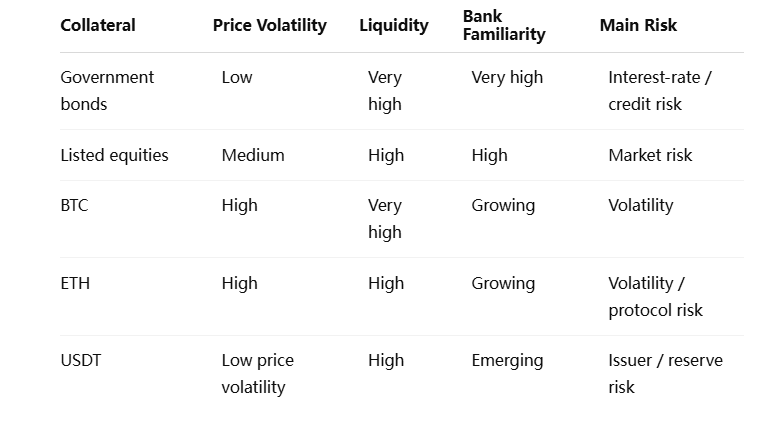
How Does Crypto Compare With Traditional Collateral?
CollateralPrice VolatilityLiquidityBank FamiliarityMain RiskGovernment bondsLowVery highVery highInterest-rate / credit riskListed equitiesMediumHighHighMarket riskBTCHighVery highGrowingVolatilityETHHighHighGrowingVolatility / protocol riskUSDTLow price volatilityHighEmergingIssuer / reserve risk
The comparison shows why crypto is unlikely to receive the same collateral treatment as government bonds immediately. Banks generally apply larger haircuts to assets with more volatile prices or less established legal structures.
At the same time, BTC and ETH have become sufficiently liquid that they can increasingly be evaluated within institutional risk frameworks. As custody infrastructure and regulation mature, more lenders may be willing to accept them while maintaining conservative collateral requirements.
MEXC View: The Bigger Signal Is Crypto's Collateral Utility
From a crypto-market perspective, Sberbank’s plan matters less as a short-term price catalyst and more as evidence that digital assets are acquiring additional financial functions. Crypto adoption is often measured by trading volume or payment usage, but collateral utility represents another important layer.
An asset that can be pledged against traditional credit becomes more useful without requiring the holder to sell it. This can increase capital efficiency for miners, businesses and other crypto holders, although it can also introduce leverage into the system.
For traders, the key indicators to watch are therefore not only whether Sberbank formally launches the product, but also the collateral haircuts, eligible borrower categories, custody model and liquidation rules. Those details will determine whether the program is a narrow institutional service or the beginning of a broader banking product.
The distinction between BTC, ETH and USDT will also be important. If banks assign materially different LTV ratios to each asset, those policies could offer insight into how regulated financial institutions quantify different forms of crypto risk.
What Could Limit Crypto-Backed Loans?
Leverage Can Amplify Losses
Borrowing against an appreciating asset can improve capital efficiency, but it also creates leverage. If the collateral price declines, a borrower can lose part of the pledged crypto through liquidation while still facing the economic consequences of the debt.
This means crypto-backed lending is not simply a way to obtain cash without selling. It transfers market risk into a leveraged credit structure.
Banks therefore need clear liquidation mechanisms, while borrowers need to understand that retaining nominal ownership exposure does not eliminate downside risk.
Regulation Could Still Change Product Design
Russia’s crypto framework is evolving quickly, and several Bank of Russia measures have been introduced through draft rules and regulatory consultations. Final requirements may affect which clients can access products, how collateral is valued and what capital banks must hold against crypto exposure.
The details matter because a product can be technically feasible but commercially unattractive if regulatory capital charges or custody requirements are too high.
For that reason, Sberbank’s plan should be treated as an important directional signal rather than evidence that mass-market crypto lending has already arrived.
Sberbank's Move Could Make Crypto a Banking Collateral Class
Sberbank’s plan to accept BTC, ETH and USDT for crypto-backed loans represents a notable shift in how traditional financial institutions can use digital assets. Instead of treating cryptocurrencies only as instruments to buy and sell, the bank is exploring how they can function inside conventional secured-credit structures.
That transition requires substantially more than market access. Banks must establish custody controls, reliable valuation, conservative LTV ratios and liquidation procedures capable of responding to 24/7 price movements. BTC and ETH bring deep liquidity but high volatility, while USDT offers greater price stability alongside separate issuer and reserve risks.
Russia’s new regulatory framework is making this experimentation easier by creating formal rules around crypto trading, custody, margin activity and prudential risk. The Bank of Russia’s inclusion of BTC, ETH and USDT among the most liquid assets available for public exchange trading provides an additional foundation for institutional products.
The next milestone will not be another announcement. It will be the actual design and usage of the lending program: who can borrow, what collateral ratios apply, how assets are held and how the bank handles a sharp market decline.
If those systems prove workable, crypto-backed loans could demonstrate that major digital assets are becoming more than trading instruments. They may increasingly function as collateral inside traditional banking itself.
Risk Disclaimer: This article is for reference only and does not constitute investment advice. The cryptocurrency market is highly volatile. Please make decisions cautiously based on your individual circumstances.


Mund të të pëlqejë edhe kjo

Pons Trading Volume Passes $4 Billion on Robinhood Chain

Zcash Private Transactions Get a Major Speed Boost From Zakura

SWIFT Blockchain Ledger Goes Live: Is Bank Money Going 24/7?