A Deep Dive into MEXC's Cold-to-Hot Wallet Transfer MechanismA Deep Dive into MEXC's Cold-to-Hot Wallet Transfer Mechanism
Category List
Cancel

A Deep Dive into MEXC's Cold-to-Hot Wallet Transfer Mechanism

Key Takeaways:

  • Cold wallets store the vast majority of assets offline, while hot wallets handle everyday deposits and withdrawals. Together, they keep your funds secure.
  • MEXC uses a cold-hot wallet separation mechanism, reinforced by multi-signature authorization and multi-layered risk controls.
  • When a hot wallet has insufficient funds to fulfill withdrawal requests, the platform initiates a cold-to-hot (consolidation) transfer.
  • During a cold-to-hot transfer, withdrawals may be delayed by up to approximately 24 hours.
  • Canceling and resubmitting a withdrawal request will not speed up the process. Please wait patiently.

1. What Are Cold Wallets and Hot Wallets?


In the crypto industry, cold wallets and hot wallets are two core methods of asset storage, each with a distinct role, and most effective when used together.

A hot wallet is a wallet system that remains connected to the internet, primarily used to process real-time deposit and withdrawal requests. Its online nature enables fast responses to user actions, but also exposes it to certain cybersecurity risks.

A cold wallet is a wallet system that is completely physically isolated from the internet. Private keys never connect to any network, fundamentally eliminating the possibility of remote hacking. The cold wallet is the "vault" for safeguarding users' long-term assets.

Simply put: a hot wallet is like a cash register, it holds a small float for day-to-day transactions. A cold wallet is like a bank vault, it securely stores the bulk of the reserves.

2. MEXC's Cold-Hot Wallet Architecture


MEXC employs an industry-standard cold-hot wallet separation strategy, storing the vast majority of user assets in cold wallets while keeping only a small portion in hot wallets to support efficient daily deposits and withdrawals. Key features of this architecture include:

1) Multi-signature authorization: Every withdrawal transaction must be independently verified and signed by multiple parties, eliminating single points of failure and internal operation risks.

2) Semi-offline signing mechanism: MEXC's hot wallets use a proprietary semi-offline signing protocol, with private keys stored on volatile storage media to resist both physical and network-based attacks.

3) Physically isolated cold storage: Cold wallet addresses and private keys are generated on offline devices and encrypted to industry standards. Keys and their backups are distributed across multiple geographically separate vaults.

4) End-to-end risk monitoring: All deposit and withdrawal activity is subject to risk control review, including blacklisted address detection, on-chain block confirmation verification, and abnormal account behavior monitoring.

3. Why Cold-to-Hot Transfers Are Necessary


Because hot wallets only hold a small portion of assets to meet everyday withdrawal needs, situations can arise where hot wallet balances run temporarily low when a large withdrawal is requested, or when withdrawal demand is concentrated over a short period. In these cases, the platform must transfer funds from cold wallets to hot wallets before it can continue processing withdrawal orders.

Think of it this way: if the cash register doesn't have enough to cover a payment, staff need to open the vault and replenish it. In the crypto industry, this process is known as a cold-to-hot transfer, or a consolidation transaction.

Because cold wallets operate with physical isolation and multi-party authorization, the entire transfer process must follow strict security protocols, which inevitably takes some time.

4. How Withdrawals Work During a Cold-to-Hot Transfer


When MEXC initiates a cold-to-hot consolidation, the withdrawal process typically unfolds as follows:

1) User submits a withdrawal request: The user initiates a withdrawal on MEXC. The system automatically checks whether the hot wallet balance for that asset is sufficient.

2) Consolidation transfer triggered: If the hot wallet balance is insufficient, the system initiates a cold-to-hot consolidation. Security personnel decrypt and sign the private key on an offline device, then broadcast the signed transaction to the blockchain through a secure channel.

3) Awaiting block confirmations: The on-chain transfer from the cold wallet to the hot wallet requires block confirmations, the time for which varies depending on the blockchain.

4) Withdrawal order processed: Once the consolidated funds arrive in the hot wallet, the system processes withdrawal orders in the sequence they were submitted and broadcasts them to the blockchain network. This entire process can delay a user's withdrawal by up to approximately 24 hours.

5. What to Do While You Wait


Many users, especially newcomers, feel anxious when they encounter a withdrawal delay. Here are a few tips to help you navigate the wait with confidence:

Understand the mechanism: A cold-to-hot transfer is a necessary security measure. It does not indicate any issue with your assets.

Avoid canceling and resubmitting: If you cancel your withdrawal during the waiting period, your place in the queue is lost. A resubmitted order still needs to wait for the cold wallet funds to arrive in the hot wallet, so canceling does not speed up the process.

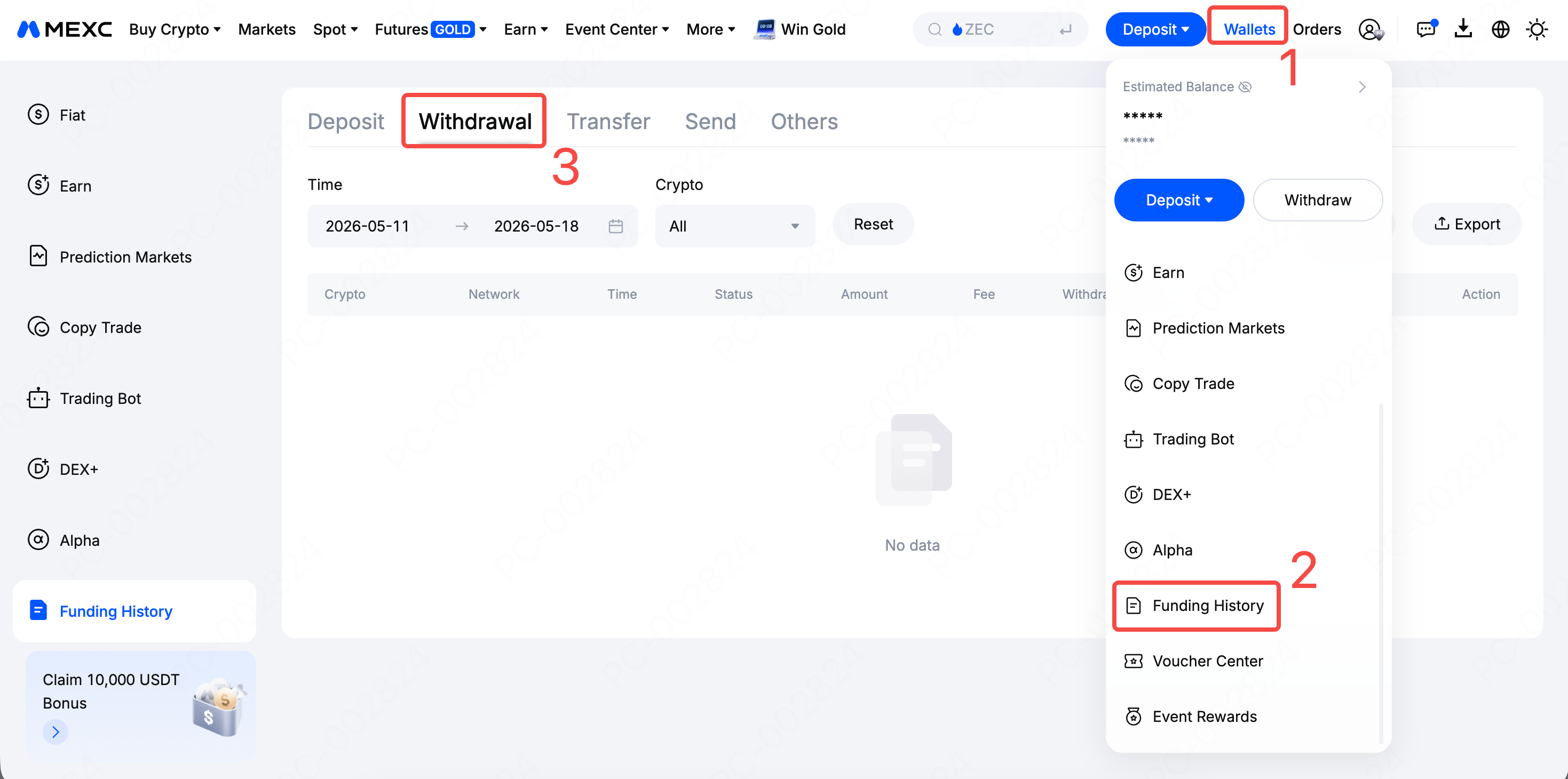
Monitor your withdrawal status: You can track your order in real time under Funding History Withdrawal on MEXC.

Plan ahead for transfers: If your funds are needed within a specific timeframe, submit your withdrawal request in advance and avoid last-minute large-amount operations.

6. How MEXC Protects Cold and Hot Wallet Assets


To maximize security without compromising efficiency, MEXC has built multiple layers of protection into its cold-hot wallet management:

Distributed private key management: Private keys and their backups are stored across multiple geographically separate vaults, so no single point of failure can compromise overall asset security.

Segregation of duties: Vault access is strictly limited to a small number of authorized personnel, with clear role separation to prevent any individual from acting alone.

Whitelist address verification: All cold wallet withdrawals and consolidation transfers must be directed to pre-approved whitelist addresses, preventing funds from being sent to unauthorized destinations.

Emergency response protocol: If any key holder becomes unavailable or loses access, backup keys can be activated within hours to ensure business continuity.

7. FAQs About Cold and Hot Wallet


7.1 Which wallet is more secure?


Cold wallets are significantly more secure due to their completely offline nature. That said, hot wallets are not without protection, MEXC's semi-offline signing, multi-signature authorization, and risk monitoring ensure hot wallets also maintain a high level of security.

7.2 What's the difference between a cold wallet and a hot wallet?


The key difference lies in internet connectivity and use case. Hot wallets are always online and handle real-time deposits and withdrawals; cold wallets are always offline and store the majority of assets for the long term. MEXC uses both to balance efficiency and security.

7.3 What is a hot wallet?


A hot wallet is an internet-connected crypto wallet capable of quickly sending and receiving on-chain transactions. It is the core infrastructure that enables exchanges to support instant deposits and withdrawals for their users.

7.4 What types of hot wallets exist?


Common hot wallet types include exchange-custodied hot wallets, desktop wallets, mobile app wallets, and browser extension wallets. The hot wallets used by MEXC are proprietary, custodial wallets developed in-house.

7.5 Can cold wallets be tracked?


A cold wallet is simply an offline method of storing private keys. Its corresponding on-chain address, like all blockchain addresses, has a publicly visible transaction history on the blockchain. On-chain activity at the address level is therefore trackable, though private keys and holder identities remain strictly confidential.

7.6 Can cold wallets be frozen if they receive assets from unknown sources?


The on-chain risk control system monitors the origin of incoming funds. If assets are detected as originating from a blacklisted address, they may be subject to further review or restricted operations. MEXC strongly encourages users to deposit and withdraw only through compliant channels.

8. Summary


Cold-to-hot consolidation transfers are a core component of digital asset platforms' fund management and a key reason why users occasionally experience withdrawal delays. Through its cold-hot wallet separation architecture, multi-signature authorization, end-to-end risk controls, and geographically distributed backups, MEXC works to maximize both the security and availability of user assets.

Understanding how cold and hot wallets operate helps users stay calm during transfer delays and plan their fund movements more effectively. MEXC will continue optimizing its consolidation processes to improve the user experience without compromising security.

A Deep Dive into MEXC's Cold-to-Hot Wallet Transfer Mechanism

Key Takeaways:

  • Cold wallets store the vast majority of assets offline, while hot wallets handle everyday deposits and withdrawals. Together, they keep your funds secure.
  • MEXC uses a cold-hot wallet separation mechanism, reinforced by multi-signature authorization and multi-layered risk controls.
  • When a hot wallet has insufficient funds to fulfill withdrawal requests, the platform initiates a cold-to-hot (consolidation) transfer.
  • During a cold-to-hot transfer, withdrawals may be delayed by up to approximately 24 hours.
  • Canceling and resubmitting a withdrawal request will not speed up the process. Please wait patiently.

1. What Are Cold Wallets and Hot Wallets?


In the crypto industry, cold wallets and hot wallets are two core methods of asset storage, each with a distinct role, and most effective when used together.

A hot wallet is a wallet system that remains connected to the internet, primarily used to process real-time deposit and withdrawal requests. Its online nature enables fast responses to user actions, but also exposes it to certain cybersecurity risks.

A cold wallet is a wallet system that is completely physically isolated from the internet. Private keys never connect to any network, fundamentally eliminating the possibility of remote hacking. The cold wallet is the "vault" for safeguarding users' long-term assets.

Simply put: a hot wallet is like a cash register, it holds a small float for day-to-day transactions. A cold wallet is like a bank vault, it securely stores the bulk of the reserves.

2. MEXC's Cold-Hot Wallet Architecture


MEXC employs an industry-standard cold-hot wallet separation strategy, storing the vast majority of user assets in cold wallets while keeping only a small portion in hot wallets to support efficient daily deposits and withdrawals. Key features of this architecture include:

1) Multi-signature authorization: Every withdrawal transaction must be independently verified and signed by multiple parties, eliminating single points of failure and internal operation risks.

2) Semi-offline signing mechanism: MEXC's hot wallets use a proprietary semi-offline signing protocol, with private keys stored on volatile storage media to resist both physical and network-based attacks.

3) Physically isolated cold storage: Cold wallet addresses and private keys are generated on offline devices and encrypted to industry standards. Keys and their backups are distributed across multiple geographically separate vaults.

4) End-to-end risk monitoring: All deposit and withdrawal activity is subject to risk control review, including blacklisted address detection, on-chain block confirmation verification, and abnormal account behavior monitoring.

3. Why Cold-to-Hot Transfers Are Necessary


Because hot wallets only hold a small portion of assets to meet everyday withdrawal needs, situations can arise where hot wallet balances run temporarily low when a large withdrawal is requested, or when withdrawal demand is concentrated over a short period. In these cases, the platform must transfer funds from cold wallets to hot wallets before it can continue processing withdrawal orders.

Think of it this way: if the cash register doesn't have enough to cover a payment, staff need to open the vault and replenish it. In the crypto industry, this process is known as a cold-to-hot transfer, or a consolidation transaction.

Because cold wallets operate with physical isolation and multi-party authorization, the entire transfer process must follow strict security protocols, which inevitably takes some time.

4. How Withdrawals Work During a Cold-to-Hot Transfer


When MEXC initiates a cold-to-hot consolidation, the withdrawal process typically unfolds as follows:

1) User submits a withdrawal request: The user initiates a withdrawal on MEXC. The system automatically checks whether the hot wallet balance for that asset is sufficient.

2) Consolidation transfer triggered: If the hot wallet balance is insufficient, the system initiates a cold-to-hot consolidation. Security personnel decrypt and sign the private key on an offline device, then broadcast the signed transaction to the blockchain through a secure channel.

3) Awaiting block confirmations: The on-chain transfer from the cold wallet to the hot wallet requires block confirmations, the time for which varies depending on the blockchain.

4) Withdrawal order processed: Once the consolidated funds arrive in the hot wallet, the system processes withdrawal orders in the sequence they were submitted and broadcasts them to the blockchain network. This entire process can delay a user's withdrawal by up to approximately 24 hours.

5. What to Do While You Wait


Many users, especially newcomers, feel anxious when they encounter a withdrawal delay. Here are a few tips to help you navigate the wait with confidence:

Understand the mechanism: A cold-to-hot transfer is a necessary security measure. It does not indicate any issue with your assets.

Avoid canceling and resubmitting: If you cancel your withdrawal during the waiting period, your place in the queue is lost. A resubmitted order still needs to wait for the cold wallet funds to arrive in the hot wallet, so canceling does not speed up the process.

Monitor your withdrawal status: You can track your order in real time under Funding History Withdrawal on MEXC.

Plan ahead for transfers: If your funds are needed within a specific timeframe, submit your withdrawal request in advance and avoid last-minute large-amount operations.


6. How MEXC Protects Cold and Hot Wallet Assets


To maximize security without compromising efficiency, MEXC has built multiple layers of protection into its cold-hot wallet management:

Distributed private key management: Private keys and their backups are stored across multiple geographically separate vaults, so no single point of failure can compromise overall asset security.

Segregation of duties: Vault access is strictly limited to a small number of authorized personnel, with clear role separation to prevent any individual from acting alone.

Whitelist address verification: All cold wallet withdrawals and consolidation transfers must be directed to pre-approved whitelist addresses, preventing funds from being sent to unauthorized destinations.

Emergency response protocol: If any key holder becomes unavailable or loses access, backup keys can be activated within hours to ensure business continuity.

7. FAQs About Cold and Hot Wallet


7.1 Which wallet is more secure?


Cold wallets are significantly more secure due to their completely offline nature. That said, hot wallets are not without protection, MEXC's semi-offline signing, multi-signature authorization, and risk monitoring ensure hot wallets also maintain a high level of security.

7.2 What's the difference between a cold wallet and a hot wallet?


The key difference lies in internet connectivity and use case. Hot wallets are always online and handle real-time deposits and withdrawals; cold wallets are always offline and store the majority of assets for the long term. MEXC uses both to balance efficiency and security.

7.3 What is a hot wallet?


A hot wallet is an internet-connected crypto wallet capable of quickly sending and receiving on-chain transactions. It is the core infrastructure that enables exchanges to support instant deposits and withdrawals for their users.

7.4 What types of hot wallets exist?


Common hot wallet types include exchange-custodied hot wallets, desktop wallets, mobile app wallets, and browser extension wallets. The hot wallets used by MEXC are proprietary, custodial wallets developed in-house.

7.5 Can cold wallets be tracked?


A cold wallet is simply an offline method of storing private keys. Its corresponding on-chain address, like all blockchain addresses, has a publicly visible transaction history on the blockchain. On-chain activity at the address level is therefore trackable, though private keys and holder identities remain strictly confidential.

7.6 Can cold wallets be frozen if they receive assets from unknown sources?


The on-chain risk control system monitors the origin of incoming funds. If assets are detected as originating from a blacklisted address, they may be subject to further review or restricted operations. MEXC strongly encourages users to deposit and withdraw only through compliant channels.

8. Summary


Cold-to-hot consolidation transfers are a core component of digital asset platforms' fund management and a key reason why users occasionally experience withdrawal delays. Through its cold-hot wallet separation architecture, multi-signature authorization, end-to-end risk controls, and geographically distributed backups, MEXC works to maximize both the security and availability of user assets.

Understanding how cold and hot wallets operate helps users stay calm during transfer delays and plan their fund movements more effectively. MEXC will continue optimizing its consolidation processes to improve the user experience without compromising security.