How to Use Market Orders in Spot TradingHow to Use Market Orders in Spot Trading
Category List
Cancel

How to Use Market Orders in Spot Trading

1. What is a market order?


A market order is an order type that allows users to buy or sell immediately at the best available market price. Its main purpose is to complete the trade as quickly as possible. Unlike limit orders, which require a specific price to be set, market orders focus on execution speed rather than price control.

Please note that if the total value of a single market order is too large, any unfilled portion may be canceled. This is because the order may consume the available liquidity in the order book.


2. How to place a market order on MEXC


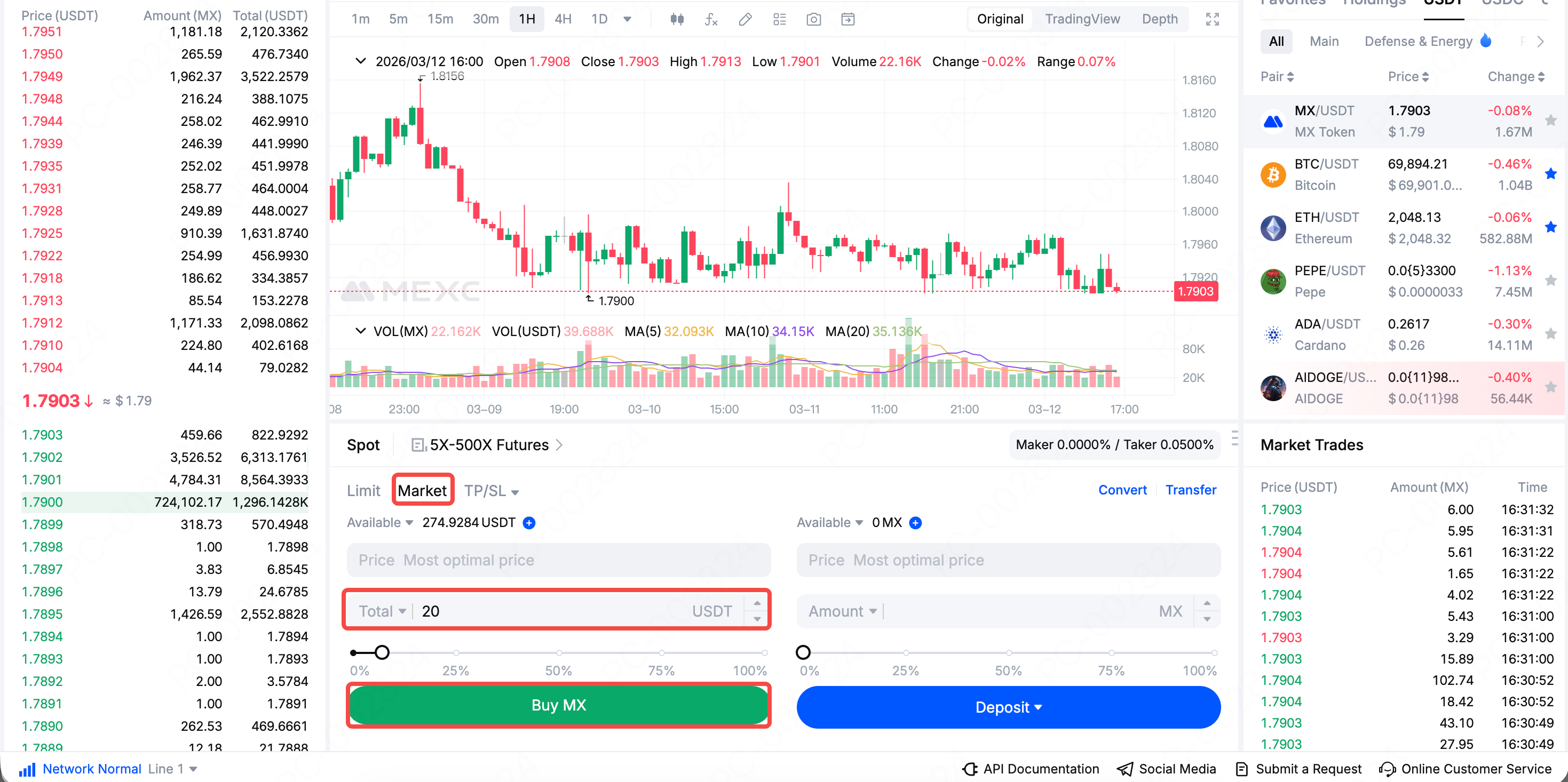
The following uses the MX/USDT trading pair as an example to show the specific steps for placing a market order.

2.1 Web


Open and log in to the MEXC official websiteSpot → select the MX/USDT trading pair → Market → enter Total or AmountBuy MX

After the purchase is completed, you can view the purchased token under Open Positions.

2.2 App


Open and log in to the MEXC App → Trade → select the MX/USDT trading pair → Market order → enter Total or AmountBuy MX

After the trade is completed, you can view the corresponding token under Positions.

3. Market order FAQ


3.1 Will a market order always be filled?


Under normal market conditions, market orders are usually filled immediately. However, during extreme market conditions, such as sharp volatility or very low liquidity, the order may not be fully filled, or the execution price may differ from your expectation. If the total value of a single market order is too large, the unfilled portion may also be canceled.

3.2 Which is executed first, a market order or a limit order?


Market orders are usually executed before limit orders. This is because market orders are designed to be filled immediately at the current market price, while limit orders can only be executed after the market reaches the specified price. To ensure faster execution, trading platforms generally prioritize market orders.

3.3 What is the fee for market orders?


On the MEXC platform, market orders are treated as taker orders, and the fee rate is 0.05%. You can check the latest Spot trading fee rates on the MEXC Fee Overview.


3.4 What is slippage? How can I avoid it?


Slippage refers to the difference between the displayed price at the time you place the order and the actual execution price. When the market is highly volatile or liquidity is low, market orders may not be executed at the displayed price. To reduce slippage risk, you can choose to trade in highly liquid markets such as major trading pairs, avoid placing orders during major news events, or consider using limit orders to control the execution price more precisely.

3.5 Are market orders suitable for beginners?


Market orders are simple to use and can be placed quickly, making them suitable for beginners who want to enter or exit the market fast. However, since the execution price cannot be controlled and slippage may occur, beginners are advised to fully understand how market orders work before trading and start with small amounts. At the same time, beginners can also learn to use other order types, such as limit orders and choose the most suitable trading method based on different market conditions.

3.6 Are market orders suitable for large trades?


For large orders, market orders may consume the available liquidity in the order book, resulting in an unfavorable average fill price. Large traders are advised to consider splitting orders into batches or using limit orders to better control the execution price and reduce trading costs.

3.7 The difference between market orders and limit orders


Market orders and limit orders are the two most basic order types in Spot trading, and they differ fundamentally in execution logic and use cases.

In terms of execution timing, a market order is executed immediately at the current market price, while a limit order is executed only when the market reaches the specified price. In terms of price control, a market order does not allow you to set the fill price and relies entirely on market conditions, while a limit order allows you to specify your expected fill price precisely.

In terms of execution speed, market orders are usually filled almost instantly, while the execution time of limit orders depends on whether the market reaches the specified price. In terms of slippage risk, market orders may experience slippage, especially during highly volatile conditions, while limit orders have capped slippage risk and can ensure execution at the specified price or a better price.

Market orders are suitable for scenarios such as quick entry, trend-following, and urgent position closing. Limit orders are more suitable for contrarian trading and support-resistance strategies.

How to Use Market Orders in Spot Trading

1. What is a market order?


A market order is an order type that allows users to buy or sell immediately at the best available market price. Its main purpose is to complete the trade as quickly as possible. Unlike limit orders, which require a specific price to be set, market orders focus on execution speed rather than price control.

Please note that if the total value of a single market order is too large, any unfilled portion may be canceled. This is because the order may consume the available liquidity in the order book.


2. How to place a market order on MEXC


The following uses the MX/USDT trading pair as an example to show the specific steps for placing a market order.

2.1 Web


Open and log in to the MEXC official websiteSpot → select the MX/USDT trading pair → Market → enter Total or AmountBuy MX

After the purchase is completed, you can view the purchased token under Open Positions.


2.2 App


Open and log in to the MEXC App → Trade → select the MX/USDT trading pair → Market order → enter Total or AmountBuy MX

After the trade is completed, you can view the corresponding token under Positions.

3. Market order FAQ


3.1 Will a market order always be filled?


Under normal market conditions, market orders are usually filled immediately. However, during extreme market conditions, such as sharp volatility or very low liquidity, the order may not be fully filled, or the execution price may differ from your expectation. If the total value of a single market order is too large, the unfilled portion may also be canceled.

3.2 Which is executed first, a market order or a limit order?


Market orders are usually executed before limit orders. This is because market orders are designed to be filled immediately at the current market price, while limit orders can only be executed after the market reaches the specified price. To ensure faster execution, trading platforms generally prioritize market orders.

3.3 What is the fee for market orders?


On the MEXC platform, market orders are treated as taker orders, and the fee rate is 0.05%. You can check the latest Spot trading fee rates on the MEXC Fee Overview.


3.4 What is slippage? How can I avoid it?


Slippage refers to the difference between the displayed price at the time you place the order and the actual execution price. When the market is highly volatile or liquidity is low, market orders may not be executed at the displayed price. To reduce slippage risk, you can choose to trade in highly liquid markets such as major trading pairs, avoid placing orders during major news events, or consider using limit orders to control the execution price more precisely.

3.5 Are market orders suitable for beginners?


Market orders are simple to use and can be placed quickly, making them suitable for beginners who want to enter or exit the market fast. However, since the execution price cannot be controlled and slippage may occur, beginners are advised to fully understand how market orders work before trading and start with small amounts. At the same time, beginners can also learn to use other order types, such as limit orders and choose the most suitable trading method based on different market conditions.

3.6 Are market orders suitable for large trades?


For large orders, market orders may consume the available liquidity in the order book, resulting in an unfavorable average fill price. Large traders are advised to consider splitting orders into batches or using limit orders to better control the execution price and reduce trading costs.

3.7 The difference between market orders and limit orders


Market orders and limit orders are the two most basic order types in Spot trading, and they differ fundamentally in execution logic and use cases.

In terms of execution timing, a market order is executed immediately at the current market price, while a limit order is executed only when the market reaches the specified price. In terms of price control, a market order does not allow you to set the fill price and relies entirely on market conditions, while a limit order allows you to specify your expected fill price precisely.

In terms of execution speed, market orders are usually filled almost instantly, while the execution time of limit orders depends on whether the market reaches the specified price. In terms of slippage risk, market orders may experience slippage, especially during highly volatile conditions, while limit orders have capped slippage risk and can ensure execution at the specified price or a better price.

Market orders are suitable for scenarios such as quick entry, trend-following, and urgent position closing. Limit orders are more suitable for contrarian trading and support-resistance strategies.