CRV price trades near $0.24 as LlamaLend exploit concerns weigh on short-term sentiment. Curve DAO (CRV) token is trading at $0.24 at press time, down 3.5% overCRV price trades near $0.24 as LlamaLend exploit concerns weigh on short-term sentiment. Curve DAO (CRV) token is trading at $0.24 at press time, down 3.5% over

CRV price slides towards range lows as LlamaLend pool exploit weighs on sentiment

2026/03/02 23:11
Okuma süresi: 3 dk
Bu içerikle ilgili geri bildirim veya endişeleriniz için lütfen [email protected] üzerinden bizimle iletişime geçin.

CRV price trades near $0.24 as LlamaLend exploit concerns weigh on short-term sentiment.

Summary
  • CRV price is holding above $0.22 support but struggling below $0.25 resistance.
  • A $240K LlamaLend pool exploit has added fresh uncertainty around Curve’s ecosystem.
  • A daily close below $0.22 could expose the psychological $0.20 level.

Curve DAO (CRV) token is trading at $0.24 at press time, down 3.5% over the past 24 hours. The pullback comes during a recovery attempt, with price still near the upper half of its seven-day range between $0.21 and $0.26.

CRV is up about 5% on the week but remains down 20% over the past month.

Derivatives activity has softened. Volume is down 12% to $127 million, while open interest has slipped 1.73% to $67.8 million, according to CoinGlass data.

As uncertainty persists, the drop in open interest shows that some leveraged positions are being closed rather than opened, indicating caution among traders.

LlamaLend pool exploit adds pressure

Curve Finance’s March 2 statement confirming that it is looking into an attack on the sDOLA LlamaLend markets has dampened sentiment. The issue stemmed from how the pool’s price oracle was configured, which introduced the risk of manipulation.

Blockchain security firm BlockSec had clarified that the vulnerability affected only the sDOLA–crvUSD LlamaLend pool and not Inverse Finance itself. The exploit resulted in an estimated $240,000 profit for the attacker.

Borrowers who used sDOLA as collateral were liquidated, while lenders were unaffected. sDOLA holders even saw gains due to the price distortion.

The attack relied on a flash loan. Funds were borrowed, sDOLA was redeemed and re-staked as a donation, and the pool’s pricing mechanism was temporarily distorted.

That shift pushed several positions below liquidation thresholds, allowing the attacker to liquidate them at a profit.

Curve emphasized that the core protocol contracts were not compromised. Even so, the incident has revived concerns about oracle design and integration risks within DeFi lending markets.

CRV price technical analysis

CRV continues to trade in a bearish structure. The daily chart shows a sequence of lower highs and lower lows. Price sits below the descending 50-day moving average, reinforcing the short- to mid-term downward bias.
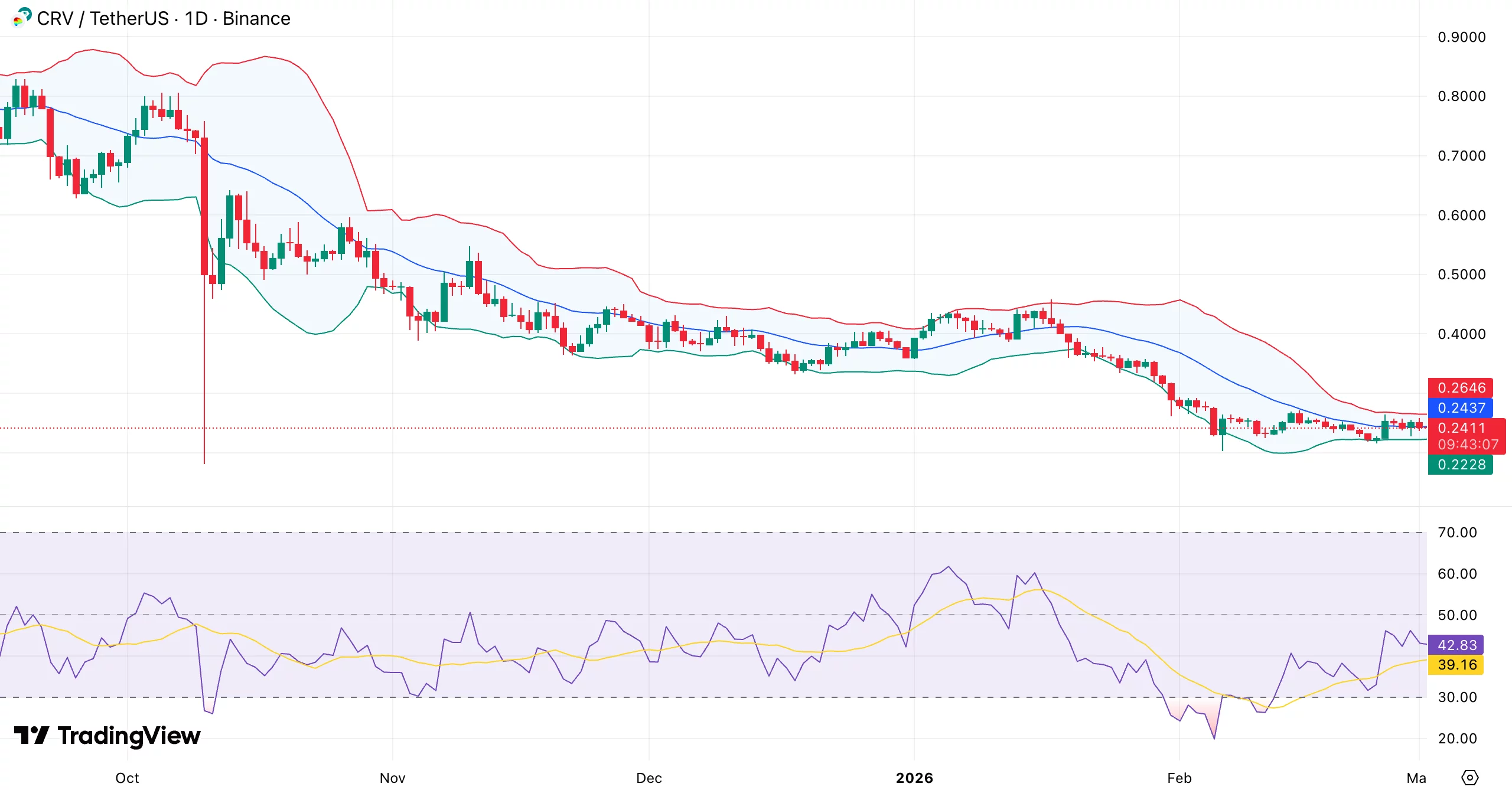
CRV price slides towards range lows as LlamaLend pool exploit weighs on sentiment - 1

Attempts to reclaim the 0.25–0.26 zone have failed so far, leaving overhead supply in place. Bollinger Bands expanded to the downside after a period of contraction, confirming that the latest volatility break favored sellers.

Price is now hugging the lower band, a sign that sell pressure has not fully eased. A close back above the mid-band would be the first sign of stabilization, but that has yet to occur.

The momentum is still skewed toward bears because the relative strength index is less than 50. It recently recovered from around the 30 level, but there hasn’t been any major bullish divergence. 

Immediate support sits near 0.22, which marks the lower boundary of the current range and a liquidity cluster. A daily close below that level could open the path toward the psychological 0.20 mark.

On the upside, 0.25 acts as near-term resistance. A sustained move above 0.30 would be required to break the pattern of lower highs and shift the broader structure.

Sorumluluk Reddi: Bu sitede yeniden yayınlanan makaleler, halka açık platformlardan alınmıştır ve yalnızca bilgilendirme amaçlıdır. MEXC'nin görüşlerini yansıtmayabilir. Tüm hakları telif sahiplerine aittir. Herhangi bir içeriğin üçüncü taraf haklarını ihlal ettiğini düşünüyorsanız, kaldırılması için lütfen [email protected] ile iletişime geçin. MEXC, içeriğin doğruluğu, eksiksizliği veya güncelliği konusunda hiçbir garanti vermez ve sağlanan bilgilere dayalı olarak alınan herhangi bir eylemden sorumlu değildir. İçerik, finansal, yasal veya diğer profesyonel tavsiye niteliğinde değildir ve MEXC tarafından bir tavsiye veya onay olarak değerlendirilmemelidir.

Ayrıca Şunları da Beğenebilirsiniz

XRPL Sidechain Proposal Targets Options Trading and Leverage

XRPL Sidechain Proposal Targets Options Trading and Leverage

The post XRPL Sidechain Proposal Targets Options Trading and Leverage appeared on BitcoinEthereumNews.com. James is dedicated to demystifying intricate technological
Paylaş
BitcoinEthereumNews2026/03/03 00:31
Google's AP2 protocol has been released. Does encrypted AI still have a chance?

Google's AP2 protocol has been released. Does encrypted AI still have a chance?

Following the MCP and A2A protocols, the AI Agent market has seen another blockbuster arrival: the Agent Payments Protocol (AP2), developed by Google. This will clearly further enhance AI Agents' autonomous multi-tasking capabilities, but the unfortunate reality is that it has little to do with web3AI. Let's take a closer look: What problem does AP2 solve? Simply put, the MCP protocol is like a universal hook, enabling AI agents to connect to various external tools and data sources; A2A is a team collaboration communication protocol that allows multiple AI agents to cooperate with each other to complete complex tasks; AP2 completes the last piece of the puzzle - payment capability. In other words, MCP opens up connectivity, A2A promotes collaboration efficiency, and AP2 achieves value exchange. The arrival of AP2 truly injects "soul" into the autonomous collaboration and task execution of Multi-Agents. Imagine AI Agents connecting Qunar, Meituan, and Didi to complete the booking of flights, hotels, and car rentals, but then getting stuck at the point of "self-payment." What's the point of all that multitasking? So, remember this: AP2 is an extension of MCP+A2A, solving the last mile problem of AI Agent automated execution. What are the technical highlights of AP2? The core innovation of AP2 is the Mandates mechanism, which is divided into real-time authorization mode and delegated authorization mode. Real-time authorization is easy to understand. The AI Agent finds the product and shows it to you. The operation can only be performed after the user signs. Delegated authorization requires the user to set rules in advance, such as only buying the iPhone 17 when the price drops to 5,000. The AI Agent monitors the trigger conditions and executes automatically. The implementation logic is cryptographically signed using Verifiable Credentials (VCs). Users can set complex commission conditions, including price ranges, time limits, and payment method priorities, forming a tamper-proof digital contract. Once signed, the AI Agent executes according to the conditions, with VCs ensuring auditability and security at every step. Of particular note is the "A2A x402" extension, a technical component developed by Google specifically for crypto payments, developed in collaboration with Coinbase and the Ethereum Foundation. This extension enables AI Agents to seamlessly process stablecoins, ETH, and other blockchain assets, supporting native payment scenarios within the Web3 ecosystem. What kind of imagination space can AP2 bring? After analyzing the technical principles, do you think that's it? Yes, in fact, the AP2 is boring when it is disassembled alone. Its real charm lies in connecting and opening up the "MCP+A2A+AP2" technology stack, completely opening up the complete link of AI Agent's autonomous analysis+execution+payment. From now on, AI Agents can open up many application scenarios. For example, AI Agents for stock investment and financial management can help us monitor the market 24/7 and conduct independent transactions. Enterprise procurement AI Agents can automatically replenish and renew without human intervention. AP2's complementary payment capabilities will further expand the penetration of the Agent-to-Agent economy into more scenarios. Google obviously understands that after the technical framework is established, the ecological implementation must be relied upon, so it has brought in more than 60 partners to develop it, almost covering the entire payment and business ecosystem. Interestingly, it also involves major Crypto players such as Ethereum, Coinbase, MetaMask, and Sui. Combined with the current trend of currency and stock integration, the imagination space has been doubled. Is web3 AI really dead? Not entirely. Google's AP2 looks complete, but it only achieves technical compatibility with Crypto payments. It can only be regarded as an extension of the traditional authorization framework and belongs to the category of automated execution. There is a "paradigm" difference between it and the autonomous asset management pursued by pure Crypto native solutions. The Crypto-native solutions under exploration are taking the "decentralized custody + on-chain verification" route, including AI Agent autonomous asset management, AI Agent autonomous transactions (DeFAI), AI Agent digital identity and on-chain reputation system (ERC-8004...), AI Agent on-chain governance DAO framework, AI Agent NPC and digital avatars, and many other interesting and fun directions. Ultimately, once users get used to AI Agent payments in traditional fields, their acceptance of AI Agents autonomously owning digital assets will also increase. And for those scenarios that AP2 cannot reach, such as anonymous transactions, censorship-resistant payments, and decentralized asset management, there will always be a time for crypto-native solutions to show their strength? The two are more likely to be complementary rather than competitive, but to be honest, the key technological advancements behind AI Agents currently all come from web2AI, and web3AI still needs to keep up the good work!
Paylaş
PANews2025/09/18 07:00
UK Looks to US to Adopt More Crypto-Friendly Approach

UK Looks to US to Adopt More Crypto-Friendly Approach

The post UK Looks to US to Adopt More Crypto-Friendly Approach appeared on BitcoinEthereumNews.com. The UK and US are reportedly preparing to deepen cooperation on digital assets, with Britain looking to copy the Trump administration’s crypto-friendly stance in a bid to boost innovation.  UK Chancellor Rachel Reeves and US Treasury Secretary Scott Bessent discussed on Tuesday how the two nations could strengthen their coordination on crypto, the Financial Times reported on Tuesday, citing people familiar with the matter.  The discussions also involved representatives from crypto companies, including Coinbase, Circle Internet Group and Ripple, with executives from the Bank of America, Barclays and Citi also attending, according to the report. The agreement was made “last-minute” after crypto advocacy groups urged the UK government on Thursday to adopt a more open stance toward the industry, claiming its cautious approach to the sector has left the country lagging in innovation and policy.  Source: Rachel Reeves Deal to include stablecoins, look to unlock adoption Any deal between the countries is likely to include stablecoins, the Financial Times reported, an area of crypto that US President Donald Trump made a policy priority and in which his family has significant business interests. The Financial Times reported on Monday that UK crypto advocacy groups also slammed the Bank of England’s proposal to limit individual stablecoin holdings to between 10,000 British pounds ($13,650) and 20,000 pounds ($27,300), claiming it would be difficult and expensive to implement. UK banks appear to have slowed adoption too, with around 40% of 2,000 recently surveyed crypto investors saying that their banks had either blocked or delayed a payment to a crypto provider.  Many of these actions have been linked to concerns over volatility, fraud and scams. The UK has made some progress on crypto regulation recently, proposing a framework in May that would see crypto exchanges, dealers, and agents treated similarly to traditional finance firms, with…
Paylaş
BitcoinEthereumNews2025/09/18 02:21