Ethereum has reclaimed the $2,300 level as renewed buying activity begins to push the market higher after months of persistent downward pressure. The move marksEthereum has reclaimed the $2,300 level as renewed buying activity begins to push the market higher after months of persistent downward pressure. The move marks

Ethereum Leverage Climbs After Historic Liquidation Event – New Cycle Starting?

2026/03/17 13:00
Okuma süresi: 4 dk
Bu içerikle ilgili geri bildirim veya endişeleriniz için lütfen [email protected] üzerinden bizimle iletişime geçin.

Ethereum has reclaimed the $2,300 level as renewed buying activity begins to push the market higher after months of persistent downward pressure. The move marks a notable shift in short-term sentiment, with traders increasingly pointing to growing bullish momentum across the broader cryptocurrency sector.

Over the past seven days, Bitcoin has climbed approximately 8.6%, reinforcing the perception that the market may be transitioning out of the corrective phase that dominated recent months.

Ethereum, which often behaves as a higher-beta asset within the crypto ecosystem, has responded even more aggressively to the improving sentiment. Over the same period, ETH has surged roughly 13.9%, outperforming Bitcoin and signaling stronger speculative demand from traders.

Analysts note that the move higher is also being supported by strong inflows into crypto-related exchange-traded funds, reflecting continued institutional appetite for digital assets. As liquidity begins to return and risk tolerance improves, Ethereum’s ability to reclaim the $2,300 level is now being closely monitored as a potential pivot point that could determine whether the recovery can extend further in the coming weeks.

Ethereum Leverage Recovers After Historic Liquidation Reset

A recent analysis from CryptoQuant highlights how the Ethereum derivatives market has undergone a significant structural reset following the dramatic liquidation event that occurred on October 10. According to the report, the flash crash triggered one of the largest deleveraging events in the history of the cryptocurrency market.

During that event, the Ethereum Estimated Leverage Ratio (ELR) on Binance dropped sharply from 0.56 to 0.41, representing a 27% contraction in market leverage. The “10/10” event is now widely recognized as the largest 24-hour liquidation cascade in crypto history, with more than $19 billion in leveraged positions forcibly liquidated across the market.

Ethereum Estimated Leverage Ratio Binance | Source: CryptoQuant

Since that reset, leverage levels have gradually rebuilt as confidence returned. The report notes that Ethereum’s ELR has climbed to approximately 0.69 in mid-March, signaling that traders are once again increasing their use of leverage as sentiment improves.

The Estimated Leverage Ratio is calculated by dividing open interest by the amount of ETH reserves held on exchanges. In practical terms, it measures how aggressively traders are using leverage relative to the collateral available in the system.

Higher ELR readings typically indicate growing risk appetite and increased speculative positioning, which can amplify both upward price momentum and market volatility.

As sentiment improves, Ethereum and Bitcoin continue to act as high-beta risk-on assets, while more defensive investors may rotate toward tokenized gold instruments such as PAXG and XAUT.

Ethereum Attempts Trend Reversal After February Capitulation

The Ethereum chart shows the asset attempting to build bullish momentum after a prolonged corrective phase that dominated the market since late 2025. On the daily timeframe, ETH is currently trading around $2,310, following a strong rebound from the sharp selloff that occurred in early February.
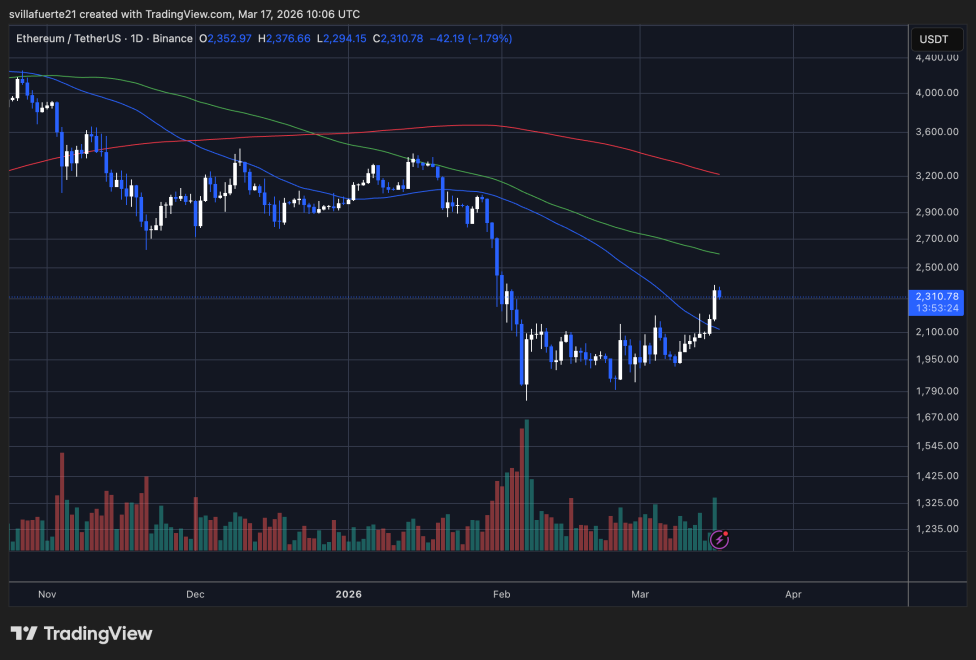
ETH testing critical resistance | Source: ETHUSDT chart on TradingView

That decline pushed Ethereum toward the $1,800 region, where a clear spike in volume indicates a capitulation event and aggressive buyer absorption. Since that low formed, price action has gradually stabilized, with Ethereum constructing a higher base between $1,900 and $2,100 before initiating the current upward move.

Technically, ETH has now reclaimed the short-term moving average, which had acted as dynamic resistance throughout the downtrend. This development suggests that short-term momentum is shifting back in favor of buyers. However, the broader market structure remains cautious, as price still trades below the longer-term 100- and 200-day moving averages, which continue to slope downward.

The $2,300–$2,400 zone now represents a critical resistance region. This level previously acted as support before the February breakdown and is likely to attract significant sell-side liquidity.

If Ethereum manages to consolidate above $2,300, it could open the door for a continuation toward $2,600 and $2,900, where the next major technical barriers and moving averages converge.

Featured image from ChatGPT, chart from TradingView.com 

Sorumluluk Reddi: Bu sitede yeniden yayınlanan makaleler, halka açık platformlardan alınmıştır ve yalnızca bilgilendirme amaçlıdır. MEXC'nin görüşlerini yansıtmayabilir. Tüm hakları telif sahiplerine aittir. Herhangi bir içeriğin üçüncü taraf haklarını ihlal ettiğini düşünüyorsanız, kaldırılması için lütfen [email protected] ile iletişime geçin. MEXC, içeriğin doğruluğu, eksiksizliği veya güncelliği konusunda hiçbir garanti vermez ve sağlanan bilgilere dayalı olarak alınan herhangi bir eylemden sorumlu değildir. İçerik, finansal, yasal veya diğer profesyonel tavsiye niteliğinde değildir ve MEXC tarafından bir tavsiye veya onay olarak değerlendirilmemelidir.

Ayrıca Şunları da Beğenebilirsiniz

Steel Dynamics (STLD) Stock Dips Following Disappointing Q1 Earnings Forecast

Steel Dynamics (STLD) Stock Dips Following Disappointing Q1 Earnings Forecast

Steel Dynamics (STLD) stock dropped 1.3% premarket after issuing Q1 EPS guidance of $2.73–$2.77, significantly below the $3.24 Wall Street consensus. The post Steel
Paylaş
Blockonomi2026/03/17 21:45
EUR/CHF slides as Euro struggles post-inflation data

EUR/CHF slides as Euro struggles post-inflation data

The post EUR/CHF slides as Euro struggles post-inflation data appeared on BitcoinEthereumNews.com. EUR/CHF weakens for a second straight session as the euro struggles to recover post-Eurozone inflation data. Eurozone core inflation steady at 2.3%, headline CPI eases to 2.0% in August. SNB maintains a flexible policy outlook ahead of its September 25 decision, with no immediate need for easing. The Euro (EUR) trades under pressure against the Swiss Franc (CHF) on Wednesday, with EUR/CHF extending losses for the second straight session as the common currency struggles to gain traction following Eurozone inflation data. At the time of writing, the cross is trading around 0.9320 during the American session. The latest inflation data from Eurostat showed that Eurozone price growth remained broadly stable in August, reinforcing the European Central Bank’s (ECB) cautious stance on monetary policy. The Core Harmonized Index of Consumer Prices (HICP), which excludes volatile items such as food and energy, rose 2.3% YoY, in line with both forecasts and the previous month’s reading. On a monthly basis, core inflation increased by 0.3%, unchanged from July, highlighting persistent underlying price pressures in the bloc. Meanwhile, headline inflation eased to 2.0% YoY in August, down from 2.1% in July and slightly below expectations. On a monthly basis, prices rose just 0.1%, missing forecasts for a 0.2% increase and decelerating from July’s 0.2% rise. The inflation release follows last week’s ECB policy decision, where the central bank kept all three key interest rates unchanged and signaled that policy is likely at its terminal level. While officials acknowledged progress in bringing inflation down, they reiterated a cautious, data-dependent approach going forward, emphasizing the need to maintain restrictive conditions for an extended period to ensure price stability. On the Swiss side, disinflation appears to be deepening. The Producer and Import Price Index dropped 0.6% in August, marking a sharp 1.8% annual decline. Broader inflation remains…
Paylaş
BitcoinEthereumNews2025/09/18 03:08
New York Regulators Push Banks to Adopt Blockchain Analytics

New York Regulators Push Banks to Adopt Blockchain Analytics

New York’s top financial regulator urged banks to adopt blockchain analytics, signaling tighter oversight of crypto-linked risks. The move reflects regulators’ concern that traditional institutions face rising exposure to digital assets. While crypto-native firms already rely on monitoring tools, the Department of Financial Services now expects banks to use them to detect illicit activity. NYDFS Outlines Compliance Expectations The notice, issued on Wednesday by Superintendent Adrienne Harris, applies to all state-chartered banks and foreign branches. In its industry letter, the New York State Department of Financial Services (NYDFS) emphasized that blockchain analytics should be integrated into compliance programs according to each bank’s size, operations, and risk appetite. The regulator cautioned that crypto markets evolve quickly, requiring institutions to update frameworks regularly. “Emerging technologies introduce evolving threats that require enhanced monitoring tools,” the notice stated. It stressed the need for banks to prevent money laundering, sanctions violations, and other illicit finance linked to virtual currency transactions. To that end, the Department listed specific areas where blockchain analytics can be applied: Screening customer wallets with crypto exposure to assess risks. Verifying the origin of funds from virtual asset service providers (VASPs). Monitoring the ecosystem holistically to detect money laundering or sanctions exposure. Identifying and assessing counterparties, such as third-party VASPs. Evaluating expected versus actual transaction activity, including dollar thresholds. Weighing risks tied to new digital asset products before rollout. These examples highlight how institutions can tailor monitoring tools to strengthen their risk management frameworks. The guidance expands on NYDFS’s Virtual Currency-Related Activities (VCRA) framework, which has governed crypto oversight in the state since 2022. Regulators Signal Broader Impact Market observers say the notice is less about new rules and more about clarifying expectations. By formalizing the role of blockchain analytics in traditional finance, New York is reinforcing the idea that banks cannot treat crypto exposure as a niche concern. Analysts also believe the approach could ripple beyond New York. Federal agencies and regulators in other states may view the guidance as a blueprint for aligning banking oversight with the realities of digital asset adoption. For institutions, failure to adopt blockchain intelligence tools may invite regulatory scrutiny and undermine their ability to safeguard customer trust. With crypto now firmly embedded in global finance, New York’s stance suggests that blockchain analytics are no longer optional for banks — they are essential to protecting the financial system’s integrity.
Paylaş
Coinstats2025/09/18 08:49