
MEXC Digest #40: Room to Be Wrong


One wallet spent $320,000 on Tuesday morning. Fourteen minutes later, $36 million of other people's positions had closed out on Morpho. For every dollar that wallet moved, roughly $114 of someone else's trade disappeared.


The asset underneath, Pendle's PT-reUSD, fell 2.8%. The traders who got liquidated weren't wrong about it: it's trading fine today. What ended them was 2.95%, the room they had left themselves to be wrong.


If you run leverage anywhere, that number has a version on your own book.


The Main Character: Nine Turns, Three Percent of Room


The Story : Third time in ten months. Stream in November, Aave in March, Pendle on Tuesday. Each time the protocols handled it better than the time before. Each time, the liquidation bill still ran to eight figures.


Tuesday's version: PT-reUSD fell 2.8%, and thirty-three liquidations closed $36.14 million of debt on Morpho between 04:37 and 04:51 UTC. Lenders were paid in full. No bad debt. reUSD, the asset underneath all of it, is still fine today.

Here's the trade. Pendle takes a yield-bearing asset and cuts it in two: a principal token (PT), redeemable for a dollar at a fixed date, and a yield token (YT), which collects the interest until then. Traders deposited PT-reUSD on Morpho, borrowed USDC against it, bought more PT-reUSD, repeated. Nine turns. Each one raised the yield.


And notice what they chose to do it on. A PT token has a fixed redemption value and a fixed maturity. It is engineered to sit still. Which is exactly why nine turns of leverage felt like the careful trade.
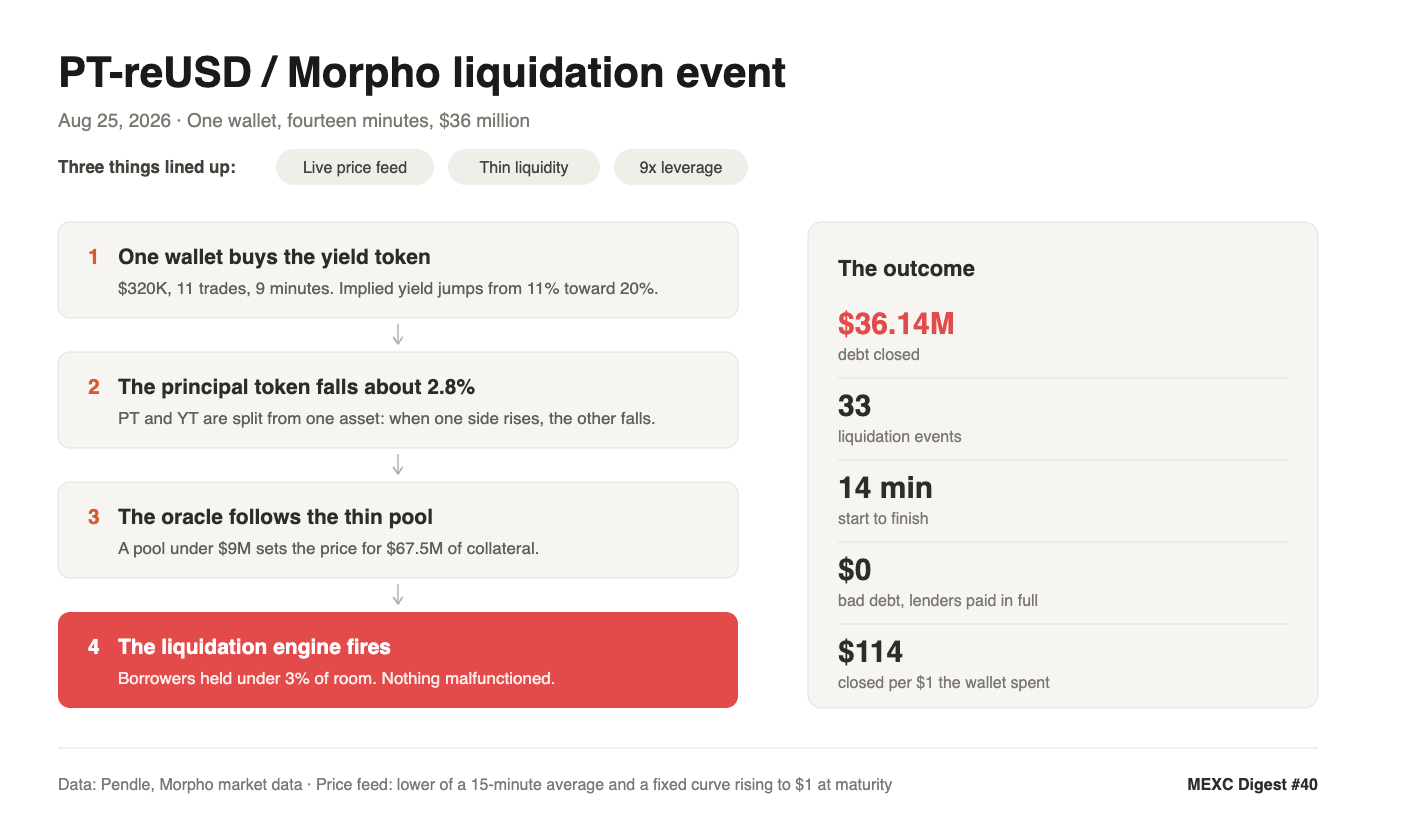


The Trigger : $320,000. Eleven trades. Under nine minutes.

The wallet bought YT-reUSD, pushing implied yields from around 11% toward 20%. PT and YT come from the same asset, so when one side rises the other has to fall. PT-reUSD dropped.

Morpho priced that collateral off an oracle taking the lower of two inputs, one of them a 15-minute average. The Pendle pool held under $9 million of liquidity. Eleven trades in nine minutes is enough to move a 15-minute average in a pool that thin. The liquidation engine did the rest.

What the wallet made, if anything, and whether it was deliberate, is still being investigated. For this story it doesn't matter. The positions were built to be ended by any 3% move; this one just had an author.

Now compare the other two. Last November, Stream Finance's vaults priced xUSD collateral at a hardcoded $1. When the real price fell, the liquidation machinery never fired: roughly $93 million in losses, about $285 million of debt exposure across protocols. In March, Aave's risk oracle glitched the other way, undervaluing wstETH by 2.85% and liquidating $27 million of positions that were actually healthy. The DAO reimbursed every affected user.

Stream's oracle was blind. Tuesday's saw every trade. Read that again, because it's the whole story: the fix for the first problem is what made the second one possible. And the refunds tell you the rest: Aave's users were repaid because the system broke. Tuesday's traders get nothing, because it didn't.


The Stakes :

The arithmetic is the argument. That market liquidates positions once debt reaches 91.5% of collateral value, per its Morpho parameters. Pendle's own post-mortem says the positions that got hit had less than 3% of price room left (a health factor below 1.03). At that boundary, a looped position is carrying roughly 8.9x exposure per dollar of equity, and the exact move that ends it is 2.95%. Nine turns of leverage, three percent of room, on an asset built not to move. Every extra loop bought a little more yield and handed back a little more control, until the position stopped being a view on reUSD and became a bet that nothing would happen until December.


You've probably run this trade without calling it looping. Looping means your collateral and your exposure are the same asset. It falls, you lose on the position and your margin shrinks at the same time. Two hits, one move. Ever held a long coin-margined futures position? Your margin is the asset. Your position is the asset. Cross-margin across correlated alts does a gentler version of the same thing. And the price that ends you isn't the last trade: on a perp you're liquidated off mark price, calculated from an index across venues. Same architecture as an oracle. Centralised venues settled this argument years ago, after early crypto futures liquidated off last price and cascaded. DeFi is having it now.


Leverage isn't the variable. Buffer is. Across three incidents the protocols improved every single time. Oracles got sharper, liquidation engines got faster, bad debt went to zero. The one thing that hasn't improved is how much room users leave themselves. Same asset, same 2.8% move, at 3x with 30% of buffer: nothing happens at all. Which is the good news, because buffer is the part you set.


So three things worth calculating this week.


How far can price move before you're out? Not roughly. The number. If you don't know it to one decimal, you don't know your position.


What sets that price? Look up how mark price is calculated on the venue you're using, and how deep the markets feeding it are. On BTC and ETH, deep. On a small-cap perp at 25x, sometimes thinner than the position sitting on top of it. Tuesday's entire story fits inside this question: a pool holding under $9 million was pricing $67.5 million of collateral. With deep liquidity, eleven trades move nothing.


What happens at 3%, 5% and 10% down? Move your current book against you at those three levels. If 3% ends you, you don't have a trade. You have a countdown.These traders ran the order backwards: picked a yield target, let it eat the room. Decide what move you need to survive, then let that number set your size.


Timing matters here. Crypto just ran 23% in a week, and unusually, leverage didn't drive it: open interest fell to a five-month low as shorts covered and spot demand did the lifting. Which means whatever leverage goes on now goes on late, at prices a fifth higher than a fortnight ago. If that's you, this math is worth running before the position, not after: not when the market moves against you, but while it's moving your way.Those traders weren't wrong about reUSD. They were wrong about how much room they had left. And 2.8% isn't a crash.It's a Tuesday.


Quick Hits


Nvidia deflated the bubble fear. For now. The setup did the work: the Philadelphia Semiconductor Index (SOX) had fallen roughly 20% from its June peak, according to Reuters, and this earnings report was the test. For four straight quarters, Nvidia beat expectations and still fell the next day. On the fifth: revenue of $96.2B against $92.3B expected, up 106% year on year; guidance of $108B for the next quarter, ahead of consensus; and shares up 8.7%, adding roughly $442B in market value in a day. The difference wasn't just the beat. It was the outlook: the AI spending cycle still has room to run. Beating expectations gets sold; beating fear gets bought.


The trade nobody was in. While chips rolled over, healthcare broke out: since semiconductors peaked on June 22, biotech ETF IBB is up more than 20% and has cleared a ceiling near $178 that capped it for five years, with XLV notching its biggest single-day gain in over a year along the way. The flows are the tell: healthcare ETFs bled more than $20 billion from 2023 through 2025 and have taken back only about $4.5 billion this year. The price has moved. The money mostly hasn't.


The 23% rally that leverage sat out. BTC

ran from around $62,000 to near $80,000 in a week and is still holding the level, yet futures open interest fell to a five-month low during the move: short covering and spot demand did the lifting, not fresh longs. The detail that belongs in this issue: crypto-margined open interest, where the margin is the coin itself, hit a record low during the run, with cash collateral dominating. The market has spent months unwinding exactly the structure that blew up on Morpho: collateral and exposure being the same asset


New & Noteworthy


Shein lists the way it sells: at a discount. The Hong Kong listing finally lands Sept 1: 280 million shares at HK$47.6 to HK$49.5, with final pricing set at HK$48.56. The valuation comes in near $26.5 billion, about 70% below the $98.2 billion peak of 2022, after revenue growth all but stalled and Q1 swung to a $99 million loss once the US scrapped its duty exemption on small packages. Four years of waiting, three-quarters of the valuation gone. Trade it on MEXC Pre-IPO before the opening bell decides who was right.


DGrid AI, judged on revenue rather than narrative. Genesis, DGAI's premium program, has pulled in $20 million in six months from 13,000+ paying users (about $1,580 each), with 500,000 monthly actives behind them. The supply side is the catch: 8% of the token supply is allocated to the airdrop, reportedly fully unlocked at TGE. Real revenue, but also real supply to absorb. Both are unusual enough in AI tokens to be worth noting.


[Get Early Access]{https://www.mexc.com/announcements/new-listings}


Stay Updated

Follow us on Telegram to be notified whenever a new digest drops.


[Follow MEXC on Telegram]{https://t.me/MEXC_OfficialAnnouncements}


Translation


"Now, compute is revenue."

Jensen Huang, Nvidia earnings release, this week.


Four words carrying a five-trillion-dollar market cap.


For two years the bear case has been that AI infrastructure is a cost, a giant capex bill waiting for a return. Huang's reframe says the machines already pay for themselves: the tokens they produce get sold, so buying compute is buying revenue. Note who's talking, though. For Nvidia, compute has always been revenue; it's the thing they sell. For the buyers, compute is a bet on revenue until the invoices prove it. The gap between those two readings is where the whole AI debate now lives.


Before You Go


MEXC Win: Infinity Arena is live. The Futures team tournament runs through Sep 15, with a prize pool that starts at 1,000,000 USDT and grows to 10,000,000 USDT once participation passes 300,000. Team PNL and solo leaderboards, and a daily lucky spin.


[Join Now]{https://www.mexc.com/announcements/article/mexc-win-17827791537714}


Not financial advice. We describe, you decide.


Coin Icon
现在注册即可获得 10,000 USDT 新人奖励

订阅 MEXC 精选

市场动态、新币上线、行业洞察,每周为您精选送达
订阅即表示您同意接收 MEXC 周报和邮件通讯,并同意我们的《隐私政策》。内容仅供参考,不构成任何投资建议。

加入 MEXC 公告电报群

最新上币、热门活动、重大更新——全部在官方 Telegram 实时推送。

MEXC Digest #40: Room to Be Wrong


One wallet spent $320,000 on Tuesday morning. Fourteen minutes later, $36 million of other people's positions had closed out on Morpho. For every dollar that wallet moved, roughly $114 of someone else's trade disappeared.


The asset underneath, Pendle's PT-reUSD, fell 2.8%. The traders who got liquidated weren't wrong about it: it's trading fine today. What ended them was 2.95%, the room they had left themselves to be wrong.


If you run leverage anywhere, that number has a version on your own book.


The Main Character: Nine Turns, Three Percent of Room


The Story : Third time in ten months. Stream in November, Aave in March, Pendle on Tuesday. Each time the protocols handled it better than the time before. Each time, the liquidation bill still ran to eight figures.


Tuesday's version: PT-reUSD fell 2.8%, and thirty-three liquidations closed $36.14 million of debt on Morpho between 04:37 and 04:51 UTC. Lenders were paid in full. No bad debt. reUSD, the asset underneath all of it, is still fine today.

Here's the trade. Pendle takes a yield-bearing asset and cuts it in two: a principal token (PT), redeemable for a dollar at a fixed date, and a yield token (YT), which collects the interest until then. Traders deposited PT-reUSD on Morpho, borrowed USDC against it, bought more PT-reUSD, repeated. Nine turns. Each one raised the yield.


And notice what they chose to do it on. A PT token has a fixed redemption value and a fixed maturity. It is engineered to sit still. Which is exactly why nine turns of leverage felt like the careful trade.


The Trigger : $320,000. Eleven trades. Under nine minutes.

The wallet bought YT-reUSD, pushing implied yields from around 11% toward 20%. PT and YT come from the same asset, so when one side rises the other has to fall. PT-reUSD dropped.

Morpho priced that collateral off an oracle taking the lower of two inputs, one of them a 15-minute average. The Pendle pool held under $9 million of liquidity. Eleven trades in nine minutes is enough to move a 15-minute average in a pool that thin. The liquidation engine did the rest.

What the wallet made, if anything, and whether it was deliberate, is still being investigated. For this story it doesn't matter. The positions were built to be ended by any 3% move; this one just had an author.

Now compare the other two. Last November, Stream Finance's vaults priced xUSD collateral at a hardcoded $1. When the real price fell, the liquidation machinery never fired: roughly $93 million in losses, about $285 million of debt exposure across protocols. In March, Aave's risk oracle glitched the other way, undervaluing wstETH by 2.85% and liquidating $27 million of positions that were actually healthy. The DAO reimbursed every affected user.

Stream's oracle was blind. Tuesday's saw every trade. Read that again, because it's the whole story: the fix for the first problem is what made the second one possible. And the refunds tell you the rest: Aave's users were repaid because the system broke. Tuesday's traders get nothing, because it didn't.


The Stakes :

The arithmetic is the argument. That market liquidates positions once debt reaches 91.5% of collateral value, per its Morpho parameters. Pendle's own post-mortem says the positions that got hit had less than 3% of price room left (a health factor below 1.03). At that boundary, a looped position is carrying roughly 8.9x exposure per dollar of equity, and the exact move that ends it is 2.95%. Nine turns of leverage, three percent of room, on an asset built not to move. Every extra loop bought a little more yield and handed back a little more control, until the position stopped being a view on reUSD and became a bet that nothing would happen until December.


You've probably run this trade without calling it looping. Looping means your collateral and your exposure are the same asset. It falls, you lose on the position and your margin shrinks at the same time. Two hits, one move. Ever held a long coin-margined futures position? Your margin is the asset. Your position is the asset. Cross-margin across correlated alts does a gentler version of the same thing. And the price that ends you isn't the last trade: on a perp you're liquidated off mark price, calculated from an index across venues. Same architecture as an oracle. Centralised venues settled this argument years ago, after early crypto futures liquidated off last price and cascaded. DeFi is having it now.


Leverage isn't the variable. Buffer is. Across three incidents the protocols improved every single time. Oracles got sharper, liquidation engines got faster, bad debt went to zero. The one thing that hasn't improved is how much room users leave themselves. Same asset, same 2.8% move, at 3x with 30% of buffer: nothing happens at all. Which is the good news, because buffer is the part you set.


So three things worth calculating this week.


How far can price move before you're out? Not roughly. The number. If you don't know it to one decimal, you don't know your position.


What sets that price? Look up how mark price is calculated on the venue you're using, and how deep the markets feeding it are. On BTC and ETH, deep. On a small-cap perp at 25x, sometimes thinner than the position sitting on top of it. Tuesday's entire story fits inside this question: a pool holding under $9 million was pricing $67.5 million of collateral. With deep liquidity, eleven trades move nothing.


What happens at 3%, 5% and 10% down? Move your current book against you at those three levels. If 3% ends you, you don't have a trade. You have a countdown.These traders ran the order backwards: picked a yield target, let it eat the room. Decide what move you need to survive, then let that number set your size.


Timing matters here. Crypto just ran 23% in a week, and unusually, leverage didn't drive it: open interest fell to a five-month low as shorts covered and spot demand did the lifting. Which means whatever leverage goes on now goes on late, at prices a fifth higher than a fortnight ago. If that's you, this math is worth running before the position, not after: not when the market moves against you, but while it's moving your way.Those traders weren't wrong about reUSD. They were wrong about how much room they had left. And 2.8% isn't a crash.It's a Tuesday.


Quick Hits


Nvidia deflated the bubble fear. For now. The setup did the work: the Philadelphia Semiconductor Index (SOX) had fallen roughly 20% from its June peak, according to Reuters, and this earnings report was the test. For four straight quarters, Nvidia beat expectations and still fell the next day. On the fifth: revenue of $96.2B against $92.3B expected, up 106% year on year; guidance of $108B for the next quarter, ahead of consensus; and shares up 8.7%, adding roughly $442B in market value in a day. The difference wasn't just the beat. It was the outlook: the AI spending cycle still has room to run. Beating expectations gets sold; beating fear gets bought.


The trade nobody was in. While chips rolled over, healthcare broke out: since semiconductors peaked on June 22, biotech ETF IBB is up more than 20% and has cleared a ceiling near $178 that capped it for five years, with XLV notching its biggest single-day gain in over a year along the way. The flows are the tell: healthcare ETFs bled more than $20 billion from 2023 through 2025 and have taken back only about $4.5 billion this year. The price has moved. The money mostly hasn't.


The 23% rally that leverage sat out. BTC

ran from around $62,000 to near $80,000 in a week and is still holding the level, yet futures open interest fell to a five-month low during the move: short covering and spot demand did the lifting, not fresh longs. The detail that belongs in this issue: crypto-margined open interest, where the margin is the coin itself, hit a record low during the run, with cash collateral dominating. The market has spent months unwinding exactly the structure that blew up on Morpho: collateral and exposure being the same asset


New & Noteworthy


Shein lists the way it sells: at a discount. The Hong Kong listing finally lands Sept 1: 280 million shares at HK$47.6 to HK$49.5, with final pricing set at HK$48.56. The valuation comes in near $26.5 billion, about 70% below the $98.2 billion peak of 2022, after revenue growth all but stalled and Q1 swung to a $99 million loss once the US scrapped its duty exemption on small packages. Four years of waiting, three-quarters of the valuation gone. Trade it on MEXC Pre-IPO before the opening bell decides who was right.


DGrid AI, judged on revenue rather than narrative. Genesis, DGAI's premium program, has pulled in $20 million in six months from 13,000+ paying users (about $1,580 each), with 500,000 monthly actives behind them. The supply side is the catch: 8% of the token supply is allocated to the airdrop, reportedly fully unlocked at TGE. Real revenue, but also real supply to absorb. Both are unusual enough in AI tokens to be worth noting.


[Get Early Access]{https://www.mexc.com/announcements/new-listings}


Stay Updated

Follow us on Telegram to be notified whenever a new digest drops.


[Follow MEXC on Telegram]{https://t.me/MEXC_OfficialAnnouncements}


Translation


"Now, compute is revenue."

Jensen Huang, Nvidia earnings release, this week.


Four words carrying a five-trillion-dollar market cap.


For two years the bear case has been that AI infrastructure is a cost, a giant capex bill waiting for a return. Huang's reframe says the machines already pay for themselves: the tokens they produce get sold, so buying compute is buying revenue. Note who's talking, though. For Nvidia, compute has always been revenue; it's the thing they sell. For the buyers, compute is a bet on revenue until the invoices prove it. The gap between those two readings is where the whole AI debate now lives.


Before You Go


MEXC Win: Infinity Arena is live. The Futures team tournament runs through Sep 15, with a prize pool that starts at 1,000,000 USDT and grows to 10,000,000 USDT once participation passes 300,000. Team PNL and solo leaderboards, and a daily lucky spin.


[Join Now]{https://www.mexc.com/announcements/article/mexc-win-17827791537714}


Not financial advice. We describe, you decide.



Coin Icon
现在注册即可获得 10,000 USDT 新人奖励

订阅 MEXC 精选

市场动态、新币上线、行业洞察,每周为您精选送达
订阅即表示您同意接收 MEXC 周报和邮件通讯,并同意我们的《隐私政策》。内容仅供参考,不构成任何投资建议。

加入 MEXC 公告电报群

最新上币、热门活动、重大更新——全部在官方 Telegram 实时推送。
及时获取 MEXC 最新上币、下币、交易活动与产品更新。探索新代币、Launchpad 项目、Earn 理财机会、AI 工具,以及合约交易优化等更多平台动态。及时获取 MEXC 最新上币、下币、交易活动与产品更新。探索新代币、Launchpad 项目、Earn 理财机会、AI 工具,以及合约交易优化等更多平台动态。