
MEXC Digest #41: Real Enough to Cancel


On Monday the Pentagon switched on ChatGPT and Grok for three million people. The same week, the AI lab it is still removing from its systems started shopping the largest IPO ever priced. And the guarantee Nvidia signed for OpenAI's Ohio campus landed at $105 billion, after a summer of headlines that said $250 billion.


Everyone's been arguing whether AI revenue is real or a bubble. This week answered it sideways. It's real enough to be cancelled.


That's the good news. Imaginary revenue doesn't get cancelled. It just never shows up.


The Main Character: Who Holds the Off Switch


The Story: The AI buildout has been paid for in phases, and we've covered two of them.


Phase one was cash. In July (#35) Alphabet and Tesla both printed negative free cash flow as capex accelerated, and Wall Street stopped taking the spending on faith.


Phase two was bonds. By #39, Amazon, Alphabet, Meta and Microsoft had issued roughly $194 billion of debt in a year, up 79%, with borrowing funding about a third of hyperscaler capex. Different instrument, same payer: the builders, funding themselves.


Phase three arrived this week, and the payer changed. A government contract. An IPO book. A chip supplier's credit. For the first time the money is coming from outside the companies building the models.


Here's the part that matters. The moment revenue moves outside, it becomes someone else's to withdraw. That is the difference between real and imaginary. Real revenue has a counterparty, and a counterparty can leave.


The Trigger: Three payers, three switches.


The state. On August 31 the Department of War added ChatGPT Mil and Grok for Government to GenAI.mil, its internal AI portal, alongside the Google Gemini that launched it nine months ago. Both are accredited for Controlled Unclassified Information at Impact Level 5. The platform has onboarded more than 1.7 million of the department's 3 million personnel.


One name is missing. Four days earlier, a federal judge ruled the Pentagon's designation of Anthropic as a supply chain risk violated the law and ordered it removed. The ruling doesn't require the Pentagon to use Anthropic, and government lawyers told the court they expect to finish removing it from military systems by the end of September anyway. The vendor won the argument and still lost the seat.


The public. That same vendor is the one about to list. Anthropic filed its S-1 confidentially on June 1, four days after a $65 billion Series H closed at a $965 billion valuation, and its bankers have been holding pre-IPO investor meetings since mid-July, targeting a Nasdaq debut as soon as October. Fortune reported in August that investors are now discussing a $2 trillion valuation, which would make it the largest IPO in history, ahead of SpaceX's $1.77 trillion in June. OpenAI, meanwhile, has drifted toward 2027.


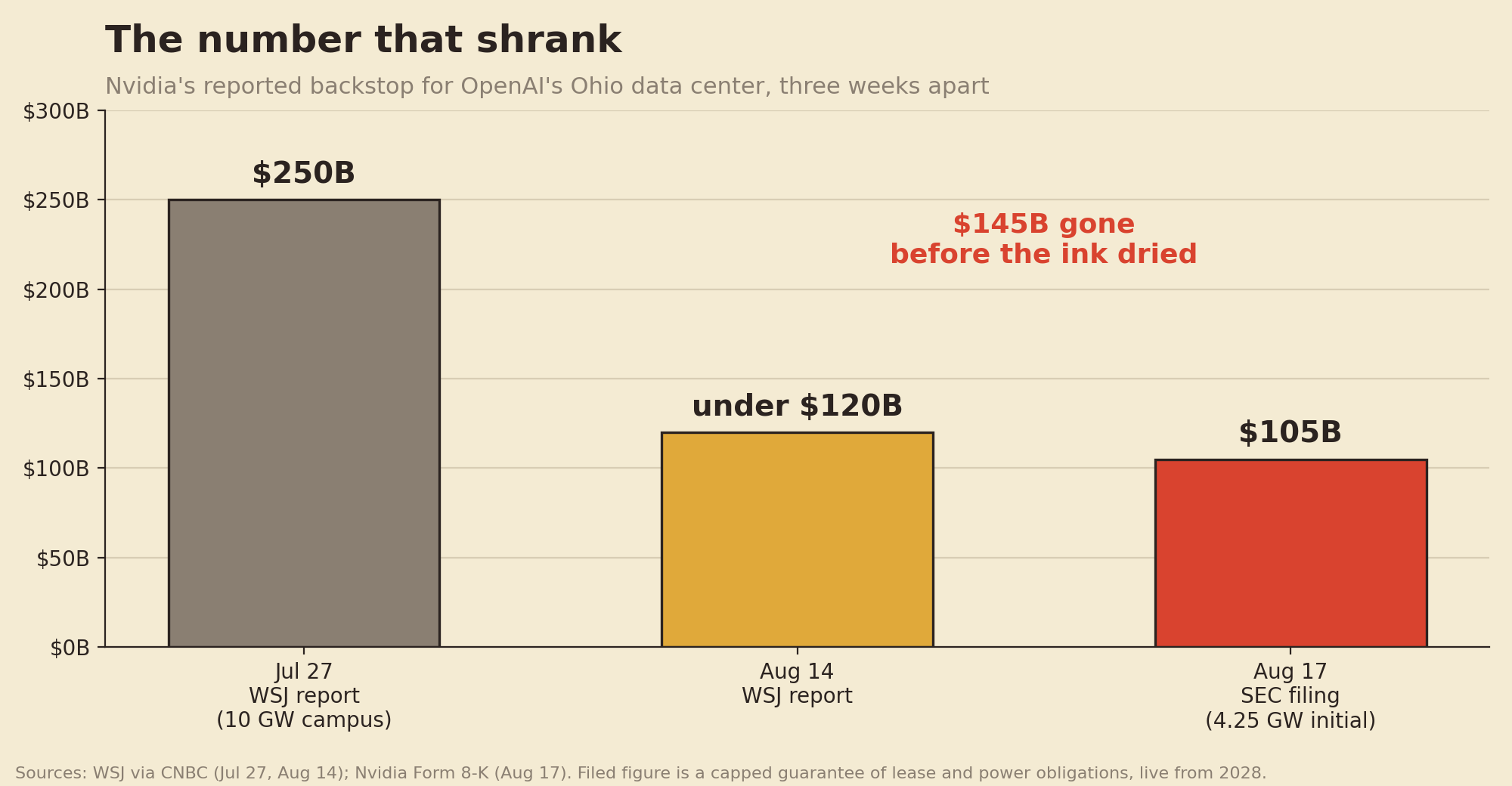
The supplier. Last week Jensen Huang told us compute is revenue. This week we got the paperwork. An August 17 SEC filing shows Nvidia guaranteeing up to $105 billion of lease and power obligations for OpenAI's Ohio campus: 4.25 gigawatts initially, an option on 3.75 more, capacity arriving from 2028, Nvidia as exclusive chip supplier. In late July the Wall Street Journal reported a figure of $250 billion for a 10-gigawatt buildout. By mid-August it was under $120 billion. It signed at $105 billion, and the campus it covers shrank with it.


Separate the three. The state buys output. The public buys equity. The supplier finances its own demand. Each one comes with a different hand on the switch.


The Stakes:


The credit committee. $145 billion came off the Nvidia number between rumour and filing, and nothing in Ohio changed. What changed was how much of Nvidia's balance sheet the market was willing to see standing behind a customer that pays Nvidia back with the proceeds. Read the filing closely and it's narrower still: a cumulatively capped guarantee, live only as each phase clears ready-for-service, expected from 2028. The circular-money question everyone asked in July got answered by price before the ink dried. That's a cancellation. It just happened before close.


The department. Contract revenue is the most stable demand in AI and the only kind a cabinet department can switch off in a month. GenAI.mil is three million seats, gated by government ID cards, on government hardware. It's also a marketplace where the buyer just demonstrated, in public, with a court ruling in the vendor's favour, that it will remove a supplier over a disagreement about terms. The under secretary running the program said in May the department will never again be single-threaded on one AI vendor. Translate that: every vendor is replaceable by design. When you look at an AI company's revenue line, ask which part is contract and which part is contestable. The vendor that loses the argument still gets the IPO. Its buyers should know which revenue they're paying for.


The rate decision. Every gigawatt in 2028 is being discounted at today's yield, and today's yield moved. The 10-year touched roughly 4.79% on Tuesday, its highest since January 2025, and CME futures now put a September 16 hike near 66%, roughly double where it sat before Warsh's Jackson Hole keynote. A hike doesn't cancel Ohio's revenue. It cancels the price of Ohio's revenue. Same effect on your position, different signature on the order.


So three cancel buttons, three notice periods.


The state gives you none. Anthropic's designation arrived in February as a public post, and the removal ran on regardless of what happened next. The company won in court in August, and the September deadline to strip its software out of military systems stayed exactly where it was. A court can rule the process unlawful. It cannot put you back on the platform. If your exposure runs through a government contract, the revenue is real and the notice period is zero.


A credit committee gives you a quarter. The $250 billion figure reported in late July lasted three weeks before the filing came in at $105 billion. Vendor-financed demand is real demand, but it's real on the supplier's terms, and the supplier can reprice it between the rumour and the 8-K.


A rate decision gives you one meeting. September 16. If your AI position only works at a 4% ten-year, you're not long AI. You're short the Fed.


For any AI exposure you hold, name the counterparty, name the button, and count the days. The buildout didn't get more real this week. It got more cancellable. Those are the same thing.


Quick Hits


One number decides the 16th. July payrolls fell by 23,000, the prior two months were revised down by a combined 103,000, and the annual benchmark took another 79,000 off the March level. Consensus for the August print is about +55,000 with unemployment at 4.1%. A hike into a shrinking jobs market is the regime where good news and bad news both hurt. Note the calendar: the Senate's CLARITY Act cloture vote is scheduled for September 15, the day the FOMC sits down. And the two markets pricing that meeting don't agree. On the afternoon of Warsh's speech, CME futures had a hike at 56% and Kalshi had it at 48%. Futures have kept climbing since.


Privacy was the year's best large-cap trade. ZEC rose 82% in August, from about $472 to over $860, and now sits around $14 billion. The catalyst was regulatory, not speculative: the SEC finished its review of Grayscale's Zcash Trust in January with no enforcement, and on August 25 that trust converted into ZCSH on NYSE Arca, the first US spot ETF for a privacy coin. About 28% of supply now sits in shielded pools. The asset class exchanges delisted in 2023 got un-cancelled by a regulator closing a file. The reverse of this week's main story.


Telegram shipped the wallet the SEC buried. Gram Wallet, self-custodial and zero-fee, started rolling out August 31 and is due to reach Telegram's billion-plus users over the coming weeks. GRAM is the name Telegram surrendered in 2020, returning $1.2 billion to investors. The catch is underneath: TON's DeFi TVL sits near $60 million, down about 90% from its 2024 peak. Distribution just got solved. Usage hasn't.


New & Noteworthy


YMTC: the chipmaker Washington tried to cancel just filed. China's only 3D NAND maker had its STAR Market application accepted on August 21, seeking 33 billion yuan, about $4.9 billion, with a listing targeted for the first half of 2027. It has been on the US Entity List since 2022 and builds on domestic tooling. It still took 14% of global NAND shipments in Q2, passing Kioxia, Micron and SanDisk. Valuation chatter runs as high as 1 trillion yuan. Its sister listing, CXMT, popped 466% in July. Sanctioned revenue that grows anyway is the other side of this week's story.


[Get Early Access]{https://www.mexc.com/announcements/new-listings}


Stay Updated


Follow us on Telegram to be notified whenever a new digest drops.


[Follow MEXC on Telegram]{https://t.me/MEXC_OfficialAnnouncements}


Translation


"On love, I neither care nor understand. But you cannot give her the fifty million."

Claude, as quoted by Justin Sun in "My Girlfriend Jing Tian", published August 27 and labelled fiction.


He'd already run the numbers and confirmed the fifty million wouldn't dent him. What he wanted was someone else to say no, and what unsettled him, he writes, wasn't that the machine was clever. It was that it didn't hesitate.


Before You Go


Telegram is putting a wallet in a billion pockets. A wallet is where money waits. A card is where it leaves. MEXC Card turns the balance you already hold into a checkout, at the grocery store, the airline, the app subscription, with no bank in between. When we last checked (#38), crypto card spend had hit $759 million in a month. The rails are getting busier. Make sure yours are connected.


[Get MEXC Card]{https://www.mexc.com/buy-crypto/mexc-card}


Not financial advice. We describe, you decide.

Coin Icon
现在注册即可获得 10,000 USDT 新人奖励

订阅 MEXC 精选

市场动态、新币上线、行业洞察,每周为您精选送达
订阅即表示您同意接收 MEXC 周报和邮件通讯,并同意我们的《隐私政策》。内容仅供参考,不构成任何投资建议。

加入 MEXC 公告电报群

最新上币、热门活动、重大更新——全部在官方 Telegram 实时推送。

MEXC Digest #41: Real Enough to Cancel


On Monday the Pentagon switched on ChatGPT and Grok for three million people. The same week, the AI lab it is still removing from its systems started shopping the largest IPO ever priced. And the guarantee Nvidia signed for OpenAI's Ohio campus landed at $105 billion, after a summer of headlines that said $250 billion.


Everyone's been arguing whether AI revenue is real or a bubble. This week answered it sideways. It's real enough to be cancelled.


That's the good news. Imaginary revenue doesn't get cancelled. It just never shows up.


The Main Character: Who Holds the Off Switch


The Story: The AI buildout has been paid for in phases, and we've covered two of them.


Phase one was cash. In July (#35) Alphabet and Tesla both printed negative free cash flow as capex accelerated, and Wall Street stopped taking the spending on faith.


Phase two was bonds. By #39, Amazon, Alphabet, Meta and Microsoft had issued roughly $194 billion of debt in a year, up 79%, with borrowing funding about a third of hyperscaler capex. Different instrument, same payer: the builders, funding themselves.


Phase three arrived this week, and the payer changed. A government contract. An IPO book. A chip supplier's credit. For the first time the money is coming from outside the companies building the models.


Here's the part that matters. The moment revenue moves outside, it becomes someone else's to withdraw. That is the difference between real and imaginary. Real revenue has a counterparty, and a counterparty can leave.


The Trigger: Three payers, three switches.


The state. On August 31 the Department of War added ChatGPT Mil and Grok for Government to GenAI.mil, its internal AI portal, alongside the Google Gemini that launched it nine months ago. Both are accredited for Controlled Unclassified Information at Impact Level 5. The platform has onboarded more than 1.7 million of the department's 3 million personnel.


One name is missing. Four days earlier, a federal judge ruled the Pentagon's designation of Anthropic as a supply chain risk violated the law and ordered it removed. The ruling doesn't require the Pentagon to use Anthropic, and government lawyers told the court they expect to finish removing it from military systems by the end of September anyway. The vendor won the argument and still lost the seat.


The public. That same vendor is the one about to list. Anthropic filed its S-1 confidentially on June 1, four days after a $65 billion Series H closed at a $965 billion valuation, and its bankers have been holding pre-IPO investor meetings since mid-July, targeting a Nasdaq debut as soon as October. Fortune reported in August that investors are now discussing a $2 trillion valuation, which would make it the largest IPO in history, ahead of SpaceX's $1.77 trillion in June. OpenAI, meanwhile, has drifted toward 2027.


The supplier. Last week Jensen Huang told us compute is revenue. This week we got the paperwork. An August 17 SEC filing shows Nvidia guaranteeing up to $105 billion of lease and power obligations for OpenAI's Ohio campus: 4.25 gigawatts initially, an option on 3.75 more, capacity arriving from 2028, Nvidia as exclusive chip supplier. In late July the Wall Street Journal reported a figure of $250 billion for a 10-gigawatt buildout. By mid-August it was under $120 billion. It signed at $105 billion, and the campus it covers shrank with it.


Separate the three. The state buys output. The public buys equity. The supplier finances its own demand. Each one comes with a different hand on the switch.


The Stakes:


The credit committee. $145 billion came off the Nvidia number between rumour and filing, and nothing in Ohio changed. What changed was how much of Nvidia's balance sheet the market was willing to see standing behind a customer that pays Nvidia back with the proceeds. Read the filing closely and it's narrower still: a cumulatively capped guarantee, live only as each phase clears ready-for-service, expected from 2028. The circular-money question everyone asked in July got answered by price before the ink dried. That's a cancellation. It just happened before close.


The department. Contract revenue is the most stable demand in AI and the only kind a cabinet department can switch off in a month. GenAI.mil is three million seats, gated by government ID cards, on government hardware. It's also a marketplace where the buyer just demonstrated, in public, with a court ruling in the vendor's favour, that it will remove a supplier over a disagreement about terms. The under secretary running the program said in May the department will never again be single-threaded on one AI vendor. Translate that: every vendor is replaceable by design. When you look at an AI company's revenue line, ask which part is contract and which part is contestable. The vendor that loses the argument still gets the IPO. Its buyers should know which revenue they're paying for.


The rate decision. Every gigawatt in 2028 is being discounted at today's yield, and today's yield moved. The 10-year touched roughly 4.79% on Tuesday, its highest since January 2025, and CME futures now put a September 16 hike near 66%, roughly double where it sat before Warsh's Jackson Hole keynote. A hike doesn't cancel Ohio's revenue. It cancels the price of Ohio's revenue. Same effect on your position, different signature on the order.


So three cancel buttons, three notice periods.


The state gives you none. Anthropic's designation arrived in February as a public post, and the removal ran on regardless of what happened next. The company won in court in August, and the September deadline to strip its software out of military systems stayed exactly where it was. A court can rule the process unlawful. It cannot put you back on the platform. If your exposure runs through a government contract, the revenue is real and the notice period is zero.


A credit committee gives you a quarter. The $250 billion figure reported in late July lasted three weeks before the filing came in at $105 billion. Vendor-financed demand is real demand, but it's real on the supplier's terms, and the supplier can reprice it between the rumour and the 8-K.


A rate decision gives you one meeting. September 16. If your AI position only works at a 4% ten-year, you're not long AI. You're short the Fed.


For any AI exposure you hold, name the counterparty, name the button, and count the days. The buildout didn't get more real this week. It got more cancellable. Those are the same thing.


Quick Hits


One number decides the 16th. July payrolls fell by 23,000, the prior two months were revised down by a combined 103,000, and the annual benchmark took another 79,000 off the March level. Consensus for the August print is about +55,000 with unemployment at 4.1%. A hike into a shrinking jobs market is the regime where good news and bad news both hurt. Note the calendar: the Senate's CLARITY Act cloture vote is scheduled for September 15, the day the FOMC sits down. And the two markets pricing that meeting don't agree. On the afternoon of Warsh's speech, CME futures had a hike at 56% and Kalshi had it at 48%. Futures have kept climbing since.


Privacy was the year's best large-cap trade. ZEC rose 82% in August, from about $472 to over $860, and now sits around $14 billion. The catalyst was regulatory, not speculative: the SEC finished its review of Grayscale's Zcash Trust in January with no enforcement, and on August 25 that trust converted into ZCSH on NYSE Arca, the first US spot ETF for a privacy coin. About 28% of supply now sits in shielded pools. The asset class exchanges delisted in 2023 got un-cancelled by a regulator closing a file. The reverse of this week's main story.


Telegram shipped the wallet the SEC buried. Gram Wallet, self-custodial and zero-fee, started rolling out August 31 and is due to reach Telegram's billion-plus users over the coming weeks. GRAM is the name Telegram surrendered in 2020, returning $1.2 billion to investors. The catch is underneath: TON's DeFi TVL sits near $60 million, down about 90% from its 2024 peak. Distribution just got solved. Usage hasn't.


New & Noteworthy


YMTC: the chipmaker Washington tried to cancel just filed. China's only 3D NAND maker had its STAR Market application accepted on August 21, seeking 33 billion yuan, about $4.9 billion, with a listing targeted for the first half of 2027. It has been on the US Entity List since 2022 and builds on domestic tooling. It still took 14% of global NAND shipments in Q2, passing Kioxia, Micron and SanDisk. Valuation chatter runs as high as 1 trillion yuan. Its sister listing, CXMT, popped 466% in July. Sanctioned revenue that grows anyway is the other side of this week's story.


[Get Early Access]{https://www.mexc.com/announcements/new-listings}


Stay Updated


Follow us on Telegram to be notified whenever a new digest drops.


[Follow MEXC on Telegram]{https://t.me/MEXC_OfficialAnnouncements}


Translation


"On love, I neither care nor understand. But you cannot give her the fifty million."

Claude, as quoted by Justin Sun in "My Girlfriend Jing Tian", published August 27 and labelled fiction.


He'd already run the numbers and confirmed the fifty million wouldn't dent him. What he wanted was someone else to say no, and what unsettled him, he writes, wasn't that the machine was clever. It was that it didn't hesitate.


Before You Go


Telegram is putting a wallet in a billion pockets. A wallet is where money waits. A card is where it leaves. MEXC Card turns the balance you already hold into a checkout, at the grocery store, the airline, the app subscription, with no bank in between. When we last checked (#38), crypto card spend had hit $759 million in a month. The rails are getting busier. Make sure yours are connected.


[Get MEXC Card]{https://www.mexc.com/buy-crypto/mexc-card}


Not financial advice. We describe, you decide.

Coin Icon
现在注册即可获得 10,000 USDT 新人奖励

订阅 MEXC 精选

市场动态、新币上线、行业洞察,每周为您精选送达
订阅即表示您同意接收 MEXC 周报和邮件通讯,并同意我们的《隐私政策》。内容仅供参考,不构成任何投资建议。

加入 MEXC 公告电报群

最新上币、热门活动、重大更新——全部在官方 Telegram 实时推送。
及时获取 MEXC 最新上币、下币、交易活动与产品更新。探索新代币、Launchpad 项目、Earn 理财机会、AI 工具,以及合约交易优化等更多平台动态。及时获取 MEXC 最新上币、下币、交易活动与产品更新。探索新代币、Launchpad 项目、Earn 理财机会、AI 工具,以及合约交易优化等更多平台动态。