
买币
行情
现货
合约BTC
理财
活动中心
福利中心
更多
0 费狂欢节

MEXC Digest #47: Proof of Everything

October is when markets stop taking anyone's word for it. Banks opened earnings season on Tuesday, and September's inflation report landed on Wednesday. Both came down to the same question: do the numbers match the story?


The same question applies to what people hold. Central banks keep buying gold, governments are building Bitcoin reserves, and crypto platforms publish proof that customer funds are there. Only some of those can be checked by anyone, on any day.


Who Can Prove It?

Receipts Season

Earnings season opened on October 13, and the market graded on detail, not headlines. JPMorgan earned $15.3 billion, up from $14.4 billion a year earlier, yet still missed analysts' per-share estimates as bond trading slowed. Goldman Sachs beat estimates, carried by its equities business, where revenue jumped 72% to $6.44 billion. Same industry, same week, different receipts.


A day later, September's CPI came in at 3.7% against 3.6% expected, with core at 2.6% against 2.5%. Markets had mostly priced a pause at the Fed's October 28 meeting, and a print that beat on both counts makes that harder to bank on.


The Biggest Reserves Report the Least

Central banks keep adding gold even with the price roughly a quarter below its January peak. China's central bank bought 21 tonnes in September, its 23rd straight monthly purchase and its largest in three years. A record 45% of central banks told the World Gold Council they plan to add more, and a growing share are storing it at home.


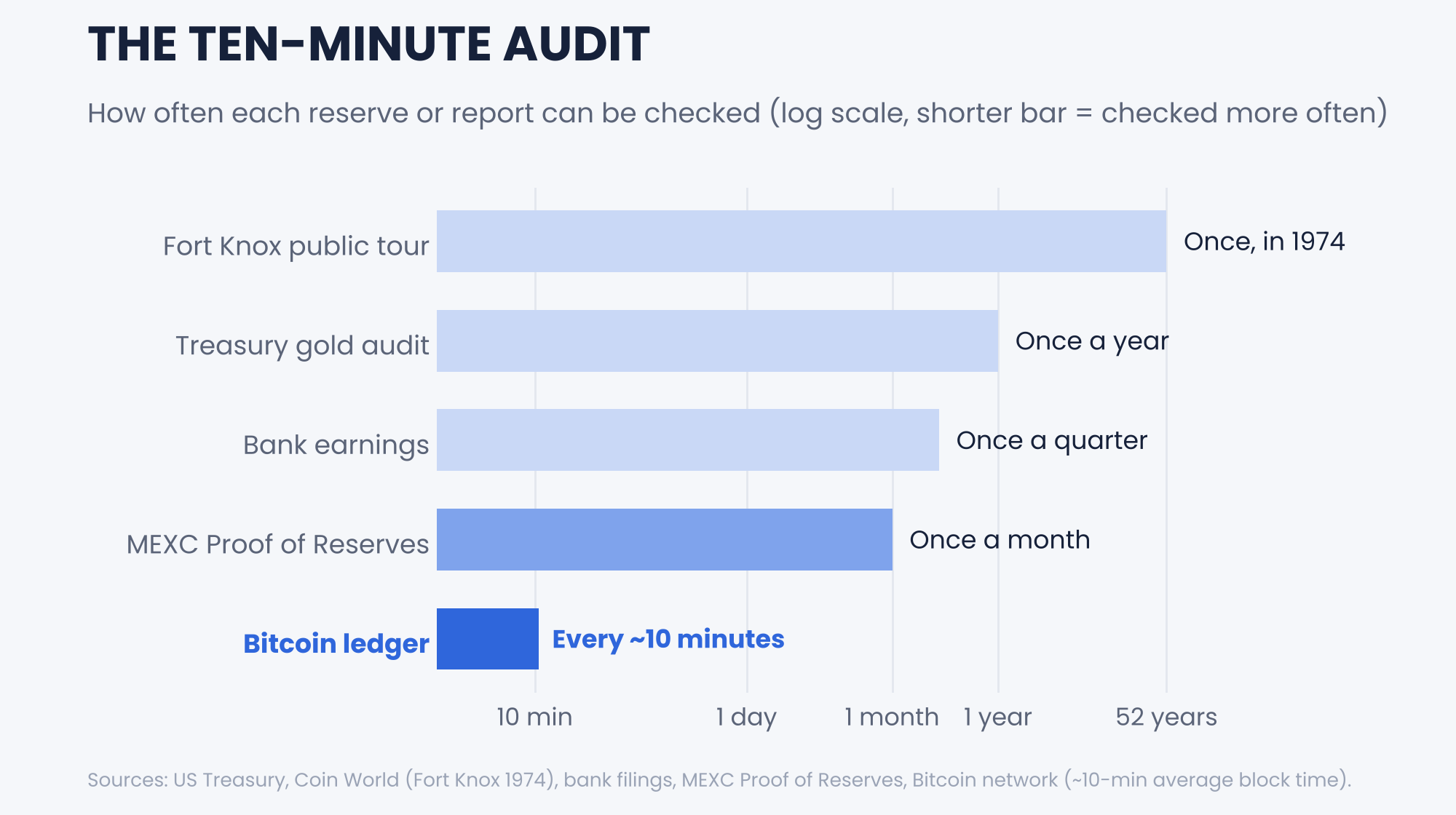
How much sits in those vaults is mostly self-reported. Fort Knox, the most famous vault of all, last had a public look inside in 1974, when lawmakers and reporters toured it. Treasury says the gold is audited every year and all of it is accounted for, and there's no reason to doubt that. But checking for yourself would take a trip to Kentucky and a key you don't have.


The Reserve That Reports Itself

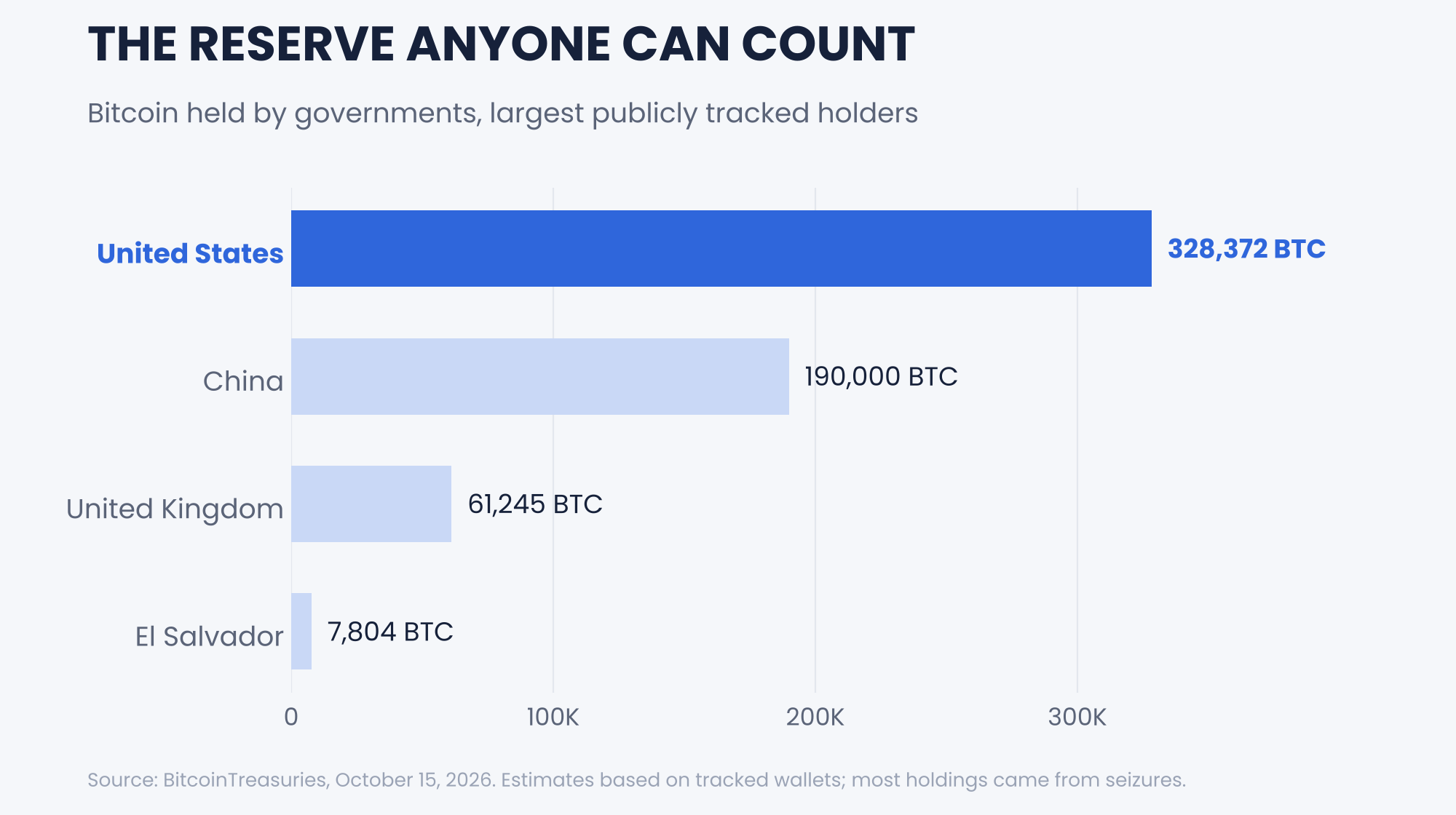
Bitcoin works the other way around. Every coin, every transfer and the total supply sit on a public ledger that updates roughly every ten minutes. The US government holds an estimated 328,372 BTC, according to BitcoinTreasuries, and blockchain trackers follow its known wallets in real time.


On September 16, the House Financial Services Committee advanced the American Reserve Modernization Act 28 to 21. The bill would put the government's Bitcoin under Treasury custody, bar its sale for 20 years and require annual proof-of-reserve reporting. It doesn't authorize new purchases, and it still needs a full House vote and Senate approval.


Gold asks you to trust the vault. Bitcoin shows you the ledger.


Proof Is Getting Cheaper

Checking is also getting faster. On October 13, ZKsync unveiled Airbender Prime, which generated zero-knowledge proofs for 99% of 7,200 consecutive Ethereum blocks in under 10 seconds each, on a single graphics card. Two days later, Vitalik Buterin called the speed race "definitively won" and said the focus now shifts to security. ZK rose about 40% over the week.


Proof is spreading beyond Bitcoin. Chainlink Proof of Reserve feeds were verifying more than $17 billion in reserve assets by mid-2026, including tokenized gold, so the vault behind a gold token can be checked on-chain.


And proof doesn't have to mean exposure. A zero-knowledge proof can show something is true without revealing the data behind it, and the Merkle tree behind an exchange's proof of reserves lets you confirm your own balance is counted without seeing anyone else's.


When Proof Is the Default

So who can prove it? Banks prove their numbers every quarter, on a schedule. Gold's biggest holders prove theirs rarely, and mostly on their own word. Bitcoin proves its supply every ten minutes, to anyone who looks.


As checking gets cheaper, claims matter less and the moment they get checked matters more. The gap between what's promised and what's shown is where prices move, whether it's an earnings beat, an inflation print or a reserve report.


The next receipts are already on the calendar. Tesla reports on October 21, and the Fed decides on October 28, the same week Alphabet, Microsoft and Amazon report. September's PCE inflation follows on October 29. Until then, run the same test on your own portfolio: check that your exchange publishes its reserves and look up your own addresses on-chain.


Trust is a promise. Proof is a receipt.


Quick Hits

Quantum stocks: big bets, uneven receipts. In May, the Commerce Department signed letters of intent for $2 billion in funding for nine quantum companies, including IBM, D-Wave and Rigetti, in exchange for minority stakes. D-Wave's second-quarter revenue was flat at $3.1 million. IonQ, which isn't among the nine, grew its revenue 287% to $80.1 million, then fell about 9% twice this week: first on an all-stock acquisition, then on a $2 billion share sale.


Two metals, opposite years. Silver peaked at about $121.6 on January 29, two days after CME raised margin requirements on silver futures, then fell 26% the next day. It now trades near $57, less than half its peak. Copper, meanwhile, sits about 5% below the record it set in September.


New and Noteworthy

The scorekeeper, listed. FICO, the company behind the credit score lenders check before they say yes, now has stock futures on MEXC, part of a fresh batch added this week that includes T-Mobile and Boston Scientific.

On-chain finance, in concrete terms. Concrete bills itself as an operating system for on-chain finance, built to launch products and bring real-world assets on-chain. Its Airdrop+ shares 300,000 CT and 10,000 USDT until October 20.


Translation

“A common-sense measure that brings digital assets held across federal agencies under Treasury custody.”

French Hill, Chairman of the House Financial Services Committee, September 16, 2026

Washington is starting to treat its Bitcoin the way it treats its gold, as a reserve with one custodian, one rulebook and a long holding period. The difference is that anyone can check this one.


Before You Go


MEXC publishes its Proof of Reserves every month, audited by Hacken. The September report put BTC reserves at 297% of user balances, with ETH, USDT and USDC all above 100%.


And if you'd rather show your own receipts, the RealStocks PNL Rate Leaderboard ranks traders by return, not account size. Trade at least $100 in RealStocks to qualify, with $10,000 for first place, until October 31.


Not financial advice. We describe, you decide.

Coin Icon
现在注册即可获得 10,000 USDT 新人奖励

订阅 MEXC 精选

市场动态、新币上线、行业洞察,每周为您精选送达
订阅即表示您同意接收 MEXC 周报和邮件通讯,并同意我们的《隐私政策》。内容仅供参考,不构成任何投资建议。

加入 MEXC 公告电报群

最新上币、热门活动、重大更新——全部在官方 Telegram 实时推送。

MEXC Digest #47: Proof of Everything

October is when markets stop taking anyone's word for it. Banks opened earnings season on Tuesday, and September's inflation report landed on Wednesday. Both came down to the same question: do the numbers match the story?


The same question applies to what people hold. Central banks keep buying gold, governments are building Bitcoin reserves, and crypto platforms publish proof that customer funds are there. Only some of those can be checked by anyone, on any day.


Who Can Prove It?

Receipts Season

Earnings season opened on October 13, and the market graded on detail, not headlines. JPMorgan earned $15.3 billion, up from $14.4 billion a year earlier, yet still missed analysts' per-share estimates as bond trading slowed. Goldman Sachs beat estimates, carried by its equities business, where revenue jumped 72% to $6.44 billion. Same industry, same week, different receipts.


A day later, September's CPI came in at 3.7% against 3.6% expected, with core at 2.6% against 2.5%. Markets had mostly priced a pause at the Fed's October 28 meeting, and a print that beat on both counts makes that harder to bank on.


The Biggest Reserves Report the Least

Central banks keep adding gold even with the price roughly a quarter below its January peak. China's central bank bought 21 tonnes in September, its 23rd straight monthly purchase and its largest in three years. A record 45% of central banks told the World Gold Council they plan to add more, and a growing share are storing it at home.


How much sits in those vaults is mostly self-reported. Fort Knox, the most famous vault of all, last had a public look inside in 1974, when lawmakers and reporters toured it. Treasury says the gold is audited every year and all of it is accounted for, and there's no reason to doubt that. But checking for yourself would take a trip to Kentucky and a key you don't have.


The Reserve That Reports Itself

Bitcoin works the other way around. Every coin, every transfer and the total supply sit on a public ledger that updates roughly every ten minutes. The US government holds an estimated 328,372 BTC, according to BitcoinTreasuries, and blockchain trackers follow its known wallets in real time.


On September 16, the House Financial Services Committee advanced the American Reserve Modernization Act 28 to 21. The bill would put the government's Bitcoin under Treasury custody, bar its sale for 20 years and require annual proof-of-reserve reporting. It doesn't authorize new purchases, and it still needs a full House vote and Senate approval.


Gold asks you to trust the vault. Bitcoin shows you the ledger.


Proof Is Getting Cheaper

Checking is also getting faster. On October 13, ZKsync unveiled Airbender Prime, which generated zero-knowledge proofs for 99% of 7,200 consecutive Ethereum blocks in under 10 seconds each, on a single graphics card. Two days later, Vitalik Buterin called the speed race "definitively won" and said the focus now shifts to security. ZK rose about 40% over the week.


Proof is spreading beyond Bitcoin. Chainlink Proof of Reserve feeds were verifying more than $17 billion in reserve assets by mid-2026, including tokenized gold, so the vault behind a gold token can be checked on-chain.


And proof doesn't have to mean exposure. A zero-knowledge proof can show something is true without revealing the data behind it, and the Merkle tree behind an exchange's proof of reserves lets you confirm your own balance is counted without seeing anyone else's.


When Proof Is the Default

So who can prove it? Banks prove their numbers every quarter, on a schedule. Gold's biggest holders prove theirs rarely, and mostly on their own word. Bitcoin proves its supply every ten minutes, to anyone who looks.


As checking gets cheaper, claims matter less and the moment they get checked matters more. The gap between what's promised and what's shown is where prices move, whether it's an earnings beat, an inflation print or a reserve report.


The next receipts are already on the calendar. Tesla reports on October 21, and the Fed decides on October 28, the same week Alphabet, Microsoft and Amazon report. September's PCE inflation follows on October 29. Until then, run the same test on your own portfolio: check that your exchange publishes its reserves and look up your own addresses on-chain.


Trust is a promise. Proof is a receipt.


Quick Hits

Quantum stocks: big bets, uneven receipts. In May, the Commerce Department signed letters of intent for $2 billion in funding for nine quantum companies, including IBM, D-Wave and Rigetti, in exchange for minority stakes. D-Wave's second-quarter revenue was flat at $3.1 million. IonQ, which isn't among the nine, grew its revenue 287% to $80.1 million, then fell about 9% twice this week: first on an all-stock acquisition, then on a $2 billion share sale.


Two metals, opposite years. Silver peaked at about $121.6 on January 29, two days after CME raised margin requirements on silver futures, then fell 26% the next day. It now trades near $57, less than half its peak. Copper, meanwhile, sits about 5% below the record it set in September.


New and Noteworthy

The scorekeeper, listed. FICO, the company behind the credit score lenders check before they say yes, now has stock futures on MEXC, part of a fresh batch added this week that includes T-Mobile and Boston Scientific.

On-chain finance, in concrete terms. Concrete bills itself as an operating system for on-chain finance, built to launch products and bring real-world assets on-chain. Its Airdrop+ shares 300,000 CT and 10,000 USDT until October 20.


Translation

“A common-sense measure that brings digital assets held across federal agencies under Treasury custody.”

French Hill, Chairman of the House Financial Services Committee, September 16, 2026

Washington is starting to treat its Bitcoin the way it treats its gold, as a reserve with one custodian, one rulebook and a long holding period. The difference is that anyone can check this one.


Before You Go


MEXC publishes its Proof of Reserves every month, audited by Hacken. The September report put BTC reserves at 297% of user balances, with ETH, USDT and USDC all above 100%.


And if you'd rather show your own receipts, the RealStocks PNL Rate Leaderboard ranks traders by return, not account size. Trade at least $100 in RealStocks to qualify, with $10,000 for first place, until October 31.


Not financial advice. We describe, you decide.

Coin Icon
现在注册即可获得 10,000 USDT 新人奖励

订阅 MEXC 精选

市场动态、新币上线、行业洞察,每周为您精选送达
订阅即表示您同意接收 MEXC 周报和邮件通讯,并同意我们的《隐私政策》。内容仅供参考,不构成任何投资建议。

加入 MEXC 公告电报群

最新上币、热门活动、重大更新——全部在官方 Telegram 实时推送。
及时获取 MEXC 最新上币、下币、交易活动与产品更新。探索新代币、Launchpad 项目、Earn 理财机会、AI 工具,以及合约交易优化等更多平台动态。及时获取 MEXC 最新上币、下币、交易活动与产品更新。探索新代币、Launchpad 项目、Earn 理财机会、AI 工具,以及合约交易优化等更多平台动态。