

Nvidia has once again delivered results that underscore the extraordinary scale of the artificial-intelligence infrastructure boom. The chipmaker reported fiscal second-quarter revenue of $96.2 billioNvidia has once again delivered results that underscore the extraordinary scale of the artificial-intelligence infrastructure boom. The chipmaker reported fiscal second-quarter revenue of $96.2 billio
Nvidia Earnings Beat Estimates as Revenue Hits $96.2B, Company Forecasts $108B Next Quarter

Nvidia has once again delivered results that underscore the extraordinary scale of the artificial-intelligence infrastructure boom. The chipmaker reported fiscal second-quarter revenue of $96.2 billion, comfortably ahead of Wall Street expectations, while adjusted earnings also surpassed forecasts.
More importantly, Nvidia’s outlook points to another major jump in sales, with the company projecting $108 billion in revenue for its fiscal third quarter. The figures provide fresh evidence that demand for AI computing remains exceptionally strong, even as investors begin paying closer attention to rising costs and profitability.
1.Revenue Growth Continues to Accelerate
Nvidia’s latest numbers show how dramatically the company’s business has expanded. Revenue for the quarter ended July 26 reached $96.22 billion, representing an increase of 106% from the same period a year earlier and 18% from the previous quarter. Analysts had expected revenue of roughly $92.27 billion. Adjusted earnings came in at $2.22 per share, exceeding the approximately $2.09 forecast. The company’s ability to deliver another large earnings beat is particularly notable because expectations for Nvidia had already risen significantly ahead of the report.
2.Data Center Business Remains the Main Growth Engine
The strongest part of Nvidia’s results came from its Data Center operation, which generated $89 billion during the quarter. That figure increased 117% from a year earlier and accounted for the overwhelming majority of Nvidia’s total revenue.
The performance reflects continued spending by cloud providers and other large technology companies seeking additional computing capacity for AI workloads. Nvidia’s accelerated-computing products have become a central component of this infrastructure buildout, allowing the company to benefit directly from the rapid expansion of generative AI and other computationally intensive applications.
3.$108 Billion Forecast Raises the Bar Again
Nvidia’s forward guidance may be even more significant than its latest earnings beat. For the fiscal third quarter, the company expects revenue of approximately $108 billion, with a possible variation of 2% in either direction. That compares with Wall Street expectations of roughly $103.9 billion. If Nvidia reaches the midpoint of its forecast, quarterly revenue would increase by more than $11 billion from the latest reported period. The company also said its outlook does not assume Data Center compute revenue from China, making the guidance particularly notable given the scale of the forecast.
4.AI Demand Is Expanding Beyond GPUs
The latest results also demonstrate that Nvidia’s opportunity is becoming broader than simply selling individual graphics processors. The company is increasingly positioning its technology as a complete computing platform that includes chips, networking, systems and software. Its next-generation Vera Rubin architecture is entering production, giving customers another path to increase AI computing capacity. Nvidia has also highlighted demand from AI laboratories and major cloud providers, suggesting that the company expects infrastructure investment to remain elevated as businesses move from experimentation toward larger-scale AI deployment.
5. Rising Costs Create a New Challenge
Despite the impressive growth, Nvidia’s report contained a potential warning sign for investors: margins are expected to narrow down over the coming months. The company reported a 75% gross margin for the second quarter but expects approximately 74% in the third quarter (plus or minus 50 basis points), with guidance pointing toward a temporary floor of 71%–72% in Q4. This compression is primarily driven by transition costs tied to ramp-up of the next-generation Vera Rubin platform and rapid spikes in high-bandwidth memory (HBM) and component costs. Even small changes in margins can have a major financial impact at Nvidia’s scale, making cost management a central focus for analysts.
6.Nvidia Faces Supply and Geopolitical Risks
Meeting demand could prove just as important as generating it. Nvidia has indicated that supply constraints remain a factor and that it is working with suppliers to secure memory, power and other infrastructure required for expansion. At the same time, restrictions affecting advanced semiconductor exports to China continue to create uncertainty around one of the world’s largest technology markets. Nvidia’s current guidance excludes Data Center compute revenue from China, which reduces the immediate impact on its forecast but also highlights the geopolitical challenges surrounding the global AI-chip industry.
7. Why Nvidia’s Results Matter for Markets
Nvidia’s earnings have become an important barometer for the tech sector, given its position at the center of the AI buildout. Strong demand indicates that major tech giants are continuing to pour capital into data centers and hardware infrastructure.
Beyond equity markets, the company’s performance influences broader investor risk appetite across alternative asset classes:
Digital Assets: Cryptocurrencies often move in tandem with high-beta tech sentiment. At the time of reporting, Bitcoin traded near $78,713, Ethereum stood around $2,489, and Solana was near $100.71.
Semiconductor & Cloud Ecosystem: Results directly shape market valuations across memory suppliers, foundry partners, and cloud service providers tied to AI infrastructure spending.
8. Investors Shift Focus to Sustainability of Growth
The central debate around Nvidia is no longer whether AI demand exists, but whether the company can maintain high growth while preserving profitability and generating long-term cash flow. Management projected approximately 70% revenue growth for the fiscal year ending in January 2028, reinforcing confidence that the infrastructure cycle remains strong.
However, several key variables could influence how much of that growth translates into bottom-line profits:
Supply Constraints: Securing sufficient advanced memory, chip packaging, and power infrastructure remains a gating factor for fulfillment.
Competitive Pressures & Custom Silicon: Major hyperscalers and rivals continue to develop in-house AI chips to reduce hardware dependencies.
Spending Durability: Long-term capital expenditures depend on whether end-users can monetize AI deployments effectively.
Conclusion
Nvidia’s fiscal second-quarter results delivered another powerful signal for the AI industry. Revenue reached $96.2 billion, beating expectations by several billion dollars, while Data Center sales climbed to $89 billion as demand for AI computing continued to accelerate.
The company then raised the stakes with a $108 billion revenue forecast for the next quarter. While the expected decline in gross margin and ongoing supply and geopolitical risks introduce uncertainty, the overall picture remains one of extraordinary expansion. Nvidia’s latest report suggests that the AI investment cycle is still generating enormous demand, but the next phase of the story will increasingly depend on how efficiently the company can turn that demand into sustainable profitability.
Disclaimer: This article is for informational and educational purposes only and does not constitute financial, investment, or trading advice. Financial metrics and market data reflect conditions at the time of reporting and are subject to change.
市场机遇
Audiera实时价格 (BEAT)
--
----
USD
Audiera (BEAT) 实时价格图表
本页面分享的文章均源自公开平台,仅供参考。该内容不代表 MEXC 的立场或观点。所有版权归 Mubashir 所有。如果您认为任何内容侵犯了第三方的权益,请联系 [email protected] 以便及时删除。 MEXC 不保证任何内容的准确性、完整性或及时性,且不对基于所提供信息而采取的任何行动负责。本内容不构成财务、法律或其他专业建议,亦不应被解释为 MEXC 的推荐或认可。如需专家见解和深入分析,请造访 MEXC 学院。
Audiera 最新动态
查看更多
博通财报后股价下跌,凸显AI基础设施板块预期门槛正在变高
博通交出了又一个受AI强劲驱动的季度财报,但股价的反应表明,仅靠稳健的数据已经不足以打动市场。第二财季营收达到222亿美元,同比增长48%,同时AI半导体营收飙升143%至108亿美元。公司还预计下季度AI半导体营收将达到160亿美元。问题不在于需求疲软,而在于预期过高。在近期AI基础设施板块集体大涨之后,交易员们原本期待着更大的超预期惊喜,而博通的业绩未能将标尺设定得足够高。
2026/06/04
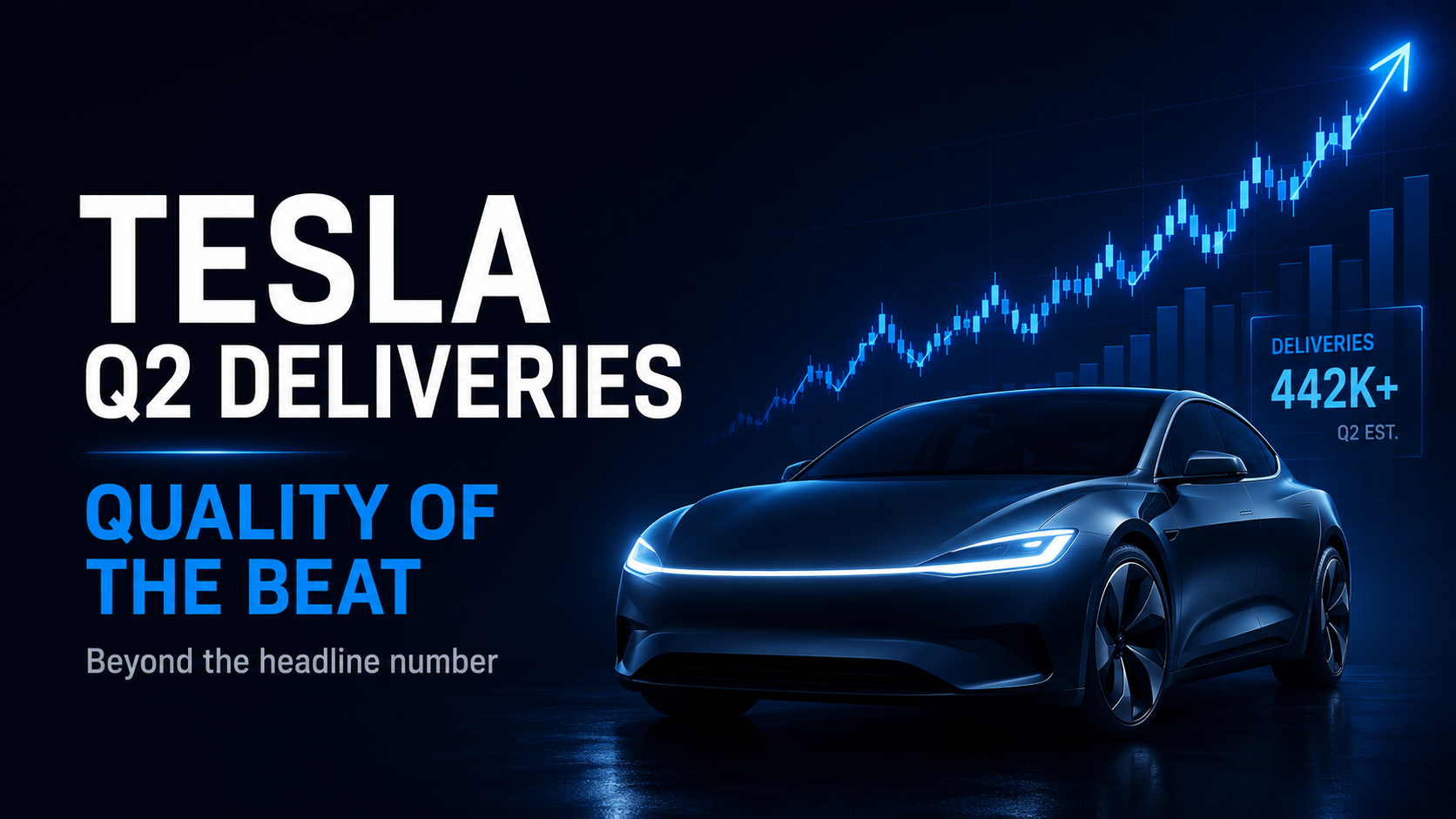
特斯拉交付前股价大涨:为什么真正的考验在于质量,而非数量
特斯拉(TSLA)在第二季度交付报告公布前股价大涨 8.46% 至 411.84 美元,表现优于大盘,分析师称其为“预期重置交易”。华尔街已大幅提高门槛,主要机构将“耳语预测”(whisper numbers)上调至 413,024 至 420,000 辆之间,远高于公司官方统计的 406,024 辆共识预期。尽管监管压力的缓解以及与 Sunrun 达成的 16GW 虚拟电厂巨额合作,对特斯拉的能源和 AI 基础设施叙事提供了多重支撑,但市场最终的反应仍将取决于交付超预期的“质量”——即这究竟反映了全球需求的持续复苏,还是仅仅是牺牲利润率的季末库存清仓。
特斯拉股价在发布第二季度交付报告前夕迎来飙升,但这并不应该被解读为公司已经交出超预期答卷的确认信号。相反,这更应该被理解为在官方数据揭晓前,市场进行的一场“预期重置交易”(expectations-reset trade)。
TSLA 最近收于 411.84 美元,当日涨幅达 8.46%,表现明显优于大盘。相比之下,纳斯达克综合指数上涨 2.07%,标普 500 指数上涨 1.18%,QQQ 上涨 2.49%。如此巨大的涨幅表明,这不仅仅是一场单纯的技术股反弹。更确切地说,特斯拉股价的上涨反映了市场风险偏好增强、交付预期上升、监管压力缓解,以及对特斯拉能源和 AI 基础设施叙事再度产生浓厚兴趣的综合结果。
核心问题不再是特斯拉能否超越共识预期,而是这一“超预期”(beat)的含金量是否足以支撑近期的这场暴涨。
2026/06/30

万事达完成对BVNK的收购,交易金额高达18亿美元——稳定币进入全球支付核心
万事达于2026年8月3日完成了对稳定币基础设施提供商BVNK的收购,此前已于三月宣布该交易。
2026/08/04
热门
目前热门备受市场关注的加密货币
加密货币价格
按交易量计算交易量最大的加密货币