

Key TakeawaysNvidia (NVDA) reported fiscal second quarter 2027 revenue of $96.22 billion on August 26, 2026, up 106% year over year and above the $92.1 billion consensus, with adjusted earnings of $2.Key TakeawaysNvidia (NVDA) reported fiscal second quarter 2027 revenue of $96.22 billion on August 26, 2026, up 106% year over year and above the $92.1 billion consensus, with adjusted earnings of $2.
Nvidia Earnings Explained: Record $96 Billion Quarter, $108 Billion Guide, a Margin Reset, and What It Means for Crypto

作者:OoJae
分享
Key Takeaways
Nvidia (NVDA) reported fiscal second quarter 2027 revenue of $96.22 billion on August 26, 2026, up 106% year over year and above the $92.1 billion consensus, with adjusted earnings of $2.22 per share against $2.09 expected. It was the fourteenth straight quarter above the company's own guidance.
Data Center revenue hit $89.02 billion, up 117% from a year ago and 18% from the prior quarter, driven by the Blackwell Ultra ramp. Sovereign AI revenue more than tripled year over year, and networking posted a record on Spectrum-X Ethernet growing 2.6 times.
Guidance was the real headline: $108 billion in third quarter revenue against a $104.2 billion consensus, assuming essentially zero Data Center compute sales to China, plus a rare preliminary forecast of roughly 70% revenue growth for fiscal 2028 that CEO Jensen Huang called supply constrained.
The catch is margins: gross margin held at 75% but is guided to 74% next quarter and a trough of 71% to 72% in the fourth quarter as memory costs soar, with supply obligations swelling to $279 billion, largely for memory tied to the Vera Rubin ramp.
For crypto, the print reinforces the AI risk complex that Bitcoin has traded within all year, feeds the memory boom behind names like SK Hynix, and validates the compute-as-revenue thesis driving miners into AI hosting and the AI agent token narrative.
The Numbers: Another Record, Another Beat
Nvidia's fiscal second quarter, reported after the close on Wednesday, August 26, was a masterclass by any traditional measure. Revenue reached $96.22 billion, more than doubling from a year earlier and rising 15% from the prior quarter, the fourth consecutive quarter of accelerating growth. Adjusted earnings of $2.22 per share beat the $2.09 consensus by more than 6%, extending Nvidia's streak of topping estimates to five quarters. The engine was Data Center at $89.02 billion, about 92% of total revenue, as hyperscalers and enterprises accelerated deployments of the Blackwell Ultra architecture. Sovereign AI revenue grew 35% sequentially and more than tripled year over year, networking set a record, and the company returned $26 billion to shareholders in the quarter.
Two details show how insulated the business has become. Shipments of Data Center products to China were less than 1% of segment revenue because of export restrictions, meaning the entire growth story is being driven by Western and allied demand. And roughly 70% of first half sales came from the United States, a concentration that analysts flag as both a strength and a policy risk.
The Guide That Mattered
Investors had made clear that anything below roughly $103 billion for the third quarter would trigger a selloff. Nvidia guided to $108 billion, plus or minus 2%, comfortably above the $104.2 billion consensus and again excluding any China compute revenue. It also did something unusual, offering a preliminary outlook for fiscal 2028 of approximately 70% revenue growth, a figure Huang described as supply constrained and well below what customers are asking for. Production shipments of the next generation Vera Rubin platform have begun, with management calling it the fastest ramp in company history, and Nvidia announced an expanded AWS partnership to deploy two million additional GPUs. Huang summarized the thesis in four words on the call: "Now, compute is revenue."
The Margin Reset That Caught the Market Off Guard
The reason the stock did not simply rip is margins. Gross margin held at 75% in the quarter, up from 72.5% a year ago, but management guided it down to 74% for the third quarter and to a bottom of 71% to 72% in the fourth, settling at 72% to 73% for fiscal 2028. The culprit is memory: prices for the high bandwidth memory that every AI accelerator needs have risen faster than Nvidia anticipated and are heading higher into next year. Supply obligations surged to $279 billion, largely memory procurement for the Rubin ramp. That dynamic flips the script for the memory makers, which is exactly why SK Hynix's record Nasdaq debut landed so well this summer: the cost pressure squeezing Nvidia's margins is the same force inflating memory suppliers' profits.
The reaction reflected that tension. Shares whipsawed in extended trading, dipping initially as investors absorbed the margin trajectory before rallying about 4% on the fiscal 2028 forecast, with analysts describing the mood as ambivalent rather than euphoric. A pending acquisition of Hugging Face, signaling a push to control the AI software layer, added another strategic wrinkle to digest.
Why Crypto Traders Care
Nvidia's results are the single most important data point for the AI trade, and in 2026 the AI trade and crypto move as one risk complex. Strong AI capital spending lifts equity risk appetite, which spills into digital assets; disappointment does the opposite, as this week's post Jackson Hole selloff showed when higher yields hit chips and crypto together. The print also validates a structural shift inside crypto: Bitcoin miners are converting power and data center capacity into AI hosting contracts, precisely because compute has become the scarcest asset in the economy. The same insight underpins Arthur Hayes' Flop Labs and its proof of useful inference design, in which mining work is AI inference. When the world's most valuable chipmaker says demand exceeds even 70% growth and supply is the bottleneck, every business selling compute, including tokenized ones, gets a tailwind.
What It Means for Traders on MEXC
NVDA trades on the Nasdaq, but the themes it drives are fully tradable in crypto. AI related tokens listed on MEXC tend to react to the same news flow that moves chip stocks, and the broader risk appetite Nvidia sets feeds directly into BTC/USDT and ETH/USDT. Traders can watch the AI token sector for follow through as Vera Rubin volumes ramp, keep an eye on memory cost headlines as the swing factor for the sector, and manage the volatility with MEXC Futures.
Disclaimer: This content is for educational and reference purposes only and does not constitute any investment advice. Digital asset investments carry high risk. Please evaluate carefully and assume full responsibility for your own decisions.
市场机遇
Audiera实时价格 (BEAT)
--
----
USD
Audiera (BEAT) 实时价格图表
本页面分享的文章均源自公开平台,仅供参考。该内容不代表 MEXC 的立场或观点。所有版权归 OoJae 所有。如果您认为任何内容侵犯了第三方的权益,请联系 [email protected] 以便及时删除。 MEXC 不保证任何内容的准确性、完整性或及时性,且不对基于所提供信息而采取的任何行动负责。本内容不构成财务、法律或其他专业建议,亦不应被解释为 MEXC 的推荐或认可。如需专家见解和深入分析,请造访 MEXC 学院。
Audiera 最新动态
查看更多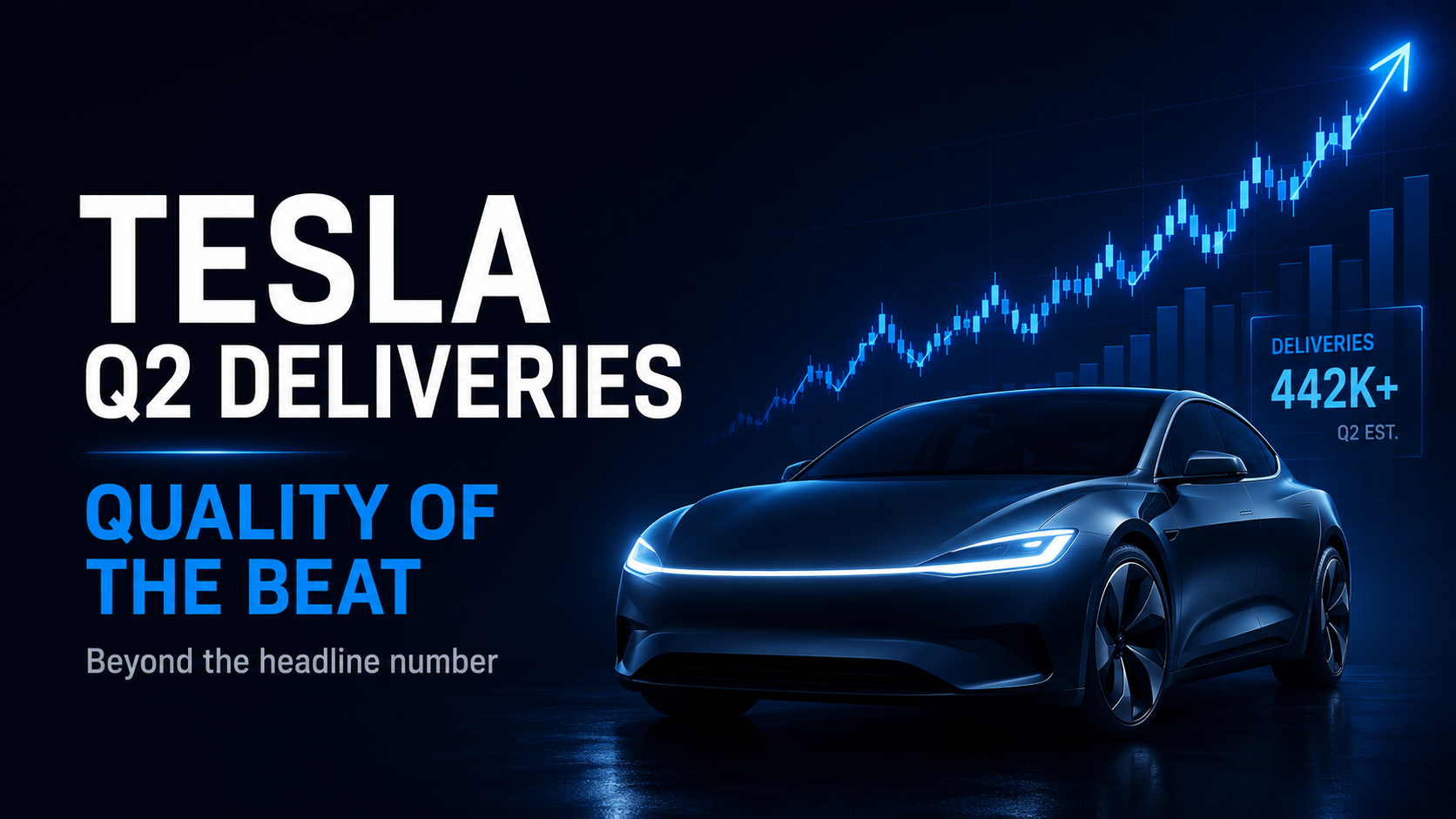
特斯拉交付前股价大涨:为什么真正的考验在于质量,而非数量
特斯拉(TSLA)在第二季度交付报告公布前股价大涨 8.46% 至 411.84 美元,表现优于大盘,分析师称其为“预期重置交易”。华尔街已大幅提高门槛,主要机构将“耳语预测”(whisper numbers)上调至 413,024 至 420,000 辆之间,远高于公司官方统计的 406,024 辆共识预期。尽管监管压力的缓解以及与 Sunrun 达成的 16GW 虚拟电厂巨额合作,对特斯拉的能源和 AI 基础设施叙事提供了多重支撑,但市场最终的反应仍将取决于交付超预期的“质量”——即这究竟反映了全球需求的持续复苏,还是仅仅是牺牲利润率的季末库存清仓。
特斯拉股价在发布第二季度交付报告前夕迎来飙升,但这并不应该被解读为公司已经交出超预期答卷的确认信号。相反,这更应该被理解为在官方数据揭晓前,市场进行的一场“预期重置交易”(expectations-reset trade)。
TSLA 最近收于 411.84 美元,当日涨幅达 8.46%,表现明显优于大盘。相比之下,纳斯达克综合指数上涨 2.07%,标普 500 指数上涨 1.18%,QQQ 上涨 2.49%。如此巨大的涨幅表明,这不仅仅是一场单纯的技术股反弹。更确切地说,特斯拉股价的上涨反映了市场风险偏好增强、交付预期上升、监管压力缓解,以及对特斯拉能源和 AI 基础设施叙事再度产生浓厚兴趣的综合结果。
核心问题不再是特斯拉能否超越共识预期,而是这一“超预期”(beat)的含金量是否足以支撑近期的这场暴涨。
2026/06/30

Bitget 将退出日本:面向日本居民的服务将于 2026 年 12 月 31 日终止
Bitget 将于 2026 年 12 月 31 日终止对日本用户的服务。受影响的用户必须在截止日期前平仓并提取资产。
2026/08/04

万事达完成对BVNK的收购,交易金额高达18亿美元——稳定币进入全球支付核心
万事达于2026年8月3日完成了对稳定币基础设施提供商BVNK的收购,此前已于三月宣布该交易。
2026/08/04


热门
目前热门备受市场关注的加密货币
加密货币价格
按交易量计算交易量最大的加密货币