Japan Blockchain Stock Settlement Explained: Why On-Chain Securities Could Matter
A stock trade can happen in a fraction of a second. Settling that trade is another matter.
Behind the simple “Buy” button sits a network of brokers, custodians, securities depositories, banks and payment systems that must make sure ownership and money actually change hands.
Japan is experimenting with whether blockchain can simplify part of that machinery.
The country's Financial Services Agency is supporting proof-of-concept work around on-chain securities settlement involving major securities firms and banking groups. The Bank of Japan is separately experimenting with ways central-bank money could potentially be used for settlement on blockchain-based systems.
Taken together, these projects offer a useful glimpse at what “real-world asset tokenization” looks like when it moves beyond issuing tokens and starts touching financial-market infrastructure itself.
Summary
Japan is exploring blockchain-based settlement for securities including government bonds, corporate bonds, investment trusts and equities.
The Financial Services Agency has described a proof-of-concept involving Nomura Securities, Daiwa Securities and Japan's three megabank groups.
One of the central ideas is on-chain delivery versus payment, or DvP: synchronizing the transfer of a security with payment so that both sides of a transaction occur together.
The Bank of Japan is also experimenting with the use of central-bank money on blockchain-based systems and has explicitly identified securities settlement as a potential use case.
These initiatives remain experimental. They should not be described as Japan having already moved its stock market or government-bond market onto a blockchain.
The Interesting Part Isn't “Stocks on Blockchain”
That phrase makes a good headline, but it misses the problem Japan is actually investigating.
The question is settlement.
Imagine Investor A sells a security to Investor B.
Two things ultimately need to happen:
The security must move from A to B.
The money must move from B to A.
Financial infrastructure is designed to make those two movements happen reliably. If one side completes while the other fails, settlement risk appears.
Blockchain systems offer the possibility of coordinating those transfers differently.
What Is Delivery Versus Payment?
Delivery versus payment, usually shortened to DvP, means linking the delivery of an asset to payment for that asset.
In simple terms:
no security without payment, and no payment without the security.
Japan's FSA has highlighted the possibility of instantaneous DvP using blockchain.
Under the concept being explored, transfers of securities rights and payment could be synchronized while relevant ownership changes are still reflected in legally recognized book-entry accounts.
That last part deserves attention.
The experiment is not simply about replacing Japan's entire securities system with public crypto tokens.
It is about determining how blockchain-based processes can interact with existing legal and financial infrastructure.
Which Assets Could Be Involved?
The FSA's materials discuss several categories:
| Asset | Potential blockchain-settlement relevance |
|---|---|
| Japanese government bonds | On-chain securities transfer and settlement |
| Corporate bonds | Potential DvP settlement |
| Investment trusts | Blockchain-based transfer and settlement |
| Equities | On-chain settlement processes |
| Cash/payment leg | Potential use of stablecoins or other blockchain-compatible settlement assets |
The range is important.
Tokenization is often associated with a single asset — a tokenized Treasury bill, stock or fund.
Settlement infrastructure operates one layer deeper. If common rails can support multiple security types, blockchain starts functioning less like an isolated product technology and more like market infrastructure.
Who Is Involved in Japan's Experiment?
The Financial Services Agency says its supported proof-of-concept involves Nomura Securities, Daiwa Securities and the three megabank groups.
Japan's megabanks sit at the heart of the country's financial system, so their participation makes this more significant than a standalone blockchain experiment run by a crypto startup.
At the same time, the project should be described accurately.
It is a proof of concept.
Proofs of concept are designed to discover what works, what breaks and what legal or technical changes might be necessary. They are not evidence that a nationwide production system has already been approved.
Where the Bank of Japan Fits In
There is another piece of the puzzle: what money should settle a blockchain-based securities transaction?
A tokenized security can move on-chain, but the payment leg still needs a reliable settlement asset.
Bank of Japan Governor Kazuo Ueda said in March 2026 that the central bank was conducting a sandbox project involving the use of central-bank money for settlement on systems using blockchains.
The BOJ is exploring connections with existing infrastructure and potential applications including domestic interbank settlement and securities settlement.
This gets to a central problem in institutional tokenization.
Putting an asset on-chain solves only half the transaction.
If the asset moves instantly but payment remains trapped in a separate legacy process, much of the efficiency disappears.
Why Stablecoins Enter the Conversation
Stablecoins are one possible answer to the cash side of blockchain settlement.
The FSA's own illustration refers to payment methods such as stablecoins.
A programmable settlement asset can potentially move alongside a tokenized security, allowing smart-contract logic to coordinate both legs of a transaction.
But stablecoins are not the only possibility.
Tokenized commercial-bank deposits and blockchain-connected central-bank money are also being explored internationally.
That is why the eventual structure of institutional blockchain finance may not resemble today's crypto market.
Different forms of regulated money could coexist for different purposes.
Could Blockchain Make Settlement Faster?
Potentially.
One attraction of on-chain DvP is the possibility of reducing the time between trade execution and final settlement.
Faster settlement can reduce the period during which counterparties are exposed to one another. Automation could also reduce reconciliation work across separate databases.
The FSA has gone further, noting that blockchain settlement could eventually contribute to 24/7 securities trading and potentially make Japanese markets more accessible to overseas investors.
Those are possible long-term benefits, not guarantees.
Faster settlement also changes liquidity management. Institutions may have less time to arrange cash and securities, while around-the-clock markets create new operational demands.
Removing one friction can expose another.
What Does This Have to Do With Tokenized Stocks?
Quite a lot, but the terms should not be confused.
A tokenized stock product gives an investor blockchain-based economic exposure associated with a conventional equity.
On-chain securities settlement concerns the infrastructure used to transfer and settle financial assets.
They sit at different layers.
MEXC already provides access to certain tokenized securities products issued by third parties. Its tokenized-securities terms make an important distinction: these tokens do not automatically mean the holder directly owns the underlying listed security.
That distinction is useful when thinking about Japan's experiments.
“Stocks on blockchain” can describe several completely different structures. Investors need to ask what exactly has been tokenized, who legally owns the underlying security and what rights the blockchain record represents.
Japan Is Building a Broader On-Chain Finance Story
Japan's experimentation is notable because several pieces are developing at the same time.
Financial institutions are exploring tokenized securities.
Banks are examining digital forms of money.
The central bank is testing blockchain-linked settlement concepts.
Regulators are studying how existing legal records can interact with distributed ledgers.
Put those pieces together and the direction becomes clearer.
The long-term objective is not necessarily to replace traditional finance with crypto infrastructure. It may instead be to make parts of traditional finance programmable.
Why 24/7 Securities Markets Would Be a Bigger Change Than It Sounds
Crypto traders are accustomed to markets that never close.
Traditional securities markets were not designed that way.
Extending securities activity toward 24/7 operation affects staffing, liquidity, corporate actions, risk monitoring, market making and the availability of settlement money.
A blockchain can technically operate at 3 a.m. on Sunday.
That does not automatically mean every institution connected to it can.
This is one reason institutional blockchain adoption tends to move more slowly than token launches. The technology is only one component. Laws, operating procedures and financial institutions have to move with it.
Could This Replace the Tokyo Stock Exchange?
There is no basis for making that claim.
Japan's current initiatives concern experiments in financial infrastructure and settlement.
A blockchain-based settlement layer can coexist with conventional exchanges. Trading, clearing, custody and settlement are related but distinct functions.
The more realistic near-term question is whether blockchain can improve selected processes without requiring the entire market to be rebuilt from scratch.
The Bigger RWA Lesson
Real-world asset tokenization is entering a more mature phase.
The first question was:
Can we represent an asset as a token?
The next questions are harder:
Can institutions trade it efficiently?
Can cash and assets settle simultaneously?
Does the blockchain record have legal recognition?
Can existing financial institutions connect to it?
Can regulators supervise it without recreating every legacy process?
Japan's experiments matter because they are beginning to address that second set of questions.
FAQ
Is Japan putting its entire stock market on blockchain?
No. Japanese authorities and financial institutions are conducting proof-of-concept work around blockchain-based securities settlement. This is not the same as moving the entire Japanese stock market onto a blockchain.
What is on-chain securities settlement?
It refers to using blockchain or distributed-ledger infrastructure for some or all of the process through which ownership of a security and payment for that security are transferred and finalized.
What is DvP?
Delivery versus payment links delivery of a security with the corresponding payment, reducing the risk that one side of a transaction completes while the other does not.
Is the Bank of Japan launching a blockchain currency for stock trading?
No such conclusion should be drawn from the current experiments. The BOJ is researching how central-bank money could be used for settlement on blockchain-based systems and has identified securities settlement as one possible use case.
Are tokenized stocks the same as on-chain stock settlement?
No. Tokenized stock products provide blockchain-based representations or economic exposure related to securities, depending on their legal structure. On-chain settlement concerns the infrastructure for completing securities transactions.
Could blockchain enable 24/7 stock trading?
Technically, blockchain infrastructure can operate continuously, and Japan's FSA has identified 24/7 securities trading as a potential longer-term benefit. Actual implementation would also require changes in liquidity, operations, regulation and market infrastructure.
Disclaimer
This article is for informational purposes only and does not constitute investment, legal or financial advice. Blockchain settlement projects discussed here are experimental and may not progress to commercial implementation. Tokenized securities can have legal and economic structures that differ substantially from direct ownership of conventional shares.
热门加密动态
查看更多
Robinhood Chain 之后:一家金融公司该自己掌握多少基础设施?
我经营的是一家中心化交易所,所以我当然有自己的立场。 当一家拥有近 2800 万客户的零售金融平台上线自己的 L2 时,我首先想到的并不是「Robinhood 也来做链了」,而是一个更现实的问题:如果券商开始自己建链,钱包开始做交易,交易所开始接入越来越多的链上和传统资产,那么我们过去用来划分这个行业的那些边界,还剩下多少意义? 7 月 1 日,Robinhood 正式上线 Robinhood C

2026年7月加密货币市场最值得关注的五个点
概述 进入2026年7月,加密市场的核心问题已经不只是“比特币会不会涨”,而是资金正在流向哪里、监管如何改变市场结构、稳定币竞争是否升级、RWA和代币化能否继续吸引机构资金,以及哪些链上叙事可能重新点燃风险偏好。 从比特币和以太坊ETF资金流变化,到稳定币新联盟 Open USD 的出现,再到BlackRock 持续推进代币化基金,7月的加密市场更像是一场“资金、政策和叙事”的重新排序。 对于普通

Robinhood 再次加码加密货币:交易所该紧张了吗?
概述 Robinhood 正在把加密业务从“交易功能”升级为“全球金融入口”。 根据 Robinhood 官方发布的全球扩张公告,公司已推出 Robinhood Chain 主网、Stock Tokens、链上借贷、AI Agent 交易能力,并计划进一步扩展英国、欧洲、加拿大和新加坡市场。与此同时,Reuters 对 Robinhood 欧洲与英国扩张的报道显示,Robinhood 计划在英国推

热门新闻
查看更多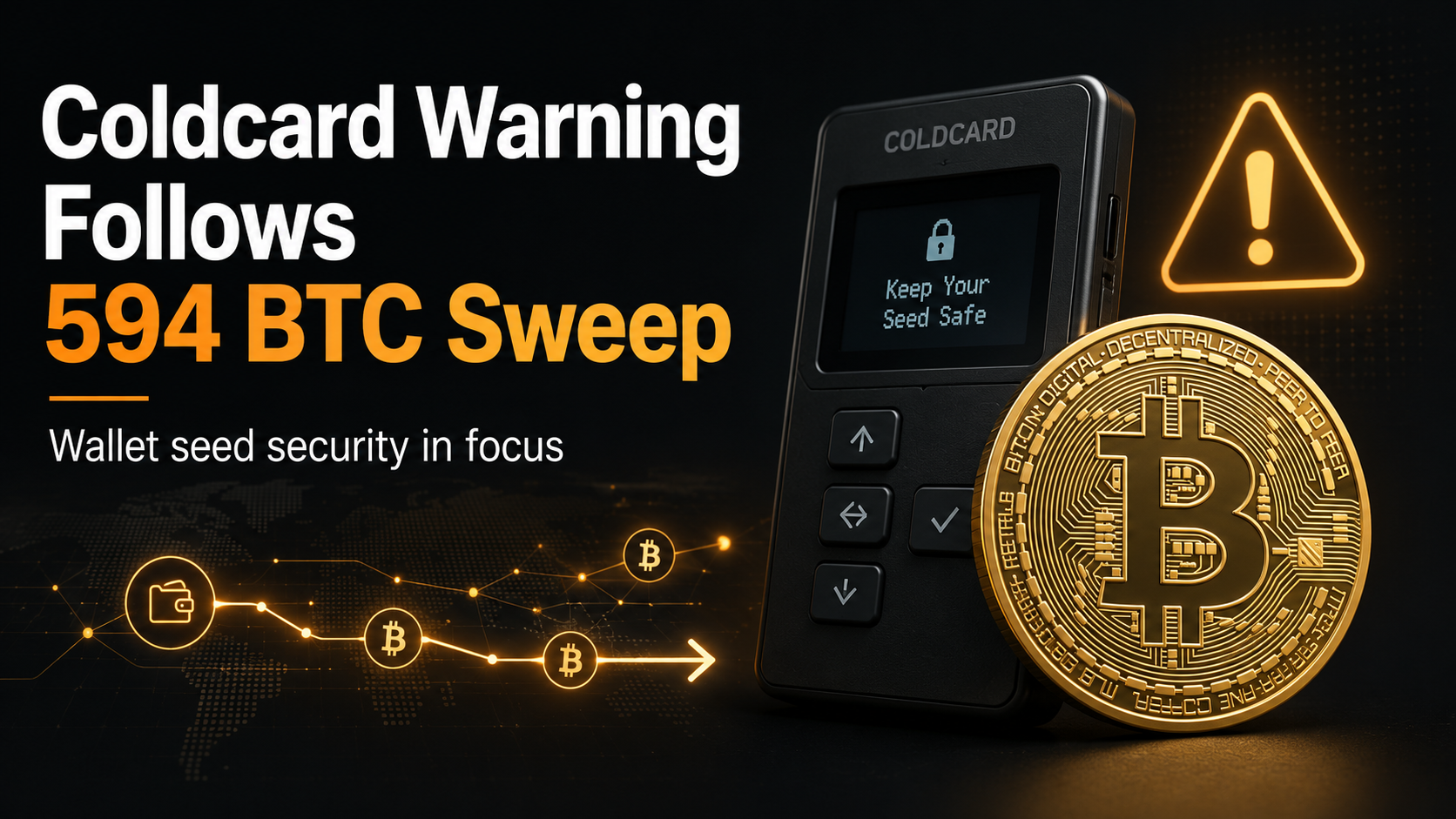
Coldcard Mk3 警告紧随 3800 万美元 Bitcoin 被扫荡事件,但原因仍未确认
比特币硬件钱包制造商Coinkite已警告用户,Coldcard设备存在种子生成问题,影响从4.0.1版本起的所有Mk3固件版本。该警告是在安全研究人员调查一起涉及594.48 BTC(约合3,800万美元)的协同转移事件时发出的。然而,目前尚无公开的技术证据证实Coldcard的问题导致了这些转账。


相关文章
查看更多
MEXC 流动性有多深?订单簿深度、滑点与第三方报告数据解析
您点击下单时的价格与实际成交的价格之间差多少,取决于流动性。本页按照第三方研究机构的衡量方式追踪 MEXC 的流动性:一是中间价上下窄区间内的订单簿(Order Book)深度,二是以实际规模模拟下单时产生的滑点(Slippage)。本页是一份持续更新的记录,收录自 2026 年 5 月以来每一份 TokenInsight 流动性报告中 MEXC 的主要结果,也包括 MEXC 排名第二或第三的项目
加息落地,BTC不跌反涨创八个月新高——利空出尽还是轧空狂欢?| MEXC Alpha Trader 投研周报
2026年9月第3周统计周期:2026年9月16日 – 9月22日数据截止:2026年9月22日核心叙事过去一周,加密市场经历了 “决议前承压——决议落地——强势反弹” 的完整周期。比特币从决议前的76,000-78,000美元区间起步,在美联储宣布加息后短暂下探,随后在财政部长债回购与ETF巨额流入的推动下强势拉升,9月21日触及 87,395美元,为2026年1月以来最高水平,单周涨幅约11%
CPI超预期引爆“加息押注”,美债收益率破5%创19年新高——市场在定价什么?| MEXC Alpha Trader 投研周报
2026年9月第2周统计周期:2026年9月9日 – 9月15日数据截止:2026年9月15日核心叙事过去一周,加密市场在通胀数据、加息预期与地缘政治的三重压制下持续承压。BTC从78,000美元附近起步,在CPI超预期与美债收益率突破5%的双重压制下逐步走低,9月11日一度下探至76,000美元附近,随后反弹至79,800美元。截至9月15日,比特币在77,000-78,000美元区间弱势整理。