TLDR SOS surges after hours despite widening losses and sharp cash depletion. SOS pivots to commodities; revenue up, but losses and cash risks grow. SOS earnings lift stock post-market as revenue jumps 48% on rubber sales. SOS revenue surges, but losses deepen and liquidity remains a concern. SOS stock rallies after hours on growth, despite [...] The post SOS Limited (SOS) Stock: Revenue Surges 48%, But Net Loss and Cash Burn Raise Red Flags appeared first on CoinCentral.TLDR SOS surges after hours despite widening losses and sharp cash depletion. SOS pivots to commodities; revenue up, but losses and cash risks grow. SOS earnings lift stock post-market as revenue jumps 48% on rubber sales. SOS revenue surges, but losses deepen and liquidity remains a concern. SOS stock rallies after hours on growth, despite [...] The post SOS Limited (SOS) Stock: Revenue Surges 48%, But Net Loss and Cash Burn Raise Red Flags appeared first on CoinCentral.

SOS Limited (SOS) Stock: Revenue Surges 48%, But Net Loss and Cash Burn Raise Red Flags

2025/09/27 05:08

TLDR

  • SOS surges after hours despite widening losses and sharp cash depletion.
  • SOS pivots to commodities; revenue up, but losses and cash risks grow.
  • SOS earnings lift stock post-market as revenue jumps 48% on rubber sales.
  • SOS revenue surges, but losses deepen and liquidity remains a concern.
  • SOS stock rallies after hours on growth, despite cash crunch and losses.

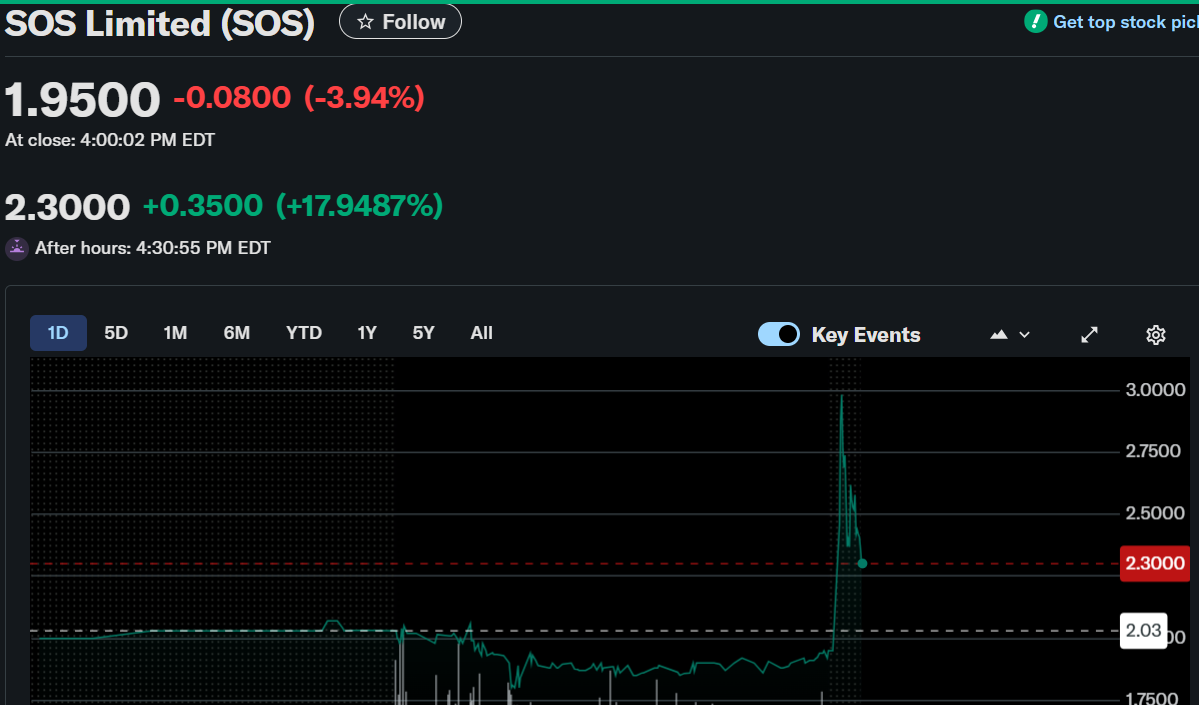
SOS stock closed at $1.95 during regular trading on September 26, 2025, down 3.94% from the prior session. However, shares surged 17.95% after hours to $2.30 following the earnings release. The contrasting stock reaction reflects optimism around revenue growth but concern over losses and cash depletion.
SOS Limited (SOS

Revenue Growth Driven by Commodities Trading

SOS Limited reported semi-annual results for the six months ended June 30, 2025. The company achieved revenue of $89.6 million, reflecting a 48.1% increase from the prior year. Growth came mainly from higher natural rubber sales as demand in China recovered steadily.

The commodities trading segment contributed 94.9% of revenue, while hosting services delivered 4.3% and others provided 0.8%. The company shifted away from cryptocurrency mining operations to focus on hosting services. Management highlighted stronger demand for third-party hosting despite suspending self-mining.

Nevertheless, despite higher revenue, SOS faced a gross loss of $1.3 million, reversing a gross profit of $2.4 million in 2024. The gross margin stood at negative 1.5%, down from a positive 4% in the previous year. Falling rubber spot prices and losses from petroleum coke weighed heavily on profitability.

Losses Widen and Costs Escalate

The company recorded a GAAP net loss of $14.2 million, a 30.3% increase from last year’s $10.9 million. Operating costs surged 56.5% to $90.9 million, outpacing revenue growth and further pressuring margins. Selling expenses rose slightly to $2.3 million, mainly due to higher transportation costs.

General and administrative expenses dropped 35% to $9.4 million as mining machines were fully impaired and required no depreciation. However, this reduction did not offset the broader rise in costs across operations. The loss per share was $(0.0139), compared with $(0.0299) a year earlier.

The company sold petroleum coke inventory at cost and absorbed over $1.6 million in losses from rubber price declines. Management emphasized a strategy of pursuing market share over short-term profitability. Competitive pricing was prioritized to maintain trading volume amid challenging conditions.

Liquidity Risks and Strategic Investments

Cash and cash equivalents fell sharply to $4.2 million from $246.7 million a year earlier. The decline of 98.3% resulted mainly from a $228.4 million prepayment for blockchain commodity trading platform development. Management described the payment as a move to secure long-term value and secure critical partner resources.

During the reporting period, the company raised $6.8 million in net proceeds through a registered direct offering under Form F-3. Despite this, liquidity remains constrained, and further capital raising plans have been confirmed. The shift underscores the company’s ongoing dependence on external funding to sustain operations.


The post SOS Limited (SOS) Stock: Revenue Surges 48%, But Net Loss and Cash Burn Raise Red Flags appeared first on CoinCentral.

Disclaimer: The articles reposted on this site are sourced from public platforms and are provided for informational purposes only. They do not necessarily reflect the views of MEXC. All rights remain with the original authors. If you believe any content infringes on third-party rights, please contact [email protected] for removal. MEXC makes no guarantees regarding the accuracy, completeness, or timeliness of the content and is not responsible for any actions taken based on the information provided. The content does not constitute financial, legal, or other professional advice, nor should it be considered a recommendation or endorsement by MEXC.

You May Also Like

Campaign For A Progressive Income Tax In Colorado Faces Setback

Campaign For A Progressive Income Tax In Colorado Faces Setback

The post Campaign For A Progressive Income Tax In Colorado Faces Setback appeared on BitcoinEthereumNews.com. Campaign to replace Colorado’s flat income tax with progressive rate structure runs into stumbling block. getty On June 22, 1987, Colorado became the first state in the nation to move from a progressive income tax code to a flat rate when then-Governor Roy Romer (D) signed House Bill 1331 into law. Now, nearly four decades later, A ballot measure campaign dubbed “Protect Colorado’s Future” (PCF) is seeking to move the state back to a progressive income tax system. “A coalition led by the Bell Policy Center is pushing the proposal, which is estimated to lower taxes for any person or company making less than $500,000 a year and raise them for those making more,” noted Ed Sealover, vice president of the Colorado Chamber of Commerce, of the effort to put a graduated income tax initiative on the 2026 ballot. “The plan’s method of calculating taxes is complex, with businesses and individuals paying different rates on different portions of income, such as the first $100,000, the amount between $100,000 and $500,000, the amount between $500,000 and $750,000, etc. But Bell estimated it will create an effective tax rate between 4.2% and 4.4% for those earning $500,000 or less and effective rates from 4.9% to 9.2% for those making more, with the highest rate reserved for businesses and individuals generating $10 million or more.” “Colorado is at a turning point,” said Bell Policy Center president and CEO Chris deGruy Kennedy at the May launch of the PCF coalition’s campaign for a progressive income tax. “For more than three decades, an upside-down tax code has hurt Colorado’s schools, health care, childcare and the environment. We’ve made the wealthy even wealthier while everyone else struggles to keep up.” However, Kennedy and other members of the PCF coalition recently encountered procedural hurdles that they must…
Share
BitcoinEthereumNews2025/10/25 00:32
The Adoption of Web3 in Europe: Current Status, Opportunities, and Challenges

The Adoption of Web3 in Europe: Current Status, Opportunities, and Challenges

How decentralization technologies are advancing in the Old Continent.
Share
The Cryptonomist2025/12/06 15:00
Why This New Trending Meme Coin Is Being Dubbed The New PEPE After Record Presale

Why This New Trending Meme Coin Is Being Dubbed The New PEPE After Record Presale

The post Why This New Trending Meme Coin Is Being Dubbed The New PEPE After Record Presale appeared on BitcoinEthereumNews.com. Crypto News 17 September 2025 | 20:13 The meme coin market is heating up once again as traders look for the next breakout token. While Shiba Inu (SHIB) continues to build its ecosystem and PEPE holds onto its viral roots, a new contender, Layer Brett (LBRETT), is gaining attention after raising more than $3.7 million in its presale. With a live staking system, fast-growing community, and real tech backing, some analysts are already calling it “the next PEPE.” Here’s the latest on the Shiba Inu price forecast, what’s going on with PEPE, and why Layer Brett is drawing in new investors fast. Shiba Inu price forecast: Ecosystem builds, but retail looks elsewhere Shiba Inu (SHIB) continues to develop its broader ecosystem with Shibarium, the project’s Layer 2 network built to improve speed and lower gas fees. While the community remains strong, the price hasn’t followed suit lately. SHIB is currently trading around $0.00001298, and while that’s a decent jump from its earlier lows, it still falls short of triggering any major excitement across the market. The project includes additional tokens like BONE and LEASH, and also has ongoing initiatives in DeFi and NFTs. However, even with all this development, many investors feel the hype that once surrounded SHIB has shifted elsewhere, particularly toward newer, more dynamic meme coins offering better entry points and incentives. PEPE: Can it rebound or is the momentum gone? PEPE saw a parabolic rise during the last meme coin surge, catching fire on social media and delivering massive short-term gains for early adopters. However, like most meme tokens driven largely by hype, it has since cooled off. PEPE is currently trading around $0.00001076, down significantly from its peak. While the token still enjoys a loyal community, analysts believe its best days may be behind it unless…
Share
BitcoinEthereumNews2025/09/18 02:50