The disagreement issue in post hoc feature attribution techniques is discussed in this study. Explainers like SHAP, LIME, and gradient-based techniques frequently result in contradictory feature importance rankings for the same model. Post hoc Explainer Agreement Regularization (PEAR), a loss term added after model training, is introduced to counteract this and promote increased explainer consensus without significantly compromising accuracy. Experiments on three datasets show that PEAR offers a customizable balance between explanation consensus and predictive performance, and it enhances agreement across explainers, including those not directly used in training. PEAR improves explanations' dependability and credibility in crucial machine learning applications by turning disagreement into a controlled parameter.The disagreement issue in post hoc feature attribution techniques is discussed in this study. Explainers like SHAP, LIME, and gradient-based techniques frequently result in contradictory feature importance rankings for the same model. Post hoc Explainer Agreement Regularization (PEAR), a loss term added after model training, is introduced to counteract this and promote increased explainer consensus without significantly compromising accuracy. Experiments on three datasets show that PEAR offers a customizable balance between explanation consensus and predictive performance, and it enhances agreement across explainers, including those not directly used in training. PEAR improves explanations' dependability and credibility in crucial machine learning applications by turning disagreement into a controlled parameter.

New AI Study Tackles the Transparency Problem in Black-Box Models

2025/09/21 13:46

:::info Authors:

(1) Avi Schwarzschild, University of Maryland, College Park, Maryland, USA and Work completed while working at Arthur (avi1umd.edu);

(2) Max Cembalest, Arthur, New York City, New York, USA;

(3) Karthik Rao, Arthur, New York City, New York, USA;

(4) Keegan Hines, Arthur, New York City, New York, USA;

(5) John Dickerson†, Arthur, New York City, New York, USA ([email protected]).

:::

Abstract and 1. Introduction

1.1 Post Hoc Explanation

1.2 The Disagreement Problem

1.3 Encouraging Explanation Consensus

  1. Related Work

  2. Pear: Post HOC Explainer Agreement Regularizer

  3. The Efficacy of Consensus Training

    4.1 Agreement Metrics

    4.2 Improving Consensus Metrics

    [4.3 Consistency At What Cost?]()

    4.4 Are the Explanations Still Valuable?

    4.5 Consensus and Linearity

    4.6 Two Loss Terms

  4. Discussion

    5.1 Future Work

    5.2 Conclusion, Acknowledgements, and References

Appendix

ABSTRACT

As neural networks increasingly make critical decisions in highstakes settings, monitoring and explaining their behavior in an understandable and trustworthy manner is a necessity. One commonly used type of explainer is post hoc feature attribution, a family of methods for giving each feature in an input a score corresponding to its influence on a model’s output. A major limitation of this family of explainers in practice is that they can disagree on which features are more important than others. Our contribution in this paper is a method of training models with this disagreement problem in mind. We do this by introducing a Post hoc Explainer Agreement Regularization (PEAR) loss term alongside the standard term corresponding to accuracy, an additional term that measures the difference in feature attribution between a pair of explainers. We observe on three datasets that we can train a model with this loss term to improve explanation consensus on unseen data, and see improved consensus between explainers other than those used in the loss term. We examine the trade-off between improved consensus and model performance. And finally, we study the influence our method has on feature attribution explanations.

1 INTRODUCTION

As machine learning becomes inseparable from important societal sectors like healthcare and finance, increased transparency of how complex models arrive at their decisions is becoming critical. In this work, we examine a common task in support of model transparency that arises with the deployment of complex black-box models in production settings: explaining which features in the input are most influential in the model’s output. This practice allows data scientists and machine learning practitioners to rank features by importance – the features with high impact on model output are considered more important, and those with little impact on model output are considered less important. These measurements inform how model users debug and quality check their models, as well as how they explain model behavior to stakeholders.

1.1 Post Hoc Explanation

The methods of model explanation considered in this paper are post hoc local feature attribution scores. The field of explainable artificial intelligence (XAI) is rapidly producing different methods of this

\ Figure 1: Our loss that encourages explainer consensus boosts the correlation between LIME and other common post hoc explainers. This comes with a cost of less than two percentage points of accuracy compared with our baseline model on the Electricity dataset. Our method improves consensus on six agreement metrics and all pairs of explainers we evaluated. Note that this plot measures the rank correlation agreement metric and the specific bar heights depend on this choice of metric.
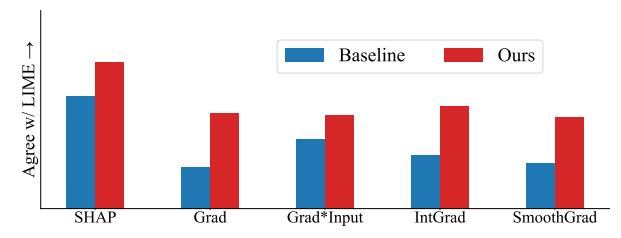
\ type to make sense of model behavior [e.g., 21, 24, 30, 32, 37]. Each of these methods has a slightly different formula and interpretation of its raw output, but in general they all perform the same task of attributing a model’s behavior to its input features. When tasked to explain a model’s output with a corresponding input (and possible access to the model weights), these methods answer the question, “How influential is each individual feature of the input in the model’s computation of the output?”

\ Data scientists are using post hoc explainers at increasing rates – popular methods like LIME and SHAP have had over 350 thousand and 6 million downloads of their Python packages in the last 30 days, respectively [23].

1.2 The Disagreement Problem

The explosion of different explanation methods leads Krishna et al. [15] to observe that when neural networks are trained naturally, i.e. for accuracy alone, often post hoc explainers disagree on how much different features influenced a model’s outputs. They coin the term the disagreement problem and argue that when explainers disagree about which features of the input are important, practitioners have little concrete evidence as to which of the explanations, if any, to trust.

\ There is an important discussion around local explainers and their true value in reaching the communal goal of model transparency and interpretability [see, e.g., 7, 18, 29]; indeed, there are ongoing discussions about the efficacy of present-day explanation methods in specific domains [for healthcare see, e.g., 8]. Feature importance estimates may fail at making a model more transparent when the model being explained is too complex to allow for easily attributing the output to the contribution of each individual feature.

\ In this paper, we make no normative judgments with respect to this debate, but rather view “explanations” as signals to be used alongside other debugging, validation, and verification approaches in the machine learning operations (MLOps) pipeline. Specifically, we take the following practical approach: make the amount of explanation disagreement a controllable model parameter instead of a point of frustration that catches stakeholders off-guard.

1.3 Encouraging Explanation Consensus

Consensus between two explainers does not require that the explainers output the same exact scores for each feature. Rather, consensus between explainers means that whatever disagreement they exhibit can be reconciled. Data scientists and machine learning practitioners say in a survey that explanations are in basic agreement if they satisfy agreement metrics that align with human intuition, which provides a quantitative way to evaluate the extent to which consensus is being achieved [15]. When faced with disagreement between explainers, a choice has to be made about what to do next – if such an arbitrary crossroads moment is avoidable via specialized model training, we believe it would be a valuable addition to a data scientist’s toolkit.

\ We propose, as our main contribution, a training routine to help alleviate the challenge posed by post hoc explanation disagreement. Achieving better consensus between explanations does not provide more interpretability to a model inherently. But, it may lend more trust to the explanations if different approaches to attribution agree more often on which features are important. This gives consensus the practical benefit of acting as a sanity check – if consensus is observed, the choice of which explainer a practitioner uses is less consequential with respect to downstream stakeholder impact, making their interpretation less subjective.

2 RELATED WORK

Our work focuses on post hoc explanation tools. Some post hoc explainers, like LIME [24] and SHAP [21], are proxy models trained atop a base machine learning model with the sole intention of “explaining” that base model. These explainers rely only on the model’s inputs and outputs to identify salient features. Other explainers, such as Vanilla Gradients (Grad) [32], Gradient Times Input (Grad*Input) [30], Integrated Gradients (IntGrad) [37] and SmoothGrad [34], do not use a proxy model but instead compute the gradients of a model with respect to input features to identify important features.[1] Each of these explainers has its quirks and there are reasons to use, or not use, them all—based on input type, model type, downstream task, and so on. But there is an underlying pattern unifying all these explanation tools. Han et al. [12] provide a framework that characterizes all the post hoc explainers used in this paper as different types of local-function approximation. For more details about the individual post hoc explainers used in this paper, we refer the reader to the individual papers and to other works about when and why to use each one [see, e.g., 5, 13].

\ We build directly on prior work that defines and explores the disagreement problem [15]. Disagreement here refers to the difference in feature importance scores between two feature attribution methods, but can be quantified several different ways as are described by the metrics Krishna et al. [15] define and use. We describe these metrics in Section 4.

\ The method we propose in this paper relates to previous work that trains models with constraints on explanations via penalties on the disagreement between feature attribution scores and handcrafted ground-truth scores [26, 27, 41]. Additionally, work has been done to leverage the disagreement between different posthoc explanations to construct new feature attribution scores that improve metrics like stability and pairwise rank agreement [2, 16, 25].

\

:::info This paper is available on arxiv under CC BY 4.0 DEED license.

:::

\

Disclaimer: The articles reposted on this site are sourced from public platforms and are provided for informational purposes only. They do not necessarily reflect the views of MEXC. All rights remain with the original authors. If you believe any content infringes on third-party rights, please contact [email protected] for removal. MEXC makes no guarantees regarding the accuracy, completeness, or timeliness of the content and is not responsible for any actions taken based on the information provided. The content does not constitute financial, legal, or other professional advice, nor should it be considered a recommendation or endorsement by MEXC.

You May Also Like

American Bitcoin’s $5B Nasdaq Debut Puts Trump-Backed Miner in Crypto Spotlight

American Bitcoin’s $5B Nasdaq Debut Puts Trump-Backed Miner in Crypto Spotlight

The post American Bitcoin’s $5B Nasdaq Debut Puts Trump-Backed Miner in Crypto Spotlight appeared on BitcoinEthereumNews.com. Key Takeaways: American Bitcoin (ABTC) surged nearly 85% on its Nasdaq debut, briefly reaching a $5B valuation. The Trump family, alongside Hut 8 Mining, controls 98% of the newly merged crypto-mining entity. Eric Trump called Bitcoin “modern-day gold,” predicting it could reach $1 million per coin. American Bitcoin, a fast-rising crypto mining firm with strong political and institutional backing, has officially entered Wall Street. After merging with Gryphon Digital Mining, the company made its Nasdaq debut under the ticker ABTC, instantly drawing global attention to both its stock performance and its bold vision for Bitcoin’s future. Read More: Trump-Backed Crypto Firm Eyes Asia for Bold Bitcoin Expansion Nasdaq Debut: An Explosive First Day ABTC’s first day of trading proved as dramatic as expected. Shares surged almost 85% at the open, touching a peak of $14 before settling at lower levels by the close. That initial spike valued the company around $5 billion, positioning it as one of 2025’s most-watched listings. At the last session, ABTC has been trading at $7.28 per share, which is a small positive 2.97% per day. Although the price has decelerated since opening highs, analysts note that the company has been off to a strong start and early investor activity is a hard-to-find feat in a newly-launched crypto mining business. According to market watchers, the listing comes at a time of new momentum in the digital asset markets. With Bitcoin trading above $110,000 this quarter, American Bitcoin’s entry comes at a time when both institutional investors and retail traders are showing heightened interest in exposure to Bitcoin-linked equities. Ownership Structure: Trump Family and Hut 8 at the Helm Its management and ownership set up has increased the visibility of the company. The Trump family and the Canadian mining giant Hut 8 Mining jointly own 98 percent…
Share
BitcoinEthereumNews2025/09/18 01:33
Solana News: SOL Faces Liquidity Crunch as $500M in Longs Sit on the Brink

Solana News: SOL Faces Liquidity Crunch as $500M in Longs Sit on the Brink

The post Solana News: SOL Faces Liquidity Crunch as $500M in Longs Sit on the Brink appeared on BitcoinEthereumNews.com. Key Insights On-chain insights suggest Solana liquidity has thinned to levels typically seen in a bear market. Institutional capital continues to pour into spot Solana ETFs, which have seen $17.72 million in net inflows this week, almost matching last week’s $20.30 million. Roughly $500 million in long positions could be exposed if the price slips just 5.5%. On-chain insights suggest Solana’s liquidity has thinned to levels typically seen in a bear market. According to a top analyst,  roughly $500 million in long positions could be exposed if the price slips just 5.5%. Meanwhile, Bitcoin’s mid-week buying burst lifted most major altcoins. Even so, Solana isn’t sharing in that confidence. Its liquidity continues to pull back, and the overall market remains uneasy, leaving the token on fragile footing despite the recent lift across the sector. Solana Realized Losses Outpace Profits as Liquidity Shrinks Solana’s 30-day average realized profit-to-loss ratio has remained below one since mid-November, according to a Wednesday tweet from on-chain analytics platform Glassnode. A ratio under one shows that realized losses are outpacing profits. This suggests liquidity has contracted to levels typically seen in a bear market. Solana realized profit/loss ratio data by Glassnode A tweet by Altcoin Vector pointed out that Solana is undergoing a full liquidity reset. This signal has marked the start of new liquidity cycles in the past and often leads to bottoming phases. If the current pattern mirrors April’s setup, a market reignition could take about four more weeks, potentially lining up with early January. The reset is being driven by several factors. Realized losses are prompting sell-offs, futures open interest is declining, market-makers are pulling back, and liquidity is fragmenting across trading pools. The mid- to long-term outlook for the market remains slightly bullish, particularly if macroeconomic pressures ease. In the near term,…
Share
BitcoinEthereumNews2025/12/11 14:11
Best Crypto to Buy as Saylor & Crypto Execs Meet in US Treasury Council

Best Crypto to Buy as Saylor & Crypto Execs Meet in US Treasury Council

The post Best Crypto to Buy as Saylor & Crypto Execs Meet in US Treasury Council appeared on BitcoinEthereumNews.com. Michael Saylor and a group of crypto executives met in Washington, D.C. yesterday to push for the Strategic Bitcoin Reserve Bill (the BITCOIN Act), which would see the U.S. acquire up to 1M $BTC over five years. With Bitcoin being positioned yet again as a cornerstone of national monetary policy, many investors are turning their eyes to projects that lean into this narrative – altcoins, meme coins, and presales that could ride on the same wave. Read on for three of the best crypto projects that seem especially well‐suited to benefit from this macro shift:  Bitcoin Hyper, Best Wallet Token, and Remittix. These projects stand out for having a strong use case and high adoption potential, especially given the push for a U.S. Bitcoin reserve.   Why the Bitcoin Reserve Bill Matters for Crypto Markets The strategic Bitcoin Reserve Bill could mark a turning point for the U.S. approach to digital assets. The proposal would see America build a long-term Bitcoin reserve by acquiring up to one million $BTC over five years. To make this happen, lawmakers are exploring creative funding methods such as revaluing old gold certificates. The plan also leans on confiscated Bitcoin already held by the government, worth an estimated $15–20B. This isn’t just a headline for policy wonks. It signals that Bitcoin is moving from the margins into the core of financial strategy. Industry figures like Michael Saylor, Senator Cynthia Lummis, and Marathon Digital’s Fred Thiel are all backing the bill. They see Bitcoin not just as an investment, but as a hedge against systemic risks. For the wider crypto market, this opens the door for projects tied to Bitcoin and the infrastructure that supports it. 1. Bitcoin Hyper ($HYPER) – Turning Bitcoin Into More Than Just Digital Gold The U.S. may soon treat Bitcoin as…
Share
BitcoinEthereumNews2025/09/18 00:27
