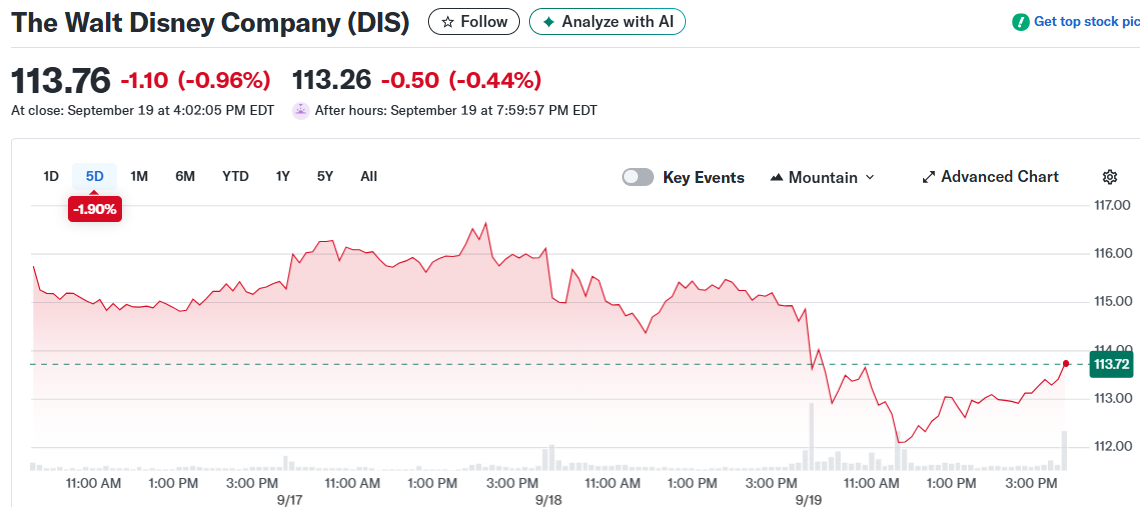
TLDR Disney stock dropped 1.9% over the week, closing at $113.76 down from $115.96 high ABC suspended Jimmy Kimmel’s show after controversial remarks, sparking immediate market reaction Streaming segment turned profitable with ESPN partnerships driving growth Traditional TV division continues facing subscriber decline challenges Analysts maintain positive outlook with $5.85 EPS guidance for full year [...] The post Disney (DIS) Stock Takes Hit as Kimmel Controversy Rocks ABC Network appeared first on CoinCentral.TLDR Disney stock dropped 1.9% over the week, closing at $113.76 down from $115.96 high ABC suspended Jimmy Kimmel’s show after controversial remarks, sparking immediate market reaction Streaming segment turned profitable with ESPN partnerships driving growth Traditional TV division continues facing subscriber decline challenges Analysts maintain positive outlook with $5.85 EPS guidance for full year [...] The post Disney (DIS) Stock Takes Hit as Kimmel Controversy Rocks ABC Network appeared first on CoinCentral.

Disney (DIS) Stock Takes Hit as Kimmel Controversy Rocks ABC Network

TLDR

  • Disney stock dropped 1.9% over the week, closing at $113.76 down from $115.96 high
  • ABC suspended Jimmy Kimmel’s show after controversial remarks, sparking immediate market reaction
  • Streaming segment turned profitable with ESPN partnerships driving growth
  • Traditional TV division continues facing subscriber decline challenges
  • Analysts maintain positive outlook with $5.85 EPS guidance for full year

Disney shares experienced a bumpy ride this week, closing at $113.76 after falling from a weekly high of $115.96. The 1.9% decline came as the entertainment giant navigated both operational challenges and media-related controversies.
The Walt Disney Company (DIS)The Walt Disney Company (DIS)

Trading volume peaked at nearly 8.9 million shares during Friday’s session. The stock moved within a $111.93 to $114.22 range over the past two days.

Disney’s market cap sits at $204.5 billion with a trailing P/E ratio of 18.17. This valuation aligns with historical media sector benchmarks.

The company had been struggling to break through resistance levels around $117-$118 throughout September. Previous gains earlier in the month proved short-lived as selling pressure emerged.

Streaming Success Meets Broadcasting Turbulence

Disney’s direct-to-consumer streaming business recently turned profitable, marking a key milestone. ESPN’s digital transformation and new partnership deals have generated analyst optimism about future revenue streams.

However, the traditional television division continues facing headwinds. Linear TV subscriber declines and Disney+ pricing concerns remain investor worries.

The company’s latest quarterly results showed mixed signals across different segments. While streaming profits improved, entertainment division challenges persisted.

ABC’s decision to suspend Jimmy Kimmel’s show created immediate market volatility. The move followed politically charged on-air comments that sparked public debate.

Celebrity Mark Ruffalo publicly criticized the suspension decision on social media. His comments suggested the cancellation could hurt Disney’s stock performance further.

Initial reports indicated a 7% stock drop following the ABC announcement. However, the actual closing decline proved less severe at around 2% for the trading session.

Analyst Confidence Remains Strong

Despite recent challenges, no Wall Street analysts issued sell ratings on Disney shares. The research community maintains a generally constructive view on the company’s long-term prospects.

Theme park investments have started generating improved returns according to recent financial data. The parks and experiences division continues showing steady operating profit growth.

Management reaffirmed full-year earnings guidance of $5.85 per share. This target assumes double-digit gains in entertainment and sports segments.

Disney’s international expansion plans include additional theme park developments. The company also plans deeper partnerships with NFL and WWE for ESPN content.

Free cash flow remains strong despite moderate debt levels across the business. This financial position supports continued share buyback programs and dividend payments.

The current dividend yield stands near 0.88% for income-focused investors. Disney’s balance sheet provides flexibility for strategic investments and shareholder returns.

Recent streaming price increases have created some subscriber churn concerns. Management continues balancing revenue growth with customer retention strategies.

ESPN’s digital pivot represents a major strategic shift for the sports broadcasting unit. New distribution partnerships could unlock additional revenue opportunities in coming quarters.

Disney’s exposure to high-profile media events highlights ongoing portfolio risks. The entertainment business remains sensitive to public relations challenges and content controversies.

The November earnings report will provide updated guidance on streaming subscriber trends and theme park performance metrics.

The post Disney (DIS) Stock Takes Hit as Kimmel Controversy Rocks ABC Network appeared first on CoinCentral.

Market Opportunity
1 Logo
1 Price(1)
$0,006859
$0,006859$0,006859
+41,94%
USD
1 (1) Live Price Chart
Disclaimer: The articles reposted on this site are sourced from public platforms and are provided for informational purposes only. They do not necessarily reflect the views of MEXC. All rights remain with the original authors. If you believe any content infringes on third-party rights, please contact [email protected] for removal. MEXC makes no guarantees regarding the accuracy, completeness, or timeliness of the content and is not responsible for any actions taken based on the information provided. The content does not constitute financial, legal, or other professional advice, nor should it be considered a recommendation or endorsement by MEXC.

You May Also Like

What We Know (and Don’t) About Modern Code Reviews

What We Know (and Don’t) About Modern Code Reviews

This article traces the evolution of modern code review from formal inspections to tool-driven workflows, maps key research themes, and highlights a critical gap
Share
Hackernoon2025/12/17 17:00
X claims the right to share your private AI chats with everyone under new rules – no opt out

X claims the right to share your private AI chats with everyone under new rules – no opt out

X says its Terms of Service will change Jan. 15, 2026, expanding how the platform defines user “Content” and adding contract language tied to the operation and
Share
CryptoSlate2025/12/17 19:24
Michael Saylor Pushes Digital Capital Narrative At Bitcoin Treasuries Unconference

Michael Saylor Pushes Digital Capital Narrative At Bitcoin Treasuries Unconference

The post Michael Saylor Pushes Digital Capital Narrative At Bitcoin Treasuries Unconference appeared on BitcoinEthereumNews.com. The suitcoiners are in town.  From a low-key, circular podium in the middle of a lavish New York City event hall, Strategy executive chairman Michael Saylor took the mic and opened the Bitcoin Treasuries Unconference event. He joked awkwardly about the orange ties, dresses, caps and other merch to the (mostly male) audience of who’s-who in the bitcoin treasury company world.  Once he got onto the regular beat, it was much of the same: calm and relaxed, speaking freely and with confidence, his keynote was heavy on the metaphors and larger historical stories. Treasury companies are like Rockefeller’s Standard Oil in its early years, Michael Saylor said: We’ve just discovered crude oil and now we’re making sense of the myriad ways in which we can use it — the automobile revolution and jet fuel is still well ahead of us.  Established, trillion-dollar companies not using AI because of “security concerns” make them slow and stupid — just like companies and individuals rejecting digital assets now make them poor and weak.  “I’d like to think that we understood our business five years ago; we didn’t.”  We went from a defensive investment into bitcoin, Saylor said, to opportunistic, to strategic, and finally transformational; “only then did we realize that we were different.” Michael Saylor: You Come Into My Financial History House?! Jokes aside, Michael Saylor is very welcome to the warm waters of our financial past. He acquitted himself honorably by invoking the British Consol — though mispronouncing it, and misdating it to the 1780s; Pelham’s consolidation of debts happened in the 1750s and perpetual government debt existed well before then — and comparing it to the gold standard and the future of bitcoin. He’s right that Strategy’s STRC product in many ways imitates the consols; irredeemable, perpetual debt, issued at par, with…
Share
BitcoinEthereumNews2025/09/18 02:12