

US Acting AG: Devs Not Charged Without Proven Intent to Aid Crimes
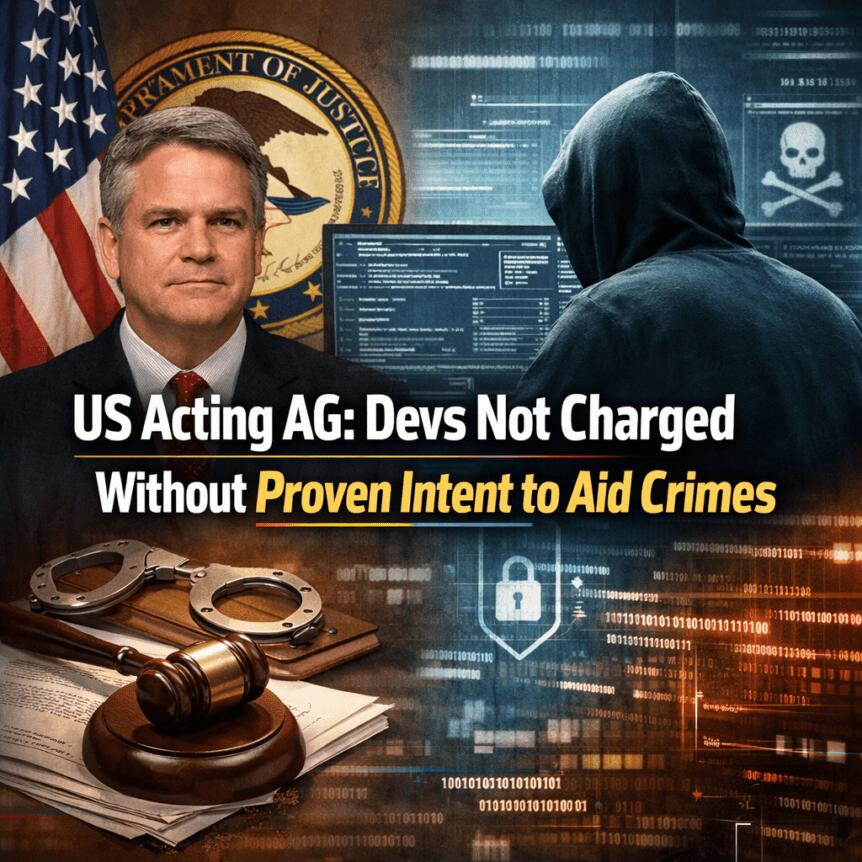
Acting U.S. Attorney General Todd Blanche signaled a notable shift in how federal authorities approach blockchain development, indicating that the Department of Justice (DOJ) and the FBI will not target developers merely because their platforms are used for illicit activity. Speaking at a Las Vegas Bitcoin conference alongside FBI Director Kash Patel and Coinbase chief legal officer Paul Grewal, Blanche framed the enforcement posture as a change in tone and strategy that prioritizes the behavior of users over the creators of software tools.
According to Cointelegraph, Blanche explained that as long as developers have no involvement in illicit activity and do not knowingly facilitate wrongdoing, the DOJ and FBI should not pursue them. He asserted that authorities have fundamentally changed the dynamic of investigations, underscoring a shift away from prosecuting developers who merely provide noncustodial or widely available software.
Blanche’s remarks come after years during which federal authorities pursued aggressive actions against platforms associated with privacy-enhancing technologies. The acting attorney general emphasized that developers who are not involved in wrongdoing should not be the targets of enforcement actions. The message is that a platform’s mere existence or the noncustodial nature of its tools should not automatically invite liability, a departure from earlier narratives that linked tool developers to potential criminal misuse.
“The basic principle is that if you are developing software, if you are a coder, if you are part of that process and you are not the third-party user, and you are not helping and knowing the third party is using what you developed to commit crimes, you are not going to be investigated and not going to be charged,” Blanche stated.
These comments reflect a broader regulatory philosophy shift that some in the crypto community view as a potential opening for developers to operate with greater clarity. Still, observers caution that the real measure of this policy will be its application in court and regulatory programs, particularly as enforcement agencies continue to draw lines around what constitutes “knowing” assistance or complicity in illicit activity.
The shift in rhetoric diverges from the DOJ’s earlier high-profile actions against cryptocurrency platforms associated with privacy tooling. One emblematic case involved Tornado Cash, a crypto mixer that faced sanctions from the Office of Foreign Assets Control (OFAC) in August 2022 for facilitating illicit activity before sanctions were lifted in November 2024. In the ensuing legal saga, developers Roman Storm and Roman Semenov were indicted in August 2023, with Storm later convicted in August 2025 and Semenov remaining at large. Storm has denied wrongdoing. These cases have been central to debates about whether publishing or maintaining open-source software could expose developers to liability for users’ misconduct.
Blanche’s appearance and remarks were met with cautious optimism by sections of the crypto community, even as questions about legal clarity persist. Critics argue that while the message is more measured than in recent years, it stops short of delivering precise guidance on where the line lies between publishing noncustodial software and “helping” or “knowing” about a bad actor’s use of that software. Peter Van Valkenburgh, executive director of Coin Center, described the message as a step forward but continued to press for clearer standards. He noted on social media that the key question remains how the DOJ delineates the boundary between open-source publishing and actionable knowledge of wrongdoing.
The current discourse sits within a broader regulatory milieu. In April 2025, Blanche issued a memo outlining a refreshed enforcement framework designed to reduce “regulation by prosecution” and to limit actions against developers absent direct involvement in illicit activity. He reiterated that the DOJ does not intend to impose broad liability on platforms merely because users may misuse them, a stance that could influence risk assessments, licensing decisions, and compliance programs across the crypto ecosystem.
Key takeaways
- The DOJ and FBI indicate a policy shift toward pursuing users of crypto platforms who engage in financial crime, rather than targeting developers absent involvement in illicit activity.
- A public memo from April 2025 formalizes the goal of ending regulation by prosecution and reframing enforcement around actual misuse by end users.
- Historical enforcement against Tornado Cash and related cases illustrate ongoing tensions between innovation, privacy tools, and regulatory oversight, underscoring the unsettled nature of legal standards for developers.
- Industry observers caution that while the message improves clarity, meaningful guidance on where to draw the line between open-source publishing and knowingly aiding wrongdoing remains incomplete.
- Regulatory implications extend to institutional actors—exchanges, banks, and compliance programs—who must reassess risk models, licensing expectations, and cross-border considerations in light of evolving enforcement posture.
Shifting enforcement posture and its practical implications
According to Cointelegraph, Blanche’s comments reflect a deliberate recalibration of how federal authorities pursue accountability in the crypto space. The emphasis is on user-focused enforcement, with developers not implicated by default when their tools are exploited for crime if they do not participate in or knowingly enable illicit conduct. This reframing has practical repercussions for compliance offices within crypto firms and for developers who maintain open-source or noncustodial projects. Institutions are urged to reexamine risk controls around product design, governance, and disclosure practices to ensure they align with a more nuanced liability landscape.
From a policy perspective, the remarks intersect with broader regulatory debates in the United States and abroad. While the EU’s MiCA framework advances a different regulatory approach to crypto assets and service providers, the core objective—reducing illicit finance risk while supporting innovation—remains a common thread. For U.S. firms, the evolving enforcement posture may influence licensing strategies, due diligence protocols, and the scope of permissible research and development activities, particularly for tools that facilitate privacy-preserving transactions or cross-border transfers.
Historical context and ongoing legal questions
The Tornado Cash episode remains a reference point in discussions about developer liability. OFAC designated Tornado Cash in 2022 due to its role in facilitating illicit activity, a designation that was subsequently reversed in 2024. Indictments against developers followed in 2023, with courtroom outcomes continuing to shape the legal landscape. The Storm/Semenov arc underscored the tension between open-source software and regulatory oversight, raising questions about how much responsibility developers bear for user misuses and at what point publishing noncustodial tools could cross into criminal liability.
Critics point to a case involving Michael Lewellen, who challenged the DOJ for pre-enforcement clarity on whether his Ethereum-based crowdfunding tool could constitute money transmission. The related suit was dismissed in 2024, with a Texas court finding no credible threat of enforcement. Coin Center’s Van Valkenburgh used this backdrop to argue that the DOJ must provide clearer standards; otherwise, developers may continue to “sleep with one eye open.” The tension between a need for clarity and the DOJ’s willingness to pursue the line between lawful publishing and knowledge of wrongdoing remains a core issue for policy makers and industry participants alike.
Regulatory, institutional, and market structure implications
For regulated entities and financial institutions engaging with crypto markets, Blanche’s framing could influence supervisory expectations and compliance workflows. If developers are shielded from liability absent direct involvement in illicit activity, risk assessment models may shift focus toward end-user behavior, platform governance, and feature-level risk controls rather than broad liabilities placed on tool creators. Banks and exchanges may need to adjust AML/KYC frameworks, conduct risk parameters, and due-diligence processes for a wider set of service providers and counterparties in the ecosystem. The enforcement paradigm that prioritizes factual involvement over platform design could also affect licensing considerations and cross-border cooperation in investigations, aligning U.S. practice with evolving international standards while preserving space for continued technical innovation.
As policy discussions advance, observers expect continued scrutiny of “how much is too much” when it comes to publishing code and maintaining open-source software that can be used for both legitimate and illicit purposes. The conversation is likely to feed into ongoing regulatory debates, including the balance between privacy-enhancing technologies and compliance obligations, and the role of civil enforcement in shaping platform development and distribution of noncustodial tools.
Closing perspective
The DOJ’s evolving enforcement stance, as articulated at the Las Vegas conference, signals a notable attempt to recalibrate the interaction between regulation and innovation. While the shift toward prosecuting users rather than developers may reduce some near-term legal risk for platform creators, the landscape remains nuanced and uncertain. Practitioners should monitor how courts interpret “knowing” assistance and how regulatory agencies translate high-level policy into concrete guidance for developers, distributors, and financial institutions operating in a globally interconnected crypto economy.
This article was originally published as US Acting AG: Devs Not Charged Without Proven Intent to Aid Crimes on Crypto Breaking News – your trusted source for crypto news, Bitcoin news, and blockchain updates.


You May Also Like

Turkey reveals domestic tax support and overseas incentives
Pudgy Penguins (PENGU) Hits 3-Month Peak Amid NFT Token Revival




