TLDR Apple stock plunged at $254.43on Sept. 24 down by 1.26% YTD but behind Big Tech peers. UBS data shows strong wait times for iPhone 17 Base but muted demand for higher-end models. ASP growth may be limited by pricing strategy favoring entry-level buyers. The iPhone 17 Air’s $999 redesign and China subsidies boost near-term [...] The post Apple Inc. ($AAPL) Stock: Turns Positive in 2025 After iPhone 17 Launch appeared first on CoinCentral.TLDR Apple stock plunged at $254.43on Sept. 24 down by 1.26% YTD but behind Big Tech peers. UBS data shows strong wait times for iPhone 17 Base but muted demand for higher-end models. ASP growth may be limited by pricing strategy favoring entry-level buyers. The iPhone 17 Air’s $999 redesign and China subsidies boost near-term [...] The post Apple Inc. ($AAPL) Stock: Turns Positive in 2025 After iPhone 17 Launch appeared first on CoinCentral.

Apple Inc. ($AAPL) Stock: Turns Positive in 2025 After iPhone 17 Launch

2025/09/25 00:24

TLDR

  • Apple stock plunged at $254.43on Sept. 24 down by 1.26% YTD but behind Big Tech peers.

  • UBS data shows strong wait times for iPhone 17 Base but muted demand for higher-end models.

  • ASP growth may be limited by pricing strategy favoring entry-level buyers.

  • The iPhone 17 Air’s $999 redesign and China subsidies boost near-term demand.

  • Apple still lags Microsoft and Google in AI, with major Siri updates delayed until 2026.

Apple Inc. (AAPL) shares were down 1.21% as of 12:46 PM EDT, dropping from around $254.43 to $251.36.
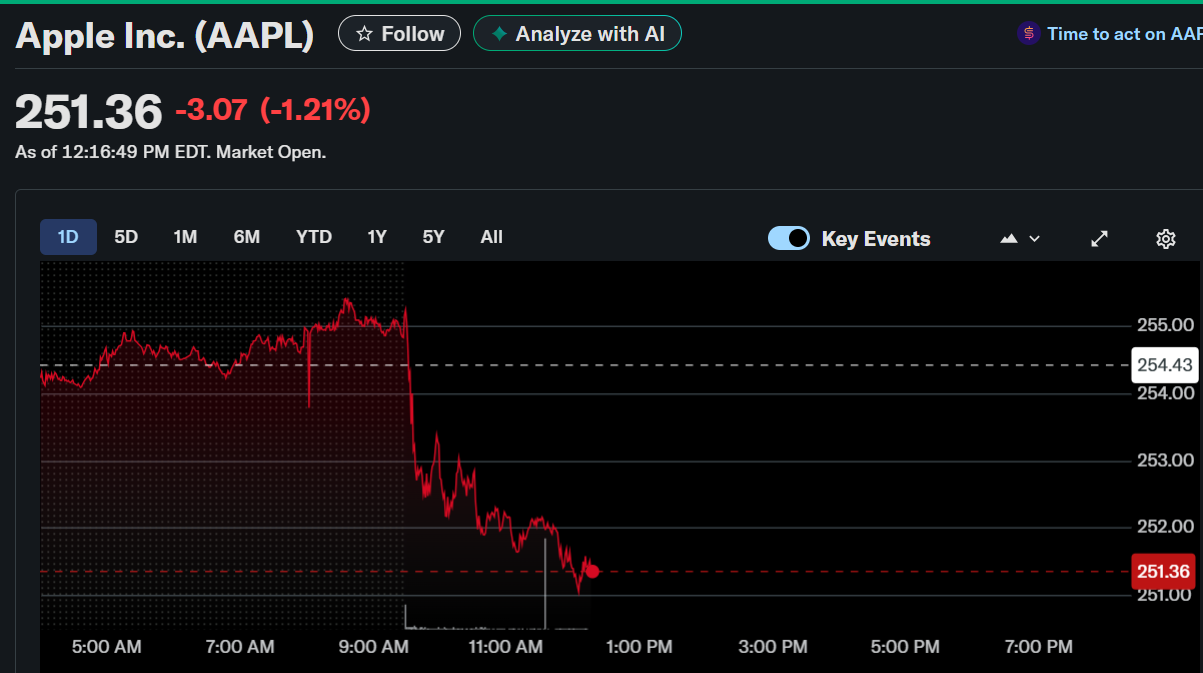
Apple Inc. (AAPL)

With these gains, Apple has erased its 2025 losses, now up 1.96% year-to-date, though still trailing the S&P 500’s 13.18% rise. The September 25 earnings report will give further clarity on Apple’s momentum.

The rally followed strong initial demand for Apple’s newly launched iPhone 17 lineup. Shares climbed 4% earlier this week as shipping times lengthened for the redesigned iPhone Air, signaling healthy interest heading into the holiday quarter.

UBS warns of ASP pressure

Despite the positive stock reaction, UBS analysts flagged potential risks for Apple’s average selling price. Evidence Lab data showed “elevated year-over-year wait times” for the iPhone 17 Base model across 30 tracked markets, while demand for higher-end models like the Pro Max looked flatter.

In the U.S., wait times for the iPhone 17 Base stretched to 18 days versus 11 days for the iPhone 16 Base. In China, wait times jumped to 25 days compared with 9 days for last year’s model, which UBS partly attributed to subsidies. However, the analysts noted that heavy mixing toward entry-level models may dampen ASP upside this quarter.

Apple’s pricing strategy

UBS pointed to Apple’s strategic pricing adjustments. The Base model now starts with 256GB storage, effectively lowering its price per gigabyte, while the Air and Pro models saw implied price increases. This mix could weigh on revenue per unit even if total shipments grow.

The $999 iPhone Air is proving a strong draw, being Apple’s first major redesign in years. Bank of America analysts reported longer delivery windows of 18 days for the Air compared with just 10 days for last year’s iPhone 16.

Broader product ecosystem and AI lag

Apple’s fall lineup also included new AirPods Pro 3 and the latest Apple Watch, which introduced AI-driven health features such as blood pressure risk alerts. Still, the company lags competitors in AI innovation. A major Siri update isn’t expected until 2026, leaving Apple behind Microsoft and Google, both of which have heavily invested in AI this year.

Performance overview

Looking beyond 2025, Apple remains a long-term outperformer. The company has returned 12.87% over the past year and 144.18% over five years, compared with the S&P 500’s 16.41% and 105.66% gains, respectively. Yet the near-term focus rests squarely on the iPhone 17’s holiday season performance and whether Apple can sustain momentum despite ASP concerns and AI challenges.

The post Apple Inc. ($AAPL) Stock: Turns Positive in 2025 After iPhone 17 Launch appeared first on CoinCentral.

Disclaimer: The articles reposted on this site are sourced from public platforms and are provided for informational purposes only. They do not necessarily reflect the views of MEXC. All rights remain with the original authors. If you believe any content infringes on third-party rights, please contact [email protected] for removal. MEXC makes no guarantees regarding the accuracy, completeness, or timeliness of the content and is not responsible for any actions taken based on the information provided. The content does not constitute financial, legal, or other professional advice, nor should it be considered a recommendation or endorsement by MEXC.

You May Also Like

Solana Price Stalls as Validator and Address Counts Collapse

Solana Price Stalls as Validator and Address Counts Collapse

The post Solana Price Stalls as Validator and Address Counts Collapse  appeared on BitcoinEthereumNews.com. Since mid-November, the Solana price has been resonating within a narrow consolidation of $145 and $125. Solana’s validator count collapsed from 2,500 to ~800 over two years, raising questions about economic sustainability. The number of active addresses on the Solana network recorded a sharp decline from 9.08 million in January 2025 to 3.75 million now, indicating a drop in user participation. On Tuesday, the crypto market witnessed a notable spike in buying pressure, leading major assets like Bitcoin, Ethereum, and Solana to a fresh recovery. However, the Solana price faced renewed selling at $145, evidenced by a long-wick rejection in the daily candle. The headwinds can be linked to networks facing scrutiny following a notable decline in active validators and active addresses.  Validator Exodus Exposes Economic Pressure on Solana Operators The layer-1 blockchain Solana has witnessed a sharp decline in the number of its validators from 2,500 in early 2023 to around 800 in late 2025, according to Solanacompass data. The collapse has caused an ecosystem divide between opposing camps. One side lauds the trend, arguing that the exodus comprises nearly exclusively unreal identities and poor-quality nodes that were gaming rewards without providing real hardware and uptime. In their view, narrowing the list down to a smaller number of committed validators strengthened the network rather than cooled it down. Infrastructure providers that work directly with node operators have a different story to tell. Teams like Layer 33, which is a collective of 25 independent Solana validators, say, “We personally know the teams shutting down. It is not mostly Sybils.” These operators cited increasing server costs, thin staking yields because of commission cuts, and increasing complexity of keeping nodes profitable as reasons for shutting down. Both sides agree on one thing: raw validator numbers don’t tell us much in and of…
Share
BitcoinEthereumNews2025/12/10 12:05
Surges to $94K One Day Ahead of Expected Fed Rate Cut

Surges to $94K One Day Ahead of Expected Fed Rate Cut

The post Surges to $94K One Day Ahead of Expected Fed Rate Cut appeared on BitcoinEthereumNews.com. What started as a slow U.S. morning on crypto markets has taken a quick turn, with bitcoin BTC$92,531.15 re-taking the $94,000 level. Hovering just above $90,000 earlier in the day, the largest crypto surged back to $94,000 minutes after 16:00 UTC, gaining more than $3,000 in less than an hour and up 4% over the past 24 hours. Ethereum’s ether ETH$3,125.08 jumped 5% during the same period, while native tokens of ADA$0.4648 and Chainlink LINK$14.25 climbed even more. The action went down while silver climbed to fresh record highs above $60 per ounce. While broader equity markets remained flat, crypto stocks followed bitcoin’s advance. Digital asset investment firm Galaxy (GLXY) and bitcoin miner CleanSpark (CLSK) led with gains of more than 10%, while Coinbase (COIN), Strategy (MSTR) and BitMine (BMNR) were up 4%-6%. While there was no single obvious catalyst for the quick move higher, BTC for weeks has been mostly selling off alongside the open of U.S. markets. Today’s change of pattern could point to seller exhaustion. Vetle Lunde, lead analyst at K33 Research, pointed to “deeply defensive” positioning on crypto derivatives markets with investors concerned about further weakness, and crowded positioning possibly contributing to the quick snapback. Further signs of bear market capitulation also emerged on Tuesday with Standard Chartered bull Geoff Kendrick slashing his outlook for the price of bitcoin for the next several years. The Coinbase bitcoin premium, which shows the BTC spot price difference on U.S.-centric exchange Coinbase and offshore exchange Binance, has also turned positive over the past few days, signaling U.S. investor demand making a comeback. Looking deeper into market structure, BTC’s daily price gain outpaced the rise in open interest on the derivatives market, suggesting that spot demand is fueling the rally instead of leverage. The Federal Reserve is expected to lower…
Share
BitcoinEthereumNews2025/12/10 11:51