

- Quick Buy/SellBuy & sell with cards and mobile payments
- P2PTrade with local payments at best prices
- Fiat DepositDeposit in BRL, COP, EUR, and more
- Global Bank TransferBuy and sell via local banks
- MEXC CardSpend your crypto worldwide
- SpotBuy and sell crypto with ease
- RealStocksTrade top US equities directly with crypto
- ConvertSwap hot tokens instantly with 0 fees
- Pre-MarketGet in early before official listings
- MX ZoneUnlock exclusive perks with MX
- Spot DCASteady growth through ups and downs
- Spot GridBuy low and sell high 24/7
- Meme+Discover on-chain gems early
- On-ChainYour unified hub for discovering, trading, and managing on-chain assets
- USDT-MPerpetual Futures settled in USDT
- USDC-MPerpetual Futures settled in USDC
- USD1-MPerpetual Futures settled in USD1
- Coin-MPerpetual Futures settled in other cryptos
- Futures EarnEarn up to 20% APR on your Futures funds
- AI StrategyConvert ideas into strategic action
- Grid TradingCapture volatility with automated trading
- Copy Trade × AIFollow seasoned traders or strategize with AI
- Demo TradingSimulate Futures trading risk-free
- Futures OverviewExplore Futures tools, products, and features
- GOLD Futures24/7 access to top liquidity & leveraged power
- OIL Futures24/7 access to top liquidity & leveraged trading
- SILVER FuturesTrade with 0 fees, top liquidity, and flexible leverage.
- BTC FuturesMarket's lowest fees and high leverage
- ETH FuturesMarket's lowest fees and high leverage
- ZEC Futures SurgeEnjoy 0 fees, up to 150× leverage, and top position capacity at 21×+ leverage
- MEXC EarnEarn high APR on your crypto
- Hold and EarnHold assets and earn interest daily
- Futures EarnEarn on balance and unlock higher APR as you trade
- On-Chain EarnEasy staking. Real on-chain yield
- MEXC LoansBorrow instantly at competitive rates
- Rewards HubGet started with $10,000 in bonuses
- Event CenterHigher rewards, 0 fees
- Invite and EarnInvite friends and earn 140 USDT each
- LaunchpadAccess top tokens early or at a discount
- $500K TSLA FeverWin TSLAX, TSLAON & more!
- Airdrop+Deposit and trade to claim new airdrops
- KickstarterHold MX to earn new tokens
- RealStocks PNL Rate LeaderboardTrade $100 to win up to $10,000 in stock rewards
- 0 FeesTrade hot futures, enjoy limited 0 fees
- Futures M-DayTrade Futures and claim daily rewards
- Futures Loss Coverage PlanGet triple protection and win $5,000 in XAUT
- Referral ProgramInvite friends and unlock commissions from 40%
- Affiliate ProgramTop-tier affiliate commissions up to 70%
- MEXC VVIPM-Score into Wealth, 10+ Elite Benefits Upgrading
- MEXC × TradingViewConnect MEXC to trade directly on TradingView
- Crypto NewsFollow the latest crypto headlines
- AnnouncementsStay on top of every happening on MEXC
- LearnStrong crypto fundamentals for every beginner
- MEXC InstitutionalTailored solutions for institutional clients
Pump.fun vs Fomo: Can onchain trading go mainstream?
Overview
Pump.fun vs Fomo has become a test of whether competition among consumer-facing crypto applications can move onchain finance beyond its existing audience. Alliance co-founder Imran Khan argued on August 9, 2026, that the energy between the two platforms could help take onchain finance mainstream and expand the market by at least one order of magnitude. That statement represents an industry view, not a confirmed growth forecast.
The competition is increasingly about distribution rather than trading infrastructure alone. Social identity, creator communities, public wallet activity and integrated execution can shorten the path between discovering an asset and trading it. Reports that pump.fun offered selected Fomo users substantial migration incentives further indicate that active traders and creators have become strategically valuable acquisition targets.
Fomo already claims more than $4 billion in first-year trading volume and 600,000 users, according to figures published by investor Index Ventures. Those company-linked statistics show scale but do not reveal retention, profitability or how much activity came from repeat traders. Competition could improve interfaces and make onchain execution more accessible, but subsidized migration and speculative activity can also inflate headline growth. The strongest evidence of mainstream adoption would be sustained, unsubsidized use rather than temporary changes in wallets or trading volume.
Key Takeaways
- Pump.fun and Fomo are competing for creators, active traders and social distribution.
- Imran Khan’s mainstream-adoption thesis is an opinion, not an established market outcome.
- Reported migration incentives could accelerate switching but distort demand.
- Fomo claims more than $4 billion in first-year volume and 600,000 users.
- Retention, revenue quality and consumer protection will determine whether growth is sustainable.
Pump.fun vs Fomo reshapes user acquisition
Why are Pump.fun and Fomo competing for creators?
Creators can bring attention, identifiable communities and trading activity to the same platform. In a socially distributed market, they do more than publish content: they can influence where users create wallets, discover assets and execute transactions.
Traditional trading platforms often acquire users through advertising, referral programs or established brokerage relationships. Consumer crypto applications can combine those methods with public wallet profiles, performance feeds, group discussions and real-time transaction activity. A creator’s audience can therefore become a direct product-distribution channel.
This model can produce network effects. More creators may attract more traders, whose activity generates additional content and market signals. Greater activity can then attract token issuers, liquidity providers and other creators. If users build identities and relationships around a specific application, switching costs may increase even when the underlying assets remain available elsewhere.
However, follower counts and engagement do not necessarily produce durable liquidity. Creator audiences may concentrate around a small number of speculative assets, while visible winning trades can obscure losses. Platforms must distinguish between attention that generates short-lived transaction spikes and communities that remain active through different market conditions.
Migration incentives can move users but distort demand
According to documents and media reports, pump.fun offered certain Fomo users a one-time $20,000 signing bonus and $30,000 in monthly compensation. Reported conditions included moving funds and positions, using a dedicated wallet, linking an X account, closing a Fomo account and meeting monthly trading-volume requirements.
The arrangement has not been established as a universally available pump.fun program. It should therefore be described as a reported targeted incentive rather than a standard reward offered to every user.
Such payments can produce visible migration quickly because they compensate recipients for switching costs and abandoning an existing account. If the recruited users are prominent traders or creators, their movement may also encourage followers to open accounts or redirect activity.
The limitation is measurement. Incentivized wallets, transaction counts and trading volume may reflect contractual requirements rather than product preference. A platform could gain market share during the payment period without establishing sustainable demand.
The key test is what happens after incentives end. If users continue trading, attract organic participants and generate revenue above acquisition costs, the program may have created lasting value. If activity falls rapidly, the platform has effectively rented volume and attention.
How Pump.fun vs Fomo could broaden onchain trading
Can Pump.fun vs Fomo take onchain finance mainstream?
Competition can contribute to mainstream adoption by improving interfaces, distribution and execution, but it cannot achieve that outcome on its own. Applications must also reduce the practical complexity of wallets, transaction fees, cross-chain transfers, private-key security and asset evaluation.
Pump.fun became known for simplifying token creation and discovery, particularly within the memecoin market. Its broader product environment connects issuance, communities and trading activity. Fomo presents onchain trading through a consumer-oriented interface and emphasizes social discovery, public wallet performance and accessible execution.
Both approaches attempt to reduce the distance between attention and a completed transaction. A user can encounter a creator’s idea, review related activity and trade without moving through several disconnected services. This integrated experience resembles the simplicity of mainstream financial or social applications more closely than earlier decentralized trading workflows.
Simplification also introduces risk. Making speculation frictionless can encourage users to transact before understanding token concentration, liquidity, smart-contract exposure or creator incentives. Mainstream product design must improve risk communication as well as execution speed.
The competition may therefore expand participation, but adoption should not be measured only by how quickly users can trade. A durable consumer market requires understandable products, reliable execution and users who return for reasons beyond short-term speculation.
Social trading turns activity into distribution
Social trading converts market behavior into content. Public wallet performance, asset discussions, trading feeds and creator commentary allow users to discover opportunities through people rather than through conventional market screens.
This structure can shorten the sequence from asset discovery to execution. Instead of reading a post, searching for a token contract, selecting a wallet and navigating a separate decentralized exchange, users may be able to complete the entire process within one application.
The model can also improve transparency when claims are connected to verifiable wallet activity. Users may compare a creator’s public statements with actual positions rather than relying entirely on screenshots or unverified performance claims.
Nevertheless, onchain visibility does not eliminate misleading presentation. Traders can divide activity among multiple wallets, display successful accounts while concealing losses or benefit from positions accumulated before promoting an asset. Public rankings may also encourage excessive risk-taking because extreme returns attract more attention than consistent risk management.
Platforms seeking a mainstream audience will need clear disclosures for paid promotions, incentives and financial interests. Without them, social distribution can amplify conflicts of interest and market manipulation as efficiently as it distributes useful information.
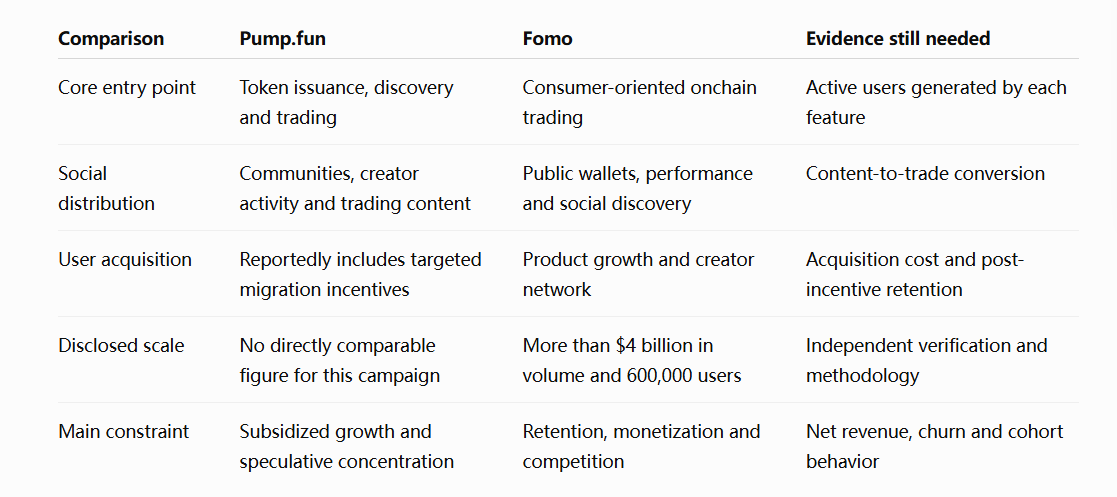
What would prove that competition creates a mass market?
User retention matters more than subsidized volume
Mainstream adoption would require users to remain active after promotions, token launches and migration payments decline. Daily volume alone cannot show whether a platform has created durable consumer demand.
Index Ventures stated that Fomo surpassed $4 billion in trading volume and 600,000 users during its first year. The figures demonstrate reported reach, but they were published in connection with the company’s $75 million Series B and have not been presented as independently audited statistics.
The number of registered users also does not reveal how many funded a wallet, completed a trade or remained active. One trader may generate substantial volume through repeated transactions, while many registered accounts may become inactive after an initial session.
More useful indicators would include 30-day and 90-day cohort retention, monthly transacting users, trades per retained user and revenue after incentives. The relationship between net revenue and customer-acquisition cost would show whether growth creates economic value rather than only activity.
Pump.fun vs Fomo will provide stronger evidence of market expansion if both platforms attract new onchain users rather than repeatedly paying to move the same existing traders between applications.
Regulation and consumer protection remain constraints
A consumer-facing onchain application operates across token issuance, trading, financial promotion and custody-related risk. The relevant legal treatment may differ by jurisdiction and by the characteristics of each token or service.
Paid creator arrangements require particular attention. If users receive compensation, preferential terms or token allocations, audiences need enough information to evaluate those conflicts. Failure to disclose incentives can turn social discovery into misleading promotion.
Token-launch platforms also face risks involving insider allocations, concentrated ownership, market manipulation and assets with limited liquidity. Fast execution does not protect buyers from adverse contract permissions, rapid price declines or coordinated selling.
Consumer protection will become more important if these applications reach users outside the crypto-native market. New participants may not understand irreversible transactions, wallet security or the difference between a platform interface and legal custody of an asset.
Sustainable mainstream adoption therefore requires more than hiding technical complexity. Platforms must help users understand the risks that remain after the interface becomes simpler.
Pump.fun and Fomo must convert attention into retention
The central argument behind Pump.fun vs Fomo is plausible: direct competition can accelerate product development, attract creators and make onchain trading easier to discover and use. Social identity and integrated execution could help crypto applications reach users who would not navigate traditional decentralized-finance interfaces.
However, the claim that this competition will expand onchain finance by at least one order of magnitude remains an industry forecast. Fomo’s reported first-year volume of more than $4 billion and 600,000 users indicates meaningful scale, but those figures do not establish long-term retention or profitability. Reported migration payments also make headline activity more difficult to interpret.
Competition creates a sustainable market only when platforms convert paid or speculative attention into recurring, unsubsidized use. The most informative measures will be user retention after incentives expire, monthly transacting wallets, net trading revenue, acquisition costs, creator concentration and the proportion of activity generated by new onchain users.
Security and consumer protection are equally important. Simpler trading can remove unnecessary friction, but it can also accelerate losses when users encounter manipulated assets, undisclosed promotions or concentrated token ownership. Product growth that depends on increasingly aggressive speculation would not demonstrate broader financial adoption.
Pump.fun and Fomo may improve how consumers discover and execute onchain trades. Whether they take the sector mainstream will depend on what remains after promotional spending and short-term market enthusiasm fade: retained users, defensible revenue, reliable execution and transparent treatment of risk.
Sources
https://x.com/lmrankhan/status/2086545291214512566
https://www.indexventures.com/perspectives/on-chain-trading-goes-mainstream-fomos-75-million-series-b/
https://join.pump.fun/HSag/x
https://www.odaily.news/en/post/5212388
Risk Disclaimer: This article is for reference only and does not constitute investment advice. The cryptocurrency market is highly volatile. Please make decisions cautiously based on your individual circumstances.
Comments
Only preset comments and emojis can be selected