Irys, a layer-1 blockchain listed on major exchanges including Coinbase, is under scrutiny after a single entity captured roughly 20% of its airdrop allocation. On November 28, blockchain analytics firm Bubblemaps said it identified about 900 wallets involved in the process. IRYS Slides After 900 Linked Wallets Take $4 Million in Airdrop Tokens According to the firm, these addresses showed no prior on-chain activity. It described the pattern as consistent with coordinated preparation rather than organic network participation. Following the distribution, the cluster network began consolidating the assets. Data shows that roughly 500 of the identified wallets transferred their IRYS allocations to intermediary addresses before routing the funds to Bitget, a centralized exchange. IRYS Token Address Clusters. Source: BubbleMaps The flow of tokens, valued at approximately $4 million, indicates a likely preparation to liquidate the position. Such a move could introduce significant sell-side pressure on the asset’s order book. IRYS price has come under pressure following the disclosures. The token has declined 16% over the past 24 hours and is trading near $0.032 as of press time. Bubblemaps noted that it found no on-chain evidence linking the IRYS team to the wallet cluster. Irys markets itself as an “on-chain AWS” designed for data storage and smart-contract execution. The protocol has raised more than $13 million from venture capital investors and listed its token this week on major exchanges, including Binance and Coinbase. Crypto Needs Stronger Sybil Protection The episode highlights a structural challenge facing crypto projects that rely on airdrops to expand ownership. Indeed, Irys allocated 8% of its total supply to the event. The goal was to distribute tokens to early users and help decentralize the network. Instead, the concentration of tokens in a single cluster shows how airdrops remain vulnerable to actors using large batches of script-generated wallets to capture outsized allocations. When one entity controls 20% of the initial circulating float, market observers say the result is heightened centralization risk and distorted price discovery. Meanwhile, incidents like this point to broader limitations in token distribution practices across permissionless ecosystems. These environments have minimal identity checks and unrestricted network access. This IRYS episode shows how difficult it is to prevent coordinated airdrop capture without stronger filtering, better identity heuristics, or more robust pre-distribution reviews. Without those safeguards, early liquidity events can disproportionately benefit short-term actors. That dynamic can weaken outcomes for long-term holders and overall network stability.Irys, a layer-1 blockchain listed on major exchanges including Coinbase, is under scrutiny after a single entity captured roughly 20% of its airdrop allocation. On November 28, blockchain analytics firm Bubblemaps said it identified about 900 wallets involved in the process. IRYS Slides After 900 Linked Wallets Take $4 Million in Airdrop Tokens According to the firm, these addresses showed no prior on-chain activity. It described the pattern as consistent with coordinated preparation rather than organic network participation. Following the distribution, the cluster network began consolidating the assets. Data shows that roughly 500 of the identified wallets transferred their IRYS allocations to intermediary addresses before routing the funds to Bitget, a centralized exchange. IRYS Token Address Clusters. Source: BubbleMaps The flow of tokens, valued at approximately $4 million, indicates a likely preparation to liquidate the position. Such a move could introduce significant sell-side pressure on the asset’s order book. IRYS price has come under pressure following the disclosures. The token has declined 16% over the past 24 hours and is trading near $0.032 as of press time. Bubblemaps noted that it found no on-chain evidence linking the IRYS team to the wallet cluster. Irys markets itself as an “on-chain AWS” designed for data storage and smart-contract execution. The protocol has raised more than $13 million from venture capital investors and listed its token this week on major exchanges, including Binance and Coinbase. Crypto Needs Stronger Sybil Protection The episode highlights a structural challenge facing crypto projects that rely on airdrops to expand ownership. Indeed, Irys allocated 8% of its total supply to the event. The goal was to distribute tokens to early users and help decentralize the network. Instead, the concentration of tokens in a single cluster shows how airdrops remain vulnerable to actors using large batches of script-generated wallets to capture outsized allocations. When one entity controls 20% of the initial circulating float, market observers say the result is heightened centralization risk and distorted price discovery. Meanwhile, incidents like this point to broader limitations in token distribution practices across permissionless ecosystems. These environments have minimal identity checks and unrestricted network access. This IRYS episode shows how difficult it is to prevent coordinated airdrop capture without stronger filtering, better identity heuristics, or more robust pre-distribution reviews. Without those safeguards, early liquidity events can disproportionately benefit short-term actors. That dynamic can weaken outcomes for long-term holders and overall network stability.

Irys Airdrop Draws Concern After One Entity Captures 20% of Supply

2025/11/30 01:50

Irys, a layer-1 blockchain listed on major exchanges including Coinbase, is under scrutiny after a single entity captured roughly 20% of its airdrop allocation.

On November 28, blockchain analytics firm Bubblemaps said it identified about 900 wallets involved in the process.

IRYS Slides After 900 Linked Wallets Take $4 Million in Airdrop Tokens

According to the firm, these addresses showed no prior on-chain activity. It described the pattern as consistent with coordinated preparation rather than organic network participation.

Following the distribution, the cluster network began consolidating the assets.

Data shows that roughly 500 of the identified wallets transferred their IRYS allocations to intermediary addresses before routing the funds to Bitget, a centralized exchange.
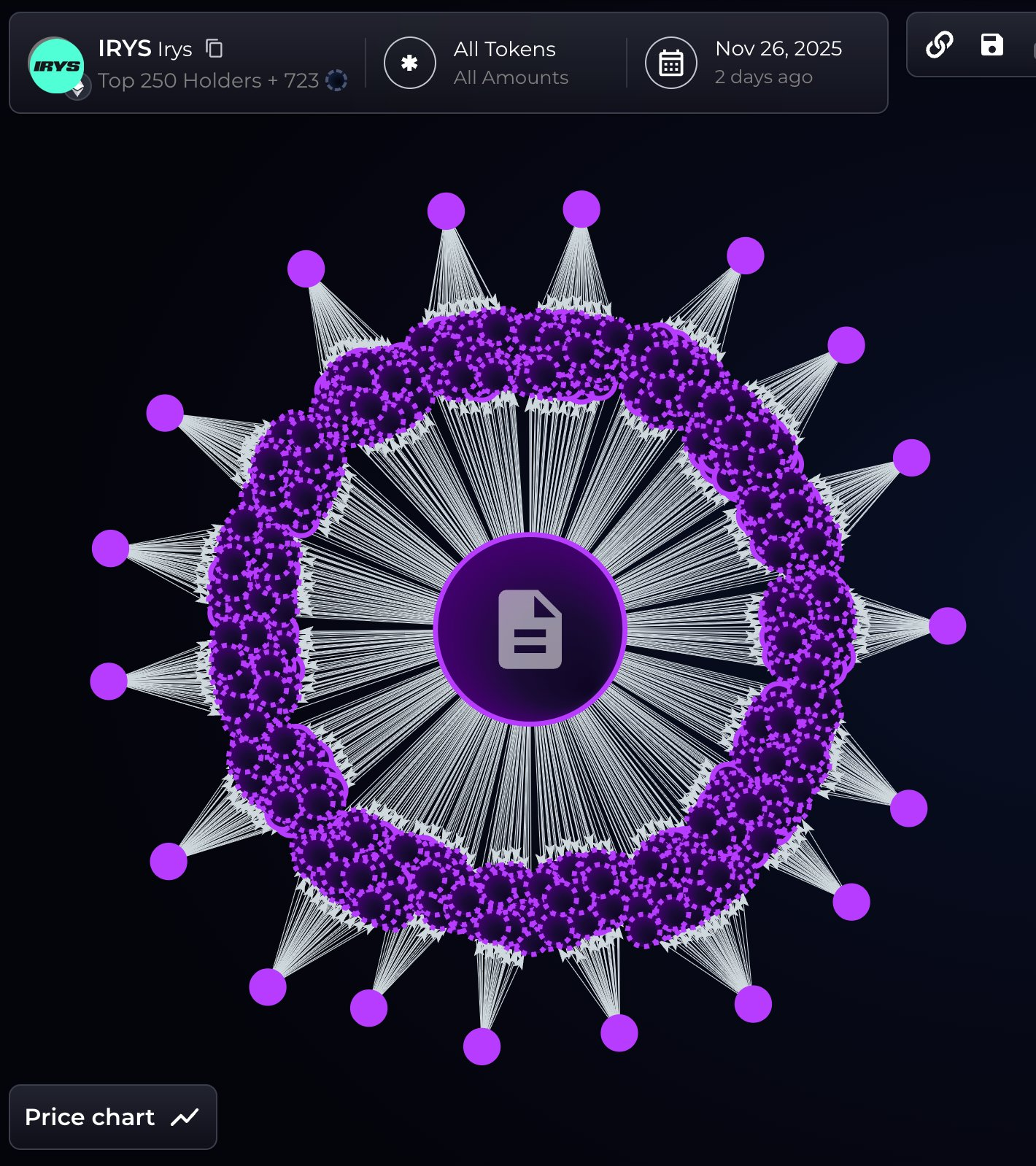
IRYS Token Address Clusters. Source: BubbleMaps

The flow of tokens, valued at approximately $4 million, indicates a likely preparation to liquidate the position. Such a move could introduce significant sell-side pressure on the asset’s order book.

IRYS price has come under pressure following the disclosures. The token has declined 16% over the past 24 hours and is trading near $0.032 as of press time.

Bubblemaps noted that it found no on-chain evidence linking the IRYS team to the wallet cluster.

Irys markets itself as an “on-chain AWS” designed for data storage and smart-contract execution.

The protocol has raised more than $13 million from venture capital investors and listed its token this week on major exchanges, including Binance and Coinbase.

Crypto Needs Stronger Sybil Protection

The episode highlights a structural challenge facing crypto projects that rely on airdrops to expand ownership.

Indeed, Irys allocated 8% of its total supply to the event. The goal was to distribute tokens to early users and help decentralize the network.

Instead, the concentration of tokens in a single cluster shows how airdrops remain vulnerable to actors using large batches of script-generated wallets to capture outsized allocations.

When one entity controls 20% of the initial circulating float, market observers say the result is heightened centralization risk and distorted price discovery.

Meanwhile, incidents like this point to broader limitations in token distribution practices across permissionless ecosystems. These environments have minimal identity checks and unrestricted network access.

This IRYS episode shows how difficult it is to prevent coordinated airdrop capture without stronger filtering, better identity heuristics, or more robust pre-distribution reviews.

Without those safeguards, early liquidity events can disproportionately benefit short-term actors. That dynamic can weaken outcomes for long-term holders and overall network stability.

Disclaimer: The articles reposted on this site are sourced from public platforms and are provided for informational purposes only. They do not necessarily reflect the views of MEXC. All rights remain with the original authors. If you believe any content infringes on third-party rights, please contact [email protected] for removal. MEXC makes no guarantees regarding the accuracy, completeness, or timeliness of the content and is not responsible for any actions taken based on the information provided. The content does not constitute financial, legal, or other professional advice, nor should it be considered a recommendation or endorsement by MEXC.

You May Also Like

UK Looks to US to Adopt More Crypto-Friendly Approach

UK Looks to US to Adopt More Crypto-Friendly Approach

The post UK Looks to US to Adopt More Crypto-Friendly Approach appeared on BitcoinEthereumNews.com. The UK and US are reportedly preparing to deepen cooperation on digital assets, with Britain looking to copy the Trump administration’s crypto-friendly stance in a bid to boost innovation.  UK Chancellor Rachel Reeves and US Treasury Secretary Scott Bessent discussed on Tuesday how the two nations could strengthen their coordination on crypto, the Financial Times reported on Tuesday, citing people familiar with the matter.  The discussions also involved representatives from crypto companies, including Coinbase, Circle Internet Group and Ripple, with executives from the Bank of America, Barclays and Citi also attending, according to the report. The agreement was made “last-minute” after crypto advocacy groups urged the UK government on Thursday to adopt a more open stance toward the industry, claiming its cautious approach to the sector has left the country lagging in innovation and policy.  Source: Rachel Reeves Deal to include stablecoins, look to unlock adoption Any deal between the countries is likely to include stablecoins, the Financial Times reported, an area of crypto that US President Donald Trump made a policy priority and in which his family has significant business interests. The Financial Times reported on Monday that UK crypto advocacy groups also slammed the Bank of England’s proposal to limit individual stablecoin holdings to between 10,000 British pounds ($13,650) and 20,000 pounds ($27,300), claiming it would be difficult and expensive to implement. UK banks appear to have slowed adoption too, with around 40% of 2,000 recently surveyed crypto investors saying that their banks had either blocked or delayed a payment to a crypto provider.  Many of these actions have been linked to concerns over volatility, fraud and scams. The UK has made some progress on crypto regulation recently, proposing a framework in May that would see crypto exchanges, dealers, and agents treated similarly to traditional finance firms, with…
Share
BitcoinEthereumNews2025/09/18 02:21
Why is Bitcoin (BTC) Trading Lower Today?
Why is Bitcoin (BTC) Trading Lower Today?

The post Why is Bitcoin (BTC) Trading Lower Today? appeared on BitcoinEthereumNews.com. Bitcoin BTC$90,457.05, the leading cryptocurrency by market value, is down following the overnight Fed rate cut. The reason likely lies in the Fed’s messaging, which has made traders less excited about future easing. The Fed on Wednesday cut the benchmark interest rate by 25 basis points to 3.25% as expected and announced it will begin purchasing short-term Treasury bills to manage liquidity in the banking system. Yet, BTC traded below $90,000 at press time, representing a 2.4% decline since early Asian trading hours, according to CoinDesk data. Ether was down 4% at $3,190, with the CoinDesk 20 Index down over 4%. The risk-off action is likely due to growing signs of internal Fed divisions on balancing inflation control against employment goals, coupled with signals of a more challenging path for future rate cuts. Two members voted for no change on Wednesday, but individual forecasts revealed that six FOMC members felt that a cut wasn’t “appropriate.” Besides, the central bank suggested just one more rate cut in 2026, disappointing expectations for two to three rate cuts. “The Fed is divided, and the market has no real insight into the future path of rates from now until May 2026, when Chairman Jerome Powell will be replaced. The replacement of Powell with a Trump loyalist (who will push to lower rates aggressively) is likely the most reliable signal for rates. Until then, however, there are still 6 months to go,” Greg Magadini, director of derivatives at Amberdata, told CoinDesk. He added that the most likely occurrence as of now is a needed “deleveraging” or down-market” to convince the Fed of lower rates decidedly. Shiliang Tang, managing partner of Monarq Asset Management, said BTC is following the stock market lower. “Crypto markets initially spiked on the news but have steadily moved lower since, in conjunction with…
Share
BitcoinEthereumNews2025/12/11 17:27