Nigeria’s Central Bank licences 82 BDCs in sweeping FX market cleanup
The Central Bank of Nigeria (CBN) has issued the first batch of final licences to 82 Bureau De Change operators under its 2024 Regulatory and Supervisory Guidelines, part of its move for a tighter FX market, aimed at shrinking the space for unregulated operators and restoring confidence after years of parallel-market distortions.
It is also part of the CBN’s push for a tighter, compliance-heavy FX framework aimed at shrinking the space for street trading, sanitising the supply chain, and restoring confidence across the market.
Under the revamped regime introduced in 2024, the CBN created two licence classes — Tier 1 and Tier 2 — with significantly higher entry thresholds. Tier 1 operators must maintain a minimum capital base of ₦2 billion ($1.38 million), while Tier 2 operators require ₦500 million ($344,385.82). The rules also shut out commercial banks, payment service banks, fintechs, IMTOs, and other regulated financial institutions from obtaining BDC licences.
Of the newly licensed BCD operators, only two operate as Tier 1 BCDs, while the other 80 remain Tier 2 BCDs and must therefore be operational only in one state. This directive aims to clean up Nigeria’s informal foreign exchange (FX) market by reducing illegal operations and restoring confidence in retail FX transactions.
In a statement signed by Hakama Ali, Acting Director of Corporate Communications, the CBN said the new licences became effective on November 27, 2025, issued pursuant to the Bank and Other Financial Institutions Act (BOFIA) 2020.
“By this notice, only Bureaux De Change listed on the Bank’s website are authorised to operate from the effective date,” Ali said. “While the CBN will continue to update the list of Bureaux De Change with valid operating licences for public verification on our website (www.cbn.gov.ng), the Bank advises the general public to avoid dealing with unlicensed Foreign Exchange Operators.”
Operating a BDC without a valid licence now attracts sanctions under Section 57(1) of BOFIA 2020, meaning that they are liable to a fine of up to ₦10,000,000 ($6,887.72) and an additional ₦200,000 ($137.75) for each day the infraction continues.
The cleanup follows a turbulent period for the FX market. In 2024, the CBN revoked the licences of over 4,000 BDCs for failures ranging from non-payment of regulatory fees to non-compliance with AML/CFT reporting obligations. It was also the year the regulator deployed the EFCC to clear FX street traders, a practice the new guidelines have now expressly prohibited.
“What we’re hoping to accomplish by this, frankly, is to bring some sanity to an industry that arguably no longer serves the interests of those whom it was meant to protect,” CBN governor Olayemi Cardoso said in 2024.
The reforms come as the naira’s official and parallel rates converge at a little less than ₦1,500, an outcome the CBN hopes to solidify by tightening control over one of the most porous segments of the FX market.
As the regulator continues to update the list of valid BCD operators on its website, the public is urged to verify the status of any BDC before initiating a transaction to ensure compliance with the new financial order.
You May Also Like

Hyperliquid Strategies Inc. announces a $30M stock buyback program
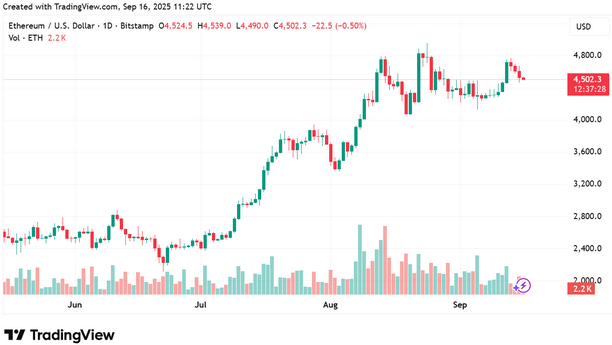
Ethereum Price Prediction: ETH Targets $10,000 In 2026 But Layer Brett Could Reach $1 From $0.0058