Zcash price is testing the $420 resistance of a multi-month symmetrical triangle as rising trading volume and institutional accumulation hint at a potential breakout. Zcash was trading at $395 at press time, up 11% over the past 24 hours, as…Zcash price is testing the $420 resistance of a multi-month symmetrical triangle as rising trading volume and institutional accumulation hint at a potential breakout. Zcash was trading at $395 at press time, up 11% over the past 24 hours, as…

Zcash price tests symmetrical triangle resistance near $420 — is a secondary breakout coming?

2025/12/09 14:09

Zcash price is testing the $420 resistance of a multi-month symmetrical triangle as rising trading volume and institutional accumulation hint at a potential breakout.

Summary
  • Zcash might be eyeing a fresh rally, testing $420 triangle resistance.
  • Spot and futures volumes show renewed trader interest and risk appetite.
  • Institutional buys and exchange listings have boosted momentum and visibility.

Zcash was trading at $395 at press time, up 11% over the past 24 hours, as the market recovered after a quiet start to the week. The seven-day range sits between $306 and $420, leaving the coin 18% higher on the week but still down 27% across the past month.

During the most recent rebound, trading activity has increased sharply, with 24-hour spot volume reaching $1.28 billion, nearly a 100% increase from the day before.

Derivatives flow paints the same picture of renewed interest. Futures volume rose more than 100% to $5.5 billion, while open interest increased 21% to $895 million.

A move of this size usually means traders are returning with fresh risk, rather than exiting positions in stress.

Privacy coins return to the spotlight

Zcash’s recent rally has tracked new interest around privacy coins. Shielded pool usage has climbed to 30% of supply, and post-halving issuance remains tight. Several recent events have pulled ZEC back into the spotlight, from new exchange listings to institutional treasury builds.

Bitget added ZEC spot trading on Dec. 3, giving the asset new reach across its large user base and triggering a double-digit intraday gain. Days later, France’s BPCE Bank integrated ZEC into its consumer app, marking one of the first banking rollouts of a privacy coin. 

The momentum was not universal, however, as Bithumb delisted ZEC on Dec. 1 under MiCA 2.0 rules. This shows the rising split between regions on how privacy coins are regarded.

Institutional activity has also been picking up. Cypherpunk Technologies announced a $100 million ZEC treasury in November, accumulating more than 200,000 coins and revealing plans to scale its position toward 5% of total supply. Grayscale’s filing to convert its Zcash Trust into an exchange-traded fund added another layer of interest. 

Zcash price technical analysis

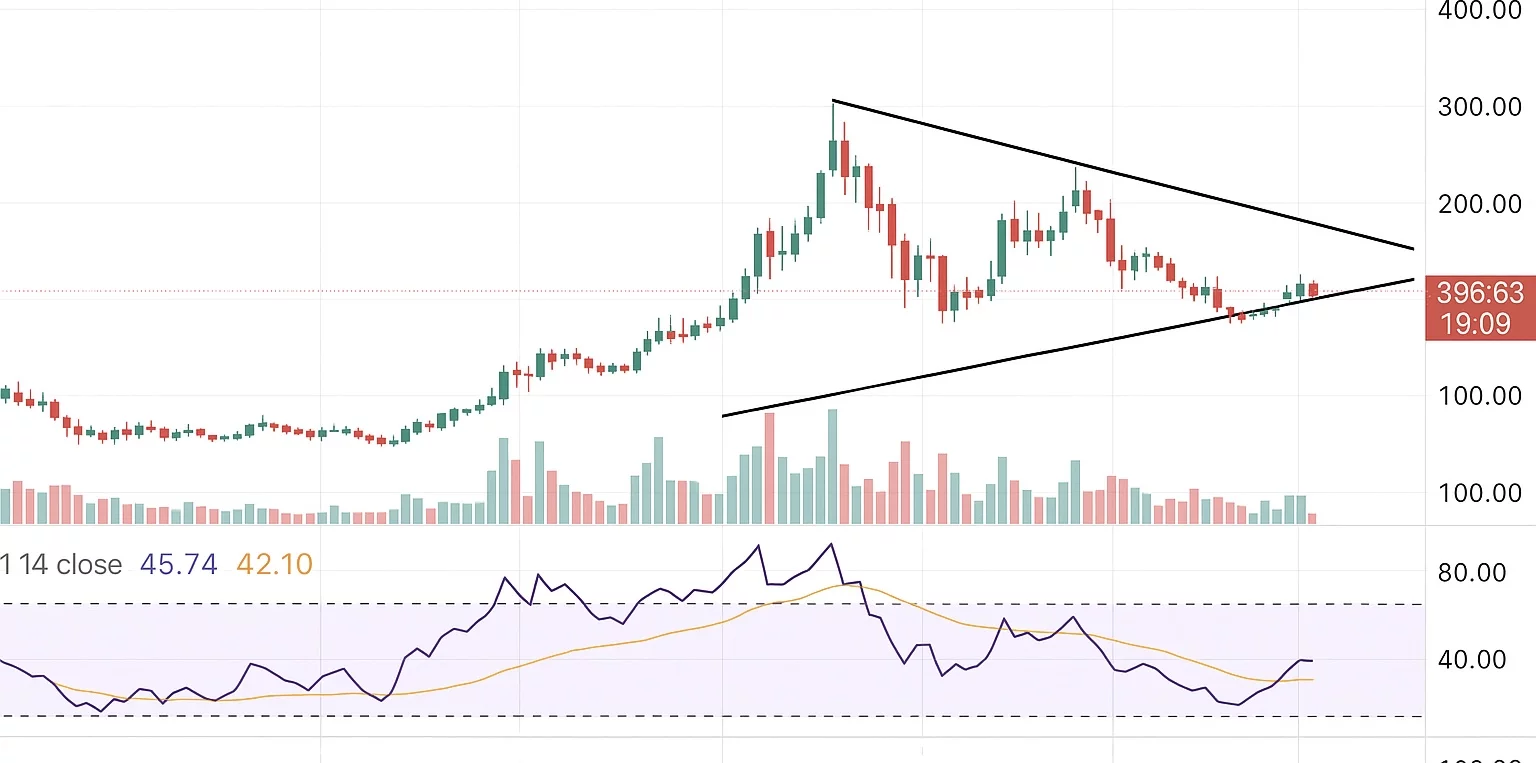
The ZEC chart shows a clear multi-month symmetrical triangle, drawn from the swing high above $300 and the series of rising higher lows that began after the November unwind.

Price is now pressing against the triangle’s upper boundary near $420, a level it briefly touched earlier this week before pulling back.
Zcash price tests symmetrical triangle resistance near $420 — is a secondary breakout coming? - 1

The structure shows a classic decline in volatility as buyers and sellers narrow their distance. Volume has thinned out through the consolidation, which often sets the stage for a sharp move once the price chooses a direction.

After declining toward oversold levels, the relative strength index has rebounded into the mid-40s. It displays early signs of stabilizing momentum but not enough to confirm a change in trend just yet. ZEC sits directly on the rising support line, a level that has held for several weeks.

A daily close above the descending trendline would open the door toward the $460–$500 region. A close below the rising base, however, would expose $350 and possibly $300. For now, Zcash remains in a tightening coil, with the next breakout likely to decide its December direction.

Disclaimer: The articles reposted on this site are sourced from public platforms and are provided for informational purposes only. They do not necessarily reflect the views of MEXC. All rights remain with the original authors. If you believe any content infringes on third-party rights, please contact [email protected] for removal. MEXC makes no guarantees regarding the accuracy, completeness, or timeliness of the content and is not responsible for any actions taken based on the information provided. The content does not constitute financial, legal, or other professional advice, nor should it be considered a recommendation or endorsement by MEXC.

You May Also Like

Ethereum unveils roadmap focusing on scaling, interoperability, and security at Japan Dev Conference


Ethereum unveils roadmap focusing on scaling, interoperability, and security at Japan Dev Conference

The post Ethereum unveils roadmap focusing on scaling, interoperability, and security at Japan Dev Conference appeared on BitcoinEthereumNews.com. Key Takeaways Ethereum’s new roadmap was presented by Vitalik Buterin at the Japan Dev Conference. Short-term priorities include Layer 1 scaling and raising gas limits to enhance transaction throughput. Vitalik Buterin presented Ethereum’s development roadmap at the Japan Dev Conference today, outlining the blockchain platform’s priorities across multiple timeframes. The short-term goals focus on scaling solutions and increasing Layer 1 gas limits to improve transaction capacity. Mid-term objectives target enhanced cross-Layer 2 interoperability and faster network responsiveness to create a more seamless user experience across different scaling solutions. The long-term vision emphasizes building a secure, simple, quantum-resistant, and formally verified minimalist Ethereum network. This approach aims to future-proof the platform against emerging technological threats while maintaining its core functionality. The roadmap presentation comes as Ethereum continues to compete with other blockchain platforms for market share in the smart contract and decentralized application space. Source: https://cryptobriefing.com/ethereum-roadmap-scaling-interoperability-security-japan/
Share
BitcoinEthereumNews2025/09/18 00:25
Vitalik Buterin Suggests Ethereum Security Intact Amid Recent Glitch

Vitalik Buterin Suggests Ethereum Security Intact Amid Recent Glitch

The post Vitalik Buterin Suggests Ethereum Security Intact Amid Recent Glitch appeared on BitcoinEthereumNews.com. Ethereum remains secure despite a recent network glitch caused by a Prysm client bug that temporarily halted block finalization. Vitalik Buterin emphasized that this does not undermine the network’s core security, as blocks continue to be produced and executed, behaving like Bitcoin’s probabilistic model during such pauses. Vitalik Buterin assures that temporary loss of finality does not compromise Ethereum’s overall security model. The glitch primarily impacted secondary systems like bridges and Layer 2 solutions, not the base chain. Experts compare Ethereum’s response to Bitcoin’s, where probabilistic finality prevents chain rewrites while allowing continued operations. Ethereum secure despite recent glitch: Vitalik Buterin explains why the network’s resilience shines through temporary finality pauses. Discover key insights on blockchain reliability. Stay informed on crypto updates—read more now. What Did Vitalik Buterin Say About Ethereum’s Security After the Recent Glitch? Ethereum remains secure even amid the recent network disruption, according to Vitalik Buterin, Ethereum’s co-founder. He clarified that the Prysm client bug, which briefly interrupted block finalization, does not pose a threat to the protocol’s integrity. Instead, it highlights the network’s design for graceful degradation, where core functions persist without deterministic certainty. How Does Ethereum Behave During Finality Pauses? During the incident, Ethereum temporarily shifted to a probabilistic security model similar to Bitcoin’s, as noted by blockchain researchers. Fabrizio Romano Genovese, an Oxford PhD and Ethereum protocol specialist, explained that many blockchains, including Bitcoin, rely on growing difficulty in rewriting history rather than instant finality. In Ethereum’s case, blocks kept being created and executed, preventing any chain halt, though secondary services like cross-chain bridges experienced delays. This behavior underscores the network’s robustness, with no risk of approving incorrect transaction histories. Genovese added that such events reveal the need for better fallback mechanisms in dependent infrastructure, ensuring smoother operations in future occurrences. Statistics from the…
Share
BitcoinEthereumNews2025/12/11 16:40