

Must Read
ARTIFICIAL INTELLIGENCE. AI letters and robot hand are placed on computer motherboard in this illustration created on June 23, 2023.ARTIFICIAL INTELLIGENCE. AI letters and robot hand are placed on computer motherboard in this illustration created on June 23, 2023.
Generative AI in 2025: From Ghibli memes to low-cost therapy and beyond
In 2025, artificial intelligence reached a point of relative normalcy in usage. Due to its ease of use, generative AI (GenAI) — that is, AI that applies machine learning techniques to data it has access to so as to output content of varying sorts — is at the forefront of what people are taking advantage of.
Right now, GenAI has been used in a staggering number of fields and contexts and for various reasons. Let’s try to pin these down.
For amusement and meme-making
One of GenAI’s common uses in 2025 was as a source of amusement or entertainment.
People took advantage of the power of GenAI to make memes and other images that mimicked various art styles, such as the style of Studio Ghibli.
Tools meant for making GenAI-enabled videos also came out in droves. These included Sora, Veo, and Firefly, among a host of others.
These memes were a source of fun on one hand, and also a way of helping people take stock of the world in a humorous way as well.
That said, there was also significant pushback from artists of all stripes, calling for protections for their works to not become AI data or licensing agreements that would allow them proper compensation for their work.
GenAI as musician
GenAI was also used, perhaps in part or in whole, to make AI “music” that was “virtually undetectable” or at the very least very difficult to distinguish from human-made music.
Human artists were pushing back against this. Music insiders are calling for guidelines to identify AI-made music on streaming services, and AI artists have already made their way into the Original Philippine Music (OPM) space.
Musicians who put their work out there for people to enjoy are not having it. As “Sandali” hitmaker MRLD said in a GMA report, “Ubos braincells, lahat ng pagpupuyat, at wala [nang] page sa notebook na sinusulatan ng kanta para lang matalo ng isang robot na iniiba lang ang genre ng mismong kanta.”
(All those empty brain cells, late-night sessions, and lyric-filled notebooks only to lose to a robot that just changes the genre of a song.)
Whether these AI tracks went onto streaming services as a money-making endeavor or for fun, it stands to reason that these tracks cribbed off existing musicians’ styles and likely skirted or ignored copyright in some shape or form.
According to a Deezer-Ipsos study, 73% of respondents supported disclosure when AI-generated tracks are recommended, 45% sought filtering options, and 40% said they would skip AI-generated songs entirely. Meanwhile, around 71% expressed surprise at their inability to distinguish between human-made and synthetic tracks.
The political sphere
Generative AI also made it into the political sphere. Usually combined with coordinated inauthentic behavior, generative AI outputs were used to simulate smart responses on Philippine political issues.
A June report by OpenAI, for one, mentioned how it had banned ChatGPT accounts using its models to generate bulk volumes of short comments in English and Taglish that were meant to be posted on politics and current events topics on TikTok and Facebook. Rappler’s report mentioned that the comments “were focused on praising Marcos and/or criticizing his erstwhile ally, Vice President Sara Duterte.”
OpenAI added that “this activity was connected to Comm&Sense Inc, a commercial marketing company in the Philippines.”
On the more insidious side of things, people also used GenAI to make Rodrigo Duterte statues pop up everywhere, or to make AI videos opposing Vice President Sara Duterte’s impeachment. An apparent attempt to appeal to the Duterte “cult of personality,” these AI images were political disinformation disguised as entertainment.
Further, GenAI images of politicians were shared alongside false claims about the former UniTeam of President Ferdinand Marcos Jr. and supporters of former vice president Leni Robredo, called the Kakampinks, banding together to form “UniPink.”
As a therapist and friend
The Philippines’ growing use of GenAI tools like ChatGPT also underscored how, despite wanting to support specific ends, people also used it as a means of finding affordable or free mental health assistance, or to serve as a surrogate social connection they could count on.
The World Health Organization Commission on Social Connection’s global report revealed one in six people worldwide was affected by loneliness, with significant impacts on health and well-being.
In GenAI’s case, chatbots served as non-judgmental connections people could turn to for solace, or as a means of finding further help for how they’re feeling or thinking
Trigger warning: AI-enabled therapy is not without its risks. AI doesn’t push back against a person’s ideas. It has led some to warn about AI as a therapy tool because it may have driven teens to not seek help from their parents and to turn to suicide as a solution.
(The Department of Health has national crisis hotlines to assist people with mental health concerns: 1553 (landline), 0966-351-4518, and 0917-899-USAP (8727) (Globe/TM); and 0908-639-2672 (Smart/Sun/TNT).)
Bridging or creating AI gaps
As artificial intelligence iterates and improves, it also becomes more important to recognize the ever-present digital divide that might be made worse by increased AI adoption, even as we enter an age of ever-increasing AI slop, as dictionaries might call it.
Not only will people have to be technologically proficient, they also have to now be mindful of how AI shapes reality at present.
Otherwise, there is a risk of increasing inequality between rich and poor states the further along in the AI cycle we go.
What started out as a marketing term to secure funding for research into a given tech field in the 1950s and became a point of entertainment at present is also a cause for concern as it upends work and play.
And yet, as we deal with the repercussions of generative and other forms of AI as they appear, further AI literacy is needed to bridge the gaps.
Governments should look to enact guardrails to protect against AI use by bad actors, and civil society should also work in tandem to inform the public of the potentials and problems posed by GenAI and all its other emerging forms. – Rappler.com
Disclaimer: The articles reposted on this site are sourced from public platforms and are provided for informational purposes only. They do not necessarily reflect the views of MEXC. All rights remain with the original authors. If you believe any content infringes on third-party rights, please contact [email protected] for removal. MEXC makes no guarantees regarding the accuracy, completeness, or timeliness of the content and is not responsible for any actions taken based on the information provided. The content does not constitute financial, legal, or other professional advice, nor should it be considered a recommendation or endorsement by MEXC.
You May Also Like

‘Already seen the low?’ – Inside Cathie Wood’s bet on a new Bitcoin cycle
The post ‘Already seen the low?’ – Inside Cathie Wood’s bet on a new Bitcoin cycle appeared on BitcoinEthereumNews.com. Bitcoin has rarely looked more fragile, and many analysts are already referring to this as the worst fourth quarter on record, marked by a massive leverage wipeout and a steep drop from its all-time highs. For over a decade, Bitcoin [BTC] has followed a harsh, predictable pattern: a Halving event, a commendable rally to new highs, and then a brutal 75–90% crash that resets the entire market. This cycle shaped the crypto world and created the “crypto winter” mentality that traders have come to expect. Cathie Wood challenges the four-year cycle But according to Cathie Wood, CEO and CIO of ARK Invest, those old rules no longer apply. Speaking with Fox Business, Wood made a profound declaration: institutional adoption is actively “disrupting” the traditional Bitcoin cycle. Wood noted that growing participation in U.S. Spot Bitcoin ETFs had started to change how BTC absorbed volatility. She pointed to a steady decline in its two-year volatility trend over the past five years, adding fuel to the idea of a maturing asset. Why Bitcoin’s old pattern may be fading Wood’s view challenges over a decade of beliefs built around Bitcoin’s strict, predictable four-year cycle. The evidence for this cycle is compelling. For instance, the 2012 Halving saw Bitcoin surge from under $10 to a peak of roughly $1,100; the 2016 Halving fueled a climb from $400 to nearly $20,000; and the 2020 Halving propelled the asset from $8,500 to a record high of around $69,000. Each of these explosive rallies was followed by a painful, defining drawdown of 70% to 85%, resetting the stage for the next run. This predictable pattern, last triggered by the 20th April 2024, Halving, has historically been the sole script for investors. Yet, this time, the narrative feels disjointed and disruptive. What is Wood so concerned about? Wood…
Share
BitcoinEthereumNews2025/12/11 19:15
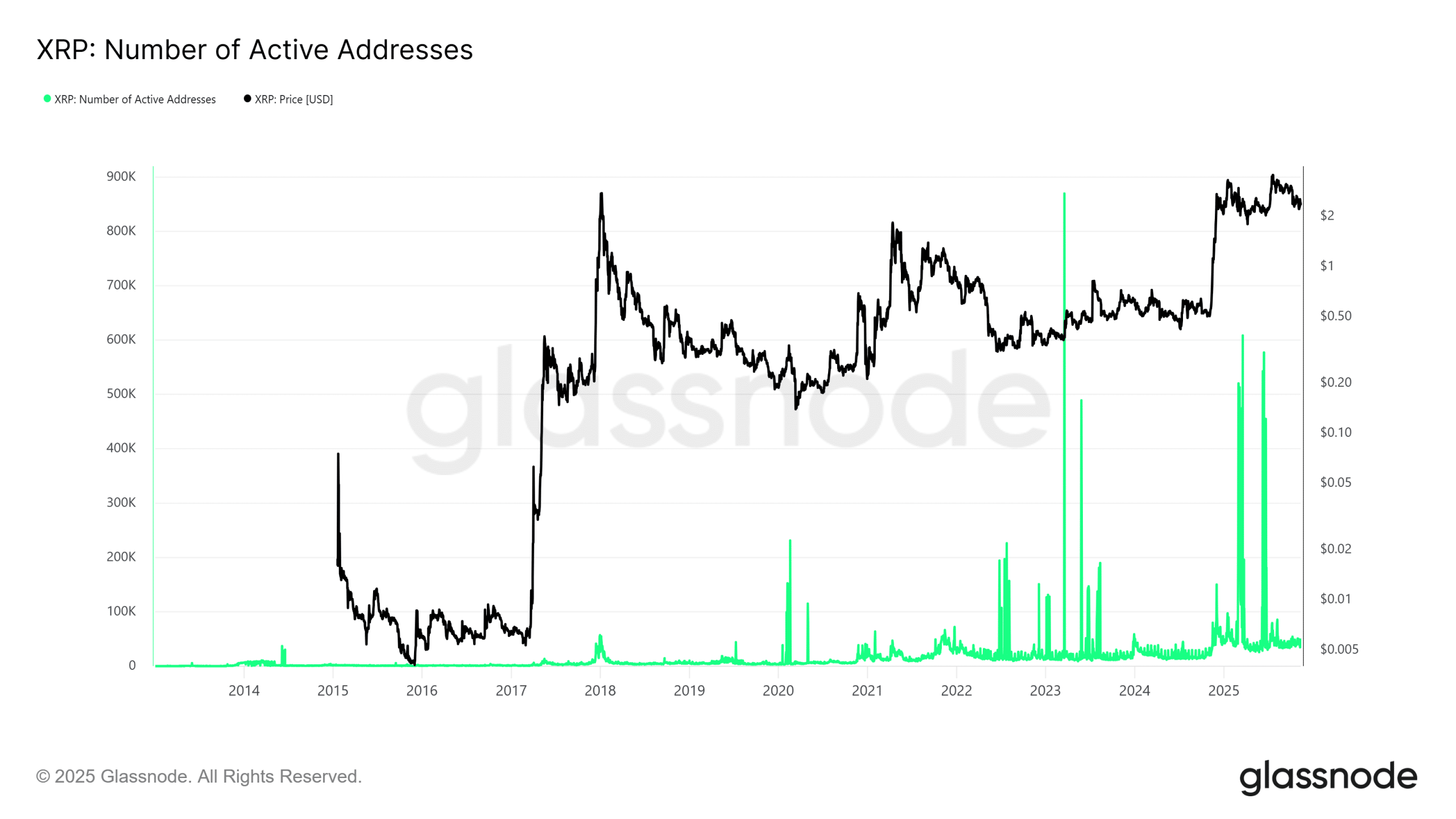
XRP Price Tumbles 3% As Fifth Ripple Token ETF Nears Launch
The entire non-fungible token ecosystem is highly susceptible to many security threats, fueled by technical vulnerabilities, human-centric scams, and a lack of regulatory oversight. These [...]
Share
Insidebitcoins2025/12/11 18:55

The Critical Security Play You Can’t Miss in the AI Era
The post The Critical Security Play You Can’t Miss in the AI Era appeared on BitcoinEthereumNews.com. The Watershed Moment That Changed Blockchain Security Forever Singapore – Blockman PR – December 2025 marked a turning point. Anthropic’s research team published findings that sent shockwaves through crypto: AI systems could successfully exploit smart contract vulnerabilities with 55.88% accuracy, simulating $4.6 million in potential theft from real-world contracts. The implications were existential. If AI could systematically identify and exploit vulnerabilities at scale, the entire blockchain ecosystem—processing over $1 trillion in transactions annually—faced an unprecedented threat. Traditional security tools couldn’t keep pace. Human auditors, already stretched thin reviewing less than 20% of deployed contracts, had no chance against autonomous AI attackers. But here’s what most people missed: Anthropic’s breakthrough wasn’t just validation of the threat. It was validation of the solution space. And one company had already been building that solution for six months—and winning. The Defense Was Already Operational While Anthropic demonstrated AI could break smart contracts in simulation, AgentLISA had been defending them in production. By the time Anthropic’s paper dropped, AgentLISA’s multi-agent system had detected over $7.3 million in actual vulnerabilities across real protocols managing billions in assets. The asymmetry is critical: Anthropic proved the threat is real and AI-powered. AgentLISA proved the defense is real, AI-powered, and already operational at scale. This matters because Anthropic’s research exposed something fundamental: the AI security race will be won by whoever controls the training data. And AgentLISA just lapped the entire field. LISA-Bench: The Data Moat Nobody Saw Coming https://github.com/agentlisa/bench Anthropic’s team used SCONE-bench—a dataset of 413 vulnerable smart contracts—to train their attack models. Solid methodology, respectable work. But fundamentally constrained by data scarcity. AgentLISA’s response was devastating: LISA-Bench, containing 23,959 professionally verified vulnerability records spanning 2016-2024—the largest curated smart contract vulnerability dataset ever assembled. It’s not just 60 times larger than SCONE-bench. It includes 10,185 code-complete vulnerability cases…
Share
BitcoinEthereumNews2025/12/11 19:01