Bitcoin has retraced to the $85,000 level, a critical support zone that bulls must defend to prevent a deeper breakdown. After failing to reclaim higher levels,Bitcoin has retraced to the $85,000 level, a critical support zone that bulls must defend to prevent a deeper breakdown. After failing to reclaim higher levels,

Who Really Sold The Dip? On-Chain Data Exposes Bitcoin’s True Sellers

2025/12/17 05:00

Bitcoin has retraced to the $85,000 level, a critical support zone that bulls must defend to prevent a deeper breakdown. After failing to reclaim higher levels, price action has slowed and volatility has compressed, reinforcing a market environment dominated by apathy and fear.

Sentiment across the crypto space has deteriorated sharply, with a growing number of analysts openly discussing the possibility of a prolonged bear market extending into next year. In this context, understanding who is actually selling becomes far more important than the price move itself.

According to a recent CryptoQuant report, Bitcoin’s pullback from the ~$88.2K region toward ~$85K provides a clean on-chain read of market behavior beneath the surface. Exchange inflow data segmented by Short-Term Holders (STH) and Long-Term Holders (LTH) shows that the decline was not driven by structural distribution from long-term investors.

Historically, bear markets accelerate when long-term holders begin distributing supply. The absence of that behavior suggests the current drawdown reflects positioning adjustments and risk reduction rather than a collapse in long-term conviction. As Bitcoin tests $85K, the market is not only evaluating price support levels.

Short-Term Profit-Taking, Not Structural Distribution

The CryptoQuant report by Crazzyblockk provides a precise breakdown of who actually drove Bitcoin’s recent pullback. On December 15, when BTC traded near the $88.2K level, Short-Term Holders sent approximately 24.7K BTC to exchanges.

Crucially, 86.8% of this supply was realized in profit, while only 13.2% was sold at a loss. In dollar terms, profitable STH inflows exceeded $1.89 billion, vastly outweighing loss-driven selling. This profile clearly indicates that sellers were primarily near-term buyers exiting from strength, rather than panicked participants capitulating under stress.

Bitcoin Long-Term holder P/L Inflow Volume | Source: CryptoQuant

As the price moved lower on December 16 toward the $86K area, total STH inflows dropped sharply to just 3.9K BTC. Although this smaller flow was realized at a loss, its limited size signals exhaustion rather than an acceleration of selling pressure. While the percentage of loss realization increased, the absolute volume did not—an important nuance often overlooked in surface-level market analysis.

Long-Term Holder behavior reinforces this constructive interpretation. Across both days, LTH inflows remained muted, falling from roughly 326 BTC to just 50 BTC. There is no sign of capitulation or meaningful distribution from this cohort. Overall, the data shows a market cooling through short-term profit-taking, not breaking through structural sell pressure.

Bitcoin Weekly Price Structure and Key Support Dynamics

Bitcoin has retraced sharply from its cycle highs and is now consolidating around the $85K–$88K zone. This area is technically significant. Price is currently interacting with the rising 100-week moving average, which has acted as dynamic support throughout the broader uptrend since 2023. So far, buyers are attempting to defend this level, preventing a deeper weekly close below it.
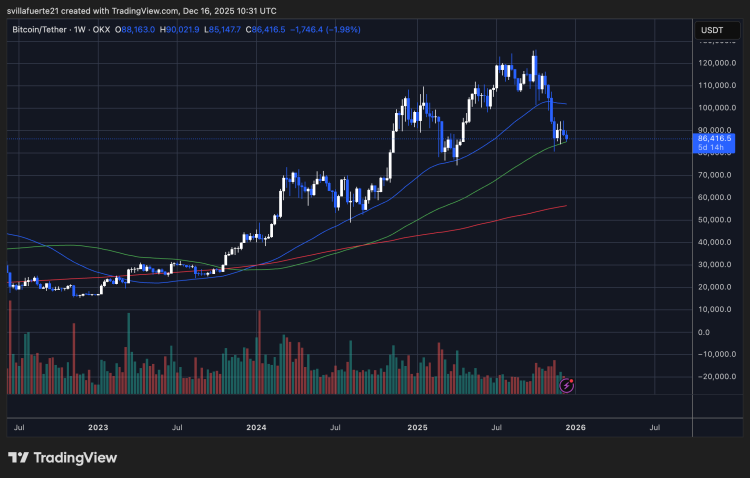
BTC consolidates around key support level | Source: BTCUSDT chart on TradingView

Structurally, the market has shifted from strong impulsive expansion into a corrective phase. The loss of the 50-week moving average earlier in the pullback signaled a transition from momentum-driven price discovery to consolidation and mean reversion. However, the longer-term trend remains intact as long as Bitcoin holds above the 200-week moving average, currently well below the price.

Volume has declined during the retracement, suggesting that selling pressure is not accelerating aggressively. This supports the view that the move is corrective rather than distributive. From a risk perspective, failure to hold the $85K region would open the door to a deeper retrace toward the low-$70K range.

Conversely, reclaiming the $90K–$92K zone would be required to restore bullish structure and momentum on the weekly timeframe.

Featured image from ChatGPT, chart from TradingView.com

Market Opportunity
BULLS Logo
BULLS Price(BULLS)
$302,98
$302,98$302,98
+%0,35
USD
BULLS (BULLS) Live Price Chart
Disclaimer: The articles reposted on this site are sourced from public platforms and are provided for informational purposes only. They do not necessarily reflect the views of MEXC. All rights remain with the original authors. If you believe any content infringes on third-party rights, please contact [email protected] for removal. MEXC makes no guarantees regarding the accuracy, completeness, or timeliness of the content and is not responsible for any actions taken based on the information provided. The content does not constitute financial, legal, or other professional advice, nor should it be considered a recommendation or endorsement by MEXC.

You May Also Like

Crypto Market Cap Edges Up 2% as Bitcoin Approaches $118K After Fed Rate Trim

Crypto Market Cap Edges Up 2% as Bitcoin Approaches $118K After Fed Rate Trim

The global crypto market cap rose 2% to $4.2 trillion on Thursday, lifted by Bitcoin’s steady climb toward $118,000 after the Fed delivered its first interest rate cut of the year. Gains were measured, however, as investors weighed the central bank’s cautious tone on future policy moves. Bitcoin last traded 1% higher at $117,426. Ether rose 2.8% to $4,609. XRP also gained, rising 2.9% to $3.10. Fed Chair Jerome Powell described Wednesday’s quarter-point reduction as a risk-management step, stressing that policymakers were in no hurry to speed up the easing cycle. His comments dampened expectations of more aggressive cuts, limiting enthusiasm across risk assets. Traders Anticipated Fed Rate Trim, Leaving Little Room for Surprise Rally The Federal Open Market Committee voted 11-to-1 to lower the benchmark lending rate to a range of 4.00% to 4.25%. The sole dissent came from newly appointed governor Stephen Miran, who pushed for a half-point cut. Traders were largely prepared for the move. Futures markets tracked by the CME FedWatch tool had assigned a 96% probability to a 25 basis point cut, making the decision widely anticipated. That advance positioning meant much of the potential boost was already priced in, creating what analysts described as a “buy the rumour, sell the news” environment. Fed Rate Decision Creates Conditions for Crypto, But Traders Still Hold Back Andrew Forson, president of DeFi Technologies, said lower borrowing costs would eventually steer more money toward digital assets. “A lower cost of capital indicates more capital flows into the digital assets space because the risk hurdle rate for money is lower,” he noted. He added that staking products and blockchain projects could become attractive alternatives to traditional bonds, offering both yield and appreciation. Despite the cut, crypto markets remained calm. Open interest in Bitcoin futures held steady and no major liquidation cascades followed the Fed’s decision. Analysts pointed to Powell’s language and upcoming economic data as the key factors for traders before building larger positions. Powell’s Caution Tempers Immediate Impact of Fed Rate Move on Crypto Markets History also suggests crypto rallies after rate cuts often take time. When the Fed eased in Dec. 2024, Bitcoin briefly surged 5% cent before consolidating, with sustained gains arriving only weeks later. This time, market watchers are bracing for a similar pattern. Powell’s insistence on caution, combined with uncertainty around inflation and growth, has kept short-term volatility muted even as sentiment for risk assets improves. BitMine’s Tom Lee this week predicted that Bitcoin and Ether could deliver “monster gains” in the next three months if the Fed continues on an easing path. His view echoes broader expectations that liquidity-sensitive assets will outperform once the cycle gathers pace. For now, the crypto sector has digested the Fed’s move with restraint. Traders remain focused on signals from the central bank’s October meeting to determine whether Wednesday’s step marks the beginning of a broader policy shift or just a one-off adjustment
Share
CryptoNews2025/09/18 13:14
Vitalik Buterin Reveals Ethereum’s Long-Term Focus on Quantum Resistance

Vitalik Buterin Reveals Ethereum’s Long-Term Focus on Quantum Resistance

TLDR Ethereum focuses on quantum resistance to secure the blockchain’s future. Vitalik Buterin outlines Ethereum’s long-term development with security goals. Ethereum aims for improved transaction efficiency and layer-2 scalability. Ethereum maintains a strong market position with price stability above $4,000. Vitalik Buterin, the co-founder of Ethereum, has shared insights into the blockchain’s long-term development. During [...] The post Vitalik Buterin Reveals Ethereum’s Long-Term Focus on Quantum Resistance appeared first on CoinCentral.
Share
Coincentral2025/09/18 00:31
Federal Reserve Officials Forecast 2025 Rate Cuts

Federal Reserve Officials Forecast 2025 Rate Cuts

Detail: https://coincu.com/markets/federal-reserve-2025-rate-cuts/
Share
Coinstats2025/09/18 13:11