

Sentient Arena: The New Frontier for Testing Artificial Intelligence in Enterprises
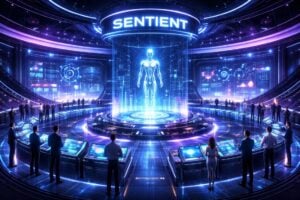
The business world is undergoing a radical transformation thanks to the increasingly widespread integration of AI agents in operational processes, from customer management to back-office operations, and even complex decision-making in financial and compliance areas.
However, this rush to adopt artificial intelligence has highlighted a new challenge: while AI agents are indeed capable of retrieving information, they often struggle to provide coherent, explainable, and reliable reasoning, especially when faced with complex, multi-step, or high-risk tasks.
Arena is Born: The Global AI Lab for Enterprises
To address this need, Sentient, an open-source artificial intelligence lab, has launched Arena: a live testing environment designed to stress-test the most advanced AI solutions and evaluate their reasoning capabilities in real business contexts.
Arena aims to be a global meeting point for developers, investors, and companies, involving from the very first phase prominent names such as Founders Fund, Pantera, Franklin Templeton (with over $1.5 trillion in assets under management), alphaXiv, Fireworks, and OpenRouter.
The involvement of these institutional players indicates a growing interest in the structured assessment of AI agents’ capabilities before their large-scale implementation in production processes.
The Value of Structured Verification
According to Julian Love, Managing Principal of Franklin Templeton Digital Assets, “the question is no longer whether these systems are powerful, but whether they are reliable in real-world workflows.” Love emphasizes how structured environments like Arena are crucial for distinguishing promising ideas from solutions that are truly ready for production.
Himanshu Tyagi, co-founder of Sentient, also highlights the paradigm shift: “It is no longer enough for a system to be impressive in a demo. Companies need to know if agents can reason reliably in production, where errors are costly and trust is fragile. Comparability, repeatability, and tools to monitor improvements over time are needed, regardless of the models or tools used.”
How Arena Works: Simulating Real-World Complexity
Arena stands out for its ability to replicate the complexity of business workflows: incomplete information, lengthy contexts, ambiguous instructions, and conflicting sources. Instead of merely assessing whether an agent has provided the “correct answer,” Arena records the entire reasoning process, allowing engineering teams to analyze failures and track progress over time.
This approach provides a neutral, vendor-independent benchmark to evaluate reasoning capabilities across different models and technology stacks. By focusing on performance in production environments, Arena enables enterprises to tailor AI solutions to their private data and internal tools, ensuring reliability and transparency.
The first major test: document reasoning
The first challenge proposed by Arena addresses one of the fundamental obstacles for businesses: document reasoning. AI agents will need to demonstrate their ability to reason and compute on complex and unstructured data, a crucial skill for activities such as financial analysis, root cause investigations, drafting investment memos, and customer support.
In addition to the partners already mentioned, Openhands and OpenRouter are also participating in this phase, with further additions expected as Arena expands into new tasks, sectors, and model integrations.
The Gap Between Ambition and Reality in Enterprises
Recent industry surveys highlight the gap that Arena aims to bridge: 85% of companies wish to become an “agentic enterprise” and nearly three out of four plan to implement autonomous agents.
However, less than a quarter report having mature governance, and many struggle to transition from the pilot phase to large-scale production. On average, companies already use a dozen agents, often isolated from each other, and fear that adding more could increase complexity rather than value, without better orchestration.
Support from the Open-Source Community
The open-source community plays a key role in this evolution. Graham Neubig, Chief Scientist and co-founder of OpenHands, expresses enthusiasm in supporting those who use agents to solve real-world problems, offering tools like the OpenHands Software Agent SDK to tackle the most complex challenges.
Alex Atallah, CEO and co-founder of OpenRouter, also emphasizes the importance of initiatives like Arena for the advancement of open-source AI: “They allow researchers to compete, iterate, and innovate publicly. We are excited to strengthen our partnership with Sentient and provide the infrastructure that makes experimentation faster and more scalable.”
A Global Initiative Based in San Francisco
Arena is gearing up for a global launch, inviting thousands of AI developers to apply for the first exclusive cohort. In-person events will be organized in San Francisco starting from March 2026, solidifying the city as the epicenter of AI innovation.
Sentient Labs: the mission of open-source AI
Leading this revolution is Sentient Labs, a research and development organization committed to advancing open-source AI. Under the aegis of the Sentient Foundation, the labs conduct cutting-edge research on reasoning, alignment, and coordination of AI agents. Sentient is already known for frameworks like ROMA and open-source models like Dobby, with the goal of transforming open-source AI from experimental to essential for critical business operations.
By providing infrastructure to build powerful and composable agent systems, Sentient enables developers to monetize open-source tools and achieve enterprise-level utility. The mission is clear: make open-source the global standard for mission-critical AI.
Towards a Future of Reliable and Transparent AI
With the launch of Arena, Sentient and its partners lay the groundwork for a new era where businesses can finally evaluate, enhance, and trust the reasoning capabilities of AI agents.
In a context where the stakes are increasingly high, the ability to test and verify solutions in realistic environments represents a crucial step towards the responsible and scalable adoption of artificial intelligence in companies worldwide.
You May Also Like

Willy Woo Warns Liquidity Breakdown Could Cap Bitcoin’s Rally Despite Short-Term Relief
Wormhole Token Surges After Tokenomics Reset and W Reserve Launch

