
MEXC Digest #44: Who Wins AI's Second Round?


AI's next advantage may belong to the companies that can turn limited capacity into real gains.


The AI boom has a familiar question with a new price tag: after spending billions to build the infrastructure, who actually makes money using it?


The first wave rewarded companies supplying chips, data centers, and power. That buildout is still accelerating. The next opportunity may be harder to spot, because it could appear in the margins of a retailer, the operations of a hospital, or the costs of an industrial business.


Who Turns AI Spending Into Results?

The Buildout Isn't Over

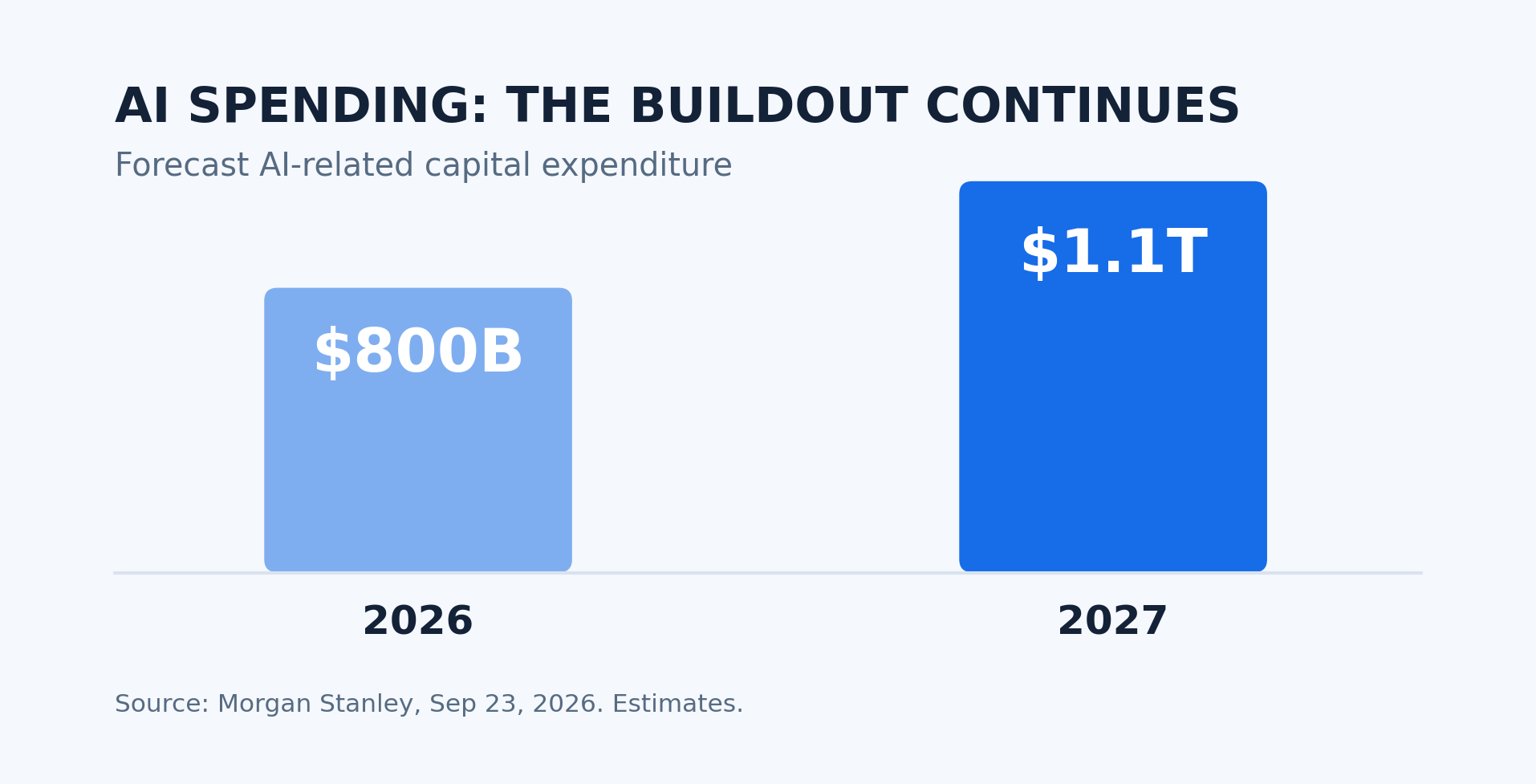
Compute is still in demand. Morgan Stanley projects AI-related capital expenditures will reach roughly $800 billion in 2026, climbing to $1.1 trillion in 2027. Companies racing to secure capacity also need power, cooling, buildings, and financing. Each constraint creates an opportunity for someone who can help remove it. The infrastructure trade is far from over.


Paying for It Is the Easy Part

But building AI capacity and earning a return from it are different jobs. The first produces visible orders: chips sold, data centers built, megawatts secured. The second asks what happens after a business pays to use that capacity. Does it serve more customers? Make fewer errors? Finish work faster? Widen margins? A company can announce an AI partnership tomorrow. It may take much longer to answer those questions.


The shift begins when AI moves beyond pilots and into everyday operations. Consider a retailer deciding what to stock, a hospital handling administrative work, or an industrial company maintaining equipment. Each has a plausible use case. None gets the benefit simply by adding a model to its software.


Klarna shows why. In 2024, it reported substantial savings from its AI assistant. It later expanded human support—a reminder that lower service costs and good service are two different measures of success.


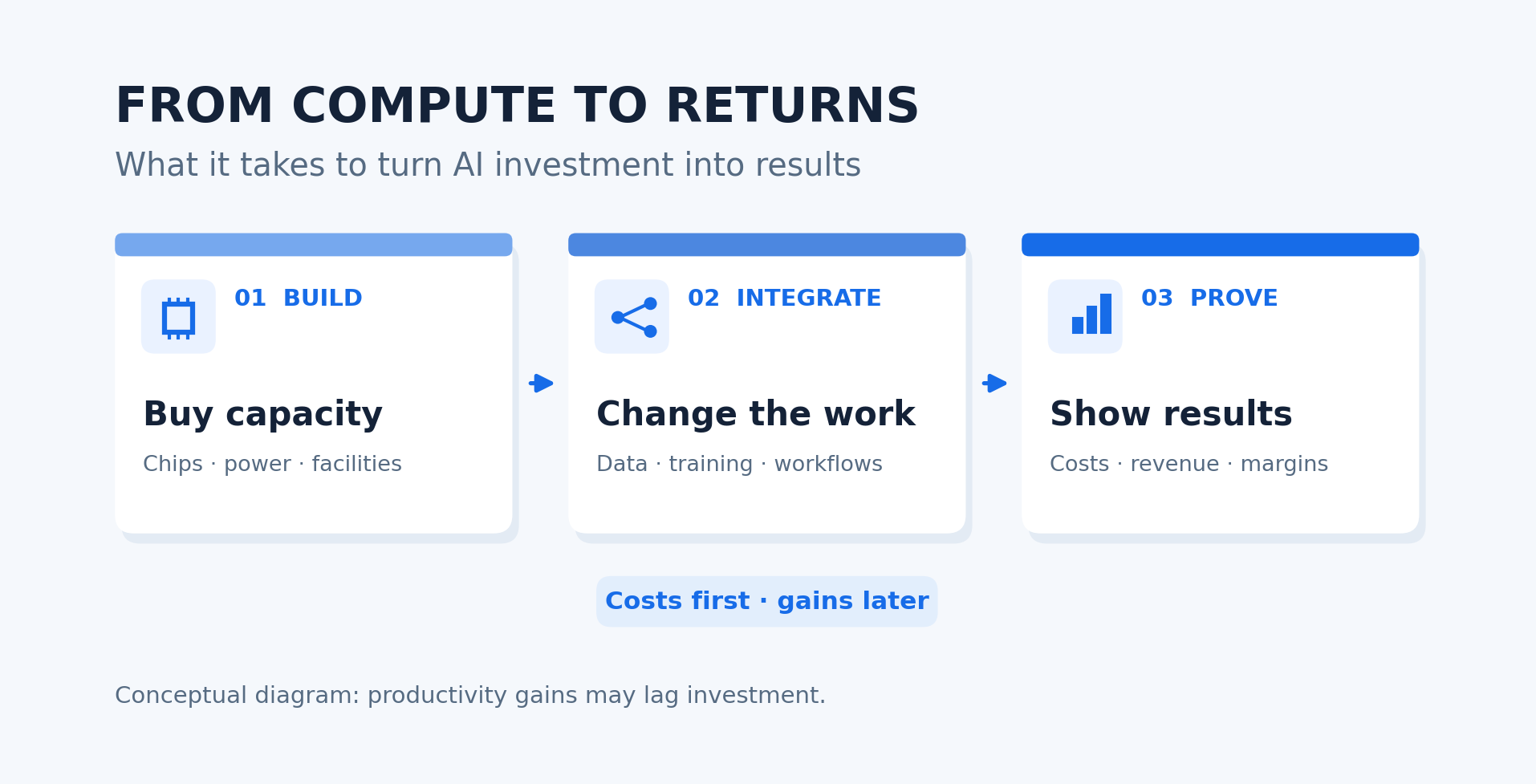
Before AI pays off, the unglamorous work comes first: preparing data, protecting it, setting rules for its use, training employees, and redesigning the workflow around what the technology can reliably do. That investment may weigh on costs before it helps earnings. Morgan Stanley points to the productivity J-curve: companies reorganize and spend first; measurable gains can follow later.


Why the Bar Just Went Up

The compute bottleneck gives infrastructure providers a clear reason to keep building. Scarce capacity also makes weak use cases harder to justify. As spending climbs, investors may become more selective about what counts as progress. Pilot counts and ambitious forecasts are easy to announce; sustained cost savings, wider margins, and revenue customers will pay for are harder to produce.


This is why the next set of AI winners could look different from the first. A business outside tech does not need to build the best model. It needs a specific problem, the ability to put AI to work at scale, and a way to measure the result.


The first test of the AI boom was who could supply it. The next is who can turn that supply into an advantage. The spending figures tell us the size of the bet. The earnings will tell us who won it. That gives investors two sets of evidence to watch: orders and capacity for the builders; measurable savings, revenue, and margins for the users.


Quick Hits

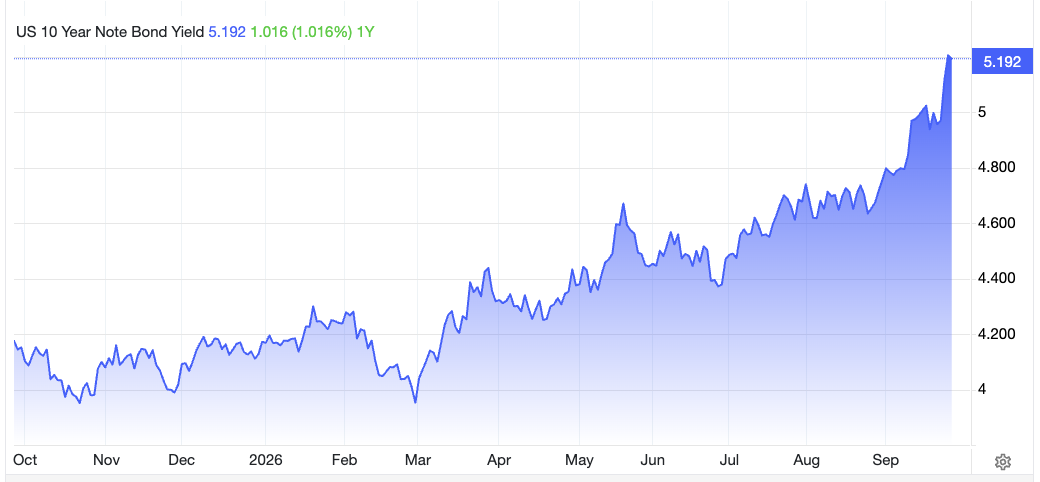
Bonds raise the price of the bet. The 10-year Treasury par yield was 5.11% on September 23; the 30-year was 5.40%. The AI buildout is reaching the bond market, too: five major hyperscalers had issued about $132 billion in bonds through July, compared with an annual average of roughly $35 billion from 2020 to 2024. Higher yields make financing and the returns needed to justify new projects harder to ignore.


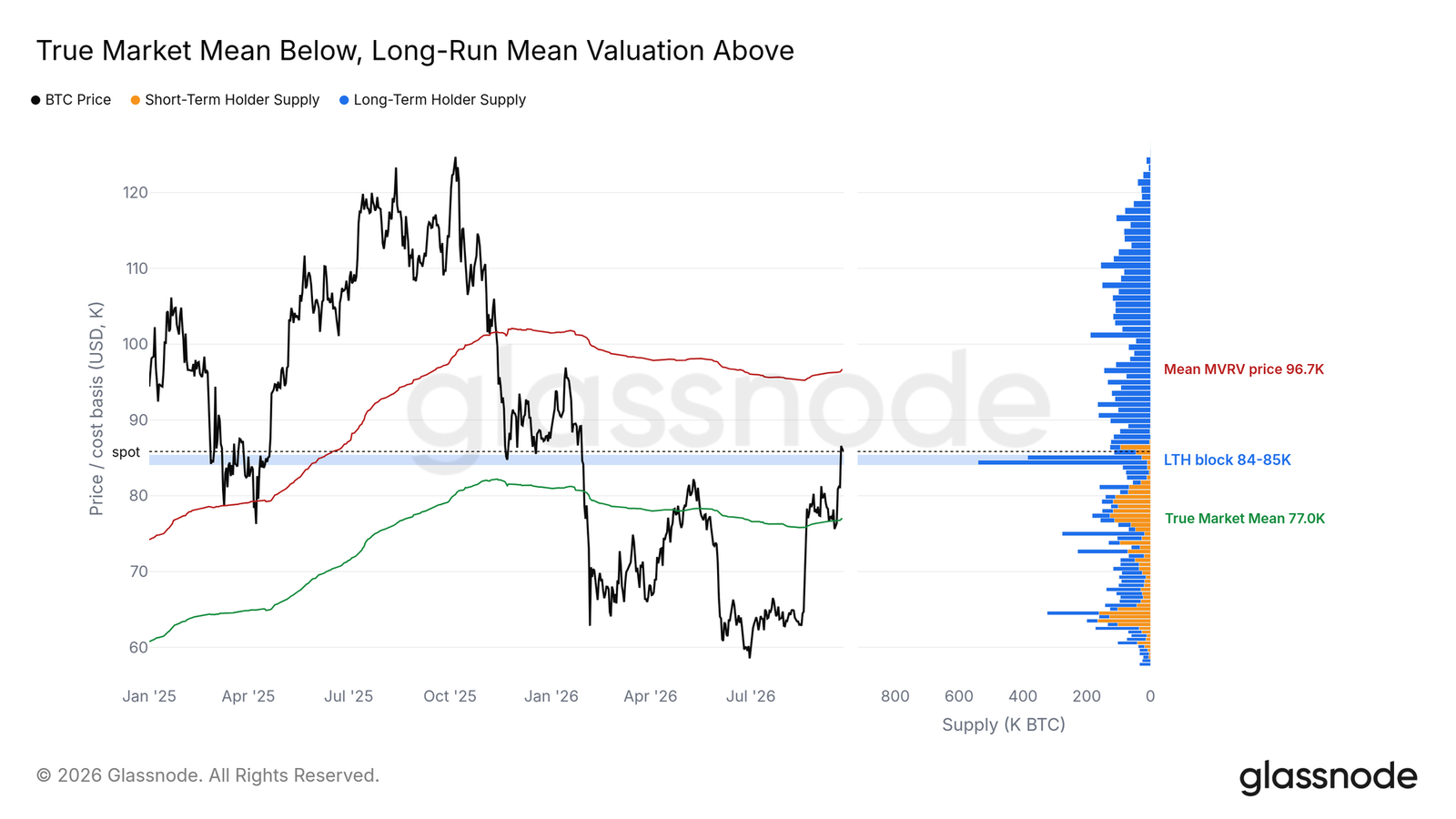
Bitcoin has its own test. Glassnode found a dense block of long-term holder supply around $84,000–$85,000, with options positioning that could accelerate moves toward $92,000 and slow them near $95,000. Altcoins have risen broadly without much new leverage. Those readings use data through September 21–23; refresh the price and options positioning before publication.


Data centers are entering the midterms. An NPR analysis counted more than $45 million spent on political ads mentioning data centers. The House has also passed a bill requiring state regulators to consider whether large power users should bear the added infrastructure costs of serving them. Electricity costs are becoming a political constraint on the AI buildout; the bill has not become law.


Stock tokens get a conditional opening. The SEC has granted certain venues temporary relief to trade tokenized U.S. listed stocks through permissioned automated market makers and liquidity pools. Trading limits apply, tokens must carry equivalent shareholder rights, and issuers must receive notice and an opportunity to object in specified cases. The interesting question now is what useful applications developers build around that access.


Translation

"Price is what you pay. Value is what you get." — Warren Buffett, crediting Ben Graham for teaching him the saying.


Buffett has stepped down as Berkshire Hathaway chairman. His old price-versus-value test has a new subject: AI. The price is in the spending forecasts; the value is still making its way into the earnings reports.


New and Noteworthy

The AI buildout, from chips to power. TSMC manufactures the chips at the heart of the AI boom; Vicor makes power components that help keep demanding systems running. Both now have Stock Futures on MEXC.


Beyond the data center. Also on Stock Futures: Lenovo (HK0992) brings the story closer to the devices people use, while Thermo Fisher (TMO) takes us into the tools behind scientific research.


Before the bell. New Pre-IPO Futures feature Oura the smart ring maker, and Polymarket, the prediction market platform.


Before You Go

AI may be the big story this week, but there are a couple of ways to get closer to the companies behind it—and bring a friend along for the ride.


IPO Express: OURA lets eligible users subscribe with USDT for exposure linked to the smart ring maker’s IPO performance through mirror credits, without buying shares.


And with Real Stocks, Real Friends, you can earn 15 USDT when a friend joins RealStocks, makes at least 100 USDT in net purchases, and holds for three days.


Coin Icon
Daftar sekarang untuk mendapatkan hadiah pengguna baru senilai 10,000 USDT

Berlangganan MEXC Digest

Pergerakan pasar, listing, & wawasan mingguan, langsung ke kotak masuk Anda.
Dengan berlangganan, Anda setuju untuk menerima buletin dan pembaruan email dari MEXC, serta menyetujui Kebijakan Privasi kami. Konten yang disediakan hanya untuk tujuan informasi dan bukan merupakan saran investasi.

Gabung dengan MEXC di Telegram

Ketahui listing, acara, dan perkembangan terbaru secara aktual, langsung dari saluran Telegram resmi kami.

MEXC Digest #44: Who Wins AI's Second Round?


AI's next advantage may belong to the companies that can turn limited capacity into real gains.


The AI boom has a familiar question with a new price tag: after spending billions to build the infrastructure, who actually makes money using it?


The first wave rewarded companies supplying chips, data centers, and power. That buildout is still accelerating. The next opportunity may be harder to spot, because it could appear in the margins of a retailer, the operations of a hospital, or the costs of an industrial business.


Who Turns AI Spending Into Results?

The Buildout Isn't Over

Compute is still in demand. Morgan Stanley projects AI-related capital expenditures will reach roughly $800 billion in 2026, climbing to $1.1 trillion in 2027. Companies racing to secure capacity also need power, cooling, buildings, and financing. Each constraint creates an opportunity for someone who can help remove it. The infrastructure trade is far from over.


Paying for It Is the Easy Part

But building AI capacity and earning a return from it are different jobs. The first produces visible orders: chips sold, data centers built, megawatts secured. The second asks what happens after a business pays to use that capacity. Does it serve more customers? Make fewer errors? Finish work faster? Widen margins? A company can announce an AI partnership tomorrow. It may take much longer to answer those questions.


The shift begins when AI moves beyond pilots and into everyday operations. Consider a retailer deciding what to stock, a hospital handling administrative work, or an industrial company maintaining equipment. Each has a plausible use case. None gets the benefit simply by adding a model to its software.


Klarna shows why. In 2024, it reported substantial savings from its AI assistant. It later expanded human support—a reminder that lower service costs and good service are two different measures of success.


Before AI pays off, the unglamorous work comes first: preparing data, protecting it, setting rules for its use, training employees, and redesigning the workflow around what the technology can reliably do. That investment may weigh on costs before it helps earnings. Morgan Stanley points to the productivity J-curve: companies reorganize and spend first; measurable gains can follow later.


Why the Bar Just Went Up

The compute bottleneck gives infrastructure providers a clear reason to keep building. Scarce capacity also makes weak use cases harder to justify. As spending climbs, investors may become more selective about what counts as progress. Pilot counts and ambitious forecasts are easy to announce; sustained cost savings, wider margins, and revenue customers will pay for are harder to produce.


This is why the next set of AI winners could look different from the first. A business outside tech does not need to build the best model. It needs a specific problem, the ability to put AI to work at scale, and a way to measure the result.


The first test of the AI boom was who could supply it. The next is who can turn that supply into an advantage. The spending figures tell us the size of the bet. The earnings will tell us who won it. That gives investors two sets of evidence to watch: orders and capacity for the builders; measurable savings, revenue, and margins for the users.


Quick Hits

Bonds raise the price of the bet. The 10-year Treasury par yield was 5.11% on September 23; the 30-year was 5.40%. The AI buildout is reaching the bond market, too: five major hyperscalers had issued about $132 billion in bonds through July, compared with an annual average of roughly $35 billion from 2020 to 2024. Higher yields make financing and the returns needed to justify new projects harder to ignore.


Bitcoin has its own test. Glassnode found a dense block of long-term holder supply around $84,000–$85,000, with options positioning that could accelerate moves toward $92,000 and slow them near $95,000. Altcoins have risen broadly without much new leverage. Those readings use data through September 21–23; refresh the price and options positioning before publication.


Data centers are entering the midterms. An NPR analysis counted more than $45 million spent on political ads mentioning data centers. The House has also passed a bill requiring state regulators to consider whether large power users should bear the added infrastructure costs of serving them. Electricity costs are becoming a political constraint on the AI buildout; the bill has not become law.


Stock tokens get a conditional opening. The SEC has granted certain venues temporary relief to trade tokenized U.S. listed stocks through permissioned automated market makers and liquidity pools. Trading limits apply, tokens must carry equivalent shareholder rights, and issuers must receive notice and an opportunity to object in specified cases. The interesting question now is what useful applications developers build around that access.


Translation

"Price is what you pay. Value is what you get." — Warren Buffett, crediting Ben Graham for teaching him the saying.


Buffett has stepped down as Berkshire Hathaway chairman. His old price-versus-value test has a new subject: AI. The price is in the spending forecasts; the value is still making its way into the earnings reports.


New and Noteworthy

The AI buildout, from chips to power. TSMC manufactures the chips at the heart of the AI boom; Vicor makes power components that help keep demanding systems running. Both now have Stock Futures on MEXC.


Beyond the data center. Also on Stock Futures: Lenovo (HK0992) brings the story closer to the devices people use, while Thermo Fisher (TMO) takes us into the tools behind scientific research.


Before the bell. New Pre-IPO Futures feature Oura the smart ring maker, and Polymarket, the prediction market platform.


Before You Go

AI may be the big story this week, but there are a couple of ways to get closer to the companies behind it—and bring a friend along for the ride.


IPO Express: OURA lets eligible users subscribe with USDT for exposure linked to the smart ring maker’s IPO performance through mirror credits, without buying shares.


And with Real Stocks, Real Friends, you can earn 15 USDT when a friend joins RealStocks, makes at least 100 USDT in net purchases, and holds for three days.

Coin Icon
Daftar sekarang untuk mendapatkan hadiah pengguna baru senilai 10,000 USDT

Berlangganan MEXC Digest

Pergerakan pasar, listing, & wawasan mingguan, langsung ke kotak masuk Anda.
Dengan berlangganan, Anda setuju untuk menerima buletin dan pembaruan email dari MEXC, serta menyetujui Kebijakan Privasi kami. Konten yang disediakan hanya untuk tujuan informasi dan bukan merupakan saran investasi.

Gabung dengan MEXC di Telegram

Ketahui listing, acara, dan perkembangan terbaru secara aktual, langsung dari saluran Telegram resmi kami.
Tetap ikuti info terkini mengenai listing, delisting, acara perdagangan, dan kabar terbaru produk MEXC. Temukan token baru, proyek Launchpad, peluang Earn, alat bertenaga AI, dan penyempurnaan perdagangan futures di platform MEXC.Tetap ikuti info terkini mengenai listing, delisting, acara perdagangan, dan kabar terbaru produk MEXC. Temukan token baru, proyek Launchpad, peluang Earn, alat bertenaga AI, dan penyempurnaan perdagangan futures di platform MEXC.