

Cardano’s May 29 hard fork vote brings ADA’s DeFi weakness into view
Cardano's next hard fork is arriving at a moment when crypto markets no longer reward blockchains for roadmap promises alone, especially as ADA price performance increasingly tracks real developer and DeFi activity.
Protocol Version 11, known as Van Rossem, is already live on the Preview testnet and targets a mainnet governance action submission on May 29, with enactment timing depending on successful infrastructure readiness.
Intersect submitted the PreProd hard fork governance action on May 8, but the Hard Fork Working Group withheld its ratification recommendation due to readiness concerns about Ogmios, a critical infrastructure dependency that keeps the May 29 mainnet target conditional. The vote also becomes a live test of Cardano governance coordination under the Conway-era framework.
Intersect describes V11 as an intra-era hard fork, with Plutus, ledger, and node enhancements that keep Cardano within the Conway era, while ADA holders maintain full wallet and token access throughout the transition.
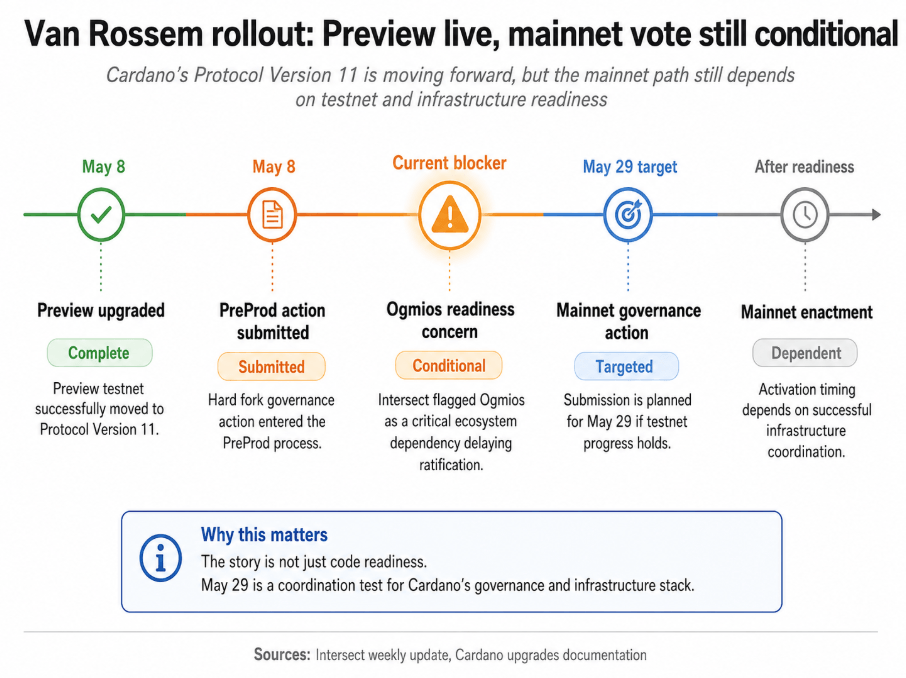 Cardano's Van Rossem upgrade cleared Preview testnet on May 8, but Ogmios readiness concerns block PreProd ratification ahead of the May 29 target.
What Cardano V11 actually changes
Plutus is Cardano's smart contract scripting environment, and it gets the deepest set of modifications. The upgrade expands Cardano smart contracts functionality through broader Plutus compatibility and lower execution costs.
V11 makes all built-in functions available across Plutus V1, V2, and V3, adds case expressions for common data types, and introduces new built-ins, including arrays, optimized multi-asset value operations, modular exponentiation, list handling, and BLS12-381 multi-scalar multiplication.
Intersect says these changes collectively improve script performance and reduce execution costs, making contracts easier to run and write in the current era.
CIP-133 proposes efficient multi-scalar multiplication over BLS12-381, V11's most forward-looking addition, a curve widely used in ZK proofs, SNARK systems, and cryptographic signature schemes.
MSM of 10 G1 points consumed 7.74% of a transaction's computational budget in testing, while operations above 129 points exceeded what a single transaction could contain.
By adding MSM as a native built-in, V11 provides Cardano with better infrastructure for applications that rely on expensive elliptic-curve operations, including ZK bridges, privacy-preserving dApps, and cross-chain verification tools.
IOG has already tied this primitive work to its Halo2-Plutus verifier and the Midnight-Cardano ZK bridge, giving the cryptographic additions a visible product roadmap.
Modular exponentiation, covered by CIP-109, adds the second cryptographic layer. The CIP notes that existing on-chain implementations of certain inverses can consume 5% to 9% of the CPU budget on mainnet, and adding modular exponentiation as a built-in reduces both transaction size and execution cost for applications relying on it.
| Upgrade area | V11 change | Reader translation |
|---|---|---|
| Plutus built-ins | Built-ins available across Plutus V1, V2, and V3 | More consistent developer environment |
| Script performance | Arrays, list handling, optimized multi-asset value operations | Contracts can become easier and cheaper to run |
| ZK infrastructure | BLS12-381 multi-scalar multiplication | Better foundation for ZK proofs, bridges, and verification |
| Cryptography | Modular exponentiation built-in | Reduces cost for cryptographic operations |
| Stake pool security | VRF key uniqueness enforcement | Prevents two pools from reusing the same VRF key |
| Governance | SPO and Constitutional Committee vote under bootstrapping | May 29 becomes a coordination test |
Intersect says V11 enforces VRF key uniqueness at the ledger level, preventing two stake pools from reusing the same VRF key, reducing potential attack vectors, and making enforcement automatic.
Intersect's FAQ confirms that the Cardano mainnet is in governance bootstrapping and that, for V11 governance actions, only the Constitutional Committee and stake pool operators can vote under current rules, with full DRep participation in a later phase.
May 29 becomes a test of SPO and CC coordination, with clean execution serving as the more immediate signal of Cardano's governance maturity.
Why Cardano's DeFi usage gap is the real benchmark
Cardano DeFi activity remains modest relative to competing smart contract ecosystems.
ADA was trading near $0.249, with a market cap of around $9.2 billion, down roughly 5.8% over the past 7 days and approximately 92% below its all-time high. The distance traces at least partly to Cardano's activity footprint relative to its capitalization.
Cardano carried roughly $129 million in DeFi total value locked (TVL), $46.7 million in stablecoin market cap, and $615,138 in 24-hour DEX volume.
Against those numbers, Solana ran over $6 billion in TVL, $15 billion in stablecoins, and $1.14 billion in 24-hour DEX volume, while Ethereum carried $43.4 billion in DeFi TVL, and $164.8 billion in stablecoins.
Cardano trades at roughly 72x TVL compared to Solana's approximately 8x and Ethereum's roughly 6x, a ratio that leaves little room for disappointment if developer adoption of V11's improvements runs slower than expected.
| Metric | Cardano | Solana | Ethereum |
|---|---|---|---|
| DeFi TVL | ~$129M | >$6B | ~$43.4B |
| Stablecoin market cap | ~$46.7M | ~$15B | ~$164.8B |
| 24h DEX volume | ~$615K | ~$1.14B | ~$1.14B |
| Market-cap-to-TVL ratio | ~72x | ~8x | ~6x |
Ethereum's Layer 2 networks carry approximately $40.3 billion in total secured value according to L2BEAT, with rollups accounting for $33.5 billion.
Cardano's ZK-related additions arrive in a market where ZK infrastructure is already a core competitive narrative, meaning V11 must translate its primitives into developer adoption and application volume.
Where Cardano usage either validates or stalls V11
If PreProd readiness resolves and the May 29 governance action proceeds cleanly, V11 could become the technical foundation for a credible Cardano developer narrative through the second half of 2025.
The bull case runs through three channels, the first being builders adopting the new arrays, cost-model improvements, and MSM built-ins in real contracts. The second is Cardano's stablecoin base and DeFi TVL climbing from a low floor, and the third is DEX volume and active addresses tracking application activity.
At 72x TVL, even modest liquidity inflows would quickly compress the ratio. The ZK and privacy application layer gives V11 a differentiated narrative in a segment still settling its architectural standards.
ADA could re-rate as a credible catch-up trade if those primitives attract developers who see Cardano's cost model as competitive against Ethereum L2s and Solana.
V11 arrives with the usage gap intact, and governance or infrastructure delays compound the problem.
If Ogmios and other dependencies take longer to clear, the mainnet timeline slips, and May 29 passes as a missed coordination signal.
Even with clean mainnet activation, developer adoption of the new primitives takes time, and investors are sorting catalysts quickly. Cardano's TVL and DEX volume show a chain where technical upgrades have preceded sustained usage growth.
If V11 follows that pattern of technically delivered but slow to generate application activity, ADA stays rangebound against faster chains and Ethereum's Layer 2 networks, with the market pricing the upgrade as necessary infrastructure.
The execution test
Van Rossem provides Cardano with a better scripting environment, stronger cryptographic primitives, and a more rigorous stake-pool security model.
The mainnet governance action on or around May 29 will test whether Cardano's decentralized coordination can deliver on a concrete technical commitment, with SPOs and the Constitutional Committee providing the first governance coordination of this scale under bootstrapping rules.
TVL, stablecoin supply, DEX volume, and active contract deployments once V11 activates will determine whether the upgrade earns a market response or files into the record as another well-built feature set awaiting users.
The post Cardano’s May 29 hard fork vote brings ADA’s DeFi weakness into view appeared first on CryptoSlate.


추천 콘텐츠

Breaking Down Settlement Factors in Formula Injury Lawsuits
India Busts ₹226 Crore Crypto Network Linked to Drugs and Terror Financing

Ripple (XRP) News Today: May 21


인기 뉴스
더보기
