Spain’s second-largest financial institution, BBVA, has introduced Bitcoin and Ethereum trading and custody capabilities for retail customers, marking a significant expansion of regulated digital asset services across Europe . BBVA has fully integrated these cryptocurrency services within its proprietary mobile platform, operating independently without relying on external service providers or third-party custodial solutions. 🚨 Breaking: Spain's major bank BBVA has rolled out trading and custody services for $BTC and $ETH directly in its mobile app for retail customers. Get ready for a surge of capital into the crypto market! pic.twitter.com/ccXoPsWOCf — Crypto Jessica (@CryptoJessXBT) July 7, 2025 The bank’s approach allows customers to execute transactions autonomously while maintaining that it does not offer investment advisory services. BBVA’s 4-Year Crypto Journey Reaches Spain According to an official release dated July 4, the cryptocurrency service launch stems from regulatory approval obtained through Spain’s National Securities Market Commission (CNMV) in March 2025. 🇪🇸 Spanish lending giant BBVA said it won approval to launch Bitcoin and Ether trading, integrating crypto into everyday banking. #BBVA #CryptoTrading https://t.co/ifB7FxuUV8 — Cryptonews.com (@cryptonews) March 10, 2025 This licensing framework authorizes BBVA to provide cryptocurrency services to all customers who meet legal age requirements. “ Our objective is to simplify cryptocurrency investment for retail customers in Spain through an accessible and user-friendly digital platform available on their mobile devices ,” stated Gonzalo Rodríguez, BBVA’s head of retail banking for Spain. The service architecture ensures compliance with the European Union’s Markets in Crypto-Assets (MiCA) regulation, which establishes comprehensive standards for cryptocurrency-related services across EU member states. BBVA’s Spanish cryptocurrency initiative builds upon the success of its Swiss operations. In June 2021, BBVA Switzerland pioneered the bank’s cryptocurrency offerings by introducing Bitcoin custody and trading services for private banking clientele Spain's BBVA, with $782 billion of total assets, is launching a #bitcoin trading service for private clients in Switzerland, due to "significant desire" among investors. — Documenting ₿itcoin 📄 (@DocumentingBTC) June 18, 2021 The Swiss division has since diversified its cryptocurrency portfolio to encompass Ethereum, Solana, XRP, and AVAX, successfully attracting both institutional investors and high-net-worth individuals. Recent reports from June 18 indicate that BBVA has been recommending portfolio allocations of 3% to 7% in cryptocurrencies for its affluent clients. Philippe Meyer, head of digital and blockchain solutions at BBVA Switzerland, indicated that the bank currently advises clients to focus on Bitcoin and Ethereum investments , with plans to introduce additional cryptocurrencies later this year. “ A 3% portfolio allocation to cryptocurrency represents manageable risk exposure ,” Meyer explained. “ In a balanced portfolio structure, introducing 3% cryptocurrency allocation can enhance overall performance. “ Expanding Stablecoin Services See 9% of Spaniards Own Crypto, While 95% of EU Banks Stay Away Beyond Bitcoin and Ethereum, BBVA has incorporated USDC stablecoin services into its offerings. In September 2024, the bank extended its cryptocurrency custody and trading capabilities to include USD Coin for institutional and private banking clients in Switzerland. This expansion enables clients to trade, hold, or convert USDC into euros, dollars, or other currencies with near-instantaneous execution. The bank noted that investment fund managers and large corporations frequently utilize stablecoins like USDC to accelerate transactions across various cryptocurrency exchanges. Additionally, stablecoins serve as a hedge against cryptocurrency volatility by allowing investors to preserve asset value during market fluctuations. Despite approximately 95% of EU banks avoiding cryptocurrency services due to the European Securities and Markets Authority’s (ESMA) cautious regulatory stance, Spain’s cryptocurrency market has demonstrated substantial growth. Europe's crypto regulation will be its biggest mistake since the dotcom era: – EU imposing MiCA – US embracing crypto – Major players leaving EU – $499B+ in crypto flowing through Eastern Europe Is crypto's future in Europe doomed? Here's the full breakdown: pic.twitter.com/mZIi79cru3 — Alessandro Palombo (@thealepalombo) December 16, 2024 A 2024 European Central Bank survey, published in January 2025, revealed that nearly 9% of Spanish citizens now hold digital assets , representing more than double the figure from 2022. Spain’s cryptocurrency adoption rate now equals that of France and Croatia within the Eurozone, though it remains below Slovenia’s 15% adoption rate and Greece’s 14% ownership levels. Between 2023 and 2024 alone, Spain received over $80 billion worth of cryptocurrency, making it the 5th largest European country with the most crypto value received. Source: Chainalysis Spain’s 28% Crypto Tax: The Hidden Cost of Digital Assets Despite growing adoption, Spain has tight tax regulations on crypto. The Spanish cryptocurrency taxation follows specific guidelines established by the Spanish State Agency for Tax Administration (AEAT). Spanish residents are required to declare gains from cryptocurrency transactions and income generated from digital asset holdings or related activities. Source: Blockpit Spanish taxpayers are required to report cryptocurrency gains exceeding €6,000 under the Income Savings Tax (Capital Gains Tax), with rates ranging from 19% to 28% depending on total gains.Spain’s second-largest financial institution, BBVA, has introduced Bitcoin and Ethereum trading and custody capabilities for retail customers, marking a significant expansion of regulated digital asset services across Europe . BBVA has fully integrated these cryptocurrency services within its proprietary mobile platform, operating independently without relying on external service providers or third-party custodial solutions. 🚨 Breaking: Spain's major bank BBVA has rolled out trading and custody services for $BTC and $ETH directly in its mobile app for retail customers. Get ready for a surge of capital into the crypto market! pic.twitter.com/ccXoPsWOCf — Crypto Jessica (@CryptoJessXBT) July 7, 2025 The bank’s approach allows customers to execute transactions autonomously while maintaining that it does not offer investment advisory services. BBVA’s 4-Year Crypto Journey Reaches Spain According to an official release dated July 4, the cryptocurrency service launch stems from regulatory approval obtained through Spain’s National Securities Market Commission (CNMV) in March 2025. 🇪🇸 Spanish lending giant BBVA said it won approval to launch Bitcoin and Ether trading, integrating crypto into everyday banking. #BBVA #CryptoTrading https://t.co/ifB7FxuUV8 — Cryptonews.com (@cryptonews) March 10, 2025 This licensing framework authorizes BBVA to provide cryptocurrency services to all customers who meet legal age requirements. “ Our objective is to simplify cryptocurrency investment for retail customers in Spain through an accessible and user-friendly digital platform available on their mobile devices ,” stated Gonzalo Rodríguez, BBVA’s head of retail banking for Spain. The service architecture ensures compliance with the European Union’s Markets in Crypto-Assets (MiCA) regulation, which establishes comprehensive standards for cryptocurrency-related services across EU member states. BBVA’s Spanish cryptocurrency initiative builds upon the success of its Swiss operations. In June 2021, BBVA Switzerland pioneered the bank’s cryptocurrency offerings by introducing Bitcoin custody and trading services for private banking clientele Spain's BBVA, with $782 billion of total assets, is launching a #bitcoin trading service for private clients in Switzerland, due to "significant desire" among investors. — Documenting ₿itcoin 📄 (@DocumentingBTC) June 18, 2021 The Swiss division has since diversified its cryptocurrency portfolio to encompass Ethereum, Solana, XRP, and AVAX, successfully attracting both institutional investors and high-net-worth individuals. Recent reports from June 18 indicate that BBVA has been recommending portfolio allocations of 3% to 7% in cryptocurrencies for its affluent clients. Philippe Meyer, head of digital and blockchain solutions at BBVA Switzerland, indicated that the bank currently advises clients to focus on Bitcoin and Ethereum investments , with plans to introduce additional cryptocurrencies later this year. “ A 3% portfolio allocation to cryptocurrency represents manageable risk exposure ,” Meyer explained. “ In a balanced portfolio structure, introducing 3% cryptocurrency allocation can enhance overall performance. “ Expanding Stablecoin Services See 9% of Spaniards Own Crypto, While 95% of EU Banks Stay Away Beyond Bitcoin and Ethereum, BBVA has incorporated USDC stablecoin services into its offerings. In September 2024, the bank extended its cryptocurrency custody and trading capabilities to include USD Coin for institutional and private banking clients in Switzerland. This expansion enables clients to trade, hold, or convert USDC into euros, dollars, or other currencies with near-instantaneous execution. The bank noted that investment fund managers and large corporations frequently utilize stablecoins like USDC to accelerate transactions across various cryptocurrency exchanges. Additionally, stablecoins serve as a hedge against cryptocurrency volatility by allowing investors to preserve asset value during market fluctuations. Despite approximately 95% of EU banks avoiding cryptocurrency services due to the European Securities and Markets Authority’s (ESMA) cautious regulatory stance, Spain’s cryptocurrency market has demonstrated substantial growth. Europe's crypto regulation will be its biggest mistake since the dotcom era: – EU imposing MiCA – US embracing crypto – Major players leaving EU – $499B+ in crypto flowing through Eastern Europe Is crypto's future in Europe doomed? Here's the full breakdown: pic.twitter.com/mZIi79cru3 — Alessandro Palombo (@thealepalombo) December 16, 2024 A 2024 European Central Bank survey, published in January 2025, revealed that nearly 9% of Spanish citizens now hold digital assets , representing more than double the figure from 2022. Spain’s cryptocurrency adoption rate now equals that of France and Croatia within the Eurozone, though it remains below Slovenia’s 15% adoption rate and Greece’s 14% ownership levels. Between 2023 and 2024 alone, Spain received over $80 billion worth of cryptocurrency, making it the 5th largest European country with the most crypto value received. Source: Chainalysis Spain’s 28% Crypto Tax: The Hidden Cost of Digital Assets Despite growing adoption, Spain has tight tax regulations on crypto. The Spanish cryptocurrency taxation follows specific guidelines established by the Spanish State Agency for Tax Administration (AEAT). Spanish residents are required to declare gains from cryptocurrency transactions and income generated from digital asset holdings or related activities. Source: Blockpit Spanish taxpayers are required to report cryptocurrency gains exceeding €6,000 under the Income Savings Tax (Capital Gains Tax), with rates ranging from 19% to 28% depending on total gains.

Spanish Banking Giant BBVA Expands Crypto Offerings with Bitcoin and Ethereum Services

2025/07/07 20:27
4분 읽기
이 콘텐츠에 대한 의견이나 우려 사항이 있으시면 [email protected]으로 연락주시기 바랍니다

Spain’s second-largest financial institution, BBVA, has introduced Bitcoin and Ethereum trading and custody capabilities for retail customers, marking a significant expansion of regulated digital asset services across Europe.

BBVA has fully integrated these cryptocurrency services within its proprietary mobile platform, operating independently without relying on external service providers or third-party custodial solutions.

The bank’s approach allows customers to execute transactions autonomously while maintaining that it does not offer investment advisory services.

BBVA’s 4-Year Crypto Journey Reaches Spain

According to an official release dated July 4, the cryptocurrency service launch stems from regulatory approval obtained through Spain’s National Securities Market Commission (CNMV) in March 2025.

This licensing framework authorizes BBVA to provide cryptocurrency services to all customers who meet legal age requirements.

Our objective is to simplify cryptocurrency investment for retail customers in Spain through an accessible and user-friendly digital platform available on their mobile devices,” stated Gonzalo Rodríguez, BBVA’s head of retail banking for Spain.

The service architecture ensures compliance with the European Union’s Markets in Crypto-Assets (MiCA) regulation, which establishes comprehensive standards for cryptocurrency-related services across EU member states.

BBVA’s Spanish cryptocurrency initiative builds upon the success of its Swiss operations. In June 2021, BBVA Switzerland pioneered the bank’s cryptocurrency offerings by introducing Bitcoin custody and trading services for private banking clientele

The Swiss division has since diversified its cryptocurrency portfolio to encompass Ethereum, Solana, XRP, and AVAX, successfully attracting both institutional investors and high-net-worth individuals.

Recent reports from June 18 indicate that BBVA has been recommending portfolio allocations of 3% to 7% in cryptocurrencies for its affluent clients.

Philippe Meyer, head of digital and blockchain solutions at BBVA Switzerland, indicated that the bank currently advises clients to focus on Bitcoin and Ethereum investments, with plans to introduce additional cryptocurrencies later this year.

A 3% portfolio allocation to cryptocurrency represents manageable risk exposure,” Meyer explained. “In a balanced portfolio structure, introducing 3% cryptocurrency allocation can enhance overall performance.

Expanding Stablecoin Services See 9% of Spaniards Own Crypto, While 95% of EU Banks Stay Away

Beyond Bitcoin and Ethereum, BBVA has incorporated USDC stablecoin services into its offerings. In September 2024, the bank extended its cryptocurrency custody and trading capabilities to include USD Coin for institutional and private banking clients in Switzerland.

This expansion enables clients to trade, hold, or convert USDC into euros, dollars, or other currencies with near-instantaneous execution.

The bank noted that investment fund managers and large corporations frequently utilize stablecoins like USDC to accelerate transactions across various cryptocurrency exchanges.

Additionally, stablecoins serve as a hedge against cryptocurrency volatility by allowing investors to preserve asset value during market fluctuations.

Despite approximately 95% of EU banks avoiding cryptocurrency services due to the European Securities and Markets Authority’s (ESMA) cautious regulatory stance, Spain’s cryptocurrency market has demonstrated substantial growth.

A 2024 European Central Bank survey, published in January 2025, revealed that nearly 9% of Spanish citizens now hold digital assets, representing more than double the figure from 2022.

Spain’s cryptocurrency adoption rate now equals that of France and Croatia within the Eurozone, though it remains below Slovenia’s 15% adoption rate and Greece’s 14% ownership levels.

Between 2023 and 2024 alone, Spain received over $80 billion worth of cryptocurrency, making it the 5th largest European country with the most crypto value received.
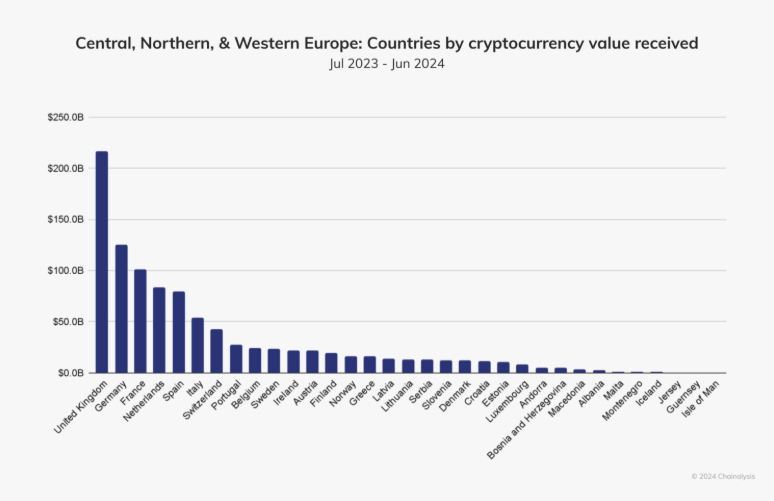
Spanish Banking Giant BBVA Expands Crypto Offerings with Bitcoin and Ethereum ServicesSource: Chainalysis

Spain’s 28% Crypto Tax: The Hidden Cost of Digital Assets

Despite growing adoption, Spain has tight tax regulations on crypto.

The Spanish cryptocurrency taxation follows specific guidelines established by the Spanish State Agency for Tax Administration (AEAT). Spanish residents are required to declare gains from cryptocurrency transactions and income generated from digital asset holdings or related activities.

Spanish Banking Giant BBVA Expands Crypto Offerings with Bitcoin and Ethereum ServicesSource: Blockpit

Spanish taxpayers are required to report cryptocurrency gains exceeding €6,000 under the Income Savings Tax (Capital Gains Tax), with rates ranging from 19% to 28% depending on total gains.


시장 기회
니어 로고
니어 가격(NEAR)
$1.5102
$1.5102$1.5102
-0.89%
USD
니어 (NEAR) 실시간 가격 차트
면책 조항: 본 사이트에 재게시된 글들은 공개 플랫폼에서 가져온 것으로 정보 제공 목적으로만 제공됩니다. 이는 반드시 MEXC의 견해를 반영하는 것은 아닙니다. 모든 권리는 원저자에게 있습니다. 제3자의 권리를 침해하는 콘텐츠가 있다고 판단될 경우, [email protected]으로 연락하여 삭제 요청을 해주시기 바랍니다. MEXC는 콘텐츠의 정확성, 완전성 또는 시의적절성에 대해 어떠한 보증도 하지 않으며, 제공된 정보에 기반하여 취해진 어떠한 조치에 대해서도 책임을 지지 않습니다. 본 콘텐츠는 금융, 법률 또는 기타 전문적인 조언을 구성하지 않으며, MEXC의 추천이나 보증으로 간주되어서는 안 됩니다.

추천 콘텐츠

PMI-ACP Exam Preparation: How to Use a Simulator and Practice Questions Effectively

PMI-ACP Exam Preparation: How to Use a Simulator and Practice Questions Effectively

Understanding the PMI-ACP Exam Structure The PMI-ACP exam is designed to evaluate how well candidates apply agile principles in real-world project environments
공유하기
Techbullion2026/04/02 18:32
Kelp DAO to Halt rsETH Bridging on 20 Networks After June 15

Kelp DAO to Halt rsETH Bridging on 20 Networks After June 15

BitcoinWorld Kelp DAO to Halt rsETH Bridging on 20 Networks After June 15 Kelp DAO, the liquid restaking protocol previously impacted by a $292 million security

공유하기
Bitcoin World2026/05/18 10:05
Franklin Templeton CEO Dismisses 50bps Rate Cut Ahead FOMC

Franklin Templeton CEO Dismisses 50bps Rate Cut Ahead FOMC

The post Franklin Templeton CEO Dismisses 50bps Rate Cut Ahead FOMC appeared on BitcoinEthereumNews.com. Franklin Templeton CEO Jenny Johnson has weighed in on whether the Federal Reserve should make a 25 basis points (bps) Fed rate cut or 50 bps cut. This comes ahead of the Fed decision today at today’s FOMC meeting, with the market pricing in a 25 bps cut. Bitcoin and the broader crypto market are currently trading flat ahead of the rate cut decision. Franklin Templeton CEO Weighs In On Potential FOMC Decision In a CNBC interview, Jenny Johnson said that she expects the Fed to make a 25 bps cut today instead of a 50 bps cut. She acknowledged the jobs data, which suggested that the labor market is weakening. However, she noted that this data is backward-looking, indicating that it doesn’t show the current state of the economy. She alluded to the wage growth, which she remarked is an indication of a robust labor market. She added that retail sales are up and that consumers are still spending, despite inflation being sticky at 3%, which makes a case for why the FOMC should opt against a 50-basis-point Fed rate cut. In line with this, the Franklin Templeton CEO said that she would go with a 25 bps rate cut if she were Jerome Powell. She remarked that the Fed still has the October and December FOMC meetings to make further cuts if the incoming data warrants it. Johnson also asserted that the data show a robust economy. However, she noted that there can’t be an argument for no Fed rate cut since Powell already signaled at Jackson Hole that they were likely to lower interest rates at this meeting due to concerns over a weakening labor market. Notably, her comment comes as experts argue for both sides on why the Fed should make a 25 bps cut or…
공유하기
BitcoinEthereumNews2025/09/18 00:36

No Chart Skills? Still Profit

No Chart Skills? Still ProfitNo Chart Skills? Still Profit

Copy top traders in 3s with auto trading!

