AI Accent Conversion for YouTube Experience Signals a New Layer of CX Control in Global Content Consumption
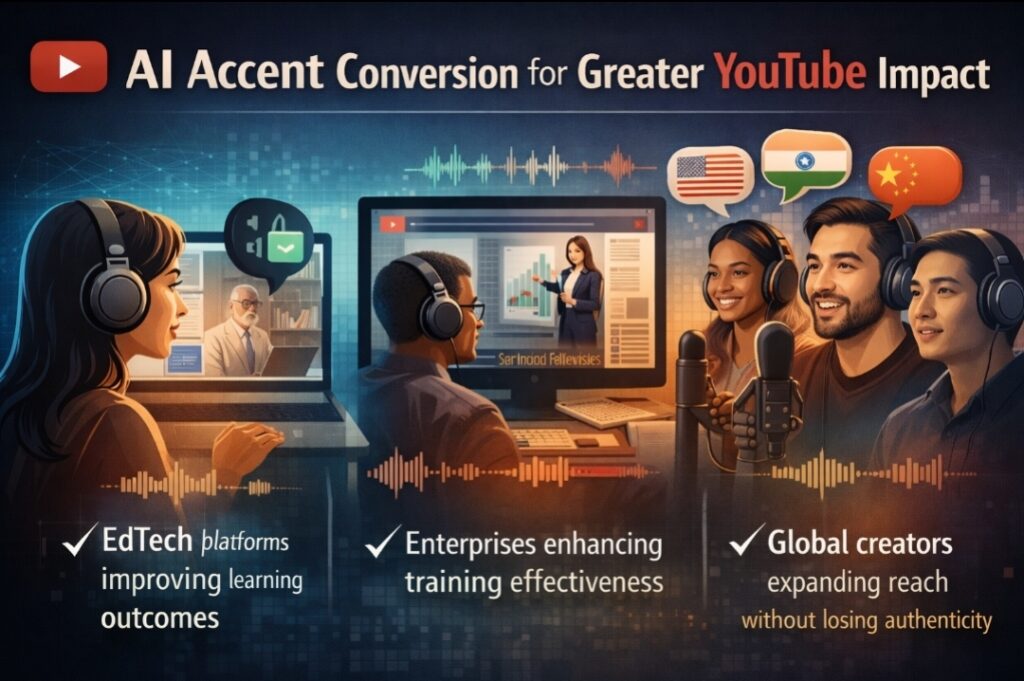
Krisp has introduced a new dimension to digital experience with the launch of its Chrome extension designed to enhance the AI accent conversion for YouTube experience. At its core, the innovation tackles a deeply embedded yet under-addressed friction point in global content consumption—understanding spoken language across diverse accents. While YouTube has long optimized for access through captions and playback controls, comprehension has remained inconsistent. Therefore, Krisp’s approach signals a shift from enabling access to enabling understanding, which is far more critical from a customer experience standpoint.
Why AI Accent Conversion for YouTube Solves a Real CX Problem
The modern content economy operates at a global scale, yet comprehension barriers persist. Users frequently encounter valuable content that they cannot fully understand due to accent differences. As a result, they either replay segments, reduce playback speed, or abandon the video altogether.
Krisp directly acknowledges this behavior pattern. The company notes that users often struggle with:
- Replaying sections multiple times
- Slowing videos down
- Abandoning difficult-to-follow content
This highlights a fundamental CX gap: availability of content does not guarantee usability. Therefore, the AI accent conversion for YouTube experience addresses a core usability challenge rather than a superficial enhancement.
From Passive Consumption to Adaptive Listening
Traditionally, users adapt to content. They replay, adjust, or compensate for comprehension gaps. However, the AI accent conversion for YouTube experience reverses this paradigm. The system adapts the audio output in real time, allowing users to consume content without friction.
The extension operates with a simple toggle and installs in one click. More importantly, it runs entirely on-device, which ensures both speed and privacy.
 Editorial Pull-Quote
Moreover, this real-time processing eliminates latency issues and avoids dependency on cloud-based processing. As a result, the experience remains seamless and uninterrupted.
AI Accent Conversion for YouTube Experience and the Shift in Experience Ownership
One of the most significant implications of this innovation is the shift in responsibility. Historically, creators have been expected to optimize their speech for global audiences. However, this approach is neither scalable nor inclusive.
The AI accent conversion for YouTube experience redistributes that responsibility toward the platform and the user interface.
Editorial Pull-Quote
This shift has strategic implications. It allows creators to maintain authenticity while expanding reach, thereby improving both engagement and content diversity.
Reducing Cognitive Load and Improving Experience Continuity
From a CX lens, the benefits extend beyond simple comprehension. The AI accent conversion for YouTube experience reduces cognitive load, which is a critical but often overlooked dimension of user experience.
Users no longer need to expend additional mental effort to interpret speech. Consequently, they can focus entirely on the content itself.
Editorial Pull-Quote
Additionally, the solution improves experience continuity. Users can consume content without interruptions caused by rewinding or slowing playback. This directly impacts engagement metrics such as watch time and completion rates.
The extension is particularly relevant for:
- Students and self-learners
- Developers and technical audiences
- Non-native English speakers
- Knowledge workers
It also supports users with ADHD or auditory processing challenges, making it a meaningful step toward inclusive design.
Enterprise and Platform Implications Beyond YouTube
Although positioned as a YouTube extension, the underlying capability has broader applications. Krisp has already extended this technology from live meetings into asynchronous content consumption.
This opens up use cases in:
- Corporate training programs
- Employee onboarding
- Recorded webinars and knowledge repositories
Editorial Pull-Quote
In enterprise environments, comprehension directly influences learning outcomes and operational efficiency. Therefore, the adoption of such technologies could redefine how organizations approach knowledge dissemination.
AI Accent Conversion for YouTube Experience as a New CX Category
This innovation introduces what can be described as a voice experience layer—a system that dynamically adapts audio to enhance understanding.
Historically, CX investments have focused on visual interfaces and interaction design. However, as voice becomes a dominant medium, audio clarity will emerge as a critical differentiator.
Editorial Pull-Quote
The AI accent conversion for YouTube experience sets a precedent for how platforms can evolve. Instead of static delivery, they can offer adaptive experiences that respond to individual user needs in real time.
Conclusion: From Access to Understanding
Krisp’s launch underscores a broader shift in digital experience strategy. Access to content is no longer sufficient. Users expect to understand content effortlessly, regardless of its origin or delivery style.
The AI accent conversion for YouTube demonstrates how AI can move beyond backend optimization into front-end experience transformation. It also reinforces a critical insight: reducing friction at the comprehension level has a direct impact on engagement, trust, and value extraction.
As a result, platforms that invest in adaptive experience layers will be better positioned to serve global audiences effectively.
The post AI Accent Conversion for YouTube Experience Signals a New Layer of CX Control in Global Content Consumption appeared first on CX Quest.


You May Also Like

Iran’s army chief warns of ‘total destruction’ for ground invasion

IMF cuts growth outlook, warns world already drifting toward more adverse scenario