

Alien Discovery Crypto Surge: Former BOE Analyst Warns of Stunning Financial Shift
BitcoinWorld
Alien Discovery Crypto Surge: Former BOE Analyst Warns of Stunning Financial Shift
LONDON, March 2025 – A startling analysis from a former Bank of England (BOE) insider suggests that one of humanity’s greatest potential discoveries—confirmed extraterrestrial life—could trigger a seismic alien discovery crypto surge, fundamentally reshaping global finance. According to a report by Asia Business Daily, former BOE analyst Helen McCaugh has formally communicated this unconventional risk assessment to Governor Andrew Bailey. McCaugh’s central thesis posits that such a paradigm-shattering revelation could severely undermine public trust in governmental institutions. Consequently, this erosion of confidence might catalyze a massive flight from traditional, state-backed assets toward decentralized digital currencies like Bitcoin.
Understanding the Alien Discovery Crypto Surge Hypothesis
Helen McCaugh’s warning rests on a clear chain of economic reasoning. First, the official confirmation of alien life represents a ‘black swan’ event of unprecedented scale. Such an event would challenge foundational human narratives and societal structures. McCaugh, leveraging her expertise in systemic risk at the BOE, argues that financial markets are ultimately built on confidence and shared belief in governing authorities. A discovery proving we are not alone could shatter that confidence almost instantly. Therefore, citizens might question the legitimacy and long-term stability of governments that failed to foresee or disclose such a monumental truth. This crisis of legitimacy could directly translate into a crisis for fiat currencies and sovereign bonds, which derive their value from state authority.
Historical Precedents for Trust Collapse and Asset Flight
While an alien discovery is hypothetical, history provides clear examples of how collapsing institutional trust drives asset migration. For instance, during periods of hyperinflation or political instability, citizens have historically turned to alternative stores of value. In the 20th century, this often meant gold or foreign stable currencies. In the 21st century, cryptocurrencies now fulfill a similar role but with key advantages: digital portability, censorship resistance, and independence from any single government. The 2013 Cypriot financial crisis saw increased Bitcoin adoption as citizens sought to protect wealth from bank levies. Similarly, geopolitical tensions often correlate with spikes in cryptocurrency trading volume in affected regions. McCaugh’s analysis extrapolates this behavior to a global, systemic shock.
The Mechanics of a Potential Market Shift
The transition would likely not be orderly. Initially, extreme volatility would grip all markets, including cryptocurrencies. However, McCaugh suggests the narrative around assets would diverge sharply. Traditional assets would be framed as ‘old world’ instruments tied to potentially compromised institutions. In contrast, cryptocurrencies, particularly Bitcoin with its fixed supply and decentralized protocol, could be re-framed as a ‘neutral’ global asset. Its value proposition—being outside direct government control—would become its primary strength. Demand could surge not just from retail investors, but from institutions, corporations, and even nation-states seeking a financial system hedge. This could accelerate existing trends of cryptocurrency integration into traditional finance, but under crisis conditions.
Potential Impact Comparison: Traditional vs. Crypto Assets| Asset Class | Perceived Risk Post-Discovery | Potential Investor Reaction |
|---|---|---|
| Fiat Currencies (USD, GBP, EUR) | High – Tied to government stability | Sell-off, capital flight |
| Government Bonds | Very High – Sovereign credit risk | Yield spike, decreased demand |
| Gold | Moderate – Physical, historical safe haven | Increased demand, price rise |
| Bitcoin & Major Cryptocurrencies | Variable – High volatility but neutral platform | Surge in demand as alternative system |
Expert Perspectives on Systemic Financial Risk
McCaugh’s view, while unique in its trigger, aligns with broader financial theory on tail-risk hedging. Economists often discuss how non-correlated assets perform during systemic crises. Several fintech analysts and economists, while cautious, acknowledge the logic. “The core argument isn’t about aliens, it’s about trust,” noted a financial sociologist from the London School of Economics in a recent paper on digital assets. “Any event that massively and suddenly degrades trust in central authorities will benefit decentralized systems. Cryptocurrencies are the most mature technological embodiment of that principle.” However, other experts warn of oversimplification. The immediate aftermath of such news could cause a liquidity crunch, impacting all risky assets, including crypto, before a longer-term reallocation occurs.
Furthermore, the response of regulators and governments would be critical. Authorities could impose capital controls or even restrict access to cryptocurrency exchanges to stabilize traditional systems. This action, however, could further validate the decentralized argument and push activity toward peer-to-peer or decentralized finance (DeFi) platforms. The scenario underscores the growing intersection between geopolitics, societal psychology, and digital asset markets. It also highlights why central banks and financial stability boards are increasingly studying the cryptocurrency ecosystem, not just as an innovation, but as a potential contingency asset class.
The Role of Bitcoin and Digital Gold Narratives
Within the cryptocurrency space, Bitcoin stands apart in this hypothesis. Its established narrative as “digital gold” or a sovereign-free store of value directly addresses the trust issue McCaugh identifies. Other cryptocurrencies might see differentiated impacts. Privacy-focused coins could see demand based on desires for financial anonymity. Stablecoins pegged to fiat currencies, however, might inherit the trust problems of their underlying assets, unless they transitioned to a commodity or algorithmically-backed model. The event would likely test the fundamental resilience of blockchain networks themselves, potentially attracting unprecedented computational attack or regulatory scrutiny even as demand grows.
- Bitcoin’s Fixed Supply: Its 21-million-coin cap becomes a powerful feature if faith in central bank monetary policy wanes.
- Network Decentralization: No single point of failure makes it resilient to institutional collapse.
- Global Accessibility: Provides a financial base for individuals regardless of changing national policies.
Conclusion
The warning from former BOE analyst Helen McCaugh about a potential alien discovery crypto surge serves as a profound thought experiment for the modern financial era. It moves beyond speculative fiction to highlight the deep, psychological foundations of market confidence. While the triggering event remains within the realm of possibility rather than prediction, the analysis underscores the fragile nature of trust that underpins global finance. It also illuminates the growing significance of decentralized digital assets as potential hedges against systemic, society-level risks. Whether or not such a scenario unfolds, the very fact it is being seriously considered by former financial stability experts marks a significant moment in the dialogue between traditional finance and the cryptocurrency ecosystem. The core lesson is clear: in a world facing unprecedented and unknowable future shocks, assets perceived as independent from traditional power structures may gain unforeseen importance.
FAQs
Q1: What exactly did the former BOE analyst propose?
Helen McCaugh suggested in a letter to BOE Governor Andrew Bailey that official confirmation of extraterrestrial life could cause a severe loss of public trust in governments. This loss of trust might then drive investors toward decentralized assets like Bitcoin, causing a significant surge in cryptocurrency demand and value.
Q2: Is this analysis considered likely by mainstream economists?
The specific trigger is considered a low-probability, high-impact scenario. However, the underlying principle—that a catastrophic loss of institutional trust benefits alternative, non-state assets—is a recognized concept in financial risk theory and history.
Q3: Would all cryptocurrencies benefit equally in this scenario?
Probably not. Bitcoin, with its strong “digital gold” narrative and decentralized nature, might be the primary beneficiary. Other assets could see varied effects based on their perceived neutrality, utility, and independence from traditional financial systems.
Q4: How have cryptocurrencies reacted to past crises of trust?
Historically, regional banking crises, hyperinflation episodes, and geopolitical tensions have often led to increased cryptocurrency adoption and trading volume in affected areas, supporting the idea that they are used as a hedge against local institutional failure.
Q5: What are the biggest criticisms of this hypothesis?
Critics argue that the immediate panic from such a discovery could cause a broad market sell-off, hurting all risky assets including crypto. Furthermore, governments might respond with severe capital controls that could temporarily limit access to cryptocurrency markets.
This post Alien Discovery Crypto Surge: Former BOE Analyst Warns of Stunning Financial Shift first appeared on BitcoinWorld.


You May Also Like
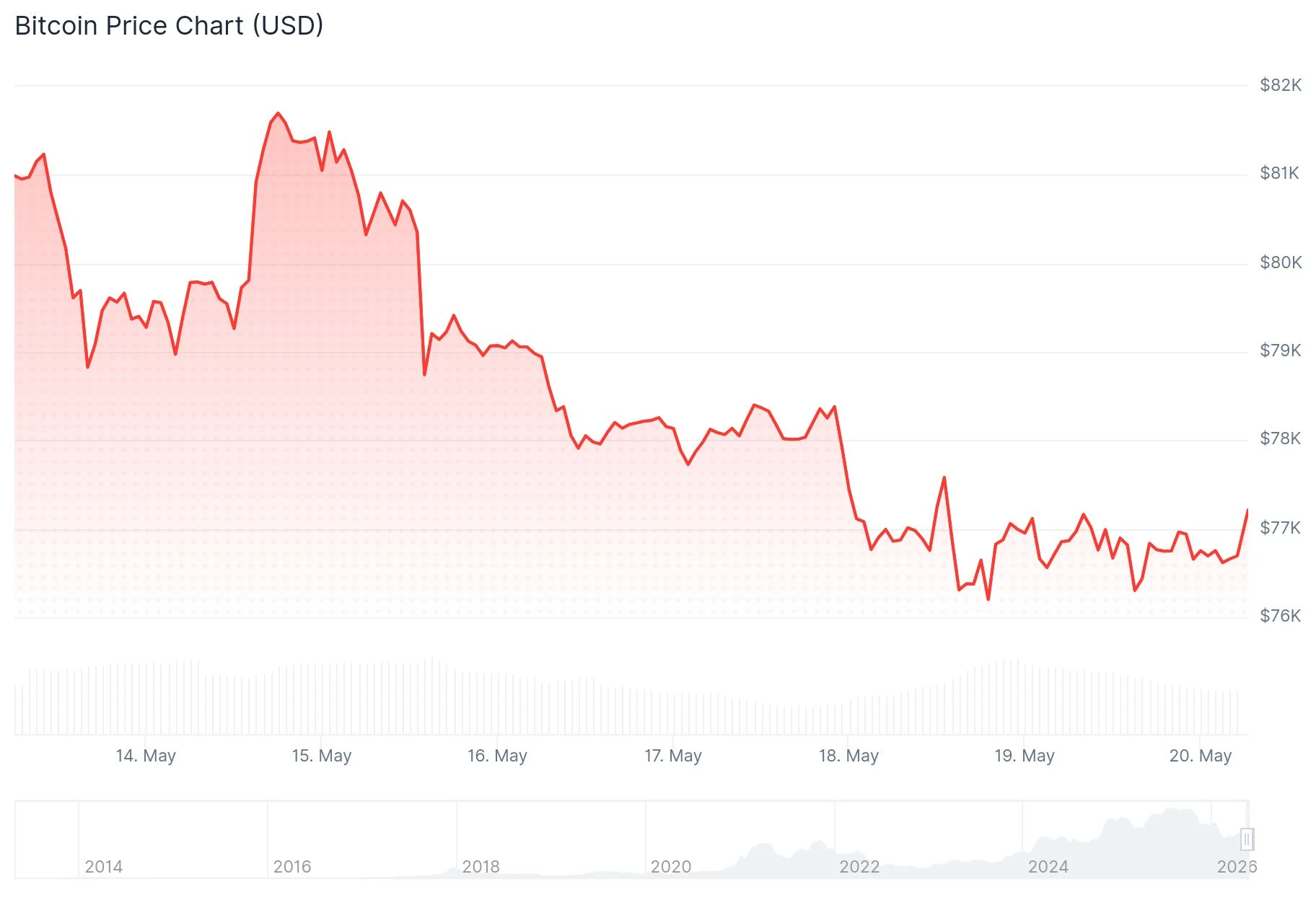
Bitcoin (BTC) Hovers Above $77K Amid Iran Diplomacy and Rising Treasury Yields

Beyond Cleaning: What Else You Must Check Before Moving Out




