

XRP price outlook: Thinning order books raise risk of breakdown below $1.30 support
XRP price is hovering near $1.42 as thinning liquidity and repeated tests of the $1.30 support level raise the risk of a breakdown.
- XRP is down 25% in 30 days and remains below major resistance.
- On-chain data shows declining USD and XRP liquidity, increasing fragility.
- $1.30 is the critical support level to watch.
XRP traded at $1.42 at press time, down 0.7% in the last 24 hours. Over the past week, price has ranged between $1.35 and $1.64, with sellers capping rebounds near the upper end of that band.
The recent correction has been sharp. After a 25% decline over the last 30 days, XRP (XRP) is now 61% below its July 2025 peak of $3.65. As lower highs continue to form on the daily chart, the overall structure remains weak.
In derivatives markets, positioning is relatively stable. CoinGlass data shows futures volume up 0.96% to $3.75 billion, while open interest slipped 0.43% to $2.36 billion. That mix suggests traders are active but not aggressively increasing leverage.
Liquidity compression adds fragility
A Feb. 20 analysis by CryptoQuant contributor The Alchemist 9 reviewed three indicators: Binance exchange inflows, USD liquidity (MAG-XRP), and XRP liquidity (MAG-XRP).
During a previous rally phase, exchange inflows spiked sharply. Large inflows usually mean tokens are moving onto exchanges, which can signal potential sell pressure. In that instance, the spike occurred before a period of strong volatility and a major price expansion.
USD liquidity measures the capital depth supporting XRP markets. When XRP rallied, USD liquidity expanded and helped sustain the move. Recently, liquidity has been declining. With less capital depth in the order book, the price becomes more sensitive to sudden selling.
XRP liquidity tracks token-side availability. Before the earlier breakout, XRP liquidity compressed significantly. That reduction in active supply aligned with the start of the upward move. Now, XRP liquidity is trending lower again, resembling those earlier pre-expansion conditions.
At present, exchange inflows are moderate, but both USD and XRP liquidity are contracting. This creates a thinner market structure. In thin conditions, breaks of support or resistance often trigger sharper moves.
These metrics do not predict direction on their own, but they highlight rising volatility risk.
XRP price technical analysis
The $1.30 level is the key short-term support. It marks the lower boundary of recent consolidation. Price has repeatedly tested this range.
While rebounds followed, repeated touches often weaken demand. A daily close below $1.30 may lead to accelerated selling in a thin market.
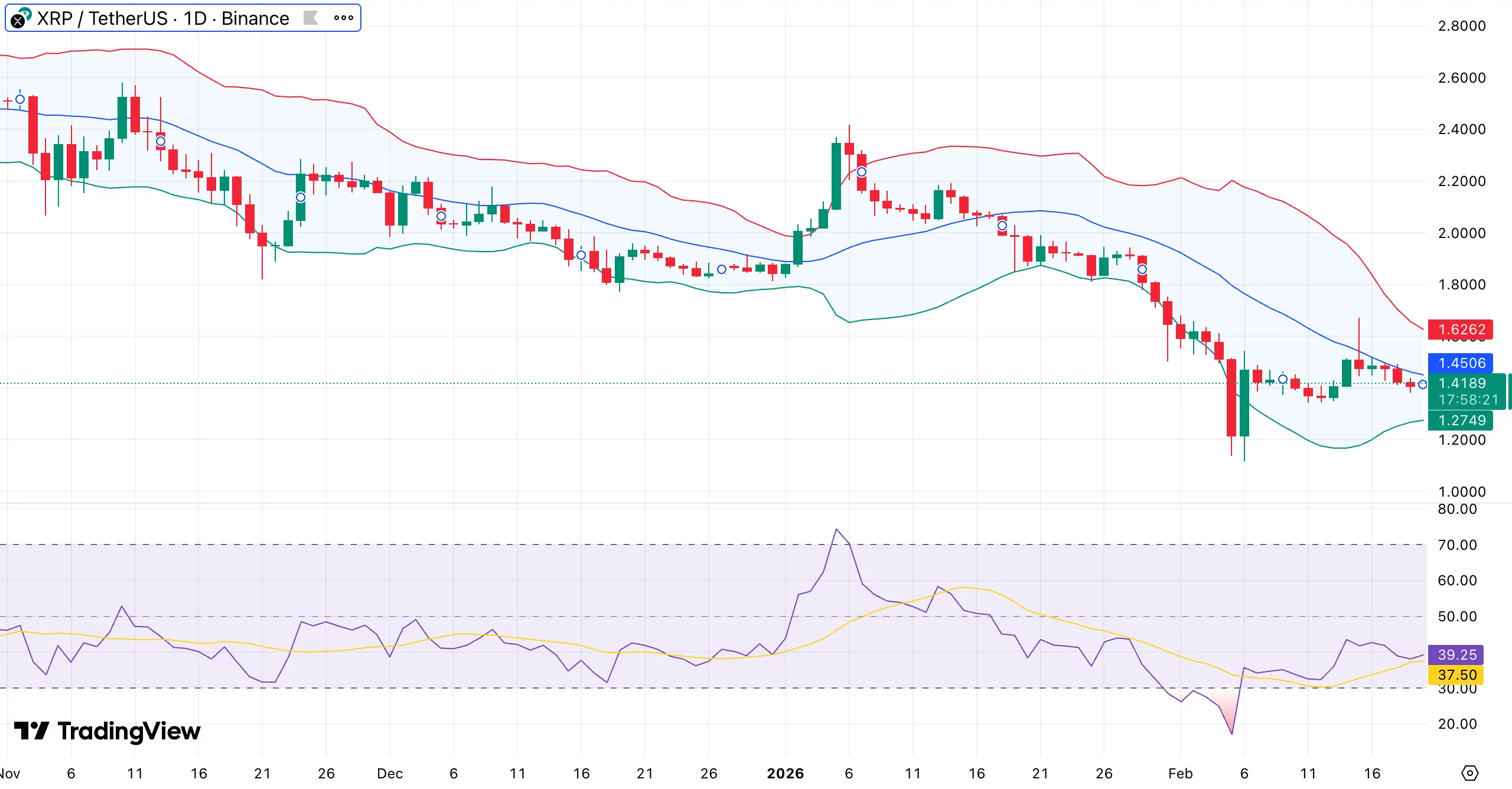
Lower highs are still visible in the daily structure. The 50-day moving average serves as trend resistance, and XRP is trading below it. Bollinger Bands are tightening, showing price compression. This often precedes a strong move once support or resistance breaks.
The relative strength index is hovering between 35 and 45, reflecting limited bullish momentum. With attempts to push above 50 having failed, there is no clear bullish divergence at this stage.
If $1.30 holds and price reclaims $1.40 to $1.45, momentum could improve, opening room toward $1.50 to $1.60. If $1.30 breaks on a daily close, the next downside targets sit near $1.20 to $1.25, followed by $1.10 to $1.15 if selling pressure intensifies.


You May Also Like

PHL pilots green skills training for construction workers

Singapore’s MAS Adds Crypto Exchange Bybit to Investor Alert List

Donald Trump’s Altcoin World Liberty Financial (WLFI) is Preparing for Major Approval in the US! Ripple (XRP) Had Already Received Approval!



