Airdrop

An Airdrop is a distribution of free tokens to a community, typically used as a marketing tool or a reward for early protocol adopters and testers. In 2026, the "points-to-airdrop" model has matured into merit-based incentive programs that utilize Sybil-resistance and Proof-of-Humanity to filter out bots. Airdrops remain a primary method for decentralized governance (DAO) bootstrapping. Follow this tag for the latest on retroactive rewards, eligibility criteria, and how to participate in the most anticipated token distributions in the ecosystem.

5448 Articles
Created: 2026/02/02 18:52
Updated: 2026/02/02 18:52
Aster burns 77.8M tokens and moves 77.8M to locked airdrop wallet

Aster burns 77.8M tokens and moves 77.8M to locked airdrop wallet

The post Aster burns 77.8M tokens and moves 77.8M to locked airdrop wallet appeared on BitcoinEthereumNews.com. Key Takeaways Aster burned around 78 million ASTER tokens following the S3 buyback program. An equal number of tokens were moved to a locked airdrop wallet, with the S4 buyback currently in progress. Aster, a multi-chain DEX backed by YZi Labs, burned approximately 78 million ASTER tokens, permanently removing them from circulation following its S3 buyback program, the team shared in a Thursday announcement. The burned tokens, now removed from circulation, were intended to create token scarcity and support long-term value. The project also allocated an equal number to an airdrop-locked wallet. Aster said it is continuing buyback activities with its ongoing S4 program. ASTER was trading above $1 at the time of reporting, down 2% over the last 24 hours. The token has demonstrated great resilience during the recent market dips. Aster on Thursday revealed its roadmap for the first half of 2026, with the spotlight on its own layer 1 network launch. Other major highlights include plans for fiat on/off-ramps, Aster Code for builders, staking, governance, and Smart Money features in Q2. Source: https://cryptobriefing.com/aster-token-burn-airdrop/

Author: BitcoinEthereumNews
Important news from last night and this morning (December 4th - December 5th)

Important news from last night and this morning (December 4th - December 5th)

Bitmine appears to have bought another 41,946 ETH about 5 hours ago, worth approximately $130 million. According to Lookonchain, Bitmine, an entity suspected to be owned by Tom Lee, bought 41,946 ETH again about 5 hours ago, with a transaction value of approximately $130.78 million. JPMorgan Chase: Whether Strategy can hold up may be key to Bitcoin's short-term trend. According to The Block, JPMorgan analysts stated that Strategy (formerly MicroStrategy) maintaining a Bitcoin holding valuation ratio above 1 and avoiding forced BTC selling was key to determining Bitcoin's short-term price movement. The analysis points out that although miners face selling pressure due to high production costs, MSTR has $1.44 billion in cash reserves, sufficient to cover debt expenditures over the next two years, reducing the risk of selling pressure. Furthermore, the bank maintains its medium-term theoretical target price for BTC at approximately $170,000. The Aster team burned $80 million in repurchase funds on-chain. On-chain data shows that the Aster team will repurchase $80 million worth of tokens from the wallet and perform on-chain destruction. The IMF warns that stablecoins may undermine monetary sovereignty and recommends setting limits to mitigate the risk of substitution. A recent report by the International Monetary Fund (IMF), "Understanding Stablecoins," reveals that dollar-dominated stablecoins are rapidly penetrating emerging markets and developing economies, potentially weakening central banks' control over domestic liquidity and interest rates. The report points out that stablecoins can quickly enter the market via mobile phones and the internet, especially in the presence of unhosted wallets, making them more prone to "currency substitution," weakening the use of local currencies, and affecting central bank monetary policy transmission and seigniorage revenue. The IMF recommends that countries establish legal frameworks to prevent stablecoins from acquiring "fiat currency" or "official currency" status, thereby safeguarding financial sovereignty. Currently, 97% of the total market capitalization of stablecoins is pegged to the US dollar, with only a small percentage linked to the euro or yen. The report also emphasizes the significant increase in the use of stablecoins in cross-border payments and in countries with high inflation, particularly in Africa, the Middle East, and Latin America. AlphaTON withdraws from the "Baby Shelf" rule and submits $420 million registration to advance AI and TON investments. According to GlobeNewswire, AlphaTON Capital announced it has withdrawn from the SEC's "baby shelf" fundraising restrictions and filed a $420.69 million shelf registration statement. The funds will be used to expand the GPU computing infrastructure supporting the Telegram Cocoon AI network and to acquire profitable companies within the Telegram ecosystem. The company will also continue to increase its holdings of Toncoin and related digital assets and strengthen its TON ecosystem through strategic acquisitions and infrastructure deployment. Baby shelf rule: SEC restrictions on fundraising by companies with a market capitalization of less than $75 million, limiting the amount they can raise through simplified procedures within a year. Shelf registration: A pre-registration document submitted by a publicly traded company to the SEC, facilitating flexible and multiple fundraisings in the future without requiring separate approval for each round. Base has launched the Solana cross-chain bridge, enabling two-way asset interoperability. Coinbase-incubated Ethereum L2 network Base has launched a cross-chain bridge connecting to Solana, enabling native use of Solana assets on Base and allowing Base assets to migrate to Solana. This bridge is powered by Chainlink's Cross-Chain Interoperability Protocol (CCIP) and securely uses dual-verification messages from Coinbase and Chainlink nodes. Polymarket is now available on the MetaMask mobile app. Polymarket, a prediction market platform, announced on the X platform that it has officially launched on the MetaMask mobile app, introducing the MetaMask prediction market powered by Polymarket. US CFTC: Spot cryptocurrencies can now be traded on exchanges registered with the CFTC. Acting Chair Caroline D. Pham of the U.S. Commodity Futures Trading Commission (CFTC) announced today that listed spot cryptocurrency products will be launched for the first time on the U.S. federally regulated market of a futures exchange registered with the CFTC. Today's announcement follows the recommendations of the President's Working Group on Digital Asset Markets and incorporates insights from stakeholders in the CFTC's "Crypto Sprint" initiative, as well as the results of collaboration with the U.S. Securities and Exchange Commission. The "Crypto Sprint" initiative also launched public consultations on all other recommendations related to the CFTC in the President's Working Group on Digital Asset Markets report. Other aspects of the initiative include: enabling tokenized collateral (including stablecoins) in derivatives markets, and rulemaking for technical revisions to CFTC regulations on collateral, margin, clearing, settlement, reporting, and record keeping to leverage blockchain technology and market infrastructure, including tokenization, in our markets. Previously, it was reported that Bitnomial would launch the first CFTC-regulated spot cryptocurrency trading platform. Prominent investor Jez San's linked address withdrew over $15 million worth of altcoins from Coinbase Prime. According to Emmett Gallic, an address associated with prominent investor Jez San (@aerobatic) withdrew over $15 million worth of various altcoins from Coinbase Prime, including $8 million worth of LINK, $5 million worth of AAVE, $2 million worth of UNI, and $250,000 worth of LDO. Matrixport withdrew 2,805 BTC from Binance in the past 8 hours, worth $260 million. According to Onchain Lens monitoring, Matrixport withdrew 2,805 BTC from Binance in the past 8 hours, worth $260.11 million. The official website of Memecoin PEPE was attacked, and users were redirected to malware. According to Cointelegraph, the official website of the Meme coin PEPE has been compromised and is currently redirecting users to malicious links. Cybersecurity firm Blockaid stated on Thursday, "Blockaid detected a front-end attack on the Pepe official website, which contained the Inferno Drainer malicious code." Inferno Drainer is a suite of fraudulent tools used by threat actors, including phishing website templates, wallet-stealing programs, and social engineering tools. The Lighter platform now offers spot trading, with ETH being the first asset that can be deposited. Cryptocurrency trading protocol Lighter announced on its X platform that it has launched spot trading, allowing users to deposit, withdraw, and transfer ETH, the first native asset on its Ethereum L2 platform. Later this week, Lighter will enable spot trading and begin rolling out more markets. Previously, on November 11th, Lighter announced a $68 million funding round led by Founders Fund and Ribbit Capital. Cross-border payment giant MoneyGram has selected Fireblocks to handle its stablecoin settlements. According to The Block, Fireblocks will begin processing stablecoin settlements for global remittance service MoneyGram. Michael Shaulov, co-founder and CEO of Fireblocks, stated in a press release, "MoneyGram is rebuilding the cross-border settlement track in real time. By moving to multi-chain, programmable infrastructure, MoneyGram is fundamentally improving the speed and reliability of global payments." MoneyGram is positioning itself as a staunch supporter of the blockchain payment track. The company stated in its press release that its early investments in "digital currency deposits and withdrawals and crypto-compliant infrastructure" have given it a "first-mover advantage." Argentine state-owned energy giant YPF is considering accepting cryptocurrency payments for fuel. According to Cointelegraph, Argentine state-owned energy company YPF is considering allowing drivers to pay for gasoline and diesel using cryptocurrency. Sources indicate the plan may rely on third-party processors rather than direct wallet payments; local and international platforms such as Lemon, Ripio, or Binance would handle currency exchange. If adopted, the system would operate similarly to YPF's existing USD purchase method. Customers would scan a QR code to transfer funds to their YPF account at Banco Santander, and the application would display the corresponding peso amount and a reference exchange rate determined based on Banco Nación's buying rate. Ledger researchers have discovered a vulnerability in an Android chip that exposes mobile Web3 wallets to physical attack risks. According to The Block, Ledger has discovered a vulnerability in a widely used Android smartphone processor chip, putting users who rely on software-based Web3 wallets at risk if their devices are physically accessed by attackers. Their Donjon team discovered that hardware fault injection can bypass core security checks and gain control of the chip. While this discovery does not affect Ledger's hardware wallet, it highlights the dangers of relying solely on smartphone hot wallets for digital asset security. The team tested MediaTek's Dimensity 7300 chip manufactured by TSMC to determine if electromagnetic fault injection could disrupt the earliest stages of the boot process. Using open-source tools, they injected timely electromagnetic pulses into the chip's boot ROM to obtain its operational information and identify the attack path. Subsequently, the team bypassed the filtering mechanism in the chip's write commands and overwrote the return address on the boot ROM stack, enabling arbitrary code execution at EL3 (the processor's highest privilege level), and this attack could be repeated within minutes. Ledger stated that even the most advanced smartphone chips are vulnerable to physical attacks and are unsuitable as an environment for protecting private keys, reiterating the critical importance of secure elements for the self-custody of digital assets. The vulnerability was notified to MediaTek in May, and the supplier has notified affected manufacturers. Portal to Bitcoin, a native Bitcoin interoperability protocol, has raised $25 million in funding, led by JTSA Global. According to Cointelegraph, Portal to Bitcoin, a native Bitcoin interoperability protocol, announced the completion of a $25 million funding round led by JTSA Global, with participation from Coinbase Ventures, OKX Ventures, Arrington Capital, and others. Alongside the new funding, the company launched an atomic over-the-counter (OTC) trading platform, promising "instant, trustless cross-chain settlement for large transactions." The protocol focuses on providing institutions and large investors with a Bitcoin-pegged cross-chain OTC market. It utilizes hash time-locked contracts (HTLCs) across multiple chains and Bitcoin Taproot contracts to enable the exchange of native Bitcoin with native assets on integrated blockchains in a non-custodial manner, emphasizing the reduction of trust assumptions in transactions. Aave deepens its integration with CoW, launching MEV-resistant Swap services and intent-based flash loan products. According to The Block, Aave Labs has expanded its partnership with CoW Swap, integrating the DEX aggregator's solver network into all Swap functionalities on Aave.com and launching a flash loan product built specifically for intent-based infrastructure. The two companies stated that this collaboration aims to provide DeFi users with safer, lower-cost, and more efficient asset management services, previously supporting basic swaps and limit orders. After integration, Aave.com will handle asset swaps, collateral swaps, debt swaps, and "collateral-based repayment" through the CoW protocol's bulk auction execution system, allowing users to manage all stages of the loan lifecycle on a single platform. This integration reduces the need for multiple interfaces, lowers gas fees, and protects users from front-running and sandwich attacks through MEV-resistant execution. The collaboration also launches the first intent-based flash loan product, expanding the programmable liquidity toolkit. Since Thursday, asset, collateral, and debt swaps powered by the CoW protocol have been available on Aave.com, and aToken swaps can be conducted via CoW Swap. Solmate plans to acquire RockawayX in an all-stock transaction, creating a $2 billion institutional-grade Solana giant. According to CoinDesk, Solmate (ticker symbol SLMT), the Abu Dhabi-based infrastructure company focused on Solana, has signed a non-binding term sheet to acquire digital asset company RockawayX in an all-stock transaction. This acquisition will create an institutional cryptocurrency group with over $2 billion in assets under management and third-party equity. The merged company will integrate RockawayX's infrastructure, liquidity, and asset management businesses into Solmate, which is transitioning from passive digital asset fund management to an operational cryptocurrency business, and will continue to trade under the ticker symbol SLMT. Solmate CEO Marco Santori will lead the group, while RockawayX CEO Viktor Fischer will be responsible for operating the RockawayX subsidiary and will serve as Solmate's executive chairman. RockawayX is the blockchain business unit of venture capital firm Rockaway Capital, providing on-chain market making, lending, and other services. The company also manages venture capital and credit funds, which collectively oversee approximately $1.04 billion in assets, with approximately $1.1 billion in assets pledged on its validator nodes. An address has once again purchased $8.92 million worth of ETH after a month's absence. According to on-chain analyst @ai_9684xtpa, after a month's hiatus, address 0xEb2...038cE has once again accumulated $8.92 million worth of ETH. Two hours ago, it withdrew 2799 ETH from Binance at a price of $3187.45, which has now been transferred to address 0xEb2...038cE. This receiving address holds 26720 ETH, with a total value of $104 million. Digital Asset Holdings has raised $50 million in funding, with participation from BNY Mellon and Nasdaq. According to Bloomberg, financial blockchain company Digital Asset Holdings LLC has completed a new $50 million funding round, with investors including BNY Mellon, Nasdaq Inc., S&P Global, and iCapital. Earlier this year, the company completed a $135 million funding round led by DRW Venture Capital and Tradeweb Markets, with participation from Citadel Securities, IMC, Optiver, and others. Digital Asset Holdings is known for developing the public blockchain Canton Network, which supports asset tokenization and processes financial transactions, allowing users to determine the scope of information confidentiality. Several institutions, including Goldman Sachs and Tradeweb Markets, have used or participated in managing the Canton Network. The number of Americans filing for initial jobless claims in the week ending November 29 was 191,000, compared to an expected 220,000. According to Jinshi News, the number of initial jobless claims in the United States for the week ending November 29 was 191,000, compared with an expected 220,000 and a revised 218,000 for the previous week (originally 216,000). Two hours ago, a new wallet withdrew 538.42 BTC from Galaxy Digital, worth $50.12 million. According to Onchain Lens monitoring, a newly created wallet withdrew 538.42 BTC (worth $50.12 million) from Galaxy Digital 2 hours ago. BlackRock CEO: Some sovereign wealth funds bought Bitcoin during the recent crypto market downturn. According to Forbes, BlackRock CEO Larry Fink stated that some sovereign wealth funds are buying Bitcoin during the recent price drop. Many sovereign wealth funds were on the sidelines, gradually accumulating Bitcoin as its price fell from its peak of $126,000. Fink indicated that these funds are buying incrementally, adding to their holdings when the price drops to the $80,000 range, aiming to build long-term positions. Fink also stated that the US risks falling behind other countries if it doesn't accelerate its investment in digitalization and tokenization. Furthermore, Fink predicts that cryptocurrency-driven tokenization will experience "huge growth" in the coming years. A whale withdrew another 10,000 ETH from Bitget, bringing its total holdings to 34,188 ETH. According to Lookonchain monitoring, the whale address 0x97BD withdrew another 10,000 ETH (worth $31.91 million) from Bitget 2 hours ago, and now holds a total of 34,188 ETH (worth $108.8 million). Ripple CEO: Bitcoin is expected to reach $180,000 by the end of 2026 According to Cryptopolitan, Ripple CEO Brad Garlinghouse stated at Binance Blockchain Week that he predicts Bitcoin's price will reach $180,000 by the end of 2026. Garlinghouse said he is more optimistic about the future of cryptocurrencies than in recent years, citing the increasingly clear US regulatory environment as a major positive factor. Solana Foundation Chair Lily Liu stated that even if Bitcoin's price reaches the $90,000 mark, it would be normal, and indicated that its price could very well break $100,000. Binance CEO Richard Teng acknowledged recent market volatility but emphasized that the overall trend remains extremely optimistic. Teng stated, "Volatility is not unique to cryptocurrencies but is a characteristic shared by all types of assets... but institutions are entering the market in large numbers. Institutional participation doubled last year, and it has doubled again this year." Axelar launches the open-source framework AgentFlux, bringing AI agents onto the blockchain and mitigating cloud risks. According to CoinDesk, Interop Labs, the team behind the Axelar network, announced on Thursday the launch of AgentFlux, an open-source framework designed to run artificial intelligence (AI) agents locally while keeping private keys, trading strategies, and customer data outside the cloud. AgentFlux allows financial companies to deploy "agent-based" automation without sending sensitive information to external infrastructure. AgentFlux is also integrated into Axelar's broader multi-chain strategy. AgentFlux enables a single AI agent to view risk, assess risk exposure, and trade across multiple ecosystems. VTB, Russia's second-largest bank, recommends allocating 7% of its assets to Bitcoin and cryptocurrencies. According to The Bitcoin Historian, VTB, Russia's second-largest bank, recommends that investors allocate 7% of their assets to Bitcoin and cryptocurrencies. This follows previous reports that VTB plans to launch cryptocurrency trading services through brokerage accounts in 2026. Binance Alpha has opened the second wave of Yooldo (ESPORTS) airdrop applications. According to the official announcement, the second wave of the Binance Alpha Yooldo (ESPORTS) airdrop rewards is now open. Users with at least 250 Binance Alpha Points can claim 80 ESPORTS tokens on a first-come, first-served basis. If the reward pool is not fully distributed, the points threshold will automatically decrease by 5 points every 5 minutes. Please note that claiming the airdrop will cost 15 Binance Alpha Points. Users must confirm their claim on the Alpha event page within 24 hours, otherwise it will be considered as a forfeiture of the claim. LISA launches "Road to Genesis" points program to prepare for TGE. According to official news, LISA, a Web3 AI security agent project, has announced the launch of a points program called "Road to Genesis," stating that it is preparing for a token generation event (TGE). Points can be earned by linking X, Telegram, and Discord social media accounts, performing wallet health checks, and sharing the results. Previously, LISA reportedly completed a $12 million funding round to advance its AI-native on-chain security system. WisdomTree launches its first fully staked Ethereum ETP backed by stETH According to the official Lido blog, WisdomTree's fully staked Ethereum ETP has officially launched. Its "WisdomTree Physical Lido Staked Ether ETP" (trading code: LIST) is the first ETP product in Europe that holds only stETH minted through the Lido protocol. The product's structure avoids the non-staking buffer mechanism commonly used in traditional products during subscription and redemption. LIST is listed and traded on the Deutsche Börse Xetra platform, the Swiss SIX stock exchange, and Euronext in Paris and Amsterdam. This product, by holding stETH, provides investors with exposure to staking ETH and its corresponding on-chain staking rewards in a listed product format that aligns with existing institutional business frameworks. At the time of its launch, LIST had approximately $50 million in assets under management and a management fee of 0.50%. Changpeng Zhao: My current focus is on the BNB Chain ecosystem project and serving as a crypto advisor to multiple governments. At Binance Blockchain Week, Changpeng Zhao stated that He Yi becoming Binance's co-CEO was perfectly normal. She has consistently worked diligently to maintain the community and serve users as a co-founder, and is already a pillar of the company. This title adjustment is more about giving her a more formal public image, allowing the Western community to become more familiar with her. He Yi and Richard have distinct yet complementary skill sets. Furthermore, Zhao stated that he enjoys his current life, no longer needing to be constantly focused on Binance, but rather giving others room to grow. Currently, his focus is on the BNB Chain ecosystem project and serving as a crypto advisor to several governments. Aster releases its roadmap for the first half of 2026: The Aster Chain mainnet will launch in Q1. Decentralized trading platform Aster has released its roadmap for the first half of 2026, focusing on strengthening three core engines: infrastructure, token utility, and ecosystem and community. In early December 2025, Aster will launch "Shield Mode" for private high-leverage trading and Time-Weighted Average Price (TWAP) strategy orders; in mid-December, it will upgrade Real-World Assets (RWA) to expand the depth and breadth of the stock perpetual contract market; and at the end of December, the Aster Chain testnet will be open for community testing. Entering 2026, the first quarter will see the launch of the Aster Chain mainnet, the release of Aster code for developers, and the opening of fiat currency deposit and withdrawal channels; the second quarter will see the implementation of ASTER token staking, on-chain governance, and the launch of smart money tools that allow users to follow top traders. VTB, Russia's second-largest bank, plans to launch cryptocurrency trading services through brokerage accounts in 2026. According to Cryptopolitan, VTB, Russia's second-largest bank, plans to allow investors to buy and sell cryptocurrencies through its brokerage accounts. The head of the bank's brokerage services department announced this at an international investment conference in Moscow this week. Currently, VTB offers clients opportunities to invest in cryptocurrency derivatives and plans to offer direct investment in digital assets next year. VTB plans to launch its cryptocurrency trading service as soon as it receives regulatory approval. Russian financial regulators have hinted that this move is likely to be implemented in the coming months. At that time, VTB's clients will be able to directly buy, hold, and sell crypto assets such as Bitcoin in personal investment accounts or regular brokerage accounts. The EU plans to expand the regulatory and enforcement powers of the European Securities and Markets Authority, involving crypto companies and pan-European market operators. According to Bloomberg, the EU's executive body has announced plans to transfer more regulatory and enforcement powers to its market regulators, sparking debate over the transfer of power from national regulators to Brussels. The proposal, released Thursday, shows that the Paris-based European Securities and Markets Authority (ESMA) will have new powers over major clearing houses, central securities depositories, and exchanges. Less than a year after the EU introduced national regulatory regimes for cryptocurrency companies, these companies, along with pan-European market operators, are now under the agency's jurisdiction. The centralization of most EU market regulatory powers requires the consent of the European Parliament and the Council of Member States, which has been strongly opposed by some member states. The core of the proposal is to strengthen the powers and resources of the ESMA, establishing a board of five independent members with terms of up to five years. The initial setup costs will be borne by the EU budget, with exchanges, central securities depositories, and crypto asset service providers bearing ongoing expenses. To simplify European market operations, the European Commission will also amend legislation to limit member states' additional requirements for securities issuers, streamline licensing procedures to improve cross-border central securities depository services, and hopes to integrate distributed ledger technology into the rulebook. Negotiations on this package will begin in January next year, when Cyprus will assume the rotating presidency of the Council of the European Union. Vitalik: There are still three aspects of the sharding technology in Fusaka that need improvement. Ethereum co-founder Vitalik Buterin stated that PeerDAS in Fusaka is significant because it is essentially a sharding technology. This technology allows Ethereum to reach block consensus without requiring individual nodes to examine extremely small portions of data, and thanks to client-side probabilistic verification, it effectively resists 51% attacks, rather than relying on validator voting. Sharding technology has been a pursuit of Ethereum since 2015, and data availability sampling became a goal in 2017, which has now been achieved. However, the sharding technology in Fusaka still has three areas for improvement: First, while L2 networks can handle O(c²) transactions (where c is the node's computing power), L1 networks cannot. For L1 networks to benefit from scaling, a mature zero-knowledge Ethereum Virtual Machine (ZK - EVMs) is needed. Second, there is a proposer/builder bottleneck; currently, builders need to obtain all data to construct the entire block, and distributed block construction urgently needs to be implemented. Third, there is no sharded mempool yet, which is currently necessary. Even so, this is still a significant advancement in blockchain design. Over the next two years, the team will have time to refine the PeerDAS mechanism, cautiously scaling it while ensuring stability. It will be used to expand the L2 network, and once ZK-EVMs matures, it will be used for gas expansion on the L1 network. Previously, it was reported that the Ethereum mainnet successfully activated the Fusaka upgrade, significantly improving data processing capabilities. The company formed by the merger of Twenty One Capital and CEP is expected to list on the NYSE on December 9. According to Businesswire, Twenty One Capital, Inc. and Cantor Equity Partners, Inc. (NASDAQ: CEP) announced that at a special shareholders' meeting held on December 3, CEP shareholders approved the previously announced proposed business merger and all other related proposals. Based on today's shareholder approval, and subject to the satisfaction or waiver of certain other closing conditions described in the CEP and Twenty One final prospectuses, the business merger and related PIPE financing are expected to close around December 8, 2025. Upon completion of the transaction, the merged company will operate as Twenty One Capital, Inc., and its Class A common stock is expected to begin trading on the New York Stock Exchange under the ticker symbol “XXI” on December 9, 2025. Related reading: Masayoshi Son plans to join forces with stablecoin giant Tether to create a $3 billion crypto joint venture; is the Bitcoin hoarding strategy entering its 2.0 era? JPMorgan Chase: The risk of Strategy being removed from MSCI has been priced in by the market. According to Bloomberg, JPMorgan Chase stated that Strategy Inc.'s stock price has already reflected the risk of being removed from major stock benchmark indices and sees the upcoming MSCI decision as a potential catalyst for an upward move, although removal would still trigger passive capital outflows. JPMorgan Chase previously estimated that if index-tracking funds were required to divest related assets, there could be as much as $2.8 billion in outflows. However, after a significant sell-off, JPMorgan Chase believes that most of the losses are already reflected in the stock price. Following the report's release, Strategy's stock price plummeted by approximately 20%, and is currently trading near the value of the company's Bitcoin holdings. In a report, their analyst team wrote, "In our view, the decision to remove Strategy from the MSCI index will have a limited negative impact on Strategy and Bitcoin, as the effects of the index removal have already been fully priced in. On the other hand, if MSCI's decision on January 15 is positive, then Strategy and Bitcoin's share prices and prices are likely to rebound strongly to levels seen before October 10." JPMorgan also reiterated its volatility-adjusted comparison of Bitcoin and gold, suggesting a theoretical price for Bitcoin approaching $170,000 over the next 6 to 12 months. While this prediction is speculative, it highlights the potential upside the bank sees ahead of the MSCI ruling.

Author: PANews
Solana Mobile Announces 2026 Token Launch Despite Security Concerns Around Seeker Chip

Solana Mobile Announces 2026 Token Launch Despite Security Concerns Around Seeker Chip

Solana Mobile’s push into decentralized mobile technology is approaching a new chapter, with the company confirming that its SKR token will launch in January 2026. The token is meant to anchor the Solana Seeker ecosystem, supporting governance, staking, rewards, and developer incentives. Related Reading: Crypto Gets Legal Recognition: UK Enacts Property Act 2025 For Digital […]

Author: Bitcoinist
Pepe Memecoin Website Potentially Compromised by Inferno Drainer Malware

Pepe Memecoin Website Potentially Compromised by Inferno Drainer Malware

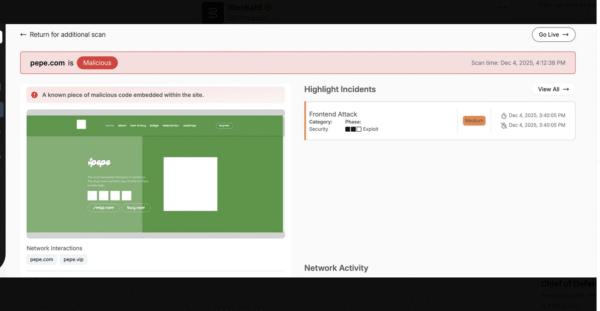
The post Pepe Memecoin Website Potentially Compromised by Inferno Drainer Malware appeared on BitcoinEthereumNews.com. The official Pepe memecoin website was compromised in a front-end attack using malware from the Inferno Drainer toolkit, as identified by cybersecurity firm Blockaid. This breach injects malicious code to redirect users to phishing sites, risking wallet credentials and asset theft. Community members should avoid the site until resolved to protect their holdings. Early Detection: Blockaid’s monitoring systems spotted the front-end compromise on the Pepe website, alerting users promptly to the presence of Inferno Drainer code. Inferno Drainer includes phishing templates and wallet drainers that steal credentials, approve unauthorized transactions, and siphon tokens, NFTs, and other crypto assets. Despite the hack, PEPE’s price rose 0.87% in the last 24 hours but remains down over 77% from 12 months ago, per CoinGecko data, underscoring memecoin volatility. Pepe memecoin website hack exposes users to Inferno Drainer phishing risks. Stay vigilant against crypto threats and learn how this breach impacts memecoin security. Protect your assets now—avoid suspicious sites. What is the Pepe Memecoin Website Hack? Pepe memecoin website hack refers to a recent front-end security breach on the official site for the popular Pepe memecoin, detected by cybersecurity experts at Blockaid. The attack involved injecting malicious code from the Inferno Drainer toolkit, a notorious set of scam tools designed to exploit visitors. This incident serves as a stark reminder of the vulnerabilities in the cryptocurrency space, where even high-profile projects like Pepe can fall victim to sophisticated phishing tactics. Blockaid’s alert on Thursday highlighted the urgency, preventing potentially widespread damage by notifying the community early. Memecoins such as Pepe have surged in popularity due to their community-driven appeal and viral marketing, but they also attract cybercriminals seeking to capitalize on hype. The Pepe memecoin, inspired by the internet meme character, has a market presence tied to its token’s performance on exchanges. This hack…

Author: BitcoinEthereumNews
Kava Falters, Blazpay Soars – Will Blazpay Be the Next Big Crypto Coin Everyone’s Watching?

Kava Falters, Blazpay Soars – Will Blazpay Be the Next Big Crypto Coin Everyone’s Watching?

The 2025 crypto market has seen a surge in demand for early-stage opportunities, making crypto presales a prime avenue for investors seeking the next big crypto coin. Among these, Blazpay and Kava (KAVA) have emerged as leading candidates. Blazpay’s structured presale phases, currently at Phase 4, provide early investors with the chance to acquire tokens […] The post Kava Falters, Blazpay Soars – Will Blazpay Be the Next Big Crypto Coin Everyone’s Watching? appeared first on TechBullion.

Author: Techbullion
Solana Mobile Says Token for Seeker Phone Coming in January

Solana Mobile Says Token for Seeker Phone Coming in January

The post Solana Mobile Says Token for Seeker Phone Coming in January appeared on BitcoinEthereumNews.com. Solana is set to roll out the awaited native token tied to its latest mobile phone model, Seeker, at the start of 2026, with the coin set to be the governance token of the company’s mobile ecosystem. Solana Mobile announced in an X post on Wednesday that the “SKR” token will have a total supply of 10 billion tokens, with 30% allocated for airdrops and 25% reserved for growth and partnerships. An additional 10% of the token’s supply will be for liquidity, 10% for a community treasury, 15% for Solana Mobile and 10% for Solana Labs, the mobile arm’s parent company. Source: Solana Mobile Solana Mobile said in May that it was planning to launch the SKR token, saying it would give owners of its new Seeker smartphone, which came pre-loaded with crypto apps and features, “actual ownership in the platform.” The company shared that the token would have “linear inflation to incentivize early participants” who stake it, but it would share more on the token at the upcoming Solana Breakpoint Conference on Dec. 11 to 13. Solana Mobile eyes ecosystem growth with SKR A key selling point Solana Mobile initially marketed for the Seeker was its decentralized application (DApp) store, which hosts over 100 Solana-based DApps as the firm looked to expand beyond the phone just being seen as a “rewards magnet” like its first variant, the Saga. While it has had some teething issues since launch, Solana Mobile has indicated that the SKR token will be utilized to bolster the DApp store and ecosystem surrounding the phone. Alongside the SKR announcement, Solana Mobile also introduced “guardians,” which will “validate trust” across its phone ecosystem.  “At launch, SKR serves as a growth and coordination mechanism: stake to Guardians, support builders, secure devices, curate the DApp Store,” Solana Mobile said.…

Author: BitcoinEthereumNews
5 Best Crypto to Buy Now: DeepSnitch, SUI & More As BlackRock Calls Tokenization the Future

5 Best Crypto to Buy Now: DeepSnitch, SUI & More As BlackRock Calls Tokenization the Future

Enjoy the videos and music you love, upload original content, and share it all with friends, family, and the world on YouTube.

Author: Blockchainreporter
Will Cardano price rally ahead of Midnight (NIGHT) launch

Will Cardano price rally ahead of Midnight (NIGHT) launch

The post Will Cardano price rally ahead of Midnight (NIGHT) launch appeared on BitcoinEthereumNews.com. Cardano’s price rally stalled today, Dec. 4, even after developers launched the NIGHT token ahead of the closely watched Midnight launch. Summary Cardano price remained in a tight range after the NIGHT token launch. NIGHT has become the first Cardano Native Asset. The launch came ahead of the Midnight mainnet launch. Cardano (ADA) token was trading at $0.4475, up modestly from this month’s low of $0.3713. According to crypto.news, the token has a market capitalization of over $16 billion. In a statement, the Midnight Foundation said that it had launched the NIGHT token, which has now become the first Cardano Native Asset. The foundation expects that the launch will provide immediate liquidity while the team continues building. The next important stage will be the Midnight launch, which will happen next week, creating the first zero-knowledge sidechain on Cardano. Once this happens, NIGHT’s total supply will be mirrored at the Midnight ledger, and Glacier airdrop participants will be able to redeem their tokens. Charles Hoskinson, Cardano’s founder, believes that Midnight will help to scale the network and boost its stablecoin supply and its decentralized finance assets.  Midnight is one of the several approaches that Hoskinson and the team are working on. Last week, they launched a proposal to use 70 million ADA tokens from the treasury to build and improve the ecosystem. The funds will be used to boost stablecoin supply, attract quality oracle providers like Chainlink, and improve its analytics. At the same time, the developers are working on Leios, a major redesign of the consensus protocol that aims at boosting scalability and transaction throughput. It will do that by introducing the concept of parallel processing. Another possible catalyst for Cardano price is that Grayscale may decide to launch its ADA ETF later this month of in early 2026, a…

Author: BitcoinEthereumNews
Hackers Breach Pepe Site With Inferno Drainer Code

Hackers Breach Pepe Site With Inferno Drainer Code

Cybersecurity firm Blockaid warns that Pepe’s official site was hacked with Inferno Drainer malicious code, redirecting users. The official Pepe website suffered a disruptive breach on December 4, as attackers injected Inferno Drainer code into its front end. As a result, users were subjected to unknown redirects to malicious pages with the intention of draining […] The post Hackers Breach Pepe Site With Inferno Drainer Code appeared first on Live Bitcoin News.

Author: LiveBitcoinNews
Solana Price Climbs 1% As Solana Mobile Confirms SKR Token Launch With 30% Airdrop

Solana Price Climbs 1% As Solana Mobile Confirms SKR Token Launch With 30% Airdrop

Zcash (ZEC) has faced notable volatility lately, retracing significantly from its recent peaks while maintaining gains from its recent lows. Despite these fluctuations, the cryptocurrency [...]

Author: Insidebitcoins