Airdrop

An Airdrop is a distribution of free tokens to a community, typically used as a marketing tool or a reward for early protocol adopters and testers. In 2026, the "points-to-airdrop" model has matured into merit-based incentive programs that utilize Sybil-resistance and Proof-of-Humanity to filter out bots. Airdrops remain a primary method for decentralized governance (DAO) bootstrapping. Follow this tag for the latest on retroactive rewards, eligibility criteria, and how to participate in the most anticipated token distributions in the ecosystem.

5463 Articles
Created: 2026/02/02 18:52
Updated: 2026/02/02 18:52

5 New Crypto Coins Shaking Up the Industry

5 New Crypto Coins Shaking Up the Industry

The post 5 New Crypto Coins Shaking Up the Industry appeared on BitcoinEthereumNews.com. Crypto Presales Discover 5 new crypto coins gaining momentum and why Noomez stands out with its structured presale, burns, and rising interest in Stage 6. New projects are popping up everywhere, but only a few are actually changing how traders think about the next wave of crypto growth. Some of these new crypto coins are gaining real traction because they offer clear ideas, tight structures, or fresh utility instead of empty hype. One of them is Noomez, a project that’s pulling attention while its presale moves through Stage 6. The other four on this list are already live and starting to build their own momentum. 5 New Crypto Coins Reshaping Momentum 1. Noomez ($NNZ) Noomez leads this new crypto coins 2025 list because it brings a structured system rarely seen in early-stage tokens.  The project uses a fixed 280 billion supply, with 140 billion $NNZ reserved for a 28-stage presale. Each stage has a set price, and unsold tokens burn permanently, tightening supply before launch. Stage 6 is live at $0.0000283, while the presale curve rises toward $0.0028. Major events like Stage X Million Airdrops, Stage 14’s First Vault unlock, and the Final Vault in Stage 28 add even more pressure. Buyers also pay attention to Noomez because the team publishes all burns, vesting, and locks with full transparency. With 66% staking rewards, a 10% referral system, and the Noom Engine delivering partner tokens straight to holders, $NNZ is getting early traction that other new projects rarely achieve. 2. Sahara AI ($SAHARA) Sahara AI sits around $93.01 million market cap and trades around $0.03780, showing steady activity backed by strong liquidity and volume near $85 million in 24 hours. With a max supply of 10 billion, the token has plenty of room to expand as AI-driven crypto projects continue to…

Author: BitcoinEthereumNews
5 New Crypto Coins Shaking Up the Industry: How Noomez Token Is Rewriting the Rules

5 New Crypto Coins Shaking Up the Industry: How Noomez Token Is Rewriting the Rules

New projects are popping up everywhere, but only a few are actually changing how traders think about the next wave […] The post 5 New Crypto Coins Shaking Up the Industry: How Noomez Token Is Rewriting the Rules appeared first on Coindoo.

Author: Coindoo
Important news from last night and this morning (December 2nd - December 3rd)

Important news from last night and this morning (December 2nd - December 3rd)

MetaMask launches "Transaction Shield," a transaction protection service offering up to $10,000 in compensation per month. According to a MetaMask announcement, the new "Transaction Shield" feature is now live, providing up to $10,000 in monthly compensation for transactions that pass its security verification, limited to 100 transactions. This service is currently available to extended users, supports multi-chain interaction, and costs $9.99 per month, with a discounted annual price of $99. New users can try it free for 14 days, and it will be expanded to mobile devices in the future. The USDC Treasury minted an additional 500 million USDC on the Solana blockchain. At 9:29 and 9:30 (UTC+8), the USDC Treasury minted 250 million USDC on the Solana chain, for a total value of $500 million. Pump.fun transferred another $75 million USDC to Kraken two hours ago, bringing its total outflows to $555 million. According to Ember's monitoring, pump.fun transferred another 75 million USDC to Kraken two hours ago. Since November 15, it has transferred a total of approximately $555 million USDC from its ICO sales to the exchange. Coinbase will launch Dash perpetual contract trading on December 4th. According to a Coinbase Markets announcement, Dash (DASH) perpetual contract trading will launch on December 4, 2025, with an expected start time after 9:30 AM UTC on that day, subject to liquidity conditions. The contract will be available to retail users in specific regions via Coinbase Advanced, while institutional users can access it through Coinbase International Exchange. Sources familiar with the matter: Anthropic has begun IPO preparations and could list as early as 2026. According to the Financial Times, artificial intelligence startup Anthropic has hired law firm Wilson Sonsini to begin preparations for one of the largest IPOs in history, potentially as early as 2026. Sources familiar with the matter revealed that the company is in talks for a private funding round with a valuation exceeding $300 billion. Multiple sources also indicated that the company has discussed potential IPO plans with several major investment banks. However, these discussions are still in the preliminary and informal stage, and the company is not yet close to selecting IPO underwriters. An Anthropic spokesperson stated, "For a company of our size and revenue level, operating as efficiently as a publicly traded company is fairly standard practice." "We have not made any decisions regarding when or even if we will go public, and there is no information to share at this time." CME launches Bitcoin volatility index, similar to the VIX in the stock market. The Chicago Mercantile Exchange (CME Group) announced the launch of new crypto benchmarks, including the Bitcoin Volatility Index (BVX), to quantify market uncertainty. The index references the implied volatility of Bitcoin and Micro Bitcoin options, similar to the VIX in the stock market, aiming to optimize option pricing and risk management. The Bitcoin volatility benchmark launched by CME and CF Benchmarks includes the real-time index BVX and the settlement index BVXS. Both are the first benchmarks to directly measure 30-day forward implied volatility, derived from the CME Bitcoin and Micro Bitcoin options order book, and use variance swap pricing to isolate volatility exposure. BVX is published every second during trading hours, while BVXS is published at 16:00 London time. Celestia-based AstraNetwork has terminated its shared sorter network. According to The Block, Astria Network, based on Celestia, "intentionally ceased" operation on December 2nd at block 15,360,577, marking the official shutdown of its shared orderer network. The project, launched in 2023, aimed to provide a decentralized orderer solution for L2 networks and had received a total of $18 million in funding. However, due to limited adoption, the gradual shutdown of key components, and development disruptions, it ultimately decided to withdraw completely, without disclosing detailed reasons for the shutdown. BitMine's new wallet received over 18,000 ETH, worth over $55 million. According to Onchain Lens, a newly created wallet under BitMine received 18,345 Ethereum from BitGo, worth approximately $55.25 million at current prices. Coinbase has included five new tokens in its listing roadmap, including WET, ZKP, and PLUME. According to Coinbase Markets, Humidifi (WET), zkPass (ZKP), Plume (PLUME), Hyperlane (HYPER), and Jupiter (JUPITER) have been added to Coinbase's listing roadmap, involving Solana, Ethereum, and the Base network. The official statement indicates that official trading launches are subject to market-making support and technical readiness conditions; specific trading times will be announced separately. Trump has been actively hinting that Hassett will be the next Federal Reserve Chairman. During a White House meeting, President Trump introduced Hassett, stating that the potential Federal Reserve Chair was "here." Earlier, Trump had indicated he might announce his nominee for Fed Chair early next year, adding that Treasury Secretary Bessett did not want the position. Tether Treasury mints an additional 1 billion USDT on the Tron network. According to Whale Alert, at 23:34 Beijing time, Tether Treasury minted an additional 1 billion USDT on the Tron network. A trader who had previously maintained a nine-game winning streak closed his short positions, incurring losses exceeding $1.78 million. According to Lookonchain, trader 0xFC78, who had previously maintained a nine-game winning streak, just closed his short position, incurring a loss of over $1.78 million. He had previously earned $2.12 million in profit through nine consecutive winning trades, but this single trade resulted in a loss of over $1.78 million, erasing most of his gains. Ethereum mainnet gas fees have dropped to as low as $0.02, even lower than some L2 networks. According to on-chain analyst Ember's monitoring, Ethereum mainnet gas has dropped to as low as 0.1 Gwei. A transaction on the Ethereum mainnet now costs only $0.02 in gas. This is a significant improvement compared to the previous fees of tens or even hundreds of dollars per transaction. The transaction fees for several major L2 blockchains are: ARB $0.004, OP $0.006, and BASE $0.03. The gas fee for BASE, an L2 blockchain, is even higher than that of the mainnet. VanEck announced that it will extend the zero-fee policy for its Bitcoin ETF until July 31, 2026. VanEck announced on its X platform that it will extend the zero-fee policy for the VanEck Bitcoin ETF (ticker symbol: HODL) until July 31, 2026. Sonnet BioTherapeutics receives shareholder approval for a business merger with Hyperliquid Strategies, Inc. According to market sources, Nasdaq-listed biotechnology company Sonnet BioTherapeutics has received shareholder approval for a business merger with Hyperliquid Strategies, Inc. Previously, it was reported that Sonnet planned to change its name to Hyperliquid Strategies through the merger, and was expected to hold 12.6 million HYPE tokens and $300 million in cash. Kraken to acquire tokenized asset platform Backed Finance According to Bloomberg, cryptocurrency exchange Kraken announced its acquisition of tokenized asset platform Backed Finance. Kraken co-CEO Arjun Sethi stated in an interview that Kraken already offers stocks and ETFs issued by Backed, and plans to more tightly integrate these products into its platform following the acquisition. Sethi said, “While everyone is talking about tokenized stocks, we’re already putting it into practice. We’re focused on long-term investing, not hype.” Kraken did not disclose the terms of the transaction. Data from rwa.xyz shows that Backed Finance is currently the second-largest platform in the tokenized listed stock space, with a market share of approximately 23%. Backed’s xStocks product offers exposure to over 60 tokenized stocks and ETFs, all backed one-to-one by underlying assets. Tether Data Introduces New LLM Inference Runtime Environment and Fine-Tuning Framework: QVAC Fabric LLM According to its official blog, Tether Data announced the release of QVAC Fabric LLM, a new comprehensive large language model (LLM) inference runtime environment and fine-tuning framework that supports running, training, and customizing large language models directly on everyday hardware such as consumer GPUs, laptops, and even smartphones. Tasks that once required high-end cloud servers or specialized NVIDIA systems can now be accomplished locally on users' existing devices. QVAC Fabric LLM also expands the capabilities of the llama.cpp ecosystem by adding fine-tuning support for modern models such as LLama3, Qwen3, and Gemma3. QVAC Fabric LLM supports training on a wide range of GPUs, including AMD, Intel, NVIDIA, Apple chips, and mobile chips, breaking the long-held assumption that meaningful AI development requires specialized hardware from a single vendor. Tether Data has released QVAC Fabric LLM as open-source software under the Apache 2.0 license and provides multi-platform binaries and ready-to-use adapters on Hugging Face. Developers can begin fine-tuning with just a few commands, lowering the barrier to AI customization. Circle established the Circle Foundation, dedicated to promoting global financial inclusion. According to its official blog, Circle announced the establishment of the Circle Foundation, a new philanthropic initiative dedicated to advancing financial resilience and inclusion in the United States and globally. The Circle Foundation, seeded by a 1% equity commitment from Circle, aims to support organizations that can strengthen the financial system, including institutions that work with small businesses in U.S. communities and international organizations that modernize humanitarian aid infrastructure. The Foundation will initially focus on strengthening the financial resilience of small businesses across the United States by providing grants to Community Development Financial Institutions (CDFIs). Globally, the Circle Foundation will partner with international organizations to modernize humanitarian financial infrastructure. Grayscale Chainlink Trust ETF, a new spot ETP, has been listed on the NYSE Arca. According to Globenewswire, Grayscale announced that the Grayscale Chainlink Trust ETF (ticker symbol GLNK) has been listed on the New York Stock Exchange Arca and will soon begin trading as a spot ETP. GLNK is an exchange-traded product and is not registered under the Investment Company Act of 1940, therefore it is not subject to the same regulations and protections as ETFs and mutual funds registered under Act 40. Analysis: Suspected PIPPIN insiders control half of the supply, worth $120 million. Blockchain analytics platform Bubblemaps published an article on its X platform claiming that suspected insiders control half of the PIPPIN supply, worth $120 million. They discovered that 50 linked wallets purchased $19 million worth of PIPPIN tokens. These wallets share the following characteristics: they all received HTX funding within a short period, received similar amounts of SOL, and had no prior on-chain activity. Furthermore, they found that 26 addresses withdrew $96 million worth of PIPPIN from the Gate exchange within two months, representing 44% of its total supply. Most withdrawals occurred on October 24th and November 23rd, and most of these wallets were newly funded. In the past two weeks, the price of PIPPIN tokens has increased tenfold, with its market capitalization rising from $20 million to $220 million. Musk predicts: A $38.3 trillion "crisis" could trigger a surge in Bitcoin prices. According to Forbes, Elon Musk has again warned that the United States is rapidly heading towards a "debt crisis" that could trigger dramatic fluctuations in Bitcoin prices. Against the backdrop of traders bracing for potential major policy changes from the Federal Reserve in December, Musk predicts that "money as a concept will cease to exist," and energy will become the only "real money." In an interview with Nikhil Kamath, Musk stated, "That's why I say Bitcoin is based on energy; you can't create energy through legislation." He also mentioned that "the United States is significantly increasing the money supply through a deficit of about $2 trillion." Musk further predicted that within three years, the development of artificial intelligence will cause the growth rate of goods and services output to outpace inflation. "In about three years, the growth rate of goods and services output will exceed the growth rate of the money supply. At that time, there may be deflation, interest rates will drop to zero, and the debt problem will be much smaller than it is now." Musk previously helped Trump return to the White House through campaign rallies and warnings about the ever-increasing US debt (currently exceeding $38 trillion), but his relationship with Trump deteriorated sharply after Trump failed to control government spending. While Musk's support for Bitcoin and cryptocurrencies has waned from its peak during the COVID-19 pandemic, he continues to endorse Bitcoin and Dogecoin. After leaving the White House, Musk stated that his "American Party" would favor Bitcoin over the US dollar, calling the dollar and other non-asset-backed currencies "hopeless." Previously, in October, Musk stated that Bitcoin relies on unforgeable energy, while fiat currencies suffer from the problem of fiat currency issuance. Binance Alpha has launched the second round of OVERTAKE (TAKE) airdrop rewards, with a minimum of 253 points required to claim. Binance Alpha has announced the launch of the second round of the OVERTAKE (TAKE) airdrop rewards. Users with at least 253 Binance Alpha Points can claim an airdrop of 105 TAKE tokens on a first-come, first-served basis. If the reward pool is not fully allocated, the score threshold will automatically decrease by 5 points every 5 minutes. Please note that claiming the airdrop will consume 15 Binance Alpha Points. Users must confirm their claim on the Alpha Events page within 24 hours; otherwise, they will be considered to have forfeited their airdrop claim. Crypto wallet Trust Wallet launches prediction market, initially integrating Myriad. According to Cointelegraph, Trust Wallet, the self-custodied cryptocurrency wallet owned by Binance founder Changpeng Zhao, has become the latest wallet to enter the prediction market. The company announced on Tuesday the launch of a new native "Prediction" feature, allowing users to trade and profit from real-world events in a fully self-custodied manner. Starting today, Trust Wallet's "Prediction" feature will integrate market information from multiple platforms, enabling users to trade on a wide range of topics, including cryptocurrencies, politics, sports, entertainment, and global events. Trust Wallet's foray into prediction markets begins with integration with the Web3 prediction market protocol Myriad, and plans to expand to major platforms such as Kalshi and Polymarket soon. BlackRock transferred approximately 1,634 BTC to Coinbase Prime. According to Solid Intel, BlackRock transferred 1,633,875 BTC (worth $142.6 million) to Coinbase Prime. US SEC Chairman: Innovation Exemption for Cryptocurrency Companies to Take Effect in January Next Year According to market sources, U.S. Securities and Exchange Commission (SEC) Chairman Atkins stated that the innovation exemption for cryptocurrency companies will take effect in January next year. The board of directors of Token Cat Limited, a US-listed company, approved a $1 billion cryptocurrency investment policy. According to PR Newswire, Token Cat Limited (NASDAQ: TC) announced that its board of directors has formally approved a crypto asset investment policy, authorizing the company to allocate a portion of its cash reserves to selected crypto assets under a strict risk management framework. The board has approved a maximum overall allocation limit of $1 billion for the digital asset plan. Deployment will be phased in based on market conditions, risk assessment, and fund management needs. The initial allocation will focus on tokens from emerging crypto projects with strong growth prospects, including assets related to artificial intelligence, on-chain raw data initiatives, and token-equity hybrid models. Future expansion to other asset classes will require reassessment and approval by the board's risk committee. The company will not self-custody the purchased crypto assets. A crypto asset risk committee, led by the CFO, has been established to oversee asset allocation, manage risk controls, and report regularly to the board. The market capitalization of Web3 gaming tokens is currently $8.83 billion, a 69% decrease year-over-year. According to Cryptopolitan, the current market capitalization of Web3 game tokens is $8.83 billion, a 69% year-over-year decrease and a 34% drop over the past month. Amid the cryptocurrency winter, despite ongoing collaboration news, trading volume has failed to pick up. In late November, the GameFi sector experienced a brief bull run, with its market capitalization increasing by 7% to nearly $10 billion in two weeks, while trading volume surged by 103% to $6.1 billion. However, according to CoinMarketCap charts, this rebound was short-lived, with a correction on December 1st causing the sector's market capitalization to fall below $9 billion for the first time in over a year. Sentiment within the GameFi ecosystem is subdued, with little discussion on crypto Twitter and one of the lowest levels of enthusiasm in nearly five years. Many Web3 game users are using these platforms primarily for speculative purposes rather than for gameplay. This has led to the closure of at least 27 studios between January and October of this year. Venture capital interest has also cooled, with funding for new Web3 game projects drying up compared to previous cycles. For Web3 games to return to the level that the industry considers unmissable, AAA game publishers need to take an interest in Web3 games and invest more money in them. Bank of America recommends that its wealth management clients allocate 1%–4% to crypto assets. According to Yahoo Finance, Bank of America (BAC) has advised its wealth management clients to consider allocating a certain percentage of their portfolios to cryptocurrencies. The firm recommends that clients of its Merrill Lynch, Bank of America Private Bank, and Merrill Lynch Edge platforms allocate 1%-4% of their funds to digital assets. Its investment strategists will begin monitoring four Bitcoin ETFs (BITB, FBTC, Grayscale Mini Trust, and IBIT) starting in January 2026. Chris Hyzy, Chief Investment Officer of Bank of America Private Bank, stated in a press release: “A moderate allocation of 1%-4% to digital assets may be appropriate for investors with a strong interest in thematic innovation and who can tolerate high volatility. Our recommendation emphasizes choosing regulated investment vehicles, making thoughtful asset allocations, and clearly understanding the opportunities and risks involved. For investors with a more conservative risk appetite, the lower end of this allocation range may be more suitable; while for investors with a higher overall portfolio risk tolerance, the upper end is more appropriate.” The Euro Stablecoin Alliance will appoint a former executive from Coinbase, Germany, as its CEO. According to Reuters, ten major European banks, including ING and UniCredit, have formed an Amsterdam-based company to launch a stablecoin pegged to the euro, a move expected to help them counter the US dominance in digital payments. The group announced at a press conference in Amsterdam on Tuesday that Jan-Oliver Sell, formerly of Coinbase in Germany, will serve as the new company's CEO. Floris Lugt, ING's head of digital assets, will become CFO, and Howard Davies, former chairman of NatWest, will become chairman. The new company's CFO announced that BNP Paribas has also joined the group, a move initially announced in September. Twenty One Capital's IPO progress: A shareholder vote on the merger was held on December 3rd, and the merger could be completed as early as next week. Jack Mallers, CEO of Bitcoin finance company Twenty One Capital, disclosed the latest developments regarding XXI on the X platform: Cantor Equity Partners, Inc. (NASDAQ: CEP) will hold a shareholder vote at 10:00 AM local time on December 3rd to approve its business merger with Twenty One Capital. If the vote is approved, the two companies could complete the merger as early as next week and officially begin their IPO process. He hopes all CEP shareholders will participate in the vote. Previously, it was reported that Twenty One would seek to trade under the ticker symbol "XXI" after the merger. Related reading: Masayoshi Son plans to join forces with stablecoin giant Tether to create a $3 billion crypto joint venture; is the Bitcoin hoarding strategy entering a 2.0 era? The Central Bank of Russia has confirmed that Russia may relax regulations on cryptocurrencies. According to Cryptopolitan, last week, Russian Deputy Finance Minister Ivan Chebeskov stated that financial regulators are prepared to abandon a single regulatory definition that only allows a small group of "highly qualified" investors access to decentralized digital currencies such as Bitcoin and their derivatives. Vladimir Chistyukhin, First Deputy Governor of the Central Bank of Russia, confirmed to reporters: "Indeed, our colleagues in the Ministry of Finance correctly pointed out that we are discussing the feasibility of using the term 'highly qualified' in the new cryptocurrency regulations." On Monday, in an interview, he explicitly stated that the Central Bank of Russia now believes it is "very likely" to relax regulations, adding: "In addition to targeting this extremely narrow group of investors, the rules for the circulation of crypto assets should also be relaxed, especially considering the current restrictions on Russian legal entities and individuals using conventional currencies for overseas payments." An ancient whale has sold off 3,000 ETH again after a week, nearly liquidating its entire holdings. According to on-chain analyst @ai_9684xtpa, the "ancient whale" holding 254,900 ETH in the ETH ICO appears to have sold another 3,000 ETH, worth $8.4 million, after a week's hiatus, nearly liquidating his entire holdings. This OG has deposited a total of 23,000 ETH into exchanges in the past week; if sold, he would profit $66.53 million, with a cost as low as $0.31 per ETH. Currently, he only has 69.83 ETH remaining on-chain, worth approximately $195,000. The Polish president vetoed a bill that would have imposed strict regulations on the cryptocurrency market. According to Cointelegraph, Polish President Karol Nawrocki's refusal to sign a bill imposing strict regulations on the cryptocurrency market has won praise from the cryptocurrency community but drawn sharp criticism from the government. In a statement released Monday by the president's press office, Nawrocki vetoed Poland's "Crypto-Asset Markets Law," stating that its provisions "significantly threaten the freedom, property, and national stability of Poles." One of the main reasons for the veto was that the bill would allow authorities to easily block cryptocurrency market websites; the president's office stated that "domain blocking laws are opaque and could lead to abuse." Furthermore, the bill was criticized for its length and complexity, reducing transparency and leading to "over-regulation," contrasting sharply with the simpler regulatory frameworks of countries like the Czech Republic. Nawrocki also emphasized that excessive regulatory costs would stifle startups and benefit foreign companies and banks. The bill, introduced in June, drew criticism from industry figures such as Polish politician Tomasz Mentzen, who anticipated the president would refuse to sign it after parliamentary approval. Cryptocurrency advocates viewed the veto as a market victory, while several government officials condemned the move, saying the president "chose chaos" and must be held accountable for the outcome. A major whale shorted a basket of 21 altcoins and has now made a floating profit of $6.417 million. According to on-chain analyst @ai_9684xtpa, address 0xa31...8aD1E has consistently adhered to a "short altcoin" strategy since June of this year. Since the flash crash on October 11, profits have increased significantly, with the total account profit exceeding $78.86 million. Currently, only ENA is a long position with a floating loss among his 22 positions, while the remaining 21 short positions are profitable. The top short position is ASTER (floating profit of $1.955 million). The total floating profit of the 21 short positions is currently $6.417 million. Wall Street investment bank Cantor Fitzgerald disclosed that it holds $1.28 million worth of Solana ETFs. According to Cryptopolitan, Wall Street investment bank Cantor Fitzgerald disclosed that it holds $1.28 million worth of Volatility Shares Solana ETF shares, marking the first time the firm has been revealed to hold regulated Solana products. The filing, submitted to the U.S. Securities and Exchange Commission (SEC) in mid-November, lists 58,000 shares of the Volatility Shares Solana ETF (NASDAQ: SOLZ). At the time of the filing, its Volatility Shares Solana ETF holdings were valued at $1,282,960.

Author: PANews
Trader: I made $580,000 shorting ETH, but I'm optimistic about the market outlook.

Trader: I made $580,000 shorting ETH, but I'm optimistic about the market outlook.

Compiled & translated by: Deep Tide TechFlow Speaker: Taiki Maeda Podcast source: Taiki Maeda Original title: I Made $578,000 Shorting ETH. What I'm Doing Next. Broadcast date: November 26, 2025 Key points summary In just two months of bear market trading, Taiki Maeda made $578,000 by shorting. In this podcast episode, he provides an in-depth analysis of potential trends in the cryptocurrency market over the next few months and advises investors to prioritize preserving capital rather than chasing high returns . He also shares his current stablecoin and airdrop mining strategies, offering listeners more practical investment insights. Summary of key viewpoints For the past two months, I've been shorting ETH. I shorted $1 million worth of ETH around $4,150, making some profit; then I added another $1.5 million to my short position at $3,387. My total profit over the past two months is approximately $578,000. Why did I choose to take profits at this time? I still believe that the price of ETH may fall further, but my short target is ETH to $3,000. Why was I bearish on ETH before? If the altcoin market has "collapsed," this impact will spread to ETH, because the slump in altcoins cannot support ETH's valuation of over $500 billion. I believe ETH is flawed, and unless circumstances change, you can completely ignore ETH as an investment target for the next 5 to 10 years as a cryptocurrency investor. If you can overcome the psychological barrier of not considering ETH investment, I believe it will make your decision-making much simpler, reduce your stress levels, and may even extend your life expectancy. I don't think we'll experience a 12-month bear market; we're more likely in the second month of a 3- to 6-month bear market. That's my optimistic assessment of the market. On November 17th, I mentioned that the market might be entering a denial phase. I anticipated another round of decline, possibly this week or in two months, after which the market would begin to form a range, ultimately leading to a better market environment in 2026. Altcoins will lose all meaning because the fair value of these assets is almost zero. The market is trying to find the fair value of ETH, and the price may stabilize around $2,500. The Ponzi effect once drove up the price of ETH, but this effect is now gradually fading. If ETH falls below $3,000, it could drag Bitcoin down with it. The biggest risk for most people is their inability to leave the market; being able to control one's investment impulses is an advantage. The current cryptocurrency market is more like a "loser's game," where most people will only keep losing money, so the best way to win is not to participate. The current market environment is in Hard Mode and PvP mode, so the best strategy is probably to maintain a cash position and accumulate funds. It's time to slow down, accumulate quality assets, and focus on airdrop farming. Even if you have recently suffered losses, don't give up easily. Persist and believe in yourself. I closed my short position in ETH. Taiki Maeda: I've shorted Ethereum (ETH) and altcoins over the past two months, making over $570,000 . In this video, I'll share my views on the current market and why I believe ETH and altcoins are still in a very, very difficult situation. I have closed my short position in ETH. I've been shorting ETH for the past two months. I initially shorted $1 million worth of ETH around $4150, making some profit; then I added another $1.5 million to the short position at $3387. At that time, my profit and loss (P&L) was approximately $268,000, which I closed last Friday. This brings my total profit over the past two months to approximately $578,000 . In addition, as a player focused on yield and airdrop mining, I'm also involved in Variational, a perpetual contract platform that I believe has great potential. So why did I choose to take profits at this time? The main reason is that I still believe the price of ETH may fall further, which I will explain in detail later. However, when I started shorting ETH around $4150, my target was to wait for it to drop below $3000. Now, it has indeed fallen below that level, and I believe I have captured the most profitable part of this move. Shorting ETH and some altcoins has been very easy over the past two months; simply holding a short position allowed me to earn funding fees and also benefit from the price decline. However, I now feel that the risk and reward in the market have become more balanced, so I have decided to reduce my position size , slow down my trading, remain on the sidelines, and enter a preservative-oriented mode. ETH has fundamental flaws. Taiki Maeda: I'm not being nitpicky. I have no problem with the Ethereum mainnet; I enjoy using the ETH mainnet and L2s. ETH has indeed done many good things, but as an asset, I do believe it has some fundamental flaws . Unless circumstances change, as a cryptocurrency investor, you can completely ignore ETH as an investment for the next 5 to 10 years. Shorting or going long on ETH as a trading tool is fine, but from a long-term investment perspective, ETH doesn't have a truly solid investment logic. Its market performance over the past 5 years has proven that ETH has consistently underperformed expectations. Aside from so-called "hope" and the "copium," there's no compelling reason to change ETH's performance trajectory as an asset. I liken buying ETH to the experience of touching a hot stove as a child. You think, "Ouch, that hurts! I have a blister! I'll never touch a hot stove again!" Through this experience, you learn not to touch a hot stove. ETH is like that hot stove, but people keep going back to it because they feel, "This is Ethereum, I have to hold it." In reality, no one is forcing you to own ETH. Many people seem to think ETH is an indispensable asset in cryptocurrency, but I don't think so. If you can overcome the psychological barrier of not considering ETH investment, I believe it will make your decision-making much simpler, reduce your stress levels, and may even extend your life expectancy. Why is ETH bearish? Taiki Maeda: I believe the current market performance is largely in line with expectations. Even if you are bullish on ETH, it's essential to understand bearish perspectives, as focusing solely on bullish information can leave you unprepared when the market reverses. I recommend maintaining a balance in your information intake, listening to both bullish and bearish analyses to make more informed decisions. Ultimately, everyone is responsible for their own financial decisions. I discussed my bearish rationale for ETH last October. At that time, I predicted that the October 10th liquidation event would be seen as the starting point of an ETH bear market . While this view was quite controversial at the time, October 10th was indeed a significant turning point, as it revealed the lack of fundamental value in many crypto assets , with altcoins beginning to decline significantly. Now, there's not much reason to hold altcoins. If the altcoin market has indeed "collapsed," this impact will spill over to ETH, as the altcoin slump cannot support ETH's valuation of over $500 billion. On October 10th, I predicted two things: DeFi TVL will decrease . TVL may decline due to hacking incidents and decreased investor confidence in on-chain altcoins, while the price of ETH may also fall. Stablecoin supply growth is slowing . Stablecoin supply growth typically stems from on-chain yield opportunities. However, when people stop buying altcoins, stablecoin yields drop rapidly, and the on-chain risk-reward ratio deteriorates. As yields decline, deposits in DeFi projects decrease while withdrawals increase, further exacerbating market pressures. As a growth asset, Ethereum (ETH) is valued at approximately $360 billion, thus requiring corresponding metrics to support this valuation. However, ETH's market capitalization is approximately $357 billion, but its annualized revenue is only $300 million, meaning its market capitalization is more than 1000 times its annualized revenue. If valued according to the standards of technology platforms, ETH's valuation is clearly too high, and current metrics fail to support this. The total value locked (TVL) in DeFi is showing a double-top pattern, a worrying sign. For a growth asset, this metric should be consistently rising, not showing signs of peaking. Stablecoin market capitalization also appears to be nearing its peak, and as I've mentioned before, future growth may slow. The annualized growth of stablecoins is projected to fall to $30-40 billion, or even as low as $20 billion, over the next 12 months. If these key metrics fail to continue growing, then ETH's valuation appears overvalued. This phenomenon can be explained by negative reflexivity. In the crypto market, price drops not only reduce buyers but also attract more sellers because price declines typically indicate deteriorating on-chain fundamentals, which in turn further depress prices. This cycle leads to a collapse in investor confidence. When asset prices fall by more than 30%, the conviction of most cryptocurrency holders crumbles, ultimately leading them to sell their assets and accelerating the market's further decline. Four-year cycle Taiki Maeda: Most crypto assets don't have cash flow, so they are traded primarily around narratives, hype, and beliefs, and price drops kill those things. If you ask me, I don't entirely believe in Bitcoin's four-year cycle; this pattern will eventually break, and this might be the time. However, I do believe that Ethereum and altcoins' four-year cycles will repeat themselves, and I've staked my reputation on that, because these assets have virtually no economic value. I introduced the concepts of "time decay" and "belief decay": if investors expect a fourth-quarter surge (Q4 pump), but the surge fails to materialize over time, their belief in this surge gradually fades. Ultimately , holding altcoins becomes meaningless because the fair value of these assets is virtually zero. I remain very bearish on ETH. I've seen many people buying severely overvalued "vaporware" based solely on the assumption that "Q4 is always bullish." Therefore, I believe these investors will be shaken out of the market if there's no upward movement in Q4. I observed a significant outflow of marginal sellers from the market, hence my shorting strategy. It now appears that most of these sellers have been eliminated by the market. DAT foam bursting Taiki Maeda: Currently, the market appears to be entering a bottoming-out phase, a process that could last for several months. I don't believe we'll experience a 12-month bear market , but rather are more likely in the second month of a 3- to 6-month bear market—this is my optimistic assessment of the market. I believe a significant factor exacerbating the market downturn was the bursting of the DATs (Digital Asset Treasury Companies) bubble . David Bailey's assessment seems somewhat unsound, even containing typos in his 10Q filing. These assets had seen prices surge from $1 to $30, then to $50, ultimately leading to substantial capital losses. Taking MicroStrategy's MNAV (Net Asset Value Multiple) as an example, its multiple was close to 1 at the time, indicating a decrease in speculative demand for leveraged Bitcoin. The MNAV trend is similar to the market situation in 2021-2022, a period not suitable for going long on cryptocurrencies. Currently, the market is experiencing a negative feedback effect. According to Bloomberg, MicroStrategy may be delisted from Nasdaq, which would be a serious blow to them. Meanwhile, I believe most other DATs are also struggling to survive. Regarding ETH, Tom Lee's ETH digital asset trust, Bitmine, was launched on June 30th, when ETH was priced at approximately $2,500. The price of ETH subsequently surged from $2,500 to $4,900, nearly doubling, and the market is now retracing that gain. They have been continuously buying ETH, with an average cost of around $4,000, totaling $10 billion in purchases. This presents an excellent opportunity for ETH holders to exit, and a good entry point for short sellers. Currently, the market is trying to find the fair value of ETH . My intuition is that the price will fall further, but it may also stabilize around $2,500, as the cost basis for DATs is approximately between $2,000 and $2,500. The Ponzi effect once drove up the price of ETH, but this effect is now gradually fading. Where is the bottom? Taiki Maeda: I'm not overly pessimistic, but I do believe the market is nearing its bottom. While I don't have a particularly clear view on Bitcoin's trajectory, the market structure for ETH and altcoins remains challenging. Their valuations are still high, and fundamental metrics show no signs of growth. Value buyers won't easily enter the market until a true bottom is found. From a supply and demand perspective, overall demand for cryptocurrencies is currently declining . On one hand, market purchasing power has weakened significantly due to investor capitulation and the premature consumption of demand by DATs. On the other hand, the supply of cryptocurrencies is constantly increasing , including new Initial Coin Offerings (ICOs), more token releases, unlocking by teams and investors, and token emissions. Decreasing demand and increasing supply ultimately lead to price declines. This is why the prices of ETH, Solana, and other L1s are falling, as the market is trying to find a reasonable fair value for these assets, and the bubble has burst. There are typically two main reasons to buy cryptocurrencies: momentum trading (buying high and selling even higher in a bull market, regardless of valuation) and valuation-based investing (buying undervalued assets). However, neither of these reasons holds true now. Market momentum has clearly stalled, DATs are underperforming, and prices remain weak. If we look at L1s, L2s, and DeFi projects, their prices haven't entered value territory. This is why I believe market prices are likely to continue fluctuating and trending lower. My bearish logic is that if ETH falls below $3,000, it could drag Bitcoin down with it. As long as we maintain a rational analysis of the market, valuations, and indicators, the price is likely to continue its downward trend. On October 30th, I predicted that ETH would fall below $3,000 and find a bottom in the $2,000 range, or even briefly dip below $2,000. I still stand by this assessment; although ETH may not have bottomed out yet, the market could take several months to reach new lows. I believe we are still in a downtrend. I'm unsure whether the market is currently in phase four or five. For the past two months, I believe we've been in phase four, characterized by massive liquidations where every instance of positive news was quickly reversed, causing significant losses for those who went long. If you're optimistic about the market, perhaps we've entered a downtrend and may consolidate for the next three to four months. However, the current market environment is not conducive to taking excessive risks. I believe we're closer to the bottom than the top. On November 17th, I mentioned that the market might be entering a denial phase. I anticipated another round of decline, possibly this week or in two months, after which the market would begin to form a range, ultimately leading to a better market environment in 2026. Cryptocurrencies lack cash flow; their trading relies heavily on investor sentiment and human behavior. When I shorted ETH and altcoins in October and November, I was challenging the market consensus of a "Q4 rally." Now that the consensus has shifted to a "12-month bear market," should I challenge that view and start buying? My answer is that I would consider buying if prices fall further. I believe cryptocurrencies will experience a K-shaped recovery (meaning a divergence between high-quality and low-quality assets). Bitcoin and some tokens with buyback mechanisms may recover, but most tokens may have already disappeared and will never recover. I advise investors to carefully examine their holdings and ask themselves, "Is there any possibility of recovery for these coins I hold?" The answer is likely no, so sell them decisively. Portfolio and projects I am currently following Taiki Maeda: I want to talk about my portfolio and the strategy I'm currently employing. The market may fall further, but even so, we still have several months to choose from when to buy at low prices, so I won't be taking a high-risk investment approach. In investing, preserving capital is just as important as making a profit . The real " buy the dip" season is when you wait for even lower prices . Avoiding a 20% drop in your portfolio is equivalent to capturing a 25% gain. In fact, bear markets are the best time to make money; simply buy low and then relax and enjoy your vacation. For many, the biggest risk lies in being unable to leave the market . Currently, liquidity in the cryptocurrency ecosystem is gradually dwindling, and now may not be the best time to participate. Being able to control one's investment impulses is an advantage . The current cryptocurrency market is more like a "loser's game," where most people will only continue to lose money, so the best way to win is not to participate , or simply to remain on the sidelines. The cryptocurrency market is losing liquidity, like a leaky bucket. Trying to extract liquidity from the market is undoubtedly going against the market trend. The current market environment is Hard Mode and PVP mode ; the best strategy may be to maintain cash positions and accumulate funds, as seasoned investors in the market are vying for limited resources. I believe it's time to slow down, accumulate quality assets, and focus on airdrop farming. This is also my goal; currently, my portfolio is almost 100% cash (excluding illiquid positions). I'm currently monitoring Variational, Lighter, USDi, Tyro, and Poly Market. Lighter tokens are currently worth $80, and I was lucky enough to acquire them, which was more of a matter of luck than skill. Variational might also be a project worth watching. As more people leave the cryptocurrency market, it's good for investors like us because there's less competition. The best opportunities to profit tend to emerge when the market is generally down. I believe that for retail investors, the primary, reliable way to earn cryptocurrency isn't simply by buying or trading, but through airdrops, as new tokens are typically issued at very high valuations. I also participated in USDi mining, and while the returns have decreased, I'm still earning 8.5% in stablecoin yields and points. I've invested over $500,000 and so far earned $10,000, while also earning points for future token generation events. Stablecoin mining is a relatively reliable strategy, provided you do your due diligence. I also participated in Tyro, a project on the Injective chain and an instance of Kraken Layer 2. This project is low-risk, and while the returns aren't high, you still earn points. As for Poly Market, I didn't perform well, losing $20,000 on war miles. Final words of encouragement Taiki Maeda: Many people praise me as the "Japanese GCR" and even call me the "Asian quantitative trader." But frankly, when I released a video in August of this year, I felt like I had been eliminated by the market, and I was very frustrated with myself during that period. What I want to say is, even if you've recently experienced losses, don't give up easily. Persist and believe in yourself . There will always be winners and losers in the market, and what we can do is increase our chances of becoming a winner through hard work and perseverance. The market isn't that simple; to succeed, you need to put in more effort and surpass your competitors. Even when feeling frustrated, quickly forget past failures and focus on the future. The cryptocurrency market rewards persistent investors; as long as you manage risk, you won't suffer utter failure. The market is currently entering a bottoming phase, and while there may be another dip, overall, we are closer to the bottom than the top. Therefore, perhaps now is the time to start gradually increasing your risk exposure. That being said, I remain concerned. I'd like to be bullish, but there isn't yet a sufficient reason for me to make a large-scale purchase. However, if the market experiences another downturn, I would consider bidding for assets like Bitcoin and Hyperliquid. To catch the lows, you have to stay on the lookout when people are liquidating; to seize opportunities, you have to act decisively when people lose confidence in cryptocurrencies, such as by participating in Hyperliquid. The key is to seize new opportunities in the market and always maintain patience and perseverance. I hope the purpose of this video is not simply to vent my frustration with ETH, but to remind everyone that now is not the time to be overly bearish, but rather a time to remain optimistic about the future. I am bullish on the market and believe I can buy quality assets at lower prices.

Author: PANews
YieldBasis Unveils Revolutionary Fee Distribution Mechanism, Dispensing $1.5M Bitcoin Windfall

YieldBasis Unveils Revolutionary Fee Distribution Mechanism, Dispensing $1.5M Bitcoin Windfall

BitcoinWorld YieldBasis Unveils Revolutionary Fee Distribution Mechanism, Dispensing $1.5M Bitcoin Windfall In a move set to energize the DeFi community, YieldBasis (YB) has unveiled a groundbreaking new fee distribution mechanism. The protocol announced plans to distribute a staggering 17.13 BTC—valued at approximately $1.578 million—directly to its loyal veYB token holders. This strategic initiative not only shares substantial value but also fundamentally realigns incentives within the YieldBasis […] This post YieldBasis Unveils Revolutionary Fee Distribution Mechanism, Dispensing $1.5M Bitcoin Windfall first appeared on BitcoinWorld.

Author: bitcoinworld
De $SPY presale is bijna voorbij: een van de beste crypto’s van het moment

De $SPY presale is bijna voorbij: een van de beste crypto’s van het moment

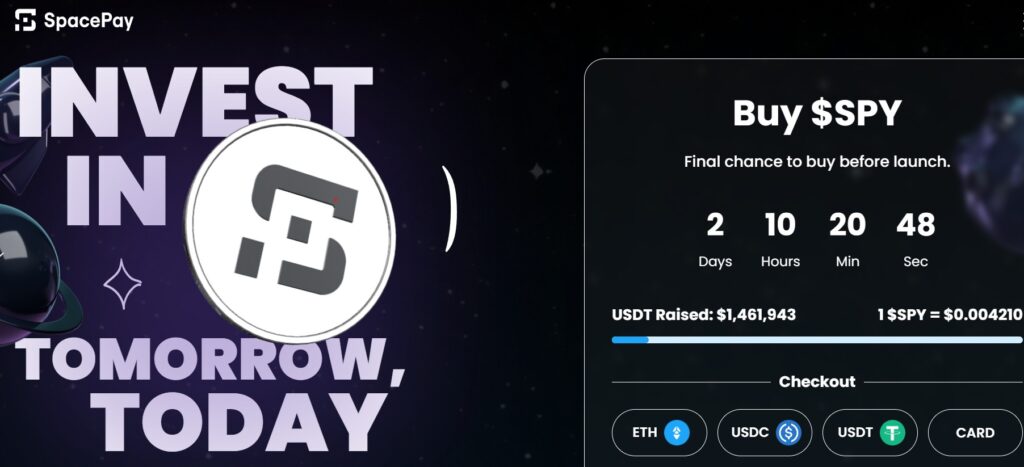
i Kennisgeving: Dit artikel bevat inzichten van onafhankelijke auteurs en valt buiten de redactionele verantwoordelijkheid van BitcoinMagazine.nl. De informatie is bedoeld ter educatie en reflectie. Dit is geen financieel advies. Doe zelf onderzoek voordat je financiële beslissingen neemt. Crypto is zeer volatiel er zitten kansen en risicos aan deze investering. Je kunt je inleg verliezen. Voor mensen die interesse hebben in SpacePay ($SPY) voordat het mainnet live gaat, zit de haast erin. De presale eindigt in november, en zodra de exchange listings van start gaan zal early access niet meer mogelijk zijn. De reden dat men deze laatste weken interesse toont in SpacePay, valt te verklaren door een gat in de markt: namelijk, hoe bedrijven met crypto betalingen omgaan. De meeste winkels kunnen nog steeds geen crypto accepteren als betaalmethode, en al helemaal niet op de eenvoudige manier hoe je nu betaalt met cash of kaart. Instellen van apparatuur is te veel gedoe en te duur, en de volatiliteit van crypto vormt een risico voor ondernemers die gewend zijn aan stabiliteit. SpacePay heeft hier een oplossing voor bedacht, betalen met crypto via de huidige systemen die winkeliers al gebruiken. Hiermee krijgen winkeliers toegang tot een heel nieuw klantenbestand van crypto gebruikers. SpacePay als oplossing voor een groot probleem SpacePay vraagt niet van een winkelier of ze allerlei nieuwe technologische snufjes willen downloaden. Het platform linkt namelijk direct aan Android POS terminals die ze al in hun winkels hebben staan. Hiervoor is geen nieuwe hardware nodig, alleen een simpele software-update. Op deze manier kunnen winkeleigenaren direct 325 verschillende crypto wallets accommoderen, zoals ETH, BNB, MATIC, USDT en nog meer bekende crypto wallets. Een van de grootste factoren die winkeliers afschrikt van crypto zijn de prijsveranderingen. Met behulp van fiat conversie rekent SpacePay af met deze zorgen. Het zit zo: een klant betaalt met crypto, en de winkelier krijgt direct de prijs in lokale valuta op de rekening. Zo is er nooit sprake van plotselinge prijsschommelingen of winstmarges die minder worden dan gedacht. SpacePay heeft ook aan de kosten gedacht. Transactiekosten blijven namelijk staan op slechts 0,5% per betaling; een groot verschil met traditionele verwerkers die makkelijk 2 tot 3% meer vragen. Dit soort procentuele verschillen kunnen gigantische verschillen maken, al helemaal als het een bedrijf is die veel kleinere verkopen doet, zoals een supermarkt of bloemenwinkel. Naast dat een winkel er dus een flink klantenbestand bij krijgt (maar liefst 400 miljoen cryptogebruikers), krijgen zij ook te maken met lagere transactiekosten. SpacePay zorgt voor directe afhandeling van betalingen. Ondernemers ontvangen hun geld onmiddellijk, in plaats van dagen te moeten wachten zoals bij traditionele kaartverwerkers gebruikelijk is. Hierdoor blijft de liquiditeit op peil en kunnen winkeliers hun inkomsten direct herinvesteren in de voorraad of dagelijkse bedrijfsvoering, zonder onnodige vertragingen. Waarom deze altcoin meer biedt dan alleen betalingen Wie $SPY token bezit, kan meebeslissen over de toekomst van het platform. Geen handjevol ontwikkelaars die achter gesloten deuren bepalen wat er gebeurt met andermans tokens; bij SpacePay stemmen token holders zelf over welke nieuwe mogelijkheden er worden gebouwd. Zo blijft SpacePay ontwikkelen, maar vooral in de richting die gebruikers écht willen. Naarmate het platform groeit en meer ondernemers overstappen naar SpacePay, stijgt ook het transactievolume. Een deel van die transactiekosten maakt rechtstreeks een ommekeer, terug naar de mensen die $SPY bezitten. Simpel gezegd: hoe beter het platform draait, hoe meer de holder verdient zonder er iets voor te hoeven doen: passief inkomen. Voor degenen die zich actief inzetten voor de community zijn er extra beloningen in de vorm van maandelijkse airdrops. Elk kwartaal organiseert het team webinars waar vragen gesteld kunnen worden en gebruikers uit eerste hand horen waar ze mee bezig zijn. Verder krijgt een token holder eerder toegang tot nieuwe features dan wie dan ook en kunnen zij als eerste de nieuwste upgrades uitproberen. SpacePay werkt met een totaal van 34 miljard tokens, die verdeeld zijn over verschillende doeleinden. Een vijfde daarvan gaat naar de publieke verkoop. Gebruikersbeloningen en loyaliteitsprogramma’s krijgen 17% toegewezen. Voor doorlopende ontwikkeling is 10% gereserveerd, zodat het team kan blijven innoveren en verder kan bouwen aan een toekomstgerichter bedrijf. Partnerschappen en marketinginspanningen krijgen beide elk 18% van het totaal. Een opvallend detail als deze cijfers onder de loep worden genomen, is dat slechts 5% voor de oprichters zelf wordt gehouden. Dat kleine aandeel laat zien dat ze investeren in de waarde voor de community, niet in hun eigen zakken vullen. Daarnaast ligt er nog 12% in reserve voor onvoorziene kansen of uitdagingen. Deze verdeling verzekert dat de macht over tokens gespreid blijft, in plaats van geconcentreerd bij een select groepje. De laatste fase van de $SPY presale De SpacePay crypto presale heeft inmiddels meer dan 1,46 miljoen dollar opgehaald van de eerste golf supporters. Momenteel kost een token $ 0,004210, maar bij elke nieuwe fase stijgt die prijs verder. November is de laatste maand voordat het mainnet live gaat en daarna verdwijnt deze instapkans definitief. Het mechanisme kennen we: wie vroeg instapt, wordt beloond met lagere prijzen. Tijdens latere fases worden de tokens duurder, en zodra de token op exchanges verschijnt, ligt de prijs nog hoger. Wachten tot na de mainnet lancering betekent simpelweg meer betalen, en dat vinden vele zonde. SpacePay maakt deelname makkelijk door verschillende betaalmethoden te accepteren: ETH, BNB, MATIC, AVAX, USDT, USDC en BASE. Ook wie nog geen crypto bezit, kan betalen met een bankpas. Het platform rekent automatisch uit hoeveel tokens je krijgt op basis van je investering. Het enthousiasme voor de presale wordt ondersteund door het SpacePay One Testnet. De technologie draait al live met de eerste versie van de betalings API en functioneert momenteel op Base Sepolia en Ethereum Sepolia netwerken. Ontwikkelaars kunnen op deze manier de betaalwidget testen om te zien hoe de multi-chain ondersteuning in de praktijk werkt. Het feit dat dit product al doet wat het moet doen, laat zien dat SpacePay kan waarmaken wat het belooft. Deze maand ligt de focus op de laatste puntjes op de i voor de lancering. Het team test opnamefuncties, optimaliseert transacties, rondt de laatste kwaliteitscontroles af en laat tenslotte compliance-werk lopen om ervoor te zorgen dat aan de regelgeving in diverse regio’s wordt voldaan. De volgende stappen van SpacePay Alle puzzelstukjes vallen op hun plek voor de mainnet lancering. SpacePay heeft de werkende technologie, groeiende presale steun en concrete toepassingen allemaal in de pocket. Het platform houdt zich niet te veel bezig met hypes, maar lost een daadwerkelijk, praktisch probleem op binnen de cryptomarkt. SpacePay bevindt zich nu nog in de eindsprint van november, voordat ze overgaan naar de volledige operatie en uitwerking. Het testnet bewijst dat het concept in de praktijk functioneert. De presale laat de interesse vanuit de community zien. Nu draait alles nog om het perfectioneren van elk laatste detail voor een vlekkeloze lancering. De markt beloont projecten met echte waarde, en SpacePay betreedt de cryptowereld met een geteste oplossing die klaar is voor gebruik door winkeliers overal. Spacepay: Zo zien de betalingen van de toekomst eruit. Presale: https://presale.spacepay.co.uk/ Website: https://spacepay.co.uk/ Social media: https://x.com/spacepayltd?s=21 i Kennisgeving: Dit artikel bevat inzichten van onafhankelijke auteurs en valt buiten de redactionele verantwoordelijkheid van BitcoinMagazine.nl. De informatie is bedoeld ter educatie en reflectie. Dit is geen financieel advies. Doe zelf onderzoek voordat je financiële beslissingen neemt. Crypto is zeer volatiel er zitten kansen en risicos aan deze investering. Je kunt je inleg verliezen. Het bericht De $SPY presale is bijna voorbij: een van de beste crypto’s van het moment is geschreven door Redactie en verscheen als eerst op Bitcoinmagazine.nl.

Author: Coinstats
ClickOptions Launches A Crypto Options Venue

ClickOptions Launches A Crypto Options Venue

ClickOptions today launched a crypto options venue built to compress the true all-in cost of trading.

Author: Crypto Breaking News
Charles Hoskinson’s Vision: Cardano to Lead Crypto Market with ADA

Charles Hoskinson’s Vision: Cardano to Lead Crypto Market with ADA

TLDR Charles Hoskinson shared an image styled as Pokémon’s Ash Ketchum to promote blockchain unity through Cardano’s technology. Hoskinson’s efforts to unite the blockchain community gained momentum after Donald Trump’s re-election in 2024. The Midnight airdrop initiative from Cardano seeks to onboard users from various blockchain networks including Bitcoin and Ethereum. Hoskinson’s long-term vision includes [...] The post Charles Hoskinson’s Vision: Cardano to Lead Crypto Market with ADA appeared first on CoinCentral.

Author: Coincentral
Zama to Hold First-Ever Onchain Sealed-Bid Dutch Auction for $ZAMA After Mainnet Launch

Zama to Hold First-Ever Onchain Sealed-Bid Dutch Auction for $ZAMA After Mainnet Launch

Zama launches its Protocol mainnet and will sell 10% of $ZAMA in January via the first onchain sealed-bid Dutch auction, encrypting bids with FHE.

Author: Blockchainreporter
Starknet (STRK) Price Prediction 2025, 2026-2030

Starknet (STRK) Price Prediction 2025, 2026-2030

In this Starknet (STRK) price prediction 2025, 2026-2030,  we will analyze the price patterns of STRK by using accurate trader-friendly technical analysis indicators and predict the future movement of the cryptocurrency. TABLE OF CONTENTS INTRODUCTION Starknet (STRK) Current Market Status What is Starknet (STRK)? Starknet (STRK) 24H Technicals STARKNET (STRK)

Author: Thenewscrypto