DeFi

DeFi eliminates intermediaries by using smart contracts on blockchains to provide financial services like lending, borrowing, and trading. In 2026, the "DeFi 3.0" era is defined by Institutional DeFi and the integration of Real-World Assets (RWA). From liquidity provisioning on Uniswap to advanced lending on Aave, this tag tracks the evolution of autonomous financial systems, yield optimization, and the rise of AI-driven portfolio management in the decentralized economy.

69925 Articles
Created: 2026/02/02 18:52
Updated: 2026/02/02 18:52
Crypto.com Bets Big on Trump Just Months After Settling With SEC

Crypto.com Bets Big on Trump Just Months After Settling With SEC

The post Crypto.com Bets Big on Trump Just Months After Settling With SEC appeared on BitcoinEthereumNews.com. The centralized exchange, once under fire for mishandling millions in crypto, is joining forces with Trump Media to roll out CRO-based rewards on Truth Social. Centralized exchange Crypto.com is betting big on U.S. President Donald Trump with a high-profile partnership with Trump Media, marking a big push into the U.S. market less than a year after settling a dispute with the U.S. Securities and Exchange Commission (SEC). In a Tuesday press release, Trump Media revealed plans to launch a CRO-linked rewards program on Truth Social and Truth+, the social media and streaming platforms created after Donald Trump was banned from X (formerly Twitter). The program is expected to integrate Crypto.com’s infrastructure, allowing users to convert earned points into CRO and access additional perks. Additionally, the two companies plan to collaborate on joint marketing campaigns and offer subscription benefits tied to CRO. As part of the agreement, Trump Media will also invest $105 million in CRO, equivalent to about 2% of CRO’s total supply, while Crypto.com will purchase $50 million of Trump Media stock. The firms are also backing a new digital asset treasury company, Trump Media Group CRO Strategy, which is expected to manage $1 billion in CRO, $200 million in cash, $220 million from warrants, and a $5 billion equity line. The price of Cronos’ native token (CRO) jumped over 20% Tuesday following the announcement, reaching levels not seen since late 2024. Longstanding Ties Crypto.com has a long history with Trump-linked companies. In December 2024, Marszalek reportedly met with Donald Trump to discuss U.S. crypto regulations. Around the same time, the company dropped its lawsuit against the SEC after receiving a Wells notice citing concerns that some tokens on its platform might be considered securities. A few months later, the SEC abruptly ended its investigation into Crypto.com without taking…

Author: BitcoinEthereumNews
Blast TVL Plunges Another 30% as Users Abandon the Network

Blast TVL Plunges Another 30% as Users Abandon the Network

The post Blast TVL Plunges Another 30% as Users Abandon the Network appeared on BitcoinEthereumNews.com. The total value locked in DeFi on the Ethereum Layer 2 blockchain is down 30% this month and 97% from its all-time high. Once the second-largest Ethereum Layer 2 (L2) network, Blast has fallen off significantly as users continue to flee the ecosystem for greener pastures. The chain’s DeFi total value locked (TVL) peaked at $2.2 billion in June 2024, just a month before its highly anticipated token generation event (TGE). Blast’s TVL now stands at just $65 million, a 97% decline from its peak and a 30% drop over just the last month. Blast TVL – DeFiLlama Blast launched with a controversial deposit vault in November 2023, where users locked capital on the chain to earn points. The mainnet launched four months later in February 2024, with Blast unveiling its farming system, which featured a points system that rewarded onchain TVL, and a Blast Gold system, which was distributed to users by native protocols. The chain became a hotbed for airdrop farmers seeking a repeat of the highly successful Blur airdrop from February 2023, which was also spearheaded by lead developer PacMan and funded by investment firm Paradigm. However, the airdrop left many users disappointed after the BLAST token opened at a $2.9 billion valuation, falling short of many farmers’ and analysts’ $5 – $10 billion projections. Activity and TVL on the chain quickly declined, with Blast losing 60% of its TVL less than two months after the airdrop. The BLAST token has performed just as poorly, down 91% from its all-time high and currently changing hands at a $250 million fully diluted valuation (FDV). BLAST Market Cap – CoinGecko Daily active users (DAU) have also plummeted, and are down to just 3,500 according to TokenTerminal, after peaking at 77,000 shortly after the airdrop. Meanwhile, leading L2s Base and…

Author: BitcoinEthereumNews
Best Altcoins That Could Turn $1,000 Into $10,000

Best Altcoins That Could Turn $1,000 Into $10,000

The post Best Altcoins That Could Turn $1,000 Into $10,000 appeared on BitcoinEthereumNews.com. Crypto News Analysts highlight the best altcoins that could turn a $1,000 investment into $10,000 in the upcoming bull run. The crypto market has always been defined by asymmetric opportunities. Unlike traditional assets, where doubling wealth is considered impressive, cryptocurrencies regularly produce multiples of 10x or more during bull cycles. Investors who placed $1,000 into Ethereum in 2017, Solana in 2020, or Shiba Inu in 2021 saw those small allocations balloon into tens of thousands of dollars. With 2025 shaping up as another major expansion cycle, analysts argue that several altcoins could once again turn $1,000 into $10,000. The key is identifying projects with strong narratives, real utility, and early momentum. Alongside established contenders, new entrants like MAGACOIN FINANCE are increasingly being flagged as rewarding plays worth watching. Ethereum: the safer growth path Ethereum (ETH) remains the second-largest cryptocurrency and the backbone of decentralized finance (DeFi), NFTs, and tokenization. While ETH’s enormous market cap means it won’t deliver the explosive returns of its early years, it remains a solid choice for steady multiples. Analysts forecast Ethereum could reach $6,000–$7,000 by 2026 if staking demand, Layer 2 adoption, and institutional inflows continue to rise. A $1,000 investment in ETH may realistically grow to $2,000–$3,000 in the coming years. It may not hit 10x, but it offers security and exposure to the largest ecosystem in blockchain. Solana: speed and adoption advantage Solana (SOL) has emerged as one of Ethereum’s fiercest challengers. With lightning-fast transactions and minimal fees, it has attracted developers in DeFi, gaming, and NFTs. After stabilizing from earlier network outages, Solana’s reliability has improved, boosting investor confidence. Analysts suggest SOL could test $200–$250 in the next cycle if adoption accelerates, representing a potential 4x–5x from current levels. While not guaranteed to produce 10x gains, its momentum and ecosystem strength make…

Author: BitcoinEthereumNews
ETH Adoption Expands — MAGACOIN Launches Daily Rewards in ETH, XRP, DOGE and ADA

ETH Adoption Expands — MAGACOIN Launches Daily Rewards in ETH, XRP, DOGE and ADA

The post ETH Adoption Expands — MAGACOIN Launches Daily Rewards in ETH, XRP, DOGE and ADA appeared on BitcoinEthereumNews.com. Ethereum is reestablishing itself as the foundation of decentralized finance in 2025, fueled by institutional inflows, regulatory clarity, and ecosystem upgrades that have transformed its usability. With more than $12 billion flowing into ETH exchange-traded funds and record staking levels, the network has entered a new phase of adoption. The momentum has also created a favorable backdrop for innovative projects like MAGACOIN FINANCE, which is tapping into Ethereum’s growth by offering daily rewards in ETH and other major altcoins. Ethereum’s Institutional Resurgence Institutional adoption is at the heart of Ethereum’s 2025 story. The approval of spot ETH ETFs has unlocked access for asset managers, pension funds, and corporate treasuries, resulting in steady inflows and renewed legitimacy. Reports show that ETH-focused ETFs have drawn more than $12 billion since launch, underscoring investor appetite for exposure to the leading smart contract platform. This capital wave coincides with record staking ratios. More ETH than ever before is being locked to secure the network, further reducing liquid supply on exchanges and tightening the asset’s availability. Combined with steady institutional allocations, these dynamics are reinforcing Ethereum’s price climb to a new all-time high and signaling confidence in its long-term trajectory. Upgrades and Scalability On the technical side, Ethereum has delivered major upgrades that have dramatically improved its usability. The Dencun upgrade introduced data availability improvements, while Pectra brought refinements to scalability and user experience. Together, these milestones have lowered transaction fees, improved network throughput, and made Ethereum more competitive against faster blockchains. These improvements are rippling through DeFi, NFTs, and tokenized assets. Billions remain locked in smart contracts, and activity across decentralized exchanges continues to climb. Developers now cite Ethereum as more accessible than in previous cycles, broadening its appeal for both startups and large enterprises seeking blockchain infrastructure. Regulatory Clarity and Mainstream Expansion Perhaps…

Author: BitcoinEthereumNews
DeFi protocol Gondor completes angel round of financing, with participation from Maven11 Capital and others

DeFi protocol Gondor completes angel round of financing, with participation from Maven11 Capital and others

PANews reported on August 27th that Gondor, a startup aiming to build a DeFi layer for prediction markets, has officially announced the completion of its angel round of funding from investors including Maven11 Capital. Its first product, a lending protocol for Polymarket positions, will launch soon.

Author: PANews
DeFi Stablecoin Yield Aggregator AutoStaking Partners With Orbiter Finance for Cross-Chain Bridge Solution

DeFi Stablecoin Yield Aggregator AutoStaking Partners With Orbiter Finance for Cross-Chain Bridge Solution

By integrating Orbiter’s Layer-2 cross-chain, AutoStaking unlocks an efficient, low-cost, high-speed cross-chain bridge in its stablecoin investing platform.

Author: Blockchainreporter
Johnson Exit Leaves CFTC Under Single-Member Leadership

Johnson Exit Leaves CFTC Under Single-Member Leadership

The post Johnson Exit Leaves CFTC Under Single-Member Leadership appeared on BitcoinEthereumNews.com. U.S. Commodity Futures Trading Commission member Kristin Johnson said she will leave the regulator on 3 September, a move that will reduce the normally five-seat commission to a single member. Johnson, the lone Democrat on the panel, announced her departure in a statement on Tuesday. Acting Chair Caroline Pham, a Republican, will become the agency’s sole commissioner until the Senate confirms additional nominees. President Donald Trump has named former commissioner Brian Quintenz to lead the CFTC, but his nomination is still awaiting Senate action, and the White House has not yet filled the other three vacancies. The vacancy adds to operational strains at the derivatives watchdog. CFTC staffing has fallen at least 15% since 2021, according to internal figures cited by staff, and the administration’s fiscal-2026 budget proposal calls for further enforcement cuts. The leadership gap comes as the agency faces an expanded mandate over cryptocurrency and other emerging markets. This is an AI-generated article powered by DeepNewz, curated by The Defiant. For more information, including article sources, visit DeepNewz. Source: https://thedefiant.io/news/regulation/johnson-exit-leaves-cftc-under-single-member-leadership-063c4ad1

Author: BitcoinEthereumNews
Chainlink Leads Social Activity With $4.6M Interactions As DePIN Projects Gain Massive Attention

Chainlink Leads Social Activity With $4.6M Interactions As DePIN Projects Gain Massive Attention

The post Chainlink Leads Social Activity With $4.6M Interactions As DePIN Projects Gain Massive Attention appeared on BitcoinEthereumNews.com. The decentralized physical infrastructure network (DePIN) sector has seen a surge in online conversations, with several major projects dominating social media activity over the past 24 hours.  At the top of the DePIN list is Chainlink ($LINK), which continues to prove its strong presence across crypto discussions. This was a very successful project as it received 21,600 interested posts and a remarkable number of 4.6 million interactions. Following closely, Bittensor ($TAO) secured the second spot with 15,500 engaged posts and 1.7 million interactions. The increased interest in the project shown in the social activity is an indicator of its attraction to communities due to the progress in decentralized AI and infrastructure solutions. Projects Leading the DePIN Category Internet Computer ($ICP) finished third in the DePIN list, with 6,200 engaged posts and 325,600 interactions, putting the project in the limelight as it pursues its decentralization narrative. Render ($RENDER) also saw significant momentum, with 4,400 engaged posts and 248,500 interactions. Helium ($HNT) and Akash Network ($AKT) both saw solid community involvement. HNT registered 1,800 engaged posts and 59,200 interactions as compared to AKT which registered 1,700 engaged posts and 70,900 interactions. These projects keep proving useful insights on the use of decentralized networks in connectivity and cloud services in the real world. Filecoin ($FIL) and IOTA ($IOTA) also posted strong numbers, with 1,600 engaged posts each. On the other hand, IOTA had 176,200 interactions, compared to LTBCOIN that only had 99,000 interactions which showed how many of its members have borne with it. Arweave ($AR) and MultiversX ($EGLD) closed the rankings with engaged posts of 1,600 and 1,500 and interactions of 46,000 and 95,600, respectively. In DePIN projects, social engagement has continued to be a sign of strength, since trust and participation are dependent on how the social capital is represented. As…

Author: BitcoinEthereumNews
Delio Rehabilitation: Shocking New Bid Despite Bankruptcy Ruling

Delio Rehabilitation: Shocking New Bid Despite Bankruptcy Ruling

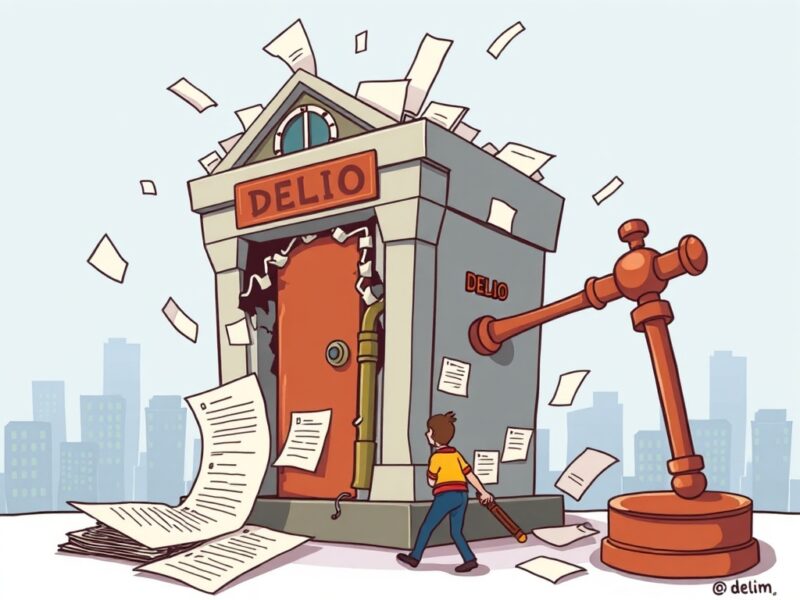
BitcoinWorld Delio Rehabilitation: Shocking New Bid Despite Bankruptcy Ruling The South Korean crypto space is buzzing with a truly shocking development: Delio rehabilitation efforts are back in the spotlight. Despite a clear bankruptcy ruling from the Seoul Bankruptcy Court in November 2024, the crypto deposit platform Delio has once again filed for corporate rehabilitation. This marks its third attempt, following two previous dismissals, as reported by Digital Asset. This latest move adds another layer of complexity to an already tumultuous situation for the company and its many creditors, creating significant uncertainty in the market. What is This Delio Rehabilitation Bid All About? Delio, a prominent South Korean crypto deposit platform, currently finds itself in a challenging legal battle. Corporate rehabilitation, in essence, is a legal process designed to help financially distressed companies restructure their debts and operations. The primary goal is to avoid outright liquidation, aiming to give the company a chance to recover and continue operating. Ultimately, this process seeks to protect stakeholder interests by finding a path to viability. However, the current filing for Delio rehabilitation is particularly noteworthy because it comes after the Seoul Bankruptcy Court had already declared the company bankrupt. This declaration initiated the process of liquidating Delio’s assets, meaning the court was actively preparing to sell off what the company owned to distribute funds among those it owed money to. Therefore, this new rehabilitation application directly challenges the ongoing liquidation process, making it a rare and complex legal maneuver. A Persistent Fight: Why Another Delio Rehabilitation Attempt? One might reasonably wonder why Delio would pursue rehabilitation after a bankruptcy declaration. Typically, bankruptcy signifies the end of a company’s operations, leading directly to asset sales. Rehabilitation, on the other hand, offers a potential lifeline. Delio’s management likely believes they can still salvage the company, perhaps by proposing a viable repayment plan or a significant restructuring of its business model. They aim to convince the court that rehabilitation offers a better outcome for creditors than a forced liquidation, which can often result in lower returns for those owed money. This persistent effort highlights the company’s determination, or perhaps desperation, to regain control of its destiny. The legal system does allow for such appeals and filings, even after initial rulings. However, each dismissal and subsequent filing adds to the legal costs and prolongs the uncertainty for all parties involved in the ongoing Delio rehabilitation saga. What Does This Mean for Delio’s Creditors? For Delio’s creditors, this latest filing introduces even more ambiguity and potential delays. They have been patiently waiting for the distribution of assets following the initial bankruptcy ruling. The new rehabilitation application could potentially pause or significantly delay the liquidation process, which means a longer wait for any potential recovery of their funds. This situation undoubtedly causes considerable frustration and financial strain. Creditors will now closely watch how the court handles this third application for Delio rehabilitation. If the court accepts the filing, it would shift the focus from selling assets to evaluating a detailed restructuring plan. Conversely, if it is dismissed again, the liquidation process would likely resume with renewed momentum. This back-and-forth creates significant stress and financial uncertainty for individuals and institutions who entrusted their crypto assets to Delio. Navigating the Complexities of Crypto Platform Failures The situation with Delio is a stark reminder of the inherent risks and regulatory challenges within the nascent cryptocurrency industry. Unlike traditional financial institutions, crypto platforms often operate in a less defined legal landscape, especially concerning insolvency and investor protection. The repeated attempts at Delio rehabilitation underscore the difficulties in resolving such complex cases within existing legal frameworks. This ongoing legal drama also sends a critical signal to other crypto firms and regulators in South Korea and beyond. It emphasizes the urgent need for clearer guidelines and robust frameworks to manage the collapse of digital asset platforms effectively. Furthermore, it highlights the paramount importance of due diligence for users when choosing where to deposit their valuable crypto assets. Transparency and strong regulatory oversight are crucial for building trust and ensuring stability in this rapidly evolving sector. In conclusion, Delio’s latest filing for corporate rehabilitation, despite a prior bankruptcy declaration, represents a critical and unexpected turn in its legal battle. This persistent pursuit of Delio rehabilitation creates further uncertainty for its creditors and poses significant questions about the future of the platform. The coming weeks will be crucial as the Seoul Bankruptcy Court reviews this third application, determining the next chapter in this complex crypto insolvency case. Stay tuned for updates on this unfolding story, as it holds important lessons for the broader digital asset ecosystem. Frequently Asked Questions (FAQs) What is corporate rehabilitation? Corporate rehabilitation is a legal process that allows financially distressed companies to restructure their debts and operations to avoid liquidation, aiming to recover and continue business. Why is Delio filing for rehabilitation after being declared bankrupt? Delio is likely seeking to convince the court that a restructuring plan could offer a better outcome for creditors than liquidation, giving the company a chance to survive despite the previous bankruptcy ruling. How does this affect Delio’s creditors? This new filing could potentially delay the liquidation process, meaning creditors might have to wait longer to recover any of their funds. It adds uncertainty to their claims. What was the initial bankruptcy ruling about? The Seoul Bankruptcy Court declared Delio bankrupt in November 2024, initiating the process of liquidating the company’s assets to distribute among its creditors. What happens if the court dismisses this third application for Delio rehabilitation? If the court dismisses the application, the liquidation process would likely resume with renewed focus, moving forward with the sale of Delio’s assets to repay creditors. What are the broader implications for the crypto industry? This case highlights the need for clearer regulatory frameworks for crypto platform insolvency and investor protection, emphasizing the risks and complexities within the digital asset sector. Did you find this update on Delio’s ongoing legal battle insightful? Share this article with your network on social media to keep others informed about the evolving landscape of crypto regulations and platform stability! To learn more about the latest crypto market trends, explore our article on key developments shaping crypto regulations and investor protection. This post Delio Rehabilitation: Shocking New Bid Despite Bankruptcy Ruling first appeared on BitcoinWorld and is written by Editorial Team

Author: Coinstats
Altcoin Season Index Plunges: What This Means for Your Portfolio

Altcoin Season Index Plunges: What This Means for Your Portfolio

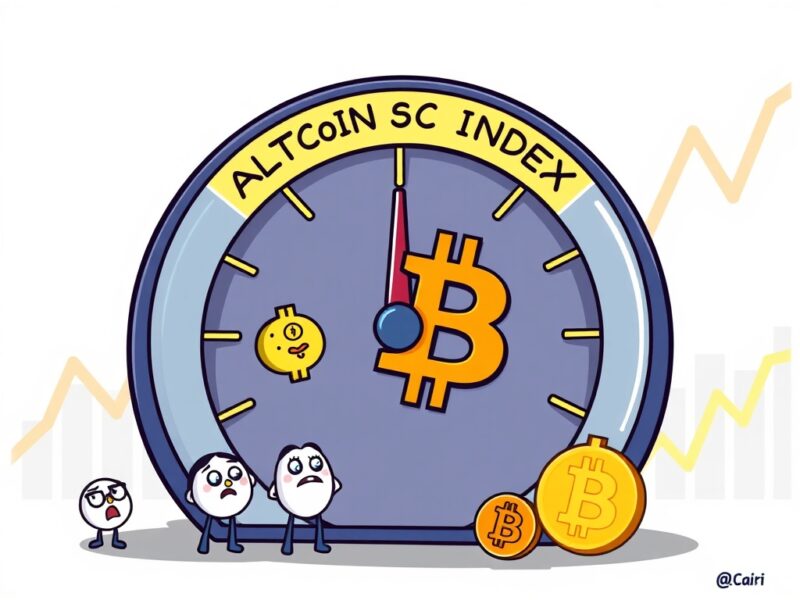
BitcoinWorld Altcoin Season Index Plunges: What This Means for Your Portfolio The crypto world is buzzing with recent market shifts, and a key indicator, the Altcoin Season Index, has just sent a compelling signal. According to CoinMarketCap data, this crucial index has recently fallen three points, landing at 43. This dip from its previous day’s score isn’t just a number; it reflects a significant change in the market’s pulse, suggesting a shift away from widespread altcoin outperformance. What Exactly is the Altcoin Season Index? Understanding the Altcoin Season Index is fundamental for any crypto investor. This unique metric helps determine whether current market conditions are favoring altcoins or if Bitcoin is taking the lead. It does this by meticulously comparing the price performance of the top 100 cryptocurrencies (excluding stablecoins and wrapped tokens) against Bitcoin over a 90-day period. Here’s how it works: The index measures how many of these top 100 altcoins have outperformed Bitcoin. An ‘altcoin season’ is officially declared when at least 75% of these altcoins surpass Bitcoin’s performance within that 90-day window. A score closer to 100 indicates a much stronger and more pervasive altcoin trend, while a lower score suggests Bitcoin’s dominance. Why is the Altcoin Season Index Signaling a Shift? The recent decline of the Altcoin Season Index to 43 is a clear indicator that Bitcoin is currently showing stronger performance relative to a majority of altcoins. This often happens during periods of market uncertainty or when investors seek the relative stability of Bitcoin as the leading cryptocurrency. Several factors can contribute to such a shift: Bitcoin Halving Cycle: Historically, Bitcoin tends to consolidate or rally post-halving, sometimes drawing capital away from altcoins. Macroeconomic Factors: Broader economic conditions, interest rate changes, or geopolitical events can influence investor sentiment, often leading to a flight to perceived safety, which in crypto is often Bitcoin. Market Dominance: When Bitcoin’s market dominance increases, it naturally pulls the Altcoin Season Index down as fewer altcoins are outperforming it. Navigating Your Portfolio When the Altcoin Season Index Dips For investors holding altcoins, a falling Altcoin Season Index presents both challenges and potential opportunities. It’s a moment to re-evaluate strategies and consider market dynamics. Here are some key considerations: Re-evaluate Risk: Altcoins can be more volatile than Bitcoin. A period of Bitcoin dominance might signal increased risk for less established altcoins. Diversification: Ensure your portfolio is adequately diversified. While altcoins offer high reward potential, a balanced approach including Bitcoin can mitigate risk during these phases. Research is Key: Focus on altcoins with strong fundamentals, active development, and clear use cases. These projects might be more resilient even when the overall index is low. Patience: Market cycles are natural. A dip in the index doesn’t mean altcoin seasons are over indefinitely; rather, it suggests a current phase of consolidation or Bitcoin strength. The current reading of the Altcoin Season Index at 43 serves as a vital signal for cryptocurrency investors. It underscores the dynamic nature of the crypto market and the ongoing tug-of-war between altcoins and Bitcoin. While the index currently points to Bitcoin strength, understanding these cycles empowers investors to make informed decisions, adapt their strategies, and prepare for future market shifts. Staying informed about these key indicators is paramount for navigating the exciting, yet volatile, world of digital assets. Frequently Asked Questions (FAQs) Q1: What does the Altcoin Season Index measure? A: The Altcoin Season Index measures whether altcoins or Bitcoin are outperforming over a 90-day period, specifically by comparing the performance of the top 100 altcoins (excluding stablecoins and wrapped tokens) against Bitcoin. Q2: What score indicates an Altcoin Season? A: An Altcoin Season is declared when 75% or more of the top 100 altcoins outperform Bitcoin over the 90-day period. A score closer to 100 indicates a stronger altcoin trend. Q3: Why did the Altcoin Season Index fall to 43? A: The fall to 43 suggests that Bitcoin is currently outperforming a significant majority of altcoins. This can be due to factors like Bitcoin’s halving cycle, broader macroeconomic trends, or increased Bitcoin market dominance. Q4: How does the Altcoin Season Index impact my investment strategy? A: A declining Altcoin Season Index signals a period of Bitcoin strength. Investors might consider re-evaluating risk, diversifying their portfolios, focusing on altcoins with strong fundamentals, and exercising patience during these market phases. Q5: Are stablecoins included in the Altcoin Season Index calculation? A: No, stablecoins and wrapped coins are explicitly excluded from the calculation of the Altcoin Season Index to provide a clearer picture of speculative asset performance. Did this article help you understand the recent shift in the crypto market? Share your thoughts and this valuable insight with your fellow crypto enthusiasts on social media! To learn more about the latest crypto market trends, explore our article on key developments shaping altcoin price action. This post Altcoin Season Index Plunges: What This Means for Your Portfolio first appeared on BitcoinWorld and is written by Editorial Team

Author: Coinstats