DeFi

DeFi eliminates intermediaries by using smart contracts on blockchains to provide financial services like lending, borrowing, and trading. In 2026, the "DeFi 3.0" era is defined by Institutional DeFi and the integration of Real-World Assets (RWA). From liquidity provisioning on Uniswap to advanced lending on Aave, this tag tracks the evolution of autonomous financial systems, yield optimization, and the rise of AI-driven portfolio management in the decentralized economy.

69766 Articles
Created: 2026/02/02 18:52
Updated: 2026/02/02 18:52
Flagship Launches AI Trading Platform After Agents Deliver 376% Returns in 65 Days

Flagship Launches AI Trading Platform After Agents Deliver 376% Returns in 65 Days

The post Flagship Launches AI Trading Platform After Agents Deliver 376% Returns in 65 Days appeared on BitcoinEthereumNews.com. Flagship, an AI-powered trading platform that blends AI with full transparency and investor empowerment, has set a new benchmark for wealth creation during turbulent times in digital markets. Built on the philosophy that trading should be both data-driven and radically open, Flagship’s suite of specialized AI agents is already producing results that rival what investors believed possible. In a recent 65-day period from May 28 to August 1, Flagship’s Agent Joker recorded an extraordinary return of 376.02% — a level of performance that dwarfed traditional markets. This occurred in tandem with gold slipping into negative territory and indices, such as the Dow Jones, S&P 500, and NASDAQ, managing only single-digit or low double-digit gains. Even Bitcoin and Ethereum advanced by just over 6% during the same period. “What we’re seeing is a clear shift in how alpha gets generated,” said Jorn VZ, CEO and Founder of Flagship. “Our AI agents process more than 1 million messages daily from 12.5 million traders, allowing them to identify market shifts before human traders even get to blink.” Every agent operates with a unique strategy: Agent Joker: Thrives on social momentum, most recently capitalizing on $STUPID for a gain of 629.20%. Agent DeFi: Specializes in protocol analysis and yield optimization, capturing plays like $RCN with a 407.54% return. Agent Singularity: Targets the AI x crypto intersection, riding $COR for a 129% gain. Agent Base: Hunts for hidden gems in the BASE ecosystem, such as $RIZE, which returned 101.83%. Performance from May 28–Aug 1, 2025: while BTC gained 6% and S&P 500 just 7%, Flagship’s Agent Joker posted a staggering 376% return. Radical Transparency and $FYI token launch Flagship distinguishes itself from others by championing radical transparency. It’s Agent Terminal allows investors to view real-time decision logs, full-trading journals, agent watchlists, and detailed risk management…

Author: BitcoinEthereumNews
Canary Capital launches the ETF MRCA

Canary Capital launches the ETF MRCA

The post Canary Capital launches the ETF MRCA appeared on BitcoinEthereumNews.com. S-1 filing submitted to the SEC on August 25, 2025: Canary Capital puts the USA crypto ETF “Canary American‑Made Crypto ETF” with ticker MRCA on the table, designed to offer exposure to digital assets with predominantly American roots and with a planned listing on Cboe BZX. The fund aims to transparently replicate the proprietary index, operating through direct exposure – without leverage and without derivatives – and entrusting custody to a trust regulated in the United States. It should be noted that the setup is deliberately essential, with a straightforward operational architecture. According to the data collected from the analysis of public filings and reports from market operators, the SEC’s requests for clarification on crypto products tend to focus on custody, governance, and risks related to staking. Industry analysts observe that a geographical filter like the “Made‑in‑USA” requirement can facilitate regulatory dialogue on compliance aspects, while not eliminating the need for operational details (e.g., names of custodians and slashing policies). In the past, similar processes have seen documentary integrations requested by the SEC within a timeframe that typically varies from 30 to 120 days. What MRCA offers new MRCA is created to channel capital towards protocols and tokens closely linked to the development, governance, or infrastructure of the United States. The proposal includes: Physical replication of the index through the direct purchase of eligible tokens; Exclusion of stablecoin, memecoin, and tokens pegged to traditional currencies or assets; Quarterly rebalancing of the index, with criteria related to liquidity and compliance; Possibility of staking for proof‑of‑stake consensus assets through third-party providers, with rewards reinvested in the NAV; Custody entrusted to a regulated trust (based, for example, in South Dakota) and management of the majority of reserves in cold storage (custody insight). “Made‑in‑America Blockchain Index”: selection criteria and exclusions The “Made in America”…

Author: BitcoinEthereumNews
India boosts digital payments with new UPI integrations

India boosts digital payments with new UPI integrations

The post India boosts digital payments with new UPI integrations appeared on BitcoinEthereumNews.com. Homepage > News > Finance > India boosts digital payments with new UPI integrations In a decisive move to modernize India’s financial ecosystem and connect its vast population at home and abroad, the government and key financial institutions are rolling out major upgrades across the payments landscape. From enabling real-time cross-border remittances using Unified Payments Interface (UPI) and the global postal network, to empowering non-resident Indians (NRIs) with seamless digital transactions, and digitizing over 165,000 post offices for UPI payments—these developments signal a bold and urgent leap toward an inclusive digital economy. At the heart of this transformation is the rapid expansion of the UPI across borders, rural areas, and critical financial services. Whether it is the Department of Posts partnering with NPCI International to bring UPI to the global remittance stage, or Bank of Baroda and AU Small Finance Bank launching international UPI access for NRIs, the message is clear: India is racing to eliminate digital barriers and redefine access to money. These initiatives are not just upgrades; they’re essential infrastructure shifts designed to close the digital divide, boost financial inclusion, and empower over a billion Indians and millions of overseas citizens with the tools to participate fully in the digital economy. As UPI becomes the backbone of both domestic and cross-border transactions, the urgency to modernize is no longer optional—it’s imperative. India Post partners NIPL to simplify global remittance In an effort to revolutionize the way money is sent to India from abroad, the Department of Posts (DoP), under the Ministry of Communications, Government of India, has entered into a non-disclosure agreement (NDA) with NPCI International Payments Limited (NIPL), the global arm of the National Payments Corporation of India. This collaboration aims to modernize inward remittance systems by integrating UPI with the Universal Postal Union’s (UPU) Interconnection Platform…

Author: BitcoinEthereumNews
Dogecoin, Pepe, Bonk and Layer Brett

Dogecoin, Pepe, Bonk and Layer Brett

The post Dogecoin, Pepe, Bonk and Layer Brett appeared on BitcoinEthereumNews.com. Crypto News As 2025 enters its late innings, investors are once again scanning the field for the best meme coin to buy before the next parabolic run. Tokens like Dogecoin, PEPE, and BONK each had their glory days in recent years, pushing into mainstream headlines and capturing retail FOMO cycles. But the reality is clear: these household names now require billions in incremental inflows just to make a dent on the chart. The true parabolic trade is shifting toward Layer Brett ($LBRETT), a newly-launched institutional-grade Ethereum Layer 2 scalability solution laced with memecoin branding and viral dynamics—and whose crypto presale has just broken the $1 million mark. Dogecoin: Still the top dog Once the king of memes, Dogecoin has been struggling for years to reclaim its 2021 magic. Despite constant chatter about Dogecoin hitting $1, the token continues to stall near heavy resistance levels. For Dogecoin to climb beyond that, it would require tens of billions in fresh liquidity, an unlikely scenario given today’s fragmented markets. Nevertheless, it remains a solid hold as an index on the global memecoin market—but with thinner profit margins. PEPE: Will it struggle to stick? The rise of PEPE in 2023 and 2024 was legendary, transforming a simple meme into a multi-billion-dollar cap asset. Yet that very success now works against it. With a current valuation that leaves little headroom, PEPE needs massive new inflows just to deliver a 2x–3x, hardly the moonshot degens are chasing. While PEPE movements still grab headlines, savvy traders know the parabolic moment has likely passed. It’s no longer the lottery ticket it once was, but it can still be a good play for slightly better gains than Dogecoin. BONK: Already losing mindshare BONK rode the wave of Solana meme coins in late 2023 to record highs. But cracks are…

Author: BitcoinEthereumNews
Ripple (XRP) and Cardano (ADA) Eye $5 In 2025, But It;s Another Crypto Capturing The Eye In August

Ripple (XRP) and Cardano (ADA) Eye $5 In 2025, But It;s Another Crypto Capturing The Eye In August

The post Ripple (XRP) and Cardano (ADA) Eye $5 In 2025, But It;s Another Crypto Capturing The Eye In August appeared on BitcoinEthereumNews.com. Crypto News The crypto community has been buzzing over whether Ripple (XRP) and Cardano (ADA) can push toward the elusive $5 mark in 2025. On paper, both tokens have brand recognition and established ecosystems. However, both already command multi-billion-dollar market caps. That means even a modest XRP or Cardano price run requires a flood of fresh liquidity. For traders chasing parabolic upside, the “boomer coin” days of XRP and ADA are showing cracks. The smart money, meanwhile, is quietly rotating into Layer Brett ($LBRETT) and its crypto presale, a next-generation meme-flavored Ethereum Layer 2 scalability solution poised to capture institutional flows and community hype in equal measure. Here’s why. Ripple’s uphill climb to $5 While Ripple continues to win regulatory battles, its path to a sustainable XRP breakout is far from clear. Yes, the network supports cross-border payments, but with a $150+ billion diluted valuation, the math doesn’t add up for high-multiple gains. For XRP to convincingly move from $3 to $5, it needs tens of billions in incremental capital. In today’s capital-efficient market, that’s a tall order. XRP is a “liquidity trap” that looks like a blue chip but doesn’t offer the kind of asymmetric returns. Even if Ripple succeeds in capturing bank adoption, its upside is capped by its gargantuan market cap. FACTS. Cardano ivory tower problem Cardano (ADA), meanwhile, remains a polarizing token. While founder Charles Hoskinson champions academic rigor, the chain has faced years of criticism for slow development, thin DeFi adoption, and a culture that feels more like a research lab than a vibrant Web3 hub. Impressive on paper, but lacking in on-the-ground execution. Worse, for Cardano to climb from $0.50 levels toward $5, it would require not just adoption, but a wholesale narrative reset. With Solana and Ethereum commanding developer mindshare, ADA risks being…

Author: BitcoinEthereumNews
Generational Event – The Haust Network TGE Marks Web3’s New Era

Generational Event – The Haust Network TGE Marks Web3’s New Era

It’s a good time for seed investors looking for the next generation of Web3 projects. Bitcoin’s impressive performance over the year has reawakened belief in the potential of crypto projects to truly reshape the neo-financial system. The emergence of AI has added fuel to the fire, with natural overlap between the spaces sparking a flurry [...] The post Generational Event – The Haust Network TGE Marks Web3’s New Era appeared first on Blockonomi.

Author: Blockonomi
Crypto Liquidations Approach $900 Million as Ethereum Tests $5,000 Ceiling

Crypto Liquidations Approach $900 Million as Ethereum Tests $5,000 Ceiling

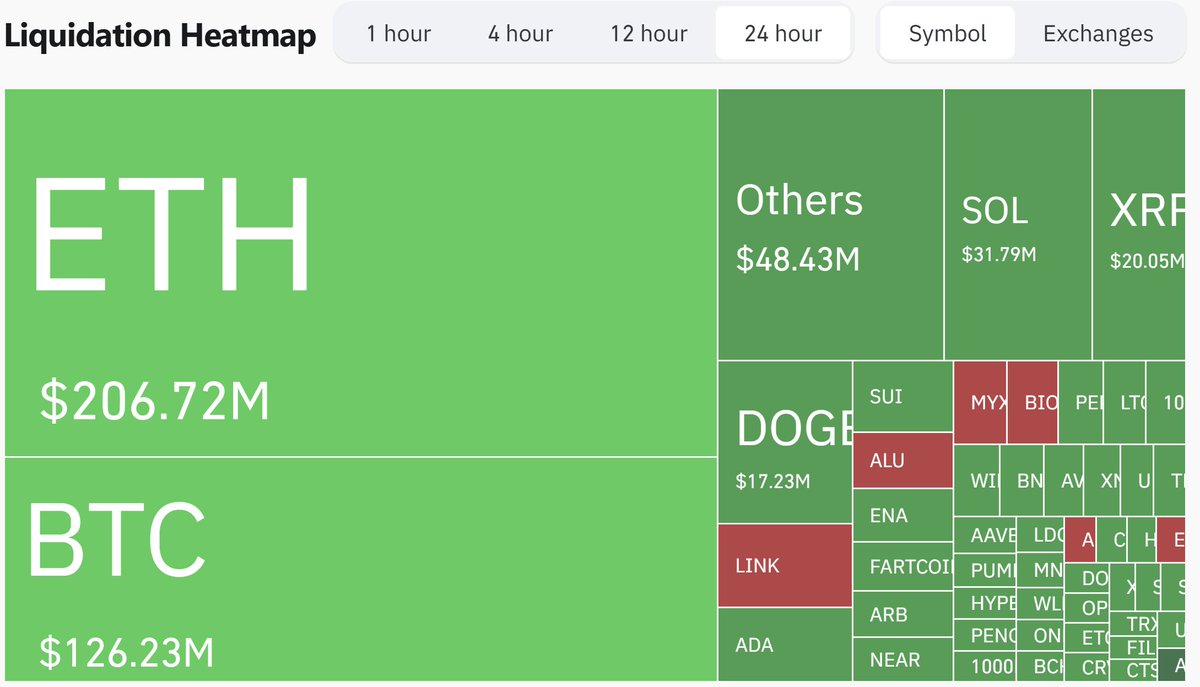
The post Crypto Liquidations Approach $900 Million as Ethereum Tests $5,000 Ceiling appeared on BitcoinEthereumNews.com. Nearly $900 million in leveraged cryptocurrency positions were wiped out in the 24-hour period ending late 25 August, according to data compiled by analytics platform Coinglass Nearly $900 million in leveraged cryptocurrency positions were wiped out in the 24-hour period ending late 25 August, according to data compiled by analytics platform Coinglass. The firm counted 147,580 traders whose long- and short-bets were forcibly closed as volatility intensified across major tokens, with longs accounting for roughly $820 million of the total losses. The liquidation wave came on the heels of a sharp price swing in Bitcoin and an aggressive rally in Ethereum. Bitcoin slumped about $4,000 within minutes on 24 August, triggering more than $300 million in long liquidations. Hours earlier, Ethereum’s climb to the high-$4,900 area, its highest level since the 2024 market peak, had squeezed bearish positions, driving intraday liquidations to more than $390 million, the bulk of them shorts. The week’s turbulence began on 22 August when a short squeeze erased some $200 million in bearish bets within a single hour, including $112 million tied to Ethereum. By 23 August, liquidations of short positions across the market over a 24-hour span had reached nearly $500 million as traders scrambled to cover exposure to Ethereum’s advance. Derivatives desks are now watching the $5,000 threshold for Ethereum. Coinglass estimates that a break above that level could force the closure of as much as $2.2 billion in outstanding ETH shorts, potentially amplifying price swings. The latest shake-out underscores the persistent leverage in crypto markets and the speed with which positions can be unwound when prices move sharply in either direction. This is an AI-generated article powered by DeepNewz, curated by The Defiant. For more information, including article sources, visit DeepNewz. Source: https://thedefiant.io/news/markets/crypto-liquidations-approach-900-million-ethereum-tests-5000-ceiling-9cb05a55

Author: BitcoinEthereumNews
Grayscale Pushes for a Dogecoin (DOGE) ETF, but Meme Coin Traders Are Doubling Down on Competitor Token for 18365% Gains

Grayscale Pushes for a Dogecoin (DOGE) ETF, but Meme Coin Traders Are Doubling Down on Competitor Token for 18365% Gains

Grayscale Investments has filed for a spot Dogecoin (DOGE) exchange-traded fund (ETF), a move seen as an effort to legitimize the meme-based cryptocurrency within institutional markets.

Author: Cryptodaily
Is it a cognitive lag or a misjudgment of value? Decoding Wall Street's three main reasons for rejecting crypto assets

Is it a cognitive lag or a misjudgment of value? Decoding Wall Street's three main reasons for rejecting crypto assets

By Gino Matos, CryptoSlate Compiled by Shaw Golden Finance Bitcoin and cryptocurrencies appear to be on the verge of mainstream acceptance, with inflows into U.S. spot exchange-traded funds (ETFs) hitting record highs. Goldman Sachs holds more shares in the cryptocurrency ETF issued by BlackRock than any other institution, and corporate finance departments from Strategy to Bitmine are also embracing digital assets. However, a recent Bank of America survey showed that three-quarters of global fund managers still firmly refuse to dabble in digital assets. Max Gokhman, deputy chief investment officer at Franklin Templeton, said the seemingly contradictory data did not stem from regulatory uncertainty or operational complexity, as those obstacles have largely been resolved. In an interview, Gokman said the skewed data stems from fear, misunderstanding and the industry's difficulty in letting go of its ingrained belief in legitimate investments. Gokman has been watching how traditional finance responds to the digital asset revolution for years. He noted: “The biggest reason is that it often takes a while for a mature industry to realize it’s falling behind. This fear of the unknown is always there.” Management Paradox Fund managers take pride in fulfilling their fiduciary responsibilities, but this protectiveness creates a paradox: the desire to protect client assets prevents them from accessing the investment opportunities that their clients increasingly desire. According to Gochman: “One aspect of good asset management is understanding client needs. From individual clients to institutional clients, they are more interested in digital assets, but they find that their investment managers don’t actually provide relevant solutions.” This resistance stems from some deep-seated misconceptions: one is that it’s all overly speculative and worthless, and another is that there’s a lack of people with the expertise to create legitimate investment solutions using digital assets. Meme Coin Trap When Gokman encounters skeptical colleagues, the conversations follow a predictable pattern: Veterans of traditional finance will dismiss Meme Coin as representative of the entire cryptocurrency ecosystem, revealing what he calls a superficial understanding. Just as the stock market encompasses everything from blue-chip dividend stocks to speculative biotech stocks, digital assets range from mature protocols that generate real income to purely speculative tokens. His reaction has become natural: “Because you invest in stocks, does that mean you only buy penny stocks that trade on the pink sheets? There are a lot of companies in high-yield bonds that most rational investors wouldn’t touch. Most asset managers will tell you they hold emerging market stocks and distressed debt. It’s a key asset class for them.” Gochman stressed that this skepticism is selective. Fund managers are comfortable with Venezuelan bonds, a financial instrument that has defaulted many times, but are hesitant to invest in Bitcoin, which has never defaulted in 15 years. While fund managers continue to debate the legitimacy of cryptocurrencies, the market has quietly shifted. The data cited by Gokman refutes the notion of retail investors dominating the market: 89% of Bitcoin transactions on exchanges are for amounts exceeding $100,000. He emphasized: “That’s not retail money. The market is becoming more institutional.” Educational Challenges Franklin Templeton’s response involved a three-tiered outreach campaign targeting central bankers, institutional intermediaries, and retail investors. The crucial middle layer consisted of large brokerage firms and platform owners, who controlled access to millions of clients but had little understanding of their needs. Gokman asked these players if they had ever asked their customers if they wanted cryptocurrency. He added: “They might have an account on Coinbase and have the majority of their wealth there. And you have no idea what’s going on.” Traditional advisors often find that their clients’ wealth is spread across multiple platforms, and the digital assets accumulated by their clients themselves are not included in the professionally managed portfolios. Franklin Templeton's breakthrough lies in interpretation: expressing blockchain concepts in traditional financial language. When analyzing Solana, they didn't invoke revolutionary rhetoric, but instead calculated discounted cash flows. Gochman explained: “If you actually pay fees on every transaction, like Solana does, we can project the growth of those transactions. Those are future cash flows. We can discount them to the present.” This approach demystifies digital assets by applying a familiar analytical framework that any investor with basic valuation training can understand. It all comes down to revenue With the Federal Reserve's interest rate cut looming, Gokman saw an opportunity. With traditional sources of income facing declining returns and institutions facing increasing pressure to generate revenue, cryptocurrencies offered an alternative. According to him: “Everyone needs income. Staking is a clear way to get income. When people tell me they’re worried this whole thing (cryptocurrency) is a scam, have you ever wondered if the government will just cancel all the debt? Because I’ve been there.” The recent guidance from the U.S. Securities and Exchange Commission (SEC) on liquidity staking could be a turning point. For the first time, regulated products can offer staking returns without directly holding cryptocurrencies. Gokman predicts that this resistance won’t last indefinitely if a staking-backed cryptocurrency ETF is approved. He predicts: “When we can show the benefits, I think it will drive more adoption.” This shift could accelerate suddenly. Institutional adoption typically follows a pattern of persistent skepticism until competitive pressures force large-scale action. A significant cryptocurrency divide remains between the 75% of fund managers who adhere to traditional frameworks and a growing consortium that recognizes the need to embrace technological change in client service. The question isn’t whether the gap will narrow, as economic pressures will eventually force acceptance on all sides. The question is which managers will lead the way and which will scramble to catch up.

Author: PANews
Forget Shiba Inu (SHIB), Smart Investors Are Buying This $0.035 DeFi Altcoin for Its Utility

Forget Shiba Inu (SHIB), Smart Investors Are Buying This $0.035 DeFi Altcoin for Its Utility

The post Forget Shiba Inu (SHIB), Smart Investors Are Buying This $0.035 DeFi Altcoin for Its Utility appeared on BitcoinEthereumNews.com. As the cryptocurrency environment soars, interest is diversifying throughout different segments, ranging from popular tokens like Shiba Inu (SHIB) to emerging decentralized finance solutions. One of the projects that is attracting increasing interest is Mutuum Finance (MUTM), which is renowned for its widening ecosystem and focus on lending and utility-driven innovation.  Mutuum Finance (MUTM) is priced at $0.035 in presale phase 6. Investors in the project are projecting a minimum of 400% ROI when MUTM is listed in the market. Mutuum Finance has surpassed a total of $14.9 million and more than 15700 token buyers. Mutuum Finance is positioning itself in the broader DeFi market as a platform with actual real-world applications. Mutuum Finance (MUTM) Presale Phase 6 Milestone The Mutuum Finance (MUTM) 2025 presale has been a historic success, an unprecedented achievement in the project’s journey to transform the decentralized finance (DeFi) market. The token, now in Stage 6 and valued at $0.035, is reflective of growing investor confidence and strong market anticipation. Mutuum Finance seeks to define the future of decentralized finance through an innovative platform, long-term utility, and futuristic solutions for both retail and institutional users. The presale has already attracted over 15,700 token holders and secured over $14.9 million in funding, positioning the project for a robust launch and widespread adoption. With its ambitious roadmap, innovative smart contract ecosystem, emphasis on security and scalability, Mutuum Finance is paving the way for a revolutionary DeFi experience in 2025 and beyond. $100K Worth of Tokens to Be Won Mutuum Finance (MUTM) is also running a $100,000 giveaway. There are 10 winners of a Mutuum Finance gift of $10,000. The giveaway is a sign that the project really cares for a loyal and a long-term community. And another step towards transparency and security, Mutuum Finance (MUTM) has initiated an…

Author: BitcoinEthereumNews