DEX

DEXs are peer-to-peer marketplaces where users trade cryptocurrencies directly from their wallets via Automated Market Makers (AMM) or on-chain order books. By removing central authorities, DEXs like Uniswap and Raydium prioritize privacy and user sovereignty. The 2026 DEX landscape is dominated by intent-based trading, MEV protection, and cross-chain liquidity aggregation. Follow this tag for the latest in on-chain trading volume, liquidity pools, and the technology behind permissionless swaps.

34181 Articles
Created: 2026/02/02 18:52
Updated: 2026/02/02 18:52
Kanye’s YZY launch rockets into Top 35 tokens then crashes 95% in hours

Kanye’s YZY launch rockets into Top 35 tokens then crashes 95% in hours

The post Kanye’s YZY launch rockets into Top 35 tokens then crashes 95% in hours appeared on BitcoinEthereumNews.com. Kanye West continued his controversy-filled era with his YZY token launch on Solana this week, where trading activity drove its market capitalization near $3 billion before collapsing within hours. The token, listed under multiple pool tickers on Raydium, initially saw rapid inflows that pushed its fully diluted valuation into multibillion territory before prices retreated more than 90%, leaving its capitalization closer to $137 million. The pace of YZY’s ascent and reversal mirrored past episodes in the Solana ecosystem where memecoins generated substantial liquidity in compressed windows. As Barron’s noted, the debut quickly shifted discussion toward whether these launches, often tied to well-known public figures, warrant more oversight as traders with early access capture profits at the expense of late entrants. On-chain monitors cited wallets that accumulated large allocations at market open. Independent analysis from Conor Grogan estimated that as much as 94% of the initial supply was controlled by insiders, including a single multisig wallet that at one point held 87% of the tokens before dispersing. Fee structures added another layer to the controversy. As one trader posting under the handle 0xBiZzy observed, the YZY pool was configured with a 1% base fee and dynamic adjustments that quickly moved to 2.68%, combined with a wider bin step that introduced another 4 to 5 percent of slippage. The effect left some participants facing an estimated 10% round-trip cost to enter and exit positions. Despite these costs, volume surged in the first hours of trading, producing more than $9 million in collected fees for the pool’s operators, according to the same account. Market activity revealed uneven outcomes for traders. Lookonchain tracked one whale wallet that spent 1.55 million USDC to purchase just under one million YZY tokens at $1.56, only to sell them two hours later at $1.06 for 1.05 million USDC,…

Author: BitcoinEthereumNews
Google enters TeraWulf to convert Bitcoin mining into AI data centers

Google enters TeraWulf to convert Bitcoin mining into AI data centers

The post Google enters TeraWulf to convert Bitcoin mining into AI data centers appeared on BitcoinEthereumNews.com. Google becomes the main shareholder of TeraWulf (WULF), supporting a plan of 3.2 billion dollars to convert part of the mining sites into data centers for artificial intelligence (AI). The operation, highlighted in documents filed with the SEC and reported by specialized publications, includes the issuance of options/warrants for over 73 million shares that will give Google, on a diluted basis, a stake close to 8% of the company’s capital. The announcement is dated August 14, 2025, as indicated by the filings and journalistic coverage. According to the data collected from the SEC filings of August 14, 2025, and market notes, the proposed structure combines components of direct equity and dilutive instruments (warrants) with financing lines for infrastructural development.  Industry analysts note that the conversion of mining facilities into HPC data centers requires significant interventions on the electrical network, cooling, and local permits, with operational timelines typically ranging from a few months up to 12–24 months depending on the site and authorizations. Markets in motion: rally and profit-taking The stock WULF has shown marked volatility in the sessions following the announcement, with fluctuations that, according to various sources, have ranged between 20% and 55%. An interesting aspect is that the 12-month high reached approximately $10.71 per share, only to then be affected by profit-taking that trimmed part of the rally. What the agreement provides: numbers and structure Total investment of $3.2 billion aimed at accelerating the conversion towards AI infrastructures and strengthening the already operational campuses. Equity participation: issuance of options/warrants on over 73 million shares, for a potential stake close to 8% of the share capital. Composition: the operation includes an equity component (shares and warrants) along with financial support for infrastructural development; further details will be clarified in the official filings and the expected 8‑K. Key asset: the…

Author: BitcoinEthereumNews
Bitcoin And Altcoins Bounce Off Daily Lows As Bulls Buy Dips

Bitcoin And Altcoins Bounce Off Daily Lows As Bulls Buy Dips

The post Bitcoin And Altcoins Bounce Off Daily Lows As Bulls Buy Dips appeared on BitcoinEthereumNews.com. Key points: Bitcoin’s drop has resulted in net outflows from BTC ETFs on Tuesday, but buyers are likely to step in and arrest the decline near $110,530. Ether bulls are trying to flip the $4,094 level into support, indicating a positive sentiment. Bitcoin (BTC) is attempting to bounce off the immediate support near $112,000, but higher levels are likely to attract sellers. BTC’s weakness triggered net outflows of $523.3 million from the US spot BTC exchange-traded funds on Tuesday, per Farside Investors data. That suggests the institutional investors are turning cautious in the near term. Blockchain analytics firm Santiment said in a post on X that BTC’s dip below $113,000 resulted in the most bearish sentiment on social media since June 22. The firm said the retail cryptocurrency traders have flipped bearish, but that is a good sign for patient traders as markets move in the “opposite direction of crowd’s expectations.” Crypto market data daily view. Source: Coin360 BTC’s fall has pulled several altcoins lower, hurting investor sentiment. Google Trends data shows that global search interest for the term “alt season” fell to 45 on Tuesday, down from the peak of 100 on Aug. 13. What are the important resistance and support levels to watch out for in BTC and the major altcoins? Let’s analyze the charts of the top 10 cryptocurrencies to find out. Bitcoin price prediction BTC fell below the neckline of the inverse head-and-shoulders pattern on Tuesday and reached near the solid support of $112,000. BTC/USDT daily chart. Source: Cointelegraph/TradingView The bulls will try to aggressively defend the $110,530 to $112,000 zone. If the price rebounds off the support zone, the BTC/USDT pair could reach the 20-day exponential moving average ($116,687). A close above the 20-day EMA signals a range-bound action between $110,530 and $124,474. Alternatively, if…

Author: BitcoinEthereumNews
Jackson Hole And Euro PMI Influence

Jackson Hole And Euro PMI Influence

The post Jackson Hole And Euro PMI Influence appeared on BitcoinEthereumNews.com. The financial world is abuzz, and for good reason. As the cryptocurrency market continues its fascinating dance, traditional financial indicators like currency movements often provide crucial context. Recently, the US Dollar has shown a noticeable drift higher, capturing the attention of investors worldwide. This movement isn’t isolated; it’s intricately linked to anticipation surrounding major economic events, particularly the upcoming Jackson Hole Symposium. For those navigating the volatile crypto landscape, understanding these macro shifts is paramount, as they frequently influence broader market liquidity and investor sentiment. Understanding the US Dollar‘s Ascent Why is the US Dollar strengthening? Several factors contribute to its current trajectory. Primarily, the market is bracing for signals from the Federal Reserve, especially concerning interest rate policy. In times of global economic uncertainty, the dollar often acts as a safe-haven asset, attracting capital from various corners of the world. This demand naturally pushes its value higher. Safe-Haven Appeal: Global economic slowdown fears or geopolitical tensions often lead investors to seek the relative safety of the US Dollar. Interest Rate Differentials: Expectations of higher interest rates in the U.S. compared to other major economies make dollar-denominated assets more attractive. Economic Data: Stronger-than-expected economic data out of the U.S., even if mixed, can bolster confidence in the American economy, supporting the dollar. The dollar’s performance is a key barometer for global trade and investment flows, directly impacting everything from commodity prices to corporate earnings. For crypto enthusiasts, a stronger dollar can sometimes imply tighter liquidity in broader markets, which may have indirect effects on digital asset valuations. The Anticipation Around Jackson Hole The annual Jackson Hole Economic Symposium is not just another conference; it’s a pivotal event on the global economic calendar. Hosted by the Federal Reserve Bank of Kansas City, it brings together central bankers, finance ministers, academics, and…

Author: BitcoinEthereumNews
Here’s Why Bitcoin (BTC USD) Price Slipped 9% From August Peak, Can BTC Recover?

Here’s Why Bitcoin (BTC USD) Price Slipped 9% From August Peak, Can BTC Recover?

The post Here’s Why Bitcoin (BTC USD) Price Slipped 9% From August Peak, Can BTC Recover? appeared on BitcoinEthereumNews.com. The crypto has been witnessing weaker retail confidence, even as whales and institutional flows continued to support Bitcoin (BTC USD). The Bitcoin price was around $113,700 at press time, about 8.5% below its August peak. Bitcoin Price Decline Triggered Weaker Sentiment The Bitcoin price lost about 0.15% over 24 hours and 6.54% in a week. Monthly performance also turned negative at around –3.7%. The move left the asset well below its record of about $124,500, set on August 14. Investor sentiment shifted accordingly. The Fear & Greed Index dropped 12 points to 44. The fall pushed sentiment back into the “Fear” range, showing weaker retail confidence at press time. Market capitalization fell to $3.8 Trillion, mirroring the downturn in Bitcoin (BTC USD). Broader altcoin markets also traded lower. Bitcoin (BTC USD) Price Decline Reflected in Derivatives Derivatives markets showed mixed signals. Futures trading volume climbed more than 6% to $83.7 Billion over 24 hours. At the same time, open interest slipped nearly 1% to $80.3 Billion. This divergence often indicated churn. Rising volume with falling open interest suggested that traders closed existing positions rather than opening new ones. Analysts said this pointed to reduced risk appetite while volatility remained elevated. Other data signaled stress in derivatives markets. Open interest had reached historically high levels before the latest decline. Funding rates, which measure the cost of holding futures contracts, stayed positive. That suggested traders still paid to hold long positions even as confidence weakened. Options activity also rose. Open interest expanded and volatility spreads widened. The 25-delta skew, a measure of options pricing, turned positive. This showed stronger demand for downside hedges and protection against further price losses. Retail Bearishness Contrasted with Whale Accumulation Retail sentiment weakened to its lowest level since June 22, according to Santiment. Analysts compared the downturn…

Author: BitcoinEthereumNews
GBP/USD Forecast: Unlocking the Pound’s Potential Towards 1.40

GBP/USD Forecast: Unlocking the Pound’s Potential Towards 1.40

BitcoinWorld GBP/USD Forecast: Unlocking the Pound’s Potential Towards 1.40 Even for those deeply immersed in the volatile world of cryptocurrencies, understanding traditional foreign exchange markets like the GBP/USD pair offers crucial insights into global economic sentiment. The recent GBP/USD forecast from financial giant UBS, predicting a climb towards 1.40, has certainly sent ripples across the financial landscape. What does this mean for broader market dynamics, and why should investors, even crypto enthusiasts, pay attention to the Pound to Dollar outlook? Understanding the GBP/USD Forecast: What’s Driving the Optimism? The GBP/USD currency pair represents the exchange rate between the British Pound and the US Dollar. It’s one of the most actively traded pairs globally, reflecting the economic health and monetary policy divergence between the United Kingdom and the United States. A rising GBP/USD rate indicates a strengthening Pound relative to the Dollar, meaning it takes fewer Dollars to buy one Pound. UBS’s latest prediction is a significant vote of confidence in the Pound’s potential. This isn’t just a random number; it’s a meticulously calculated outlook based on a confluence of economic indicators, central bank policies, and global market dynamics. For many, such a move would signal a robust recovery for the UK economy and a potential shift in global investment flows. But what are the underlying factors that could propel the Pound to such heights? The Pound to Dollar Outlook: A Deep Dive into Key Drivers Several fundamental elements contribute to the movement of any currency pair, and the GBP/USD is no exception. UBS’s optimistic Pound to Dollar outlook is likely predicated on a detailed analysis of these drivers: Interest Rate Differentials: Central bank policies, specifically those of the Bank of England (BoE) and the US Federal Reserve (Fed), play a pivotal role. Higher interest rates typically attract foreign capital seeking better returns, thus strengthening a currency. If the BoE maintains or signals a more hawkish stance (i.e., higher interest rates) compared to the Fed, the Pound could gain an advantage. Conversely, if the Fed signals earlier or more aggressive rate cuts, the Dollar could weaken. Consider a scenario where the UK’s inflation proves more persistent, forcing the BoE to keep rates elevated for longer, while the US successfully tames inflation, allowing the Fed to ease policy. This divergence would naturally favor the Pound. Economic Growth and Performance: The relative health of the UK and US economies is paramount. Strong GDP growth, low unemployment, and robust consumer spending in the UK compared to the US would bolster the Pound. UBS might be anticipating a stronger-than-expected rebound in UK economic activity, perhaps driven by improved trade relations or increased domestic investment. For example, if recent Purchasing Managers’ Index (PMI) data or retail sales figures from the UK consistently outperform expectations, while US data shows signs of slowing, this would lend credence to a positive GBP/USD trajectory. Inflation Trends: Inflation is a double-edged sword. While high inflation can erode purchasing power, central banks often raise interest rates to combat it, which can strengthen the currency. The market constantly assesses whether inflation is transitory or persistent and how central banks will react. If the UK’s inflation path aligns favorably with BoE’s targets, or if UK inflation proves more sticky, warranting higher rates, it could support the Pound. Political Stability and Geopolitical Events: Political certainty in the UK, post-Brexit, could reduce perceived risk and encourage investment. Similarly, major geopolitical events globally can drive capital towards or away from certain currencies. For instance, any perceived instability in other major economies could lead to capital flowing into the Pound as a relatively stable alternative. A clear electoral outcome in the UK, for example, could provide the stability needed to attract foreign direct investment, thereby boosting the Pound’s value. Trade Balances and Capital Flows: A country with a persistent trade surplus (exporting more than it imports) generally sees its currency appreciate due to higher demand for its goods and services. Similarly, robust foreign direct investment (FDI) into the UK would increase demand for the Pound. UBS’s forecast might factor in an improving UK trade balance or anticipated capital inflows. UBS’s Bold GBP/USD Prediction: A Closer Look at Their Rationale UBS, a leading global financial services company, doesn’t make such forecasts lightly. Their prediction of the UBS GBP/USD pair rising to 1.40 suggests they see significant tailwinds for the Pound and/or headwinds for the Dollar. While the specific details of their internal models are proprietary, their rationale likely hinges on several key arguments: UK Economic Resilience: UBS may be forecasting that the UK economy will prove more resilient than widely expected, perhaps avoiding a deep recession or experiencing a stronger rebound due to easing energy prices, improved supply chains, and consumer adaptability. This resilience would justify a more hawkish stance from the Bank of England or at least a prolonged period of higher rates. Dovish Shift in Fed Policy: Concurrently, UBS might anticipate a more pronounced dovish pivot from the US Federal Reserve. If US inflation cools rapidly and the economy shows signs of slowing, the Fed might be compelled to cut interest rates more aggressively than other central banks, weakening the Dollar across the board. Valuation Argument: From a long-term perspective, the Pound might be considered undervalued against the Dollar. UBS could be viewing the current levels as a buying opportunity, anticipating a reversion to historical means or fair value, especially if the UK’s long-term economic prospects improve. Reduced Political Risk Premium: As the dust settles on Brexit and the UK navigates its new global trade relationships, the political risk premium associated with the Pound might diminish. This reduction in uncertainty could attract investors who previously shied away. It’s important to note that while UBS is a reputable institution, their forecast represents one perspective. Other analysts may hold different views, potentially forecasting stagnation or even a decline based on alternative interpretations of economic data or geopolitical risks. Navigating Forex Market Analysis: Strategies for Investors For investors, whether seasoned forex traders or those new to currency markets, understanding how to interpret such forecasts is crucial. The Forex market analysis involves both fundamental and technical approaches: Fundamental Analysis: This involves studying economic data, central bank statements, and geopolitical events to predict currency movements. Key economic indicators to monitor include GDP reports, inflation rates (CPI, PPI), employment figures (NFP in the US, unemployment rate in the UK), retail sales, and manufacturing PMIs. Pay close attention to central bank minutes and speeches for clues on future monetary policy. Technical Analysis: This involves studying price charts and using indicators to identify patterns and predict future price movements. Traders use tools like moving averages, RSI, MACD, and Fibonacci retracements to find entry and exit points. While fundamentals drive long-term trends, technicals often dictate short-term volatility and precise timing. Actionable Insights for Investors: Stay Informed: Regularly follow economic calendars and news releases from both the UK and the US. Unexpected data can cause significant swings. Diversify: Even if your primary focus is cryptocurrencies, understanding traditional forex can help you diversify risk and identify broader market trends that might indirectly impact digital assets. Risk Management: Always employ robust risk management strategies. Use stop-loss orders to limit potential losses and don’t over-leverage your positions. The forex market can be highly volatile. Consider Long-Term vs. Short-Term: UBS’s forecast is likely a medium-to-long-term outlook. Short-term trading can be influenced by daily news and technical levels, which may contradict the longer-term fundamental view. Consult Multiple Sources: Don’t rely on a single forecast. Compare UBS’s outlook with those from other major banks and financial institutions to get a balanced perspective. Key Economic Indicators to Watch: Indicator Relevance Impact on GBP/USD (Generally) Interest Rate Decisions (BoE/Fed) Directly impacts borrowing costs and capital flows. Higher rates for one currency typically strengthen it. Inflation Data (CPI) Influences central bank policy on interest rates. Higher inflation (if leading to rate hikes) can strengthen. GDP Growth Rates Reflects overall economic health and productivity. Stronger growth typically strengthens the currency. Employment Data (Unemployment Rate, NFP) Indicates labor market strength and consumer spending potential. Stronger employment typically strengthens the currency. Retail Sales Measures consumer spending, a key component of GDP. Stronger sales typically strengthen the currency. Implications for Currency Strength: Beyond Just GBP/USD A significant move in the currency strength of the Pound against the Dollar has broader implications for the global economy and other asset classes. It’s not just about one pair; it’s about a ripple effect: Impact on UK Exports and Imports: A stronger Pound makes UK exports more expensive for foreign buyers but makes imports cheaper for UK consumers. This can impact trade balances and corporate earnings for multinational companies. Commodity Prices: Many global commodities, like oil and gold, are priced in US Dollars. A weaker Dollar (which would be the case if GBP/USD rises significantly due to Dollar weakness) generally makes these commodities cheaper for holders of other currencies, potentially boosting demand. Cross-Currency Effects: A stronger Pound against the Dollar could also imply strength against other major currencies like the Euro or Japanese Yen, depending on their respective economic conditions and central bank policies. This could shift capital flows across various global markets. Investment Flows: A more attractive Pound could draw foreign investment into UK assets, including stocks, bonds, and real estate, further bolstering the economy. Conversely, a weaker Dollar might make US assets less appealing to international investors. Inflationary Pressures: Cheaper imports due to a stronger Pound could help temper inflation in the UK, providing the Bank of England with more flexibility in its monetary policy decisions. The interconnectedness of financial markets means that a major shift in one key currency pair like GBP/USD can have far-reaching consequences, influencing everything from the cost of your imported goods to the profitability of global corporations. Challenges and Risks to the Forecast While UBS’s forecast offers an optimistic outlook, it’s crucial to acknowledge the potential challenges and risks that could derail this prediction: Unexpected Economic Downturns: A sudden and severe recession in either the UK or the US, triggered by unforeseen events (e.g., new global crises, significant energy price shocks), could quickly alter central bank policies and currency valuations. Inflation Surprises: If inflation proves more stubborn than anticipated in the US, forcing the Fed to maintain higher rates for longer, or if UK inflation cools too rapidly, limiting the BoE’s ability to keep rates elevated, the forecast could be challenged. Political Shocks: Unforeseen political instability in the UK (e.g., snap elections, leadership challenges) or significant policy shifts in the US could introduce uncertainty and deter investment, weakening the respective currencies. Geopolitical Tensions: Escalating global conflicts or new geopolitical flashpoints could increase demand for safe-haven assets like the US Dollar, regardless of economic fundamentals, thus pushing GBP/USD lower. Central Bank Policy Divergence: While UBS might anticipate a certain policy path, central banks are data-dependent. Any unexpected hawkish turn from the Fed or a more dovish stance from the BoE than expected would directly contradict the basis of the forecast. The forex market is inherently dynamic, and while forecasts provide a valuable framework, adaptability and continuous monitoring of global events are paramount. Conclusion: Riding the Waves of Currency Dynamics UBS’s projection of the GBP/USD rising to 1.40 presents an exciting prospect for the British Pound, suggesting a period of potential strength driven by favorable economic conditions and central bank policies. This GBP/USD forecast highlights the intricate dance between two major global economies and their respective currencies. For investors, it underscores the importance of staying attuned to macroeconomic indicators, central bank rhetoric, and geopolitical developments that continuously shape the Pound to Dollar outlook. While no forecast is guaranteed, understanding the rationale behind such predictions empowers you to make more informed decisions and navigate the complex, yet opportunity-rich, Forex market analysis. As global financial landscapes evolve, keeping an eye on traditional currency pairs like GBP/USD offers a crucial perspective on the broader shifts in currency strength, impacting everything from international trade to your investment portfolio. To learn more about the latest Forex market trends, explore our article on key developments shaping GBP/USD liquidity. This post GBP/USD Forecast: Unlocking the Pound’s Potential Towards 1.40 first appeared on BitcoinWorld and is written by Editorial Team

Author: Coinstats
XRP Price Prediction: Token Drops 16% as Smart Money Dumps 80% of Holdings in 30 Days

XRP Price Prediction: Token Drops 16% as Smart Money Dumps 80% of Holdings in 30 Days

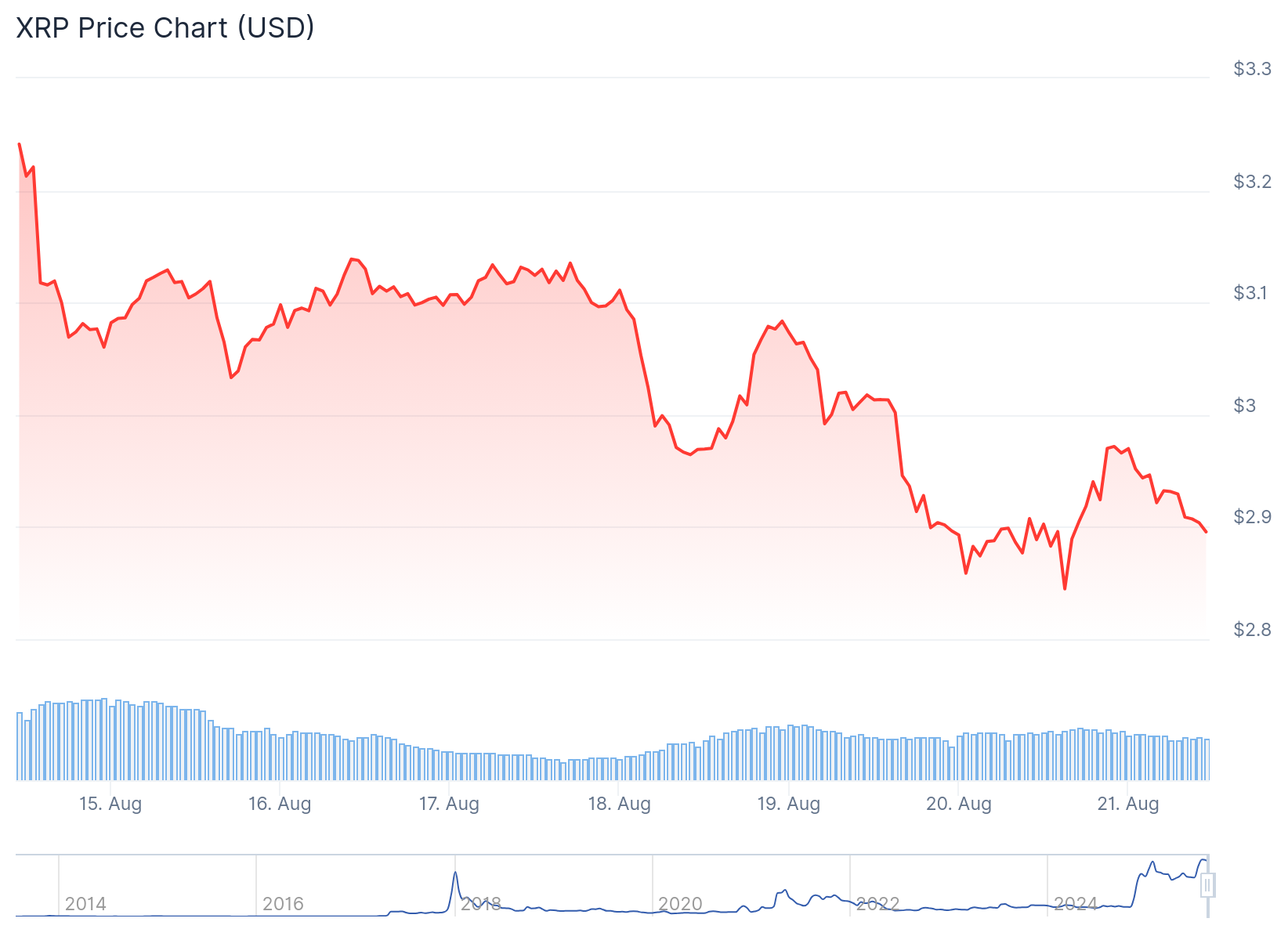
TLDR XRP has dropped 16.8% over the past 30 days, trading at $2.93 Smart money investors reduced XRP holdings by 80% in the last month Network activity declined with weekly transactions down 14.8% and active addresses falling 2.1% Technical analysis shows bearish patterns with price breaking below key support levels Futures traders turned bearish with [...] The post XRP Price Prediction: Token Drops 16% as Smart Money Dumps 80% of Holdings in 30 Days appeared first on CoinCentral.

Author: Coincentral
Bitcoin Price Forecast: BTC steadies at $113,500 as traders await Powell’s Jackson Hole speech

Bitcoin Price Forecast: BTC steadies at $113,500 as traders await Powell’s Jackson Hole speech

Bitcoin (BTC) steadies around $113,500 at the time of writing on Thursday after falling 3% so far this week. On-chain data shows that weakening demand and profit-taking continue to weigh on BTC.

Author: Fxstreet
DOGE holders can earn a stable income of $8,900 per day with PlanMining cloud mining

DOGE holders can earn a stable income of $8,900 per day with PlanMining cloud mining

Easily unlock mobile access to automated XRP and Dogecoin mining with PlanMining's secure, low-barrier-to-entry platform.

Author: The Cryptonomist
Blockchain Wants to Be the Dealer in Your Next Game of Poker

Blockchain Wants to Be the Dealer in Your Next Game of Poker

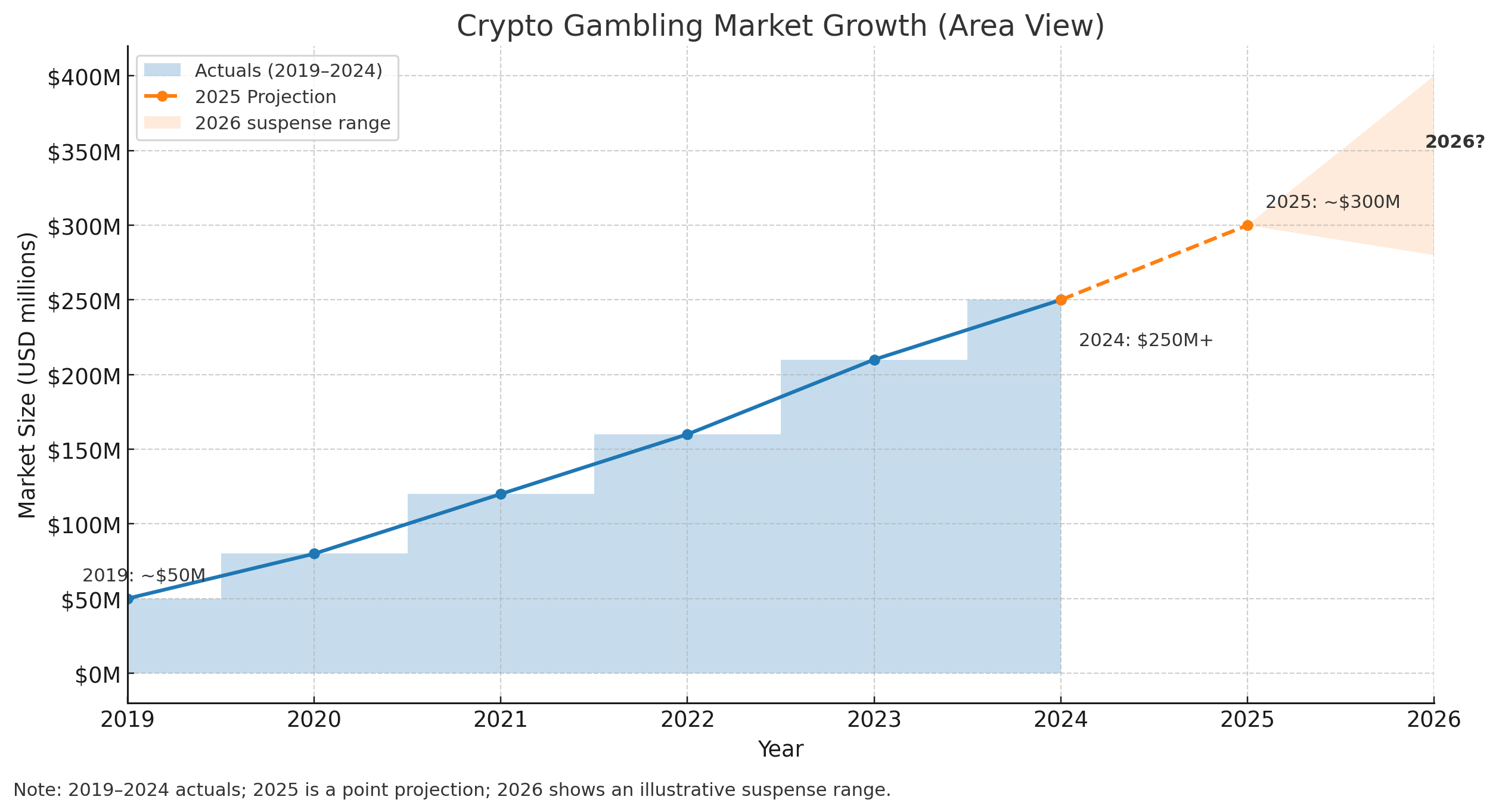
GambleFi is revolutionizing online gambling by merging blockchain, crypto, and DeFi for trustless, transparent betting. Key perks: instant borderless transactions, privacy, and provably fair games via Verifiable Random Functions (VRF) like Chainlink's, where smart contracts verify randomness cryptographically—no more rigged RNGs. Dive in for VRF code demos and real-world examples!

Author: Hackernoon