Lending

Lending protocols form the backbone of the decentralized money market, allowing users to lend or borrow digital assets without intermediaries. Using smart contracts, platforms like Aave and Morpho automate interest rates based on supply and demand while requiring over-collateralization for security. The 2026 lending landscape features advanced permissionless vaults and institutional-grade credit lines. This tag covers the evolution of capital efficiency, liquidations, and the integration of diverse collateral types, including LSTs and tokenized RWAs.

14437 Articles
Created: 2026/02/02 18:52
Updated: 2026/02/02 18:52
Saudi Awwal Bank partners with Chainlink to leverage CCIP and CRE in blockchain innovation pact

Saudi Awwal Bank partners with Chainlink to leverage CCIP and CRE in blockchain innovation pact

The post Saudi Awwal Bank partners with Chainlink to leverage CCIP and CRE in blockchain innovation pact appeared on BitcoinEthereumNews.com. Saudi Awwal Bank (SAB) has entered a strategic agreement with Chainlink to strengthen its digital transformation agenda. The partnership brings to Saudi banking Chainlink’s Cross-Chain Interoperability Protocol (CCIP) and Chainlink Runtime Environment (CRE), a step towards onchain financial services. The CCIP facilitates secure cross-chain transfers of assets and data. This functionality bridges decentralized applications and traditional financial platforms, opening up the path for the seamless integration of tokenized assets, programmable contracts, and real-time settlement mechanisms. CRE provides SAB with a developer-friendly platform for testing, building, and deploying next-generation banking tools reliably and securely. In a tweet on X, SAB noted, “This collaboration marks a pivotal step in our commitment to drive Financial Innovation in Saudi Arabia.” Through these technologies, SAB has the ability to test new applications such as automated lending, tokenization of physical assets, and faster cross-border payments. Tokenization is relevant to financial markets, where stocks, bonds, and real estate can be digitally represented for easier and safer transactions. Smart contracts can also make loans and insurance contracts more efficient by automating the process and cutting down on paperwork and operational delay. Saudi Awwal Bank (@alawwalsab), one of Saudi Arabia’s largest banks with over $100 billion in total assets, is leveraging several Chainlink services to facilitate the deployment of next-generation onchain applications in Saudi Arabia. Under the innovation agreement, SAB is… https://t.co/DAvUawI3Yg pic.twitter.com/Zhlm1GJdGp — Chainlink (@chainlink) September 16, 2025 Chainlink aligns with Saudi Arabia’s vision 2030 The collaboration is in line with Saudi Arabia’s wider Vision 2030 initiative, which focuses on innovation in financial services. Earlier this year, in a message on his vision for 2030, Saudi Arabia’s Crown Prince Mohammed bin Salman said the kingdom would “turn the Public Investment Fund into the world’s largest sovereign wealth fund. Our nation holds strong investment capabilities, which we will harness…

Author: BitcoinEthereumNews
Crypto Looks at Fed Interest Rate Cut as Trump Shakes Up Central Bank

Crypto Looks at Fed Interest Rate Cut as Trump Shakes Up Central Bank

The post Crypto Looks at Fed Interest Rate Cut as Trump Shakes Up Central Bank appeared on BitcoinEthereumNews.com. As the US Federal Reserve prepares to adjust interest rates on Wednesday, a broader shake-up at the central bank could have serious implications for crypto markets. The Fed is expected to cut interest rates tomorrow, in a move that traditionally signals a rally in crypto markets: Lower yields on assets like bonds mean riskier assets like crypto are more attractive. The expected rate cuts come amid a political battle and a new appointment to the Federal Reserve. US President Donald Trump’s administration has charged Fed governor Lisa Cook with mortgage fraud as it seeks her removal. Meanwhile, the Senate has confirmed White House economic adviser Stephen Miran to the board of governors. The charges against Cook and the effort to nominate an individual with ties to the administration could mean a less independent Federal Reserve, which plays an important role in setting crypto policy. Bitcoin price spiked in 2021-2022 amid low US interest rates. Source: Trading Economics What a political Federal Reserve means for crypto policy The Trump administration is seeking to remove Cook — a Biden-era appointee — as it aims to exert more control over the Federal Reserve. On Aug. 25, the White House X page posted a letter in which Trump fired Cook, accusing her of making false statements on one or more mortgage agreements. Cook denied the accusations and refused to step down. Her legal team said the charges were motivated by politics and that the White House is “scrambling to invent new justifications for its overreach.” Cook herself said that it is “unprecedented and illegal.” On Monday, the appeals court in Washington blocked the White House from removing Cook from her position at the Federal Reserve. This will allow her to maintain her post while the case is pending. Trump sought to remove Cook on…

Author: BitcoinEthereumNews
What is Polymarket? A Deep Dive into the Prediction Market and Its Game-Changing Data

What is Polymarket? A Deep Dive into the Prediction Market and Its Game-Changing Data

Polymarket lets people bet on real-world events, turning crowd wisdom into sharp forecasts on everything from elections to sports outcomes. Built on blockchain tech, it runs as a decentralized platform where users trade shares in event results, paying out based on what actually happens. Launched back in 2020, it quickly grew into the biggest player in prediction markets, handling billions in trades and drawing in traders who see value in its transparent setup. Unlike old-school betting sites, Polymarket skips the house edge, letting market forces set the odds directly. How Polymarket Operates: Betting Meets Blockchain Picture this: you spot a market on whether a new bridge gets built by year’s end. You buy “yes” shares if you think it will, or “no” if you doubt it. Each share pays $1 if you’re right, nothing if wrong. Prices fluctuate based on what others bet, reflecting real-time probabilities. Running on Polygon for cheap fees and fast trades, it covers politics, news, culture, tech, and more. Recent upgrades like Chainlink oracles speed up resolutions, making settlements near-instant and secure. No wonder volumes hit $969 million in one stretch, with millions of bets placed. Traders love the on-chain transparency — it shows user trends and behaviors without hiding anything. Tools track top performers, whale moves, and influencer bets, adding layers to strategy. But it’s not all smooth; regulatory hurdles, like CFTC scrutiny, force careful navigation, especially in restricted areas. Why Polymarket Data Holds Real Weight Polymarket data cuts through noise, pricing information efficiently where experts turn insights into profits. It’s proven 90% accurate a month out from events, jumping to 94% just hours before. This beats traditional polls by aggregating skin-in-the-game opinions, not just guesses. In volatile times, like stock slumps or pharma trials, it signals shifts before headlines catch up. Take elections: mainstream media cites Polymarket odds for probabilities, exposing hidden truths amid spin. Or market crashes — data showed a $5.5 trillion U.S. stock wipeout’s sentiment in real time. Even in crypto, it forecasts token pumps or regulatory wins, guiding investors. Partnerships, like with news outlets for live odds, blend price signals with facts, redefining how we gauge events. Beyond bets, this data fuels decisions in finance, policy, and beyond. Collective expectations from informed traders offer insights no single expert can match. It’s why big names pour in double-digit millions — validating prediction markets as a fresh finance frontier. Real-World Impact: From Politics to Everyday Bets During high-stakes moments, like candidate swaps or geopolitical flare-ups, Polymarket data acted as a truth filter against misinformation. Traders shifted odds on upsets, like halftime leads in games turning -150 favorites, showing live volatility’s edge. In emerging economies’ routs or cyber hacks, it highlights risks, stressing transparent metrics over hype. Communities buzz about its growth: zero-fee pivots boosted volumes, while integrations build trust. Yet, challenges like episodic use — peaking in elections — point to needs for simpler onboarding, fiat links, and broader topics like daily life or sports to go mainstream. The Road Ahead for Polymarket and Prediction Markets With $7.5 billion in cumulative volume but liquidity thin in most markets, Polymarket eyes TradFi ties and AI tools for better liquidity. Regulatory wins, like U.S. re-entry via acquisitions, could set blueprints for compliant on-chain betting. If it cracks mass adoption — think app tabs for predictions — it shifts from niche to habit, pooling liquidity across chains. In short, Polymarket isn’t just a betting spot; its data reshapes how we predict and act on the future, blending tech with human insight for clearer views in uncertain worlds. What is Polymarket? A Deep Dive into the Prediction Market and Its Game-Changing Data was originally published in Coinmonks on Medium, where people are continuing the conversation by highlighting and responding to this story

Author: Medium
Hex Trust Adds stETH Custody, Brings Lido Liquid Staking to Institutions

Hex Trust Adds stETH Custody, Brings Lido Liquid Staking to Institutions

Hex Trust adds custody and one-click staking for Lido’s stETH, letting institutions earn ETH rewards and use stETH in DeFi without running validators.

Author: Blockchainreporter
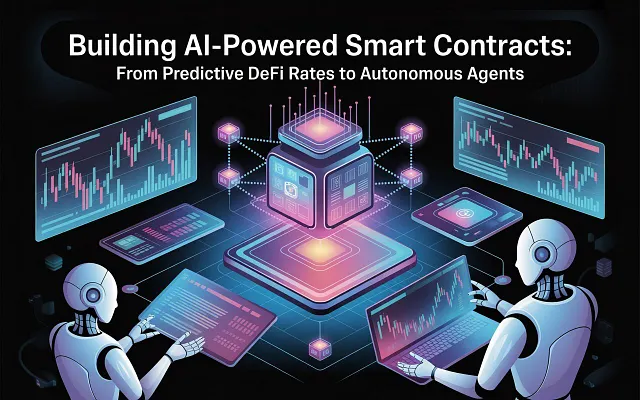
Building AI‑Powered Smart Contracts: From Predictive DeFi Rates to Autonomous Agents

Building AI‑Powered Smart Contracts: From Predictive DeFi Rates to Autonomous Agents

Smart contracts have become the foundation of decentralized applications and the broader blockchain economy. They introduce a model where rule-based execution removes intermediaries, making transactions faster, cost-effective, and transparent. With the growing complexity of decentralized finance (DeFi), NFT ecosystems, and digital identity systems, the integration of artificial intelligence (AI) into smart contracts is creating a new class of dynamic, responsive, and autonomous digital agreements. Businesses exploring decentralized applications are no longer just thinking about static contracts that execute a fixed set of instructions. They want intelligent contracts capable of analyzing data, adjusting conditions, and interacting with external systems in real-time. This is where AI‑powered smart contracts are making a significant impact. Companies offering Smart Contract Audit Services and development expertise are now engaging in projects where intelligence is embedded into the very logic of decentralized systems, making them adaptive and business-centric. This blog explores the concept of AI‑powered smart contracts, how they work, practical examples such as predictive DeFi rates, autonomous agent workflows, and why they matter to startups, enterprises, and financial institutions. It also lays out the development process, challenges, and the role expertise plays in making these solutions reliable. What Are AI‑Powered Smart Contracts? Traditional smart contracts are written in languages such as Solidity (Ethereum) or Rust (Solana), with the logic defined at the creation stage. Once deployed, these contracts only operate within the coded parameters and blockchain environment. They rely on oracles or off-chain data feeds to fetch updates but act as static executors of conditions. AI‑powered smart contracts extend this approach by integrating artificial intelligence and machine learning models into the decision-making logic. Instead of waiting for fixed inputs, these contracts can process real-time data, analyze patterns, and even predict future outcomes. For example: A DeFi liquidity pool agreement that can adjust interest rates dynamically based on predicted demand. An insurance contract that automatically validates claims through predictive fraud detection models. A supply chain agreement that validates delivery time expectations using predictive logistics data. In essence, AI adds a layer of cognitive flexibility to the deterministic nature of smart contracts. Why Businesses Should Care About AI‑Powered Smart Contracts For companies evaluating blockchain strategies, AI‑embedded smart contracts are relevant because they introduce automation that goes beyond execution — they introduce adaptability. Businesses that rely on evolving market data, customer profiles, and external conditions no longer need manual updates or human oversight for every change. Key benefits include: Dynamic pricing: Smart contracts that read live market data and adjust token prices automatically. Fraud reduction: AI‑enabled anomaly detection integrated into crypto transactions. Cost savings: Long-term process automation with reduced reliance on human intervention. Scalability: Contracts that can manage more complex logic as industries evolve. Improved customer trust: Users engage with smarter financial and business products that respond to real-time insights. For forward-looking organizations, these benefits mean smarter products in DeFi, tokenized assets, digital identity management, and cross-industrial applications. Core Components: How AI and Smart Contracts Work Together The combination of blockchain and AI requires a modular system. Businesses developing AI‑powered smart contracts must combine these elements effectively: Smart Contract LogicThe base layer coded in Solidity, Rust, or Vyper. It defines the rules and execution structure. AI ModelsAlgorithms that allow prediction, classification, and recommendation. These models can be deployed on-chain (basic AI logic) or off-chain (more resource-intensive models). OraclesGateways that bring external data, model outputs, or real-world events back onto the blockchain. AI contracts rely on trustworthy and tamper‑resistant oracles. Data PipelinesTraining AI requires data. Data from DeFi markets, supply chains, IoT devices, or customer interactions must be aggregated, cleaned, and structured for modeling. Consensus and Verification Unlike regular decentralized consensus (PoW, PoS), AI‑driven decisions may require additional verification methods to maintain trust. Predictive DeFi Rates: A Use Case Example DeFi protocols rely heavily on interest rate models that determine borrowing costs, lending returns, and risk assessment. Traditionally, these rates are defined by static formulas or governance voting. AI‑powered smart contracts open a more advanced mechanism — predictive DeFi rates. Here’s how: Historical transaction data is analyzed with AI models to detect demand patterns. Contracts predict future borrowing activity and automatically adjust rates. Rates can also adapt to macroeconomic data (such as inflation figures brought into the blockchain by trusted oracles). Borrowers and lenders get a fairer model, while liquidity providers mitigate risks. Businesses in the financial technology sector can integrate such models to introduce innovative DeFi products that differentiate them from existing services. Autonomous Agents in Smart Contracts One of the most exciting implications of combining AI and blockchain is the creation of autonomous agents — self-governing units capable of executing complex sequences of transactions, negotiations, or verifications. Consider an autonomous agent in logistics: A shipment container has a digital identity linked to an AI model on the blockchain. The contract autonomously verifies shipping routes, predicted delays, and customs documents. Payment milestones are auto-executed as checkpoints are validated. The agent negotiates with multiple stakeholders (shipping firms, ports, customs authorities) — all without human involvement. Such autonomous contracts extend the scope of blockchain beyond financial applications to global industries like real estate, healthcare, and trade. Development Process: Building AI‑Powered Smart Contracts For businesses working with Smart Contract Development companies, the process can be broken into key stages:

  1. Defining Objectives Clear understanding of what the contract must achieve. Examples: predictive interest rates, fraud detection, supply chain monitoring.
  2. Data Preparation Identifying clean and relevant datasets, essential for training AI models that will be linked to contracts.
  3. Model Training Selecting AI methods such as regression, reinforcement learning, or neural networks depending on requirements.
  4. Integration with Smart Contracts Deploying models or their outputs through oracles and APIs. The contract must remain secure, auditable, and efficient even with AI logic.
  5. Testing and Smart Contract Audit Before mainnet deployment, contracts undergo testing, simulations, and a detailed Smart Contract Audit, which includes not only vulnerabilities in on‑chain code but also in data pipelines and AI model integrity.
  6. Deployment and Monitoring Live contract execution across blockchain networks with monitoring tools to validate performance. Challenges and Considerations Businesses planning AI‑powered contract adoption must address these challenges:
Gas costs: More complex contracts require higher execution fees. Transparency in AI: Black-box models can cause disputes; explainability is vital. Model decay: AI models require retraining with updated data. Data quality: Biased or incomplete data can lead to faulty contract outcomes. Regulation: DeFi and AI both face evolving regulatory scrutiny. Addressing these concerns early smooths the adoption journey. Real-World Applications for Businesses InsuranceAI‑driven smart contracts flag fraud by analyzing claim patterns. HealthcareAutonomous AI contracts validate health‑data integrity and track drug distributions. Supply ChainsContracts predict delays and settle disputes using verified external data. Energy Trading AI models forecast usage and settle micro-transactions in near-real time. Decentralized Identity Adaptive contracts authenticate access to digital services securely. These industries are finding tangible value in combining AI’s predictive capabilities with blockchain’s immutability. The Role of Smart Contract Development Companies For organizations, building AI‑powered smart contracts from scratch is often impractical. It requires blockchain architects, AI engineers, auditors, and integration experts. This is why specialized Smart Contract Development companies play a key role. They not only deliver secure smart contracts but also integrate AI features and conduct ongoing audits to maintain efficiency and compliance. Conclusion AI‑powered smart contracts are taking decentralized applications to new levels of intelligence and functionality. From predictive DeFi rates to self-operating agents, these contracts provide a glimpse of how automation and decision-making can coexist on the blockchain. For businesses and financial institutions, this technology unlocks ways to build more adaptive, intelligent, and secure decentralized solutions. However, success in this field depends on expertise, reliable audits, and robust development methodologies. If your business is ready to explore AI‑powered Smart Contracts — whether for DeFi, enterprise automation, or digital identity — the right development partner makes all the difference. Take the next step in building intelligent blockchain solutions. Partner with Codezeros for Smart Contract Development and gain access to secure, business-ready AI‑powered contracts that align with your goals. Building AI‑Powered Smart Contracts: From Predictive DeFi Rates to Autonomous Agents was originally published in Coinmonks on Medium, where people are continuing the conversation by highlighting and responding to this story

Author: Medium
$187 Billion in Fees: Why Banks Are Fighting the GENIUS Act

$187 Billion in Fees: Why Banks Are Fighting the GENIUS Act

The post $187 Billion in Fees: Why Banks Are Fighting the GENIUS Act appeared on BitcoinEthereumNews.com. Why banks might be worried  Backtracking on the GENIUS Act A major fight has emerged between traditional finance and the cryptocurrency industry over regulation.   Banking institutions have been pushing against stablecoins, arguing that they would drain deposits.  However, crypto advocates claim that banks are actually concerned about losing profits.  Banks claim stablecoins will drain deposits and harm lending, but there’s no evidence supporting this. Bank attacks on the bipartisan GENIUS Act and on @POTUS’s crypto agenda aren’t about stability—they’re about protecting $187B in payment fees. Stablecoins modernize payments and… — Faryar Shirzad 🛡️ (@faryarshirzad) September 16, 2025 Why banks might be worried  Faryar Shirzad, chief policy officer at cryptocurrency exchange giant Coinbase, claims that the hostility from banks is all about protecting a staggering $187 billion worth of fees that they are getting from payment-related fees.  If stablecoins end up gaining widespread mainstream adoption, people might avoid using the payment rails offered by banks, thus depriving them of the massive profits.  You Might Also Like Coinbase and other crypto lobbyists argue that stablecoins are primarily used as payment tools. Thus, there is no evidence that they will cause some sort of deposit flight.  Backtracking on the GENIUS Act Even though the banking sector initially supported the GENIUS Act, they later ended up backtracking on it.  Crypto lobbyists now claim that stablecoins are the latest innovation that banks are trying to slow down after previously opposing ATM machines and online banking.  Source: https://u.today/187-billion-in-fees-why-banks-are-fighting-the-genius-act

Author: BitcoinEthereumNews
Top 3 Best Ethereum Cryptos to Invest in 2025

Top 3 Best Ethereum Cryptos to Invest in 2025

As Ethereum price continues to soar in 2025, investors are now looking to ETH ecosystem tokens that could follow its rise. Through the hype, Mutuum Finance (MUTM), Shiba Inu (SHIB) and Pepe Coin (PEPE) are quickly becoming top coins to keep an eye on.  Mutuum Finance is emerging as something greater than a mere ERC-20 […]

Author: Cryptopolitan
SEC’s “Crypto Mom” Hester Peirce Denies Endorsing Private Crypto Project

SEC’s “Crypto Mom” Hester Peirce Denies Endorsing Private Crypto Project

U.S. Securities and Exchange Commission (SEC) Commissioner Hester Peirce, widely known as “Crypto Mom” for her favorable stance on the cryptocurrency industry, has publicly denied endorsing a private crypto project. The incident occurred after a project named OpenVPP, which focuses on using blockchain technology to improve the electric utility sector, made a social media post … Continue reading "SEC’s “Crypto Mom” Hester Peirce Denies Endorsing Private Crypto Project" The post SEC’s “Crypto Mom” Hester Peirce Denies Endorsing Private Crypto Project appeared first on Cryptoknowmics-Crypto News and Media Platform.

Author: Coinstats
KernelDAO to launch new reward-bearing stablecoin KUSD

KernelDAO to launch new reward-bearing stablecoin KUSD

The post KernelDAO to launch new reward-bearing stablecoin KUSD appeared on BitcoinEthereumNews.com. BNB Chain-based restaking protocol KernelDAO is stepping into real-world credit with a reward-bearing stablecoin that generates yield from institutional usage rather than sitting idle. Summary KernelDAO unveiled KUSD, a reward-bearing stablecoin backed by short-term receivables. Designed for remittances, payroll, and trade finance, KUSD generates yield from institutional usage. Built on KernelDAO’s $2.4B DeFi base, targeting the $30T RWA market by 2034. KernelDAO is set to enter the stablecoin market with KUSD, a reward-bearing token backed by short-term receivables and designed for both fintechs and decentralized finance.  The new stablecoin, unveiled on Sept. 16 in a blog post by KernelDAO, is powered by Kred, the project’s new “Internet of Credit” layer that aims to connect idle crypto liquidity to real-world financial activity. Backed by receivables, built for scale According to the team, KUSD will be fully collateralized by receivables from institutional usage such as remittances, payroll, brokerage settlements, and trade finance. Unlike traditional stablecoins, which often sit idle, KUSD is structured to earn rewards from real repayment flows, creating what KernelDAO describes as a self-reinforcing cycle of liquidity and yield. The stablecoin builds on KernelDAO’s existing $2.4 billion ecosystem, which includes its liquid restaking protocol Kelp, high-performing vaults under Gain, and core infrastructure deployed on BNB (BNB) Chain. With 150 DeFi integrations and more than 350,000 users, the DAO is expanding its model to include real-world assets, a market expected to grow to $30 trillion by 2034. A stablecoin designed to earn KUSD is positioned as both a settlement currency for institutions and a composable yield-bearing stablecoin for DeFi protocols. Liquidity providers can mint KUSD by depositing stablecoins, which are then lent to vetted institutional borrowers. Repayments generate yield that flows back to the system, while the token itself circulates across AMMs and lending platforms. This strategy, according to KernelDAO, tackles…

Author: BitcoinEthereumNews
Ethereum Targets $5k, Avalanche Hits ATH, as BullZilla becomes the Top Presale with 100x Potential

Ethereum Targets $5k, Avalanche Hits ATH, as BullZilla becomes the Top Presale with 100x Potential

The post Ethereum Targets $5k, Avalanche Hits ATH, as BullZilla becomes the Top Presale with 100x Potential appeared on BitcoinEthereumNews.com. Crypto News 17 September 2025 | 08:15 BullZilla’s presale ROI, Ethereum’s liquidity, and Avalanche’s scalability define the top presales with 100x potential in 2025. Cryptocurrency markets are at a pivotal stage in 2025. With Ethereum holding steady above $4,500 and Avalanche gaining traction at $30, the market’s depth is clear. Yet, presales like BullZilla ($BZIL) are drawing outsized attention for their ability to deliver exponential returns. Investors, analysts, and students alike are studying these projects as case studies in risk, utility, and reward. Ethereum provides the liquidity rails, Avalanche brings scalability, and BullZilla is positioning itself as one of the top presales with 100x potential (top presales with 100x potential). Together, these projects represent the balance between established infrastructure and early-stage momentum that drives wealth creation cycles in crypto. BullZilla: Engineered Scarcity Meets Viral Presale Momentum BullZilla is more than just another meme coin launch. Updated on September 16, 2025, the project is currently in its third stage, aptly named Whale Signal Detected, signaling early backing from high-capital participants. With a price of just $0.00005908, BullZilla has already raised over $430,000, sold 26 billion tokens, and attracted more than 1,500 holders. Its appeal lies in its ROI potential. The projected listing price of $0.00527 translates into an extraordinary 8,822% gain from Stage 3A. Even the earliest participants are already sitting on 927% gains. This structure is why analysts consider Bull Zilla among the few genuine top presales with 100x potential in the market today. BullZilla Presale ROI Table Metric Value Current Stage 3rd (Whale Signal Detected) Current Price $0.00005908 Presale Raised $430,000+ Token Holders 1,500+ Tokens Sold 26B ROI (to listing $0.00527) 8,822% ROI (Stage 3A) 927% $1,000 Investment 16.926M $BZIL Next Price Increase +11.27% (to $0.00006574) The accessibility of BullZilla also stands out. Participation requires only a Web3 wallet…

Author: BitcoinEthereumNews