Lending

Lending protocols form the backbone of the decentralized money market, allowing users to lend or borrow digital assets without intermediaries. Using smart contracts, platforms like Aave and Morpho automate interest rates based on supply and demand while requiring over-collateralization for security. The 2026 lending landscape features advanced permissionless vaults and institutional-grade credit lines. This tag covers the evolution of capital efficiency, liquidations, and the integration of diverse collateral types, including LSTs and tokenized RWAs.

14345 Articles
Created: 2026/02/02 18:52
Updated: 2026/02/02 18:52

Paul Atkins Announces SEC’s Project Crypto for Clear Crypto Regulation

Paul Atkins Announces SEC’s Project Crypto for Clear Crypto Regulation

The post Paul Atkins Announces SEC’s Project Crypto for Clear Crypto Regulation appeared first on Coinpedia Fintech News The U.S. Securities and Exchange Commission (SEC) is changing course on how it regulates cryptocurrencies. At the inaugural OECD Roundtable on Global Financial Markets in Paris, SEC Chairman Paul S. Atkins declared that the “era of uncertainty is coming to an end,” with America preparing to embrace digital assets as part of its financial system. …

Author: CoinPedia
Pendle Revenue Strategy Panorama: Pulse's AgentFi New Paradigm

Pendle Revenue Strategy Panorama: Pulse's AgentFi New Paradigm

By 0xjacobzhao | https://linktr.ee/0xjacobzhao Pendle is undoubtedly one of the most successful DeFi protocols of this crypto cycle . While many protocols have stagnated due to liquidity depletion and fading narratives, Pendle, with its unique yield splitting and trading mechanism , has successfully become a "price discovery platform" for yield-generating assets. Through its deep integration with yield-generating assets like stablecoins and LST/LRT, Pendle has established its unique position as "DeFi yield infrastructure." In the research report " The Intelligent Evolution of DeFi: The Evolutionary Path from Automation to AgentFi, " we systematically reviewed and compared the three stages of DeFi's intelligent development: automation tools , intent-centric copilots, and AgentFi (on-chain agents) . Beyond lending and yield farming, two of the most valuable and readily implementable use cases, Pendle's PT/YT yield rights trading is considered a high-priority application that is highly compatible with AgentFi in our high-level vision. Pendle's unique "yield splitting + maturity mechanism + yield rights trading" architecture provides agents with a natural platform for strategic orchestration, enriching the possibilities for automated execution and yield optimization. 1. The basic principle of Pendle Pendle is the first DeFi protocol focused on yield splitting and trading . Its core innovation lies in tokenizing and separating the future income streams of on-chain yield-generating assets (such as LST, stablecoin certificates of deposit, and loan positions), allowing users to flexibly lock in fixed returns, maximize return expectations, or engage in speculative arbitrage . In short, Pendle builds a secondary market for the "yield curve" of crypto assets, allowing DeFi users to trade not only "principal" but also "yield." This mechanism is highly similar to the zero-coupon bond + coupon split in traditional finance, improving pricing accuracy and trading flexibility for DeFi assets. Pendle's revenue splitting mechanism Pendle splits a Yield-Bearing Asset (YBA) into two tradable tokens: PT (Principal Token, similar to a zero-coupon bond) : represents the principal value that can be redeemed at maturity, but no longer enjoys income. YT (Yield Token, similar to coupon rights) : represents all the income generated by the asset before maturity, but will be zero after maturity. For example, after depositing 1 ETH stETH, it will be split into PT-stETH (1 ETH can be redeemed at maturity, and the principal is locked) and YT-stETH (all staking income before maturity is obtained). Pendle goes beyond a simple token split; it also provides a liquid market for PT and YT (equivalent to the secondary liquidity pool in the bond market) through a specially designed AMM (Automated Market Maker) . Users can buy and sell PT or YT at any time, flexibly adjusting their return risk exposure. The price of PT is typically below 1, reflecting its "discounted principal value," while the price of YT depends on market expectations of future returns. More importantly, Pendle's AMM is optimized for assets with maturity dates, allowing PT/YT of varying maturities to form a yield curve within the market, highly similar to the bond market in traditional finance. It's important to note that among Pendle's stablecoin assets, PT (Principal Token, a fixed-income position) is equivalent to an on-chain bond. A fixed interest rate is locked in at a discount upon purchase, and upon maturity, it can be redeemed 1:1 for stablecoins. This offers stable returns with low risk, making it suitable for conservative investors seeking certainty in returns. Stablecoin Pools (liquidity mining positions) are essentially AMM market making. LP income comes from fees and incentives, resulting in highly volatile APYs and the risk of impermanent loss. These positions are more suitable for active investors who can tolerate volatility and pursue higher returns. In markets with active trading volume and generous incentives, Pool returns can potentially be significantly higher than PT fixed income. However, in periods of low trading volume and insufficient incentives, Pool returns are often lower than PT, and may even result in losses due to impermanent loss. project Stablecoin PT Stablecoin Pools Asset Form Bond tokens (redeemable to stablecoins upon maturity) AMM liquidity pool (PT+YT trading market) Sources of Revenue Fixed interest rate (locked in principal discount) Transaction fees + mining incentives Risk Level Lower (close to risk-free fixed income) Higher (IL risk + liquidity risk) Suitable for people Want to protect principal and lock in fixed income LPs who want to earn fees and incentives and can withstand volatility Pendle's PT/YT trading strategies primarily cover four main paths : fixed income, yield speculation, inter-period arbitrage, and leveraged returns , catering to investment needs with varying risk appetites. Users can lock in fixed returns by buying PT and holding it to maturity, effectively securing a guaranteed interest rate. Alternatively, they can buy YT, betting on rising yields or increased volatility, thereby speculating on returns. Investors can also exploit price differentials between PT/YT maturities to engage in inter-period arbitrage, or use PT and YT as collateral in multiple lending agreements to maximize their return exposure. Boros Funding Rate Trading Mechanism Beyond the profit splitting offered by Pendle V2, the Boros module further assetizes the funding rate , transforming it from a passive cost of holding a perpetual swap into an independently priced and tradable instrument. Through Boros, investors can directional speculate , hedge risk , or capitalize on arbitrage opportunities . This mechanism essentially introduces traditional interest rate derivatives (IRS, basis trading) into DeFi, providing new tools for institutional-level fund management and robust return strategies. In addition to PT/YT trading and AMM pools and the Boros funding rate trading mechanism , Pendle V2 also provides several extended features. Although not the focus of this article, they still constitute an important supplement to the protocol ecosystem: vePENDLE : A governance and incentive model based on the Vote-Escrow mechanism. Users obtain vePENDLE by locking PENDLE, thereby participating in governance voting and increasing their profit distribution weight. It is the core of the protocol's long-term incentives and governance. PendleSwap : A one-stop asset exchange portal that helps users efficiently switch between PT/YT and native assets, improving the convenience of fund use and protocol composability. It is essentially a DEX aggregator rather than an independent innovation. Points Market : Allows users to trade various project points (Points) in advance in the secondary market, providing liquidity for airdrop capture and point arbitrage. It is more inclined towards speculation and topical scenarios rather than core value. II. Pendle Strategy Panorama: Market Cycles, Risk Stratification, and Derivative Expansion In traditional financial markets, retail investors' investment channels are primarily focused on stock trading and fixed-income wealth management products, making it difficult to directly participate in the higher-threshold bond derivatives market. In the crypto market, retail users are similarly more receptive to token trading and DeFi lending. While the emergence of Pendle has significantly lowered the barrier to entry for retail investors in bond derivatives trading, Pendle's strategies still require a high level of expertise, requiring investors to conduct in-depth analysis of yield-generating asset interest rate fluctuations in different market environments. Based on this, we believe that during different market phases—such as the early stages of a bull market, the bull market's euphoria, the bear market's decline, and periods of range-bound trading—investors should tailor their Pendle trading strategies to their risk appetite. During a bull market upswing: Market risk appetite gradually recovers, lending demand and interest rates remain low, and YT on Pendle is relatively cheap. Buying YT during this period is like betting on rising future yields. Once the market accelerates upward, lending rates and LST yields will rise, driving up YT's value. This is a typical high-risk, high-reward strategy, suitable for investors willing to invest early and capture the potential gains of a bull market. During the bull market's euphoria , surging market sentiment drives a surge in lending demand. Interest rates on DeFi lending protocols often rise from single digits to over 15–30%, driving up the value of YT on Pendle and significantly discounting PT. During this period, investors using stablecoins to buy PT effectively lock in a high interest rate at a discount, redeeming it 1:1 for the underlying asset upon maturity. This effectively hedges against volatility risk through "fixed-income arbitrage" in the late stages of a bull market. This strategy offers the advantages of being robust and rational, ensuring the safety of fixed income and principal during market corrections or bear markets. However, the trade-off is forgoing the potential for greater gains from holding volatile assets. During a bear market downturn, market sentiment is depressed, lending demand plummets, and interest rates fall sharply. YT returns approach zero, while PTs perform closer to risk-free assets. During this period, buying PTs and holding them to maturity means locking in a guaranteed return even in a low-interest environment, effectively establishing a defensive position. For conservative investors, this is a key strategy for mitigating return volatility and preserving principal. During periods of range-bound volatility, market interest rates lack trending and market expectations diverge significantly, leading to frequent short-term mismatches or pricing discrepancies between Pendle's PT and YT. Investors can generate stable price differentials by engaging in inter-period arbitrage between PT/YT maturities of different maturities or by capitalizing on mispricing of income rights caused by fluctuating market sentiment. These strategies require advanced analytical and execution skills and are expected to generate stable returns in non-trending markets. Global Perspective: Pendle Strategy Full Market Cycle Comparison Chart Market Stage Market characteristics PT Strategy YT Strategy Stablecoin pool Arbitrage strategies Deep bear (sideways at low level) Interest rates are extremely low, asset prices are undervalued, and sentiment is cold. Little significance (PT has almost no discount) ✅Best time : YT is extremely cheap, betting on future interest rate recovery, leveraging income streams (especially stETH) ⚪ Low returns, almost idle positions ⚪ Limited interest rate spreads and few opportunities Slow Bear (slow decline) Prices are slowly falling, interest rates are low, and the market is directionless. ⚪ Fixed income is not high and the attractiveness is average ❌ YT has no meat, you may lose all your money ✅Defense first choice : Stable currency pool to protect principal and relax your mind ⚪ Can do small cross-platform arbitrage, but the space is limited Early stage of bull market (rebound upward) Borrowing demand rises, and interest rates start to rise ⚪ PT starts to have discounts, but not big ✅Strong explosive power : YT low valuation → interest rate rebound → income leverage ⚪ Stablecoin pools are less interesting than volatile asset pools ⚪ You can invest in PT fixed income vs floating interest rate differentials Mid-bull market (accelerated rise) Interest rates have increased significantly, and sentiment has improved. ✅Lock in fixed income : PT has a large discount, lock in 10-20% annualized return ✅Double your profits : YT price rises, continue to increase your position to bet on rising interest rates ⚪ Fixed income opportunities are inferior to PT/YT ✅Arbitrage opportunity : Pendle fixed income vs Aave floating rate spread is large Bull market excitement period (high point) Borrowing rates soar, markets frenzy ✅Best strategy : PT is deeply discounted, lock in 20–30% fixed income ❌ High risk: YT premium is too high and it is easy to lose money ⚪ The interest rate of the stablecoin pool is high, but not as attractive as PT ✅Institutional play : term arbitrage, cross-market arbitrage, low-risk profit locking Bull peak correction period Market reversal, interest rates fall rapidly ⚪ PT discount narrows, weakening its appeal ❌ YT value has shrunk significantly and is likely to return to zero ✅ Funds shift to defense, stablecoin pools return to the mainstream ✅ Do hedging arbitrage to reduce volatility risk Risk Stratification: Pendle Decision Tree for Conservative vs. Aggressive Strategies Of course, the above strategies are generally focused on achieving stable returns. Their core principle is to balance risk and reward through buying PT, buying YT, or participating in stablecoin pool mining during different market cycles. For aggressive investors with a higher risk appetite, they can also choose a more aggressive strategy of selling PT or YT to bet on interest rate trends or market mismatches. These strategies require higher levels of professional judgment and execution, and carry greater risk exposure. Therefore, this article will not elaborate on these strategies in detail, but serves only as a reference. For details, please see the decision tree below. Pendle Coin-Based Strategy: Comparison of stETH, uniBTC, and Stablecoin Pools Of course, the above analysis of Pendle strategies is based on a U-standard perspective. The strategy focuses on how to achieve excess returns by locking in high interest rates or capturing interest rate fluctuations . In addition, Pendle also offers coin-standard strategies for BTC and ETH. ETH is widely considered the best target for a coin-based strategy due to its ecosystem status and long-term value certainty. As the native asset of the Ethereum network, ETH not only serves as the settlement basis for most DeFi protocols but also offers a stable source of cash flow through staking yield. In contrast, BTC has no native interest rate, and its returns on Pendle rely primarily on protocol incentives, making its coin-based strategy relatively weak. Stablecoin pools, on the other hand, are more suitable as a defensive investment, fulfilling the role of "preserving value while waiting." In different market cycles, the strategies of the three asset pools vary significantly: Bull market : stETH pool is the most aggressive, YT is the best strategy for leveraging ETH holdings; uniBTC can be used as a supplement, but is more speculative; the attractiveness of the stablecoin pool is relatively declining. Bear market : stETH's low price provides a core opportunity to increase ETH holdings; the stablecoin pool assumes the main defensive function; uniBTC is only suitable for small-scale short-term arbitrage. In a volatile market : stETH's PT-YT mismatch and AMM fees provide arbitrage opportunities; uniBTC is suitable for short-term speculation; and the stablecoin pool provides a stable supplement. assets Sources of Revenue risk Currency standard effect bull market bear market Volatile Market stETH pool ETH Staking Native Yield (3–5% APY) ETH price fluctuations ✅ Increase holdings in ETH (YT can amplify returns) Buy YT : Bet on higher interest rates and capture leveraged staking returns; Buy discounted PT : Lock in high interest rates Buy cheap YT : Get leveraged ETH Staking income and achieve ETH standard growth Cross-period arbitrage/PT-YT mismatch : Suitable for profiting from AMM fees and price fluctuations uniBTC Pool Lending interest rates/protocol incentives (non-native benefits) BTC has no native interest rate, and its income depends on the sustainability of incentives. ⚠️ The logic of the currency standard is weak Buy YT in the short term when loan demand is strong to earn incentive benefits Unstable returns, suitable for small position speculation YT pricing fluctuates , allowing for short-term speculation or cross-market arbitrage Stablecoin pool Stablecoin lending rates (2–5% APY) Low interest rates limit the appeal of PT/YT ❌ Non-currency-based growth Fixed income is not as volatile as other assets and is suitable for very conservative investors. Core defense : Lock in stable interest rates and wait for the market to recover Small interest rate arbitrage provides low volatility supplementary income Boros Strategy Panorama: Interest Rate Swaps, Hedging, and Inter-Market Arbitrage Boros capitalizes the floating variable of the funding rate, essentially introducing interest rate swaps (IRS) and basis trading (carry trade) from traditional finance into DeFi. This transforms the funding rate from an uncontrollable cost item into a configurable investment tool. Its core token, Yield Units (YU), supports three main strategic paths: speculation, hedging, and arbitrage . In terms of speculation , investors can bet on rising funding rates through Long YU (paying a fixed rate Implied APR and receiving a floating rate Underlying APR), or bet on falling funding rates through Short YU (receiving a fixed rate Implied APR and paying a floating rate Underlying APR), similar to traditional interest rate derivative trading. In terms of hedging , Boros provides institutions holding large perpetual contract positions with a tool to convert floating funding rates into fixed rates; Funding Rate Hedging: Long Perp + Long YU, locking the floating funding rate expenditure into a fixed cost. Locking the Funding Rate Income Hedging: Short Perp + Short YU → Lock the floating funding rate income into a fixed income. In terms of arbitrage , investors can use a Delta-Neutral Enhanced Yield or Arbitrage / Spread Trade to take advantage of cross-market (Futures Premium vs. Implied APR) or cross-term pricing differences to obtain relatively stable interest rate spread returns. Overall, Boros is suitable for professional funds for risk management and steady gains , but its friendliness to retail users is limited. Strategy Type How to operate Suitable for people Analogy to traditional tools Funding Hedge Funding rate hedging : Go long Perp on CEX/DEX and long YU on Boros; Funding rate income hedging : short Perp on CEX/DEX and short YU on Boros Large long and short positions, Basis Trader Interest Rate Swap (Payer/Receiver Swap) Delta-Neutral Fixed Income Spot staking (e.g. stETH to get 4% base income) + shorting Perp to hedge price risk + locking in fixed funding income in Boros Short YU Conservative institutions and hedge funds Cash & Carry + Swap Cross-market/term arbitrage Cross-market arbitrage : Compare Futures Premium and Boros Implied APR, short the overvalued side and long the undervalued side; Term arbitrage : When there is a pricing difference between YU with different maturities, short the overvalued maturity and long the undervalued maturity Professional arbitrage funds Treasury yield curve arbitrage 3. Pendle Strategy Complexity and AgentFi’s Unique Value Based on the analysis above, Pendle's trading strategy is essentially a complex bond derivative transaction. Even the simplest purchase of PT to lock in a fixed return requires consideration of multiple factors, including rollover, interest rate fluctuations, opportunity costs, and liquidity depth. This goes without mentioning YT speculation, inter-period arbitrage, leveraged portfolios, and dynamic comparisons with external lending markets. Unlike floating-yield products like lending or staking, which offer a "one-time deposit and continuous interest," Pendle's PT (principal token) must have a specific maturity date (typically weeks to months). Upon maturity, the principal is redeemed at a 1:1 ratio for the underlying asset, requiring a new position to continue earning returns. This "periodic" maturity constraint is a necessary prerequisite for the fixed income market and a fundamental difference between Pendle and perpetual lending protocols. Currently, Pendle does not have an official built-in automatic renewal mechanism, but some DeFi strategy vaults provide " Auto-Rollover" solutions to strike a balance between user experience and protocol simplicity. Currently, there are three Auto-Rollover modes: passive, smart, and hybrid. Passive Auto-Rollover: The logic is simple: upon maturity, the principal of a PT is automatically rolled over into a new PT, providing a smooth user experience. However, this approach lacks flexibility. If the floating interest rates of Aave and Morpho become higher, forced rollovers will incur opportunity costs. Smart Auto-Rollover: Vault dynamically compares Pendle's fixed interest rate with the floating interest rate in the lending market, avoiding "blind renewals" and maintaining flexibility while increasing returns, better meeting the need for maximizing returns. If Pendle fixed rate > loan floating rate → reinvest in PT to lock in a more certain fixed income; If the floating interest rate of the loan is greater than the fixed interest rate of Pendle , transfer to a lending protocol such as Aave/Morpho to obtain a higher floating interest rate. Mixed allocation : Part of the funds are locked in the PT fixed interest rate, and part of the funds flow into the lending market, forming a combination that is both stable and flexible, avoiding being "left behind" by a single interest rate environment in extreme situations. Therefore, AgentFi offers unique value within Pendle trading strategies : it automates complex interest rate speculation. Pendle's fixed-rate lending rate and floating lending rates fluctuate in real time, making it difficult for humans to continuously monitor and switch between them. While standard Auto-Rollover simply rolls over, AgentFi dynamically compares interest rates, automatically adjusts positions, and optimizes position allocation based on user risk preferences. In more complex Boros strategies, AgentFi can also handle funding rate hedging, cross-market arbitrage, and term arbitrage, further unlocking the potential of professional yield management. 4. Pulse: The first AgentFi product based on Pendle’s PT strategy In our previous AgentFi research report, " A New Paradigm for Stablecoin Yields: From AgentFi to XenoFi ," we introduced ARMA ( https://app.arma.xyz/ ), a stablecoin yield-optimizing agent built on Giza's infrastructure. Deployed on the Base Chain, ARMA automatically switches between lending protocols like AAVE, Morpho, Compound, and Moonwell, maximizing cross-protocol returns and maintaining its position as a top-tier agent within AgentFi. In September 2025, the Giza team officially launched Pulse Optimizer ( https://app.usepulse.xyz/ ), the industry's first AgentFi automated optimization system based on the Pendle PT fixed income market . Unlike ARMA, which focuses on stablecoin lending, Pulse specializes in the Pendle fixed income scenario. Using a deterministic algorithm (non-LLM), it monitors the multi-chain PT market in real time. It dynamically allocates positions using linear programming, taking into account cross-chain costs, maturity management, and liquidity constraints. It also automates rollovers, cross-chain scheduling, and compounding. Its goal is to maximize portfolio APY while managing risk, abstracting the complex process of "finding/APY/swapping/cross-chain/timing" into a one-click fixed income experience. Pulse Core Architecture Components Data Collection : Capture Pendle multi-chain market data in real time, including active markets, APY, expiration time, liquidity, and cross-chain bridge fees, and model slippage and price impact to provide accurate input for the optimization engine. Wallet Manager : Serves as the asset and logic hub, generating portfolio snapshots, managing cross-chain asset standardization, and performing risk control (such as minimum APY improvement thresholds and historical value comparisons). Optimization Engine : Based on linear programming modeling, it comprehensively considers fund allocation, cross-chain sources, bridge fee curve, slippage and market maturity, and outputs the optimal configuration plan under risk constraints. Execution Planning : Convert optimization results into a trading sequence, including liquidating inefficient positions, planning bridge and swap paths, rebuilding new positions, and triggering a full exit mechanism when necessary to form a complete closed loop. Components Key Mechanisms Output Data collection Integrate Pendle API with multi-chain price sources to monitor market and slippage Real-time market data streaming Wallet Management Portfolio snapshot, asset standardization, cross-chain conversion, and risk control Portfolio status and reallocation control Optimize Engine Fund allocation modeling, cross-chain cost curves, and diminishing returns constraints Optimal configuration solution Execution Plan Liquidate old positions → Plan bridge/Swap → Open positions/Exit Executable cross-chain transaction scripts 5. Pulse Core Functions and Product Progress Pulse currently focuses on optimizing ETH-based yields , automating the management of ETH and its liquid staking derivatives (wstETH, weETH, rsETH, uniETH, etc.), and dynamically allocating them across multiple Pendle PT markets. Using ETH as the underlying asset, the system automatically converts tokens across multiple chains to achieve optimal allocation. Currently live on the Arbitrum mainnet, Pulse plans to expand to Ethereum mainnet, Base, Mantle, Sonic, and others, achieving multi-chain interoperability through the Stargate bridge. Pulse user experience throughout the entire process Agent Activation and Fund Management: Users can activate Pulse Agent with a single click on the official website ( www.usepulse.xyz ). The process includes connecting to a wallet, network authentication, whitelist verification, and a minimum deposit of 0.13 ETH (approximately $500). Upon activation, funds are automatically deployed to the optimal PT market and enter a continuous optimization cycle. Users can add funds at any time, and the system will automatically rebalance and reallocate funds. There is no minimum deposit requirement for subsequent deposits, and larger deposits can enhance portfolio diversification and optimization. Data dashboard and performance monitoring Pulse provides a visual data dashboard to track and evaluate investment performance in real time: Key indicators : total asset balance, cumulative investment, principal and return growth rate, position distribution of different PT tokens and cross-chain positions. Return and Risk Analysis : Supports trend tracking on a daily/weekly/monthly/yearly basis, combined with real-time APR monitoring, annual forecasts, and market comparisons to help measure excess returns from automated optimization. Multi-dimensional analysis : Displayed by PT Token (such as PT-rETH, PT-weETH), Underlying Token (LST/LRT protocol) and cross-chain distribution. Execution transparency : Complete operation logs are retained, including rebalancing time, operation type, fund size, return impact, and on-chain hash to ensure verifiability. Optimization Results : Provides information on rebalancing frequency, APR improvement, diversification, and market responsiveness, and compares it with static holdings or market benchmarks to assess risk-adjusted returns. Exit and Asset Withdrawal: Users can terminate their Agent at any time. Pulse will automatically liquidate PT tokens and convert them back to ETH, charging a 10% success fee on any profits. Principal will be fully returned. The system will transparently display a detailed breakdown of earnings and fees before exiting, and withdrawals are typically completed within minutes. Users can reactivate their Agent at any time, and their historical earnings records will be fully preserved. 6. Swarm Finance: Active Liquidity Incentive Layer In September 2025, Giza officially launched Swarm Finance , an incentive distribution layer designed specifically for active capital . Its core mission is to connect protocol incentives directly to the network of agents through standardized APR feeds (sAPR) , making capital truly "smart." For users : Funds can be optimally allocated across multiple chains and protocols in real time and automatically , without the need for manual monitoring or reinvestment, to capture the highest return opportunities. For the protocol : Swarm Finance solves the pain point of TVL loss due to maturity redemption in projects such as Pendle, bringing more stable and sticky liquidity while significantly reducing the governance costs of liquidity management. For the ecosystem : capital can complete cross-chain and cross-protocol migration in a shorter time, improving market efficiency, price discovery capabilities and capital utilization. For Giza itself : All incentive traffic routed through Swarm Finance will partially flow back to $GIZA , starting the Tokenomics flywheel through the fee capture → buyback mechanism. According to official Giza data, Pulse achieved an APR of approximately 13% when Arbitrum launched the ETH PT market. More importantly, Pulse's automatic rollover mechanism addressed the TVL loss caused by redemptions at maturity on Pendle, establishing a more robust capital accumulation and growth curve for Pendle. As the first implementation of the Swarm Finance incentive network , Pulse not only demonstrates the potential of intelligent agents but also officially marks the beginning of a new paradigm for active liquidity in DeFi. VII. Summary and Outlook As the industry's first AgentFi product based on the Pendle PT strategy, Pulse , launched by the Giza team, is undoubtedly a milestone. It abstracts the complex PT fixed-income trading process into a one-click intelligent agent experience, fully automating cross-chain configuration, maturity management, and automatic compounding. This significantly reduces the user experience and improves capital utilization and liquidity in the Pendle market. Pulse is currently still primarily focused on ETH PT strategies . Looking ahead, with the continuous iteration of the product and the addition of more AgentFi teams, we expect to see: Stablecoin PT strategy products - providing matching solutions for investors with more stable risk appetite; Intelligent Auto-Rollover – Dynamically compares Pendle fixed rates with floating rates in the lending market, increasing returns while maintaining flexibility; Comprehensive strategy coverage based on market cycles - modularize Pendle's trading strategies in different bull and bear phases, covering YT, stablecoin pools, and even more advanced strategies such as short selling and arbitrage; Boros's strategic AgentFi product - achieves Delta-Neutral fixed income and cross-market/maturity arbitrage that is smarter than Ethena, promoting further professionalization and intelligence of the DeFi fixed income market. Of course, Pulse faces the same risks as any DeFi product, including protocol and contract security (potential vulnerabilities in Pendle or cross-chain bridges), strategy execution risk (rollover or cross-chain rebalancing failures), and market risk (interest rate fluctuations, insufficient liquidity, and incentive erosion). Furthermore, Pulse's revenue relies on ETH and its LST/LRT markets. If the price of ETH drops significantly, even if the amount of ETH base increases, losses may still occur in USD terms. Overall, the birth of Pulse not only expands AgentFi's product boundaries, but also opens up new imagination space for the automation and large-scale application of Pendle strategies in different market cycles, representing an important step in the intelligent development of DeFi fixed income. Disclaimer: This article was created with the assistance of the AI tool ChatGPT-5. While the author has made every effort to proofread and ensure the accuracy of the information, some omissions are inevitable and we apologize for any inaccuracies. It is important to note that divergences between project fundamentals and secondary market price performance are common in the cryptoasset market. This article is intended solely for information aggregation and academic/research exchange and does not constitute investment advice or a recommendation to buy or sell any token.

Author: PANews
Starting from the battle for USDH, where is the fulcrum of DeFi stablecoin?

Starting from the battle for USDH, where is the fulcrum of DeFi stablecoin?

Recently, the bidding war for USDH issuance rights initiated by HyperLiquid has attracted players such as Circle, Paxos, and Frax Finance to compete openly. Some giants even offered $20 million in ecological incentives as bargaining chips. This storm not only demonstrates the huge allure of the DeFi protocol's native stablecoins, but also allows us to glimpse the stablecoin logic of the DeFi world. We would like to take this opportunity to re-examine: What are DeFi protocol stablecoins? Why are they so popular? And as the issuance mechanism becomes increasingly mature, what are the real fulcrums that determine their success or failure? Source: Paxos Why are DeFi stablecoins so popular? Before exploring this issue, we must face the fact that the stablecoin market is still dominated by stablecoins issued by centralized institutions (such as USDT and USDC). With strong compliance, liquidity, and first-mover advantage, they have become the most important bridge between the crypto world and the real world. But at the same time, a force pursuing purer decentralization, censorship resistance and transparency has always been driving the development of DeFi native stablecoins. For a decentralized protocol with a daily trading volume of billions of dollars, the value of native stablecoins is self-evident. It is not only the core pricing and settlement unit within the platform, which can greatly reduce dependence on external stablecoins, but also can lock the value of transactions, lending, clearing and other links firmly within its own ecosystem. Taking USDH to HyperLiquid as an example, its positioning is not simply to copy USDT, but to become the "heart" of the agreement - operating as a margin, pricing unit, and liquidity center. This means that whoever can hold the right to issue USDH will occupy a crucial strategic position in the future landscape of HyperLiquid. This is the fundamental reason why the market responded quickly after HyperLiquid extended the olive branch. Even Paxos and PayPal did not hesitate to put out 20 million US dollars in ecological incentives as bargaining chips. In other words, for DeFi protocols that are extremely dependent on liquidity, stablecoins are not just a "tool", but a "fulcrum" of on-chain economic activities covering transactions and value circulation. Whether it is DEX, Lending, derivatives protocols, or on-chain payment applications, stablecoins play a core role in the dollarized settlement layer. Source: DeFi protocol stablecoin from imToken Web (web.token.im) From the perspective of imToken, stablecoins are no longer a tool that can be summarized by a single narrative, but rather a multi-dimensional "asset collection" - different users and different needs will correspond to different stablecoin choices (further reading: "Stablecoin Worldview: How to Build a Stablecoin Classification Framework from the User Perspective?"). Within this classification, "DeFi protocol stablecoins" (DAI, GHO, crvUSD, FRAX, etc.) are a distinct category. Compared to centralized stablecoins, they emphasize decentralization and protocol autonomy. They rely on the protocol's inherent mechanism design and collateralized assets as anchors, striving to break away from reliance on a single institution. This is why, despite market fluctuations, numerous protocols continue to experiment. The “Paradigm Struggle” Started by DAI The evolution of DeFi protocol native stablecoins is essentially a paradigm battle centered on scenarios, mechanisms, and efficiency. 1.MakerDAO (Sky)’s DAI (USDS) As the originator of decentralized stablecoins, DAI launched by MakerDAO pioneered the paradigm of over-collateralized minting, allowing users to deposit ETH and other collateral into the vault to mint DAI, and has withstood the test of many extreme market conditions. But what is less known is that DAI is also one of the first DeFi protocol stablecoins to embrace RWA (real-world assets). As early as 2022, MakerDAO began to try to enable asset initiators to convert real-world assets into tokens for loan financing, trying to find larger asset support and demand scenarios for DAI. After the recent name change from MakerDAO to Sky and the launch of USDS as part of the final plan, MakerDAO plans to attract a different user group from DAI based on the new stablecoin and further expand its adoption from DeFi to off-chain scenarios. 2. Aave’s GHO Interestingly, Aave, which is based on lending, is moving closer to MakerDAO and has launched GHO, a decentralized, collateral-backed, and US dollar-pegged DeFi native stablecoin. It shares similar logic to DAI—it's an over-collateralized stablecoin minted using aTokens as collateral. Users can use Aave V3 assets as collateral for over-collateralization. The only difference is that since all collateral is productive capital, it generates a certain amount of interest (aTokens), which is determined by lending demand. Source: Dune From the perspective of experimental comparison, MakerDAO relies on the right to mint coins to expand its ecosystem, while Aave derives stablecoins from its mature lending scenarios. The two provide DeFi protocol stablecoin development templates under different paths. As of the time of writing, the minting volume of GHO has exceeded 350 million pieces, and it has been in a basically steady growth trend in the past two years, with market recognition and user acceptance steadily increasing. 3. Curve’s crvUSD Since its launch in 2023, crvUSD has supported a variety of mainstream assets as collateral, including sfrxETH, wstETH, WBTC, WETH, and ETH, and covers major LSD (liquidity staking) asset categories. Its unique LLAMMA liquidation mechanism also makes it easier for users to understand and use. As of the time of writing, the number of crvUSD minted has exceeded 230 million. It is worth mentioning that wstETH alone accounts for about half of the total crvUSD minting volume, highlighting its deep binding and market advantages in the LSDfi field. 4. Frax Finance’s frxUSD The story of Frax Finance is the most dramatic. During the 2022 stablecoin crisis, Frax quickly adjusted its strategy and stabilized its position by increasing sufficient reserves to completely transform into a fully collateralized stablecoin. A more critical step is that it has accurately entered the LSD track in the past two years, using its ecological product frxETH and the governance resources accumulated in its hands to create extremely attractive yields on platforms such as Curve, and successfully achieved the second growth curve. In the latest USDH bidding competition, Frax even put forward a "community first" proposal and planned to peg USDH with frxUSD at a 1:1 ratio. frxUSD is backed by BlackRock's yield-based BUIDL on-chain treasury bond fund. "100% of the underlying treasury bond income will be directly distributed to Hyperliquid users through an on-chain programmatic method, and Frax does not charge any fees." From "issuance" to "transaction", what is the fulcrum? From the above cases, we can see that, to a certain extent, stablecoins are the only way for DeFi protocols to move from "tools" to "systems." In fact, as a narrative forgotten after the midsummer of 2020-2021, DeFi protocol stablecoins have been on a path of continuous evolution. From MakerDAO, Aave, Curve to today's HyperLiquid, we found that the focus of this war has quietly changed. The key lies not in the ability to issue, but in the transaction and application scenarios. Put bluntly, whether it's overcollateralized or fully backed, issuing a stablecoin pegged to the US dollar is no longer a difficult task. The real challenges lie in "what can it be used for? Who will use it? Where can it circulate?" As HyperLiquid emphasized when bidding for USDH issuance rights, serving the HyperLiquid ecosystem first and ensuring compliance is the key. This is the true fulcrum of DeFi stablecoins: First and foremost, there must be an endogenous scenario for the stablecoin to be widely deployed. This is also the stablecoin's "base." For example, for Aave, it's lending; for Curve, it's trading; and for HyperLiquid, it's derivatives trading (margin assets). It can be said that a strong endogenous scenario can provide the most original and loyal demand for stablecoins. Secondly, liquidity depth is crucial. After all, the lifeblood of a stablecoin lies in its trading pairs with other mainstream assets (such as ETH, WBTC) and other stablecoins (such as USDC, USDT). Having one or more deep liquidity pools is fundamental to maintaining price stability and meeting large-scale trading needs. This is why Curve remains a battleground for all stablecoins. Then there are composability and scalability. Whether a stablecoin can be easily integrated into other DeFi protocols as collateral, lending assets, or the underlying asset of yield aggregators determines the ceiling of its value network. Finally, there is the "icing on the cake" revenue drive - in the DeFi market where stock-based trading is the norm, yield is the most effective means of attracting liquidity, and stablecoins that "earn money for users" are more attractive. In a nutshell, centralized stablecoins remain the underlying liquidity of DeFi. For all DeFi protocols, issuing native stablecoins is no longer a simple technical selection, but a strategic layout related to the closed loop of ecological value. Its real fulcrum has long shifted from "how to issue" to "how to make it traded and used frequently." This also means that the DeFi stablecoins that will win in the future must be those "super assets" that can provide their holders with the most solid application scenarios, the deepest liquidity and the most sustainable returns, rather than just a "currency".

Author: PANews
ETH Liquidity Hits Record $163.5B: Is a Big Rally Coming?

ETH Liquidity Hits Record $163.5B: Is a Big Rally Coming?

Ethereum liquidity hits a record $163.5B with rising fees, strong DeFi activity, and traders eyeing resistance at $4,500.

Author: CryptoPotato
SEC Chair Declares ‘Crypto’s Time Has Come’ In Latest Statement – Get The Full Scoop

SEC Chair Declares ‘Crypto’s Time Has Come’ In Latest Statement – Get The Full Scoop

Paul Atkins, the newly appointed chair of the US Securities and Exchange Commission (SEC), has boldly declared that “crypto’s time has come,” marking a pivotal moment in the regulator’s approach to digital assets. Atkins Declares End To ‘Weaponization’ Of Regulation Delivering a keynote address at the inaugural OECD roundtable on global financial markets, Atkins expressed his commitment to unlocking the potential of digital assets in the United States, highlighting the impact of new technologies on global finance.  Related Reading: WLFI Price Dips 7% As Eric Trump Leaves World Liberty Treasury Company ALT5 Sigma Atkins criticized the previous SEC approach under former chair Gary Gensler, which he described as a “weaponization” of regulatory powers that stifled the crypto industry.  The Commissioner pointed out that this “enforcement-centric strategy” not only proved ineffective but also drove innovation overseas, burdening American entrepreneurs with costly legal defenses. He asserted that those days are over and that the SEC is embarking on a new chapter. The SEC under Atkins aims to establish “clear and predictable regulations” that will enable innovation to flourish. He indicated that the agency will no longer rely on ad hoc enforcement actions to set policy.  As Congress works on legislation, the SEC is set to modernize its rules through what it has termed “Project Crypto.” This initiative seeks to adapt existing securities regulations to accommodate the digital asset landscape, ensuring that most crypto tokens are clearly classified as non-securities. Future Of Crypto Regulation Atkins also highlighted the need for regulatory efficiency, advocating for a minimum effective dose of regulation to protect investors without overburdening entrepreneurs with complex rules that only large incumbents can navigate.  He emphasized the potential for innovation through “super-app” trading platforms that could combine trading, lending, and staking services under a unified regulatory framework.  Related Reading: Solana And XRP ETFs Smash New Records In Canada Atkins further unveiled that the Securities and Exchange Commission also plans to collaborate with other regulatory bodies to create a cohesive environment that permits the trading of crypto assets alongside traditional financial services.  The regulator praised the European Union (EU) for its stance on digital assets, specifically referencing the Markets in Crypto-Assets (MiCA) regulation, which he sees as a model for regulatory clarity.  Atkins expressed a desire for the United States to learn from these efforts, ensuring that America remains a leader in fostering an economic climate conducive to financial innovation. In closing, Atkins articulated a vision for a future where breakthroughs in the financial industry are made on American soil, under American oversight, ultimately benefiting American investors.  He welcomed the opportunity to work with international allies to enhance economic collaboration and extend the sphere of freedom and prosperity in the financial markets, including the fast-growing cryptocurrency space. Featured image from DALL-E, chart from TradingView.com

Author: NewsBTC
Paul Atkins Pushes for On-Chain Capital Raising With Certainty

Paul Atkins Pushes for On-Chain Capital Raising With Certainty

The post Paul Atkins Pushes for On-Chain Capital Raising With Certainty appeared on BitcoinEthereumNews.com. Paul Atkins, Chairman of the U.S. Securities and Exchange Commission, delivered a keynote address at the OECD’s inaugural Roundtable on Global Financial Markets in Paris. He advocated for clear rules that facilitate innovation, increase international collaboration and lower obstacles for entrepreneurs raising capital on-chain. Paul Atkins Pledges Framework To Ease Legal Doubts Regarding Crypto In his keynote speech, the SEC chair that the agency will cease to rely on selective enforcement but offer predictable rules. The SEC chair emphasized that entrepreneurs must be able to raise capital without facing endless legal uncertainty. He said that most crypto tokens cannot be classified as securities. He criticized past SEC approaches that forced crypto firms to spend more resources on legal defenses than on building businesses. According to Atkins, this act drove jobs and innovation abroad. He further said that the SEC’s Project Crypto initiative is designed to modernize regulations and give digital platforms the ability to offer trading, lending, and staking under one regulatory framework. Paul Atkins vowed to change that by fostering a business climate that encourages startups and innovators to build in the United States. President Trump has directed the SEC to lead efforts that will make America the world’s crypto capital, with regulators aligning their work under a new blueprint from the President’s Working Group on Digital Asset Markets. Atkins Stresses Global Cooperation and Technology’s Role in Future Finance Atkins also highlighted the importance of international cooperation. He commended the early adoption of the MiCA framework for digital assets in Europe and asked for a deeper cooperation between the U.S. and the European Union. Senate Democrats also released their Clarity Act framework, showing their support towards clearer rules for the cryptocurrency and blockchain industry. Paul Atkins also explained how the technology of artificial intelligence is transforming the world of…

Author: BitcoinEthereumNews
Massive Galaxy Digital USDC Transfer: Unpacking a $319 Million Whale Move

Massive Galaxy Digital USDC Transfer: Unpacking a $319 Million Whale Move

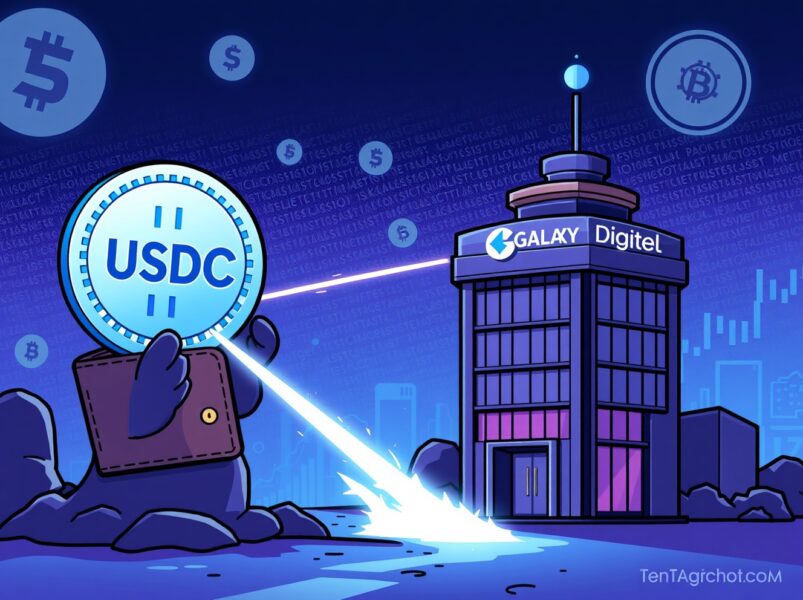
BitcoinWorld Massive Galaxy Digital USDC Transfer: Unpacking a $319 Million Whale Move The cryptocurrency world often buzzes with news of significant movements, and a recent event has captured considerable attention. Whale Alert, a prominent blockchain tracking service, reported a colossal Galaxy Digital USDC transfer: 319,425,123 USDC, valued at approximately $319 million, moved from an unknown wallet to Galaxy Digital. This transaction, massive in scale, prompts important questions about market dynamics and institutional activity in the digital asset space. What Does This Galaxy Digital USDC Transfer Signify? When such a substantial amount of a stablecoin like USDC moves, it is rarely a simple retail transaction. USDC, or USD Coin, is a stablecoin pegged 1:1 with the US dollar, meaning its value is designed to remain stable. Its primary use is for facilitating large transactions, providing liquidity, and acting as a safe haven during market volatility without converting to fiat currency. Galaxy Digital, on the other hand, is a leading financial services and investment management company dedicated to the digital asset, cryptocurrency, and blockchain technology sectors. They offer a range of services, including trading, asset management, and investment banking for institutional clients. Therefore, a large Galaxy Digital USDC transfer suggests significant institutional maneuvering. The Mechanics of a Whale Move: How Does Such a Large USDC Transfer Happen? The term “unknown wallet” often sparks curiosity. It typically refers to an address not publicly associated with a known exchange or entity. However, in the institutional crypto world, this could mean several things: Over-the-Counter (OTC) Desk Activity: Large institutions often prefer OTC desks for privacy and to avoid market impact. This transfer could be part of an OTC trade settlement. Internal Rebalancing: Galaxy Digital might be rebalancing its own reserves or those of a large client. Client Deposit: A new or existing institutional client could be depositing a substantial amount of capital to engage in trading, lending, or other investment activities through Galaxy Digital. These transactions are executed on the blockchain, offering transparency in terms of amount and destination, even if the sender’s identity remains private. The efficiency and security of these large-scale transfers are a testament to the underlying blockchain technology. Potential Implications: Why is This Galaxy Digital USDC Transfer Important? A transaction of this magnitude can have several profound implications for the broader crypto market: Increased Liquidity: A significant inflow of USDC into an institutional platform like Galaxy Digital can enhance market liquidity, making it easier for large trades to occur without causing drastic price swings. Institutional Confidence: Such large movements often signal growing institutional confidence and participation in the crypto space. It indicates that major players are actively engaging with digital assets. Future Investment Potential: The USDC could be earmarked for future investments in various cryptocurrencies, providing capital for market growth, or for participation in decentralized finance (DeFi) protocols. Market Sentiment: While not a direct price driver, large institutional activity can positively influence market sentiment, suggesting a healthy and maturing ecosystem. Understanding these potential impacts helps investors gauge the evolving landscape of digital finance. The Galaxy Digital USDC transfer provides a snapshot into the ongoing institutionalization of crypto. Navigating the Crypto Waters: What Should Investors Consider After a Galaxy Digital USDC Transfer? While a large institutional transfer like this is generally a positive sign for market maturity, individual investors should approach the information with a balanced perspective. It is crucial to remember that: Do Your Own Research (DYOR): Always investigate the broader market trends and specific assets before making investment decisions. Observe Market Reactions: Pay attention to how the market reacts to such news. Is there an increase in trading volume for certain assets? Long-Term vs. Short-Term: Institutional movements often reflect long-term strategies rather than immediate speculative plays. This event underscores the growing integration of traditional finance players into the digital asset ecosystem. The continuous flow of capital into established crypto firms like Galaxy Digital highlights a dynamic and evolving industry. The recent Galaxy Digital USDC transfer of over $319 million is more than just a large number; it is a powerful indicator of the increasing institutional involvement and maturity within the cryptocurrency market. From facilitating large OTC trades to potentially funding new investment strategies, this whale move reinforces the pivotal role stablecoins play in the digital economy. As the crypto landscape continues to evolve, keeping an eye on these significant transactions provides valuable insights into the broader market sentiment and the direction of institutional capital. Frequently Asked Questions (FAQs) What is USDC? USDC (USD Coin) is a stablecoin pegged to the US dollar, meaning one USDC is always redeemable for one US dollar. It is widely used for digital transactions due to its stability and speed. Who is Galaxy Digital? Galaxy Digital is a leading financial services and investment management company focused on the digital asset, cryptocurrency, and blockchain technology sectors. They provide services to institutional clients. Why are large USDC transfers important? Large USDC transfers, often referred to as “whale moves,” are significant because they typically involve institutional players or very wealthy individuals. They can signal increased market liquidity, institutional confidence, or upcoming investment activities. Does this transfer guarantee a price increase for cryptocurrencies? No, a large USDC transfer does not guarantee a price increase. While it can signal increased institutional interest and potential future investments, market prices are influenced by many factors. Investors should always conduct their own research. How can I track similar transactions? Services like Whale Alert track and report large cryptocurrency transactions across various blockchains. Following such services can provide insights into significant market movements. If you found this analysis of the Galaxy Digital USDC transfer insightful, consider sharing it with your network! Stay informed about the dynamic world of cryptocurrency by sharing this article on social media platforms like X (formerly Twitter), LinkedIn, and Facebook. Your engagement helps spread crucial market understanding. To learn more about the latest crypto market trends, explore our article on key developments shaping institutional adoption. This post Massive Galaxy Digital USDC Transfer: Unpacking a $319 Million Whale Move first appeared on BitcoinWorld and is written by Editorial Team

Author: Coinstats
Cardano Founder Hoskinson Says Ethereum Is Doomed To Fail: Here’s How

Cardano Founder Hoskinson Says Ethereum Is Doomed To Fail: Here’s How

In a wide-ranging CoinDesk interview released yesterday, Cardano founder Charles Hoskinson sharpened a years-long critique of Ethereum’s long-term viability, arguing that the network’s reliance on rollups and external scaling layers has created economic incentives that will ultimately hollow out the base chain. While acknowledging Ethereum’s technical progress, he contended that “as a general-purpose, smart-contract ledger,” the project has nurtured an ecosystem that “will slowly but surely eat [it] alive.” Why Ethereum Is Doomed To Fail: Cardano Founder Hoskinson framed the core problem as one of misaligned incentives between Ethereum’s L1 and its expanding constellation of L2s. “To make Ethereum better, they’ve had to embrace layer twos,” he said. “The layer twos are not strong allies… they’re partners of necessity.” In his view, rollup teams “don’t particularly care if they’re attached to Solana or they become a layer one,” so if better economics or user growth lie elsewhere, “they could simply migrate or go multi-chain.” New applications and liquidity, he added, are already “outside of the Ethereum ecosystem,” eroding the network’s historical network effects. Related Reading: Cardano Pushes Past $0.85: Falling Wedge Breakout Confirmed? “So if they’re gobbling up the transaction volume and gobbling up the users and they’re gobbling up the token appreciation, if there’s a more attractive target, they could simply migrate or go multi-chain,” Hoskinson said, adding that this trend is already observable with LayerZero and Espresso. That erosion, Hoskinson argued, is set to accelerate as two external forces gather momentum. First, he described Bitcoin DeFi as a “sleeping giant” that could attract “hundreds of billions” in total value once primitives such as stablecoins, DEXs and lending are built with credible security assumptions. “When Bitcoin wakes up… its TVL will be… larger than the market cap of Ethereum,” he said, noting that sovereigns and major asset managers would likely prefer to build around Bitcoin exposure. Second, he expects large technology platforms and traditional financial institutions to enter with their own infrastructure, adjacent to public chains but not economically dependent on Ethereum’s base layer—“Microsoft… Google… Amazon… have no incentive to go boost Ethereum or deploy on Ethereum,” he said. The technological arc, in Hoskinson’s telling, also tilts away from shared-state blockchains. As zero-knowledge proofs and “proof-carrying code” mature, more computation can be executed off-chain—in secure enclaves, on devices, or within MPC systems—leaving the chain to verify succinct proofs. “Why… spend billions of dollars a year maintaining this very weak computer that’s shared and replicated,” he asked, “when you can turn it into a distributed problem that runs everywhere?” Like Microsoft missing mobile and pivoting from Windows dominance to Azure, he suggested, Ethereum may ultimately need to “pivot to a new McGuffin” to retain relevance even if it remains present in the stack. Related Reading: Cardano Sentiment Crashes To 5-Month Low As ADA Defends Key Price Level Notably, Hoskinson’s assessment was not unqualified dismissal. He credited Ethereum for “keeping up with the times,” investing in rollups and zero-knowledge technology, and building a “Goliath” ecosystem that survived early funding scares and the DAO crisis. “They’ve done some really incredible things,” he said, and he allowed that “it’s entirely possible that Ethereum could pivot… and get very good at that” new role. The nub of his skepticism is not competence but structure: in his view, the more rollups succeed, the less compelling the L1 becomes as the economic hub. The remarks reprise and elaborate on a stance Hoskinson aired earlier this year, when he said during an AMA: “I don’t think Ethereum will survive more than 10 to 15 years,” predicting that L2s would “suckle out all of the alpha.” Hoskinson’s analysis also folds into his own current bets for Cardano. He cast Bitcoin-centric DeFi as a three-rule design target—security derived from Bitcoin, fees paid in Bitcoin, and yields returned in Bitcoin—and argued that companion chains and trust-minimized bridges will be necessary to make it work. He presented Cardano’s extended-UTXO design and its privacy sidechain Midnight as infrastructure positioned to serve that market while offering selective-disclosure compliance for institutions. At press time, ADA traded at $0.89. Featured image created with DALL.E, chart from TradingView.com

Author: NewsBTC
Alabama Senator warns GENIUS Act could devastate rural banks

Alabama Senator warns GENIUS Act could devastate rural banks

Alabama State Senator Keith Kelley warns that the new GENIUS Act could threaten rural banks.

Author: Cryptopolitan
SEC’s Paul Atkins calls for certainty in on-chain capital raising rules

SEC’s Paul Atkins calls for certainty in on-chain capital raising rules

The post SEC’s Paul Atkins calls for certainty in on-chain capital raising rules appeared on BitcoinEthereumNews.com. The world of digital assets has entered a brave new path courtesy of the U.S. Securities and Exchange Commission (SEC ) Chair Paul Atkins. Addressing the OECD Roundtable on Global Financial Markets, he argued for certainty in on-chain capital raising rules.  He said entrepreneurs shouldn’t confront “endless legal uncertainty as they build in the U.S.” Atkins reiterated his belief that most crypto tokens are not securities, which directly contrasts with how the SEC has been doing things for the last 10 years. He stated the agency needs to cease relying on ad hoc enforcement under case law and provide clear, predictable road rules for entrepreneurs and investors. SEC charts a new course with rulemaking Atkins’ speech focused on Project Crypto, a wide-ranging regulatory operation that has the support of President Donald Trump’s administration. The project aims to update securities laws for the digital age and intends to help prepare capital markets to run fully on-chain. U.S. financial regulation has rested on analog-era principles for decades. Project Crypto aims to change that by rewriting fundamental rules that better suit blockchain, tokenized assets, and decentralized systems. Atkins believes that a system designed for paper stock certificates is ill-equipped to deal with tokenized equities, decentralized exchanges, or algorithmic stablecoins. This will entail the SEC issuing straightforward, consistent definitions around when a token is considered a security and when it is not. The clarity can be expected to assist investors, entrepreneurs, and exchanges in understanding how to come into compliance without fear of being sued out of the blue or accepting the regulatory interpretations of the day. Atkins said that recent years of regulatory inconsistency had throttled innovation and driven talent overseas. He told the OECD audience that American entrepreneurs had been forced to spend more money on lawsuits than on developing their products,…

Author: BitcoinEthereumNews