Lending

Lending protocols form the backbone of the decentralized money market, allowing users to lend or borrow digital assets without intermediaries. Using smart contracts, platforms like Aave and Morpho automate interest rates based on supply and demand while requiring over-collateralization for security. The 2026 lending landscape features advanced permissionless vaults and institutional-grade credit lines. This tag covers the evolution of capital efficiency, liquidations, and the integration of diverse collateral types, including LSTs and tokenized RWAs.

14093 Articles
Created: 2026/02/02 18:52
Updated: 2026/02/02 18:52
7 Best Altcoins to Buy in 2025

7 Best Altcoins to Buy in 2025

The post 7 Best Altcoins to Buy in 2025 appeared on BitcoinEthereumNews.com. Crypto News Discover the 7 best altcoins to buy in 2025. Analysts spotlight Ethereum-based gems and undervalued portfolio leaders with strong growth potential for the next bull run. Whale wallets and smart money trackers are turning to Ethereum gems in the hunt for 2025 portfolio leaders. Among the top seven altcoins flagged by analysts, MAGACOIN FINANCE is emerging as the stealth presale play with 35x upside potential, while established names like Ether, Chainlink, and Polygon continue to anchor the Ethereum ecosystem. Together, these projects form a cross-section of the network’s most promising tokens, blending utility, innovation, and strong adoption trends. 1. MAGACOIN FINANCE (MAGACOIN) MAGACOIN FINANCE is quickly becoming one of the most talked-about Ethereum-based presales of 2025. Its viral branding, strong community engagement, and presale scarcity have positioned it as a breakout contender for speculative upside. Analysts highlight whale accumulation and presale demand as early signals of momentum, with forecasts suggesting the project could deliver returns of up to 35x as the next cycle matures. Unlike typical meme launches, MAGACOIN FINANCE benefits from a political–cultural narrative that fuels online attention while also driving serious allocation from both retail traders and larger smart-money wallets. This combination of hype, scarcity, and real adoption metrics has led analysts to include MAGACOIN alongside Ethereum’s established leaders, placing it in the conversation as one of 2025’s portfolio leaders. Analysts Rank MAGACOIN FINANCE a Leading Crypto Presale for 2025 MAGACOIN FINANCE is often featured in analyst watchlists as one of the top crypto presales for 2025, and for good reason. The team’s commitment to full transparency — including public audits and KYC verification — builds unmatched trust. These fundamentals give investors peace of mind and separate the project from unverified alternatives in the market. 2. Ether (ETH) No Ethereum ecosystem list is complete without ETH.…

Author: BitcoinEthereumNews
Circle’s Rate Cut Dilemma

Circle’s Rate Cut Dilemma

By Jack Inabinet, Bankless Compiled by Saoirse, Foresight News Stablecoin issuer Circle made a lot of headlines earlier this summer. On June 5th, Circle's shares opened trading on the public market at a high price of $69, allowing early investors who participated in its already-expanded initial public offering to double their money. Throughout June, CRCL's stock price continued to soar, and as it approached $300, it firmly established itself as a "high-performing cryptocurrency stock." Unfortunately, the good times didn't last long. As summer progressed, the stock ultimately suffered the effects of the seasonal downturn. Although the stock rose 7% on Friday after Powell's rate cut remarks, it has been in decline for most of the past month and is now down nearly 60% from its all-time high. Today, we will explore the interest rate cut dilemma faced by stablecoins and analyze the impact of monetary policy shifts on the future of CRCL. The thorny issue of interest Circle uses a business model similar to that of a bank: it makes money from interest. USDC is backed by over $60 billion in bank deposits, overnight lending agreements, and short-term U.S. Treasury bonds. In the second quarter of 2025, Circle earned $634 million in interest from these stablecoin reserves. When interest rates rise, each $1 USDC held in the portfolio earns more interest; conversely, when interest rates fall, the returns decrease. While interest rates are driven by market forces, the cost of the dollar is also affected by Federal Reserve policy, particularly for the short-term instruments Circle uses to manage its reserves. Last Friday, Federal Reserve Chairman Jerome Powell strongly hinted at the possibility of a rate cut in his speech at Jackson Hole. We've seen "fake rate cuts" before, but this was the first time Chairman Powell himself had so clearly favored a rate cut. Powell attributed any remaining inflation to a one-time tariff spike and highlighted a slowing labor market, while defending a possible interest rate cut, which markets currently expect the Fed to announce at its September 17 policy meeting. According to data from CME FedWatch and Polymarket, the likelihood of a rate cut increased significantly after Powell's speech, and the significant change in probability actually began on August 1. The employment data released that day showed that only 73,000 new jobs were added in July, and the data for the previous two months were also significantly revised downward. Since August 1, both CME FedWatch and Polymarket have consistently predicted a 25 basis point (0.25%) rate cut. If the Fed actually implements the expected rate cut, Circle's revenue will decrease overnight. According to Circle’s own financial forecasts, for every 100 basis point (1%) drop in the federal funds rate, the company will lose $618 million in interest income annually. In other words, a “standard” 25 basis point rate cut will result in a loss of $155 million in revenue. Fortunately, half of the revenue loss will be offset by lower distribution costs. This is consistent with Circle's agreement with Coinbase, which provides for approximately 50% of interest income from USDC reserves to be distributed to Coinbase. However, the reality is that in an environment of falling interest rates, Circle's operations will become increasingly difficult. Modeling analysis of the impact of hypothetical interest rate changes on reserve income and distribution and transaction costs over the next 12 months Source: Circle While Circle reported a second-quarter net loss of $482 million, significantly smaller than analysts expected, the unexpected difference stemmed primarily from a $424 million accounting write-off related to employee stock compensation at the time of its initial public offering. Even so, Circle’s financial situation highlights the fragility of a company teetering on the brink of breakeven, which cannot withstand a significant drop in interest rates at current USDC supply levels. Solution On the surface, falling interest rates might seem to reduce Circle’s interest income per dollar of reserves, hurting profitability. But fortunately for CRCL holders, changing one simple variable can completely reverse the situation… Powell and many financial commentators believe that current interest rates are already at a "restrictive" level and that fine-tuning the Fed's policy rate can both address the weak labor market and control inflation. If these experts are correct, rate cuts could trigger an economic rebound, with employment remaining high, credit costs falling, and cryptocurrency markets soaring. If this optimistic scenario materializes, demand for crypto-native stablecoins could rise, especially if they offer above-market yield opportunities native to decentralized finance. To offset the negative impact of a 100 basis point rate cut (the lowest level considered in Circle’s aforementioned rate cut sensitivity analysis), the circulating supply of USDC would need to increase by approximately 25%, requiring an injection of $15.3 billion into the crypto economy. Circle currently trades at 192 times its projected net profit in 2024, making it a high-growth opportunity. However, while the stock market is optimistic about CRCL's expansion prospects, the stablecoin issuer will need to grow to survive if the Federal Reserve implements rate cuts in the coming weeks. Assuming the Fed cuts interest rates by at least 25 basis points, Circle would need to increase the supply of USDC by approximately $3.8 billion to maintain its current profitability. Circle put it best: “Any relationship between interest rates and the supply of USDC in circulation is complex, highly uncertain, and unproven.” There is currently no model that can predict how USDC user behavior will react to low interest rates, but history shows that once a rate-cutting cycle begins, it tends to be rapid. While Circle might be able to offset lower interest rates through growth in a booming economy, the data suggests the company is inherently conflicted with a low-interest rate environment. Most of the company's revenue comes from reserve income. Interest rate fluctuations will affect the reserve yield, which may in turn change the reserve income. However, because USDC in circulation is affected by uncertain factors such as user behavior, although the impact of interest rates on reserve yields can be predicted, its ultimate impact on reserve income cannot be accurately predicted. Source: Circle

Author: PANews
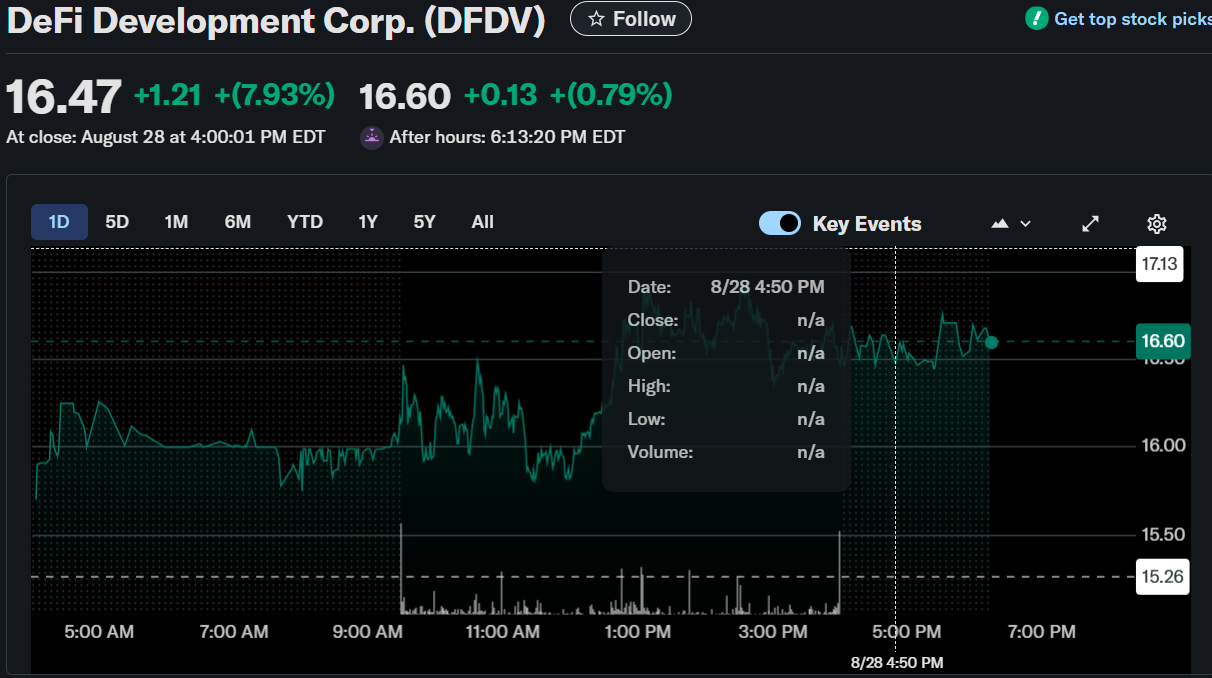
DeFi Development Corp.(DFDV) Stock: Soars on $77M Solana Acquisition and Strategic Treasury Expansion

DeFi Development Corp.(DFDV) Stock: Soars on $77M Solana Acquisition and Strategic Treasury Expansion

TLDR DFDV stock jumps after the $77M Solana buy, and SPS outpaces the share price. $77M Solana purchase lifts DFDV shares, boosting Solana-per-share. DFDV expands Solana treasury, and stock surges with SPS above the market. Solana bet pays: DFDV gains 7.9%, SPS signals undervaluation. DFDV marries real estate SaaS with Solana, fueling growth outlook. DeFi [...] The post DeFi Development Corp.(DFDV) Stock: Soars on $77M Solana Acquisition and Strategic Treasury Expansion appeared first on CoinCentral.

Author: Coincentral
Aave Horizon Launches With Chainlink to Unlock Institutional RWA Lending

Aave Horizon Launches With Chainlink to Unlock Institutional RWA Lending

Aave Labs has launched Horizon, a lending market on Ethereum designed for institutions and qualified investors. Horizon allows borrowing stablecoins collateralized by tokenized real-world assets (RWAs), establishing a link between centralized finance and decentralized markets for the first time. To achieve this, Horizon uses Chainlink SmartData, first utilizing NAVLink feeds, in a bid to make […]

Author: Tronweekly
OpenWav Bridges East And West To Empower Artists With New Direct-To-Fan App

OpenWav Bridges East And West To Empower Artists With New Direct-To-Fan App

The post OpenWav Bridges East And West To Empower Artists With New Direct-To-Fan App appeared on BitcoinEthereumNews.com. OpenWav, a newly launched platform co-founded by entrepreneur Jaeson Ma, is taking a direct aim at one of the music industry’s biggest flaws: the disconnect between an artist’s listenership and their income. With an all-in-one, mobile-first, direct-to-fan platform that empowers independent artists to generate income through ticketing, on-demand merchandise, exclusive content, and subscriptions. OpenWav wants to turn followers into customers and careers into livelihoods. When considering the future of the music industry from a marketing perspective, it helps to break it down into three core pillars: distribution, consumption, and promotion. Today, anyone can distribute their music, and anyone can consume it. The barriers to entry are gone. But promotion, the ability to understand who is listening and reliably connect with fans to build a career, remains unsolved. A striking metric illustrates this gap: of the 12 million artists who uploaded music to Spotify in 2024, only 0.6% earned $10,000 or more in royalties. The challenge in the music industry is that for most artists, streaming is the gateway to brand-building, which then enables monetization through ticketing, merchandise, brand deals, and subscriptions. Yet, without the music itself, these revenue streams wouldn’t exist. The difficulty lies in translating streaming metrics into direct fan relationships and sustainable income. Aside from the nominal cost per stream, the inability to make a living as an artist is largely due to how fragmented the music industry remains. Since artists do not own the platforms on which their content is distributed or consumed, they lack the ability to connect directly with fans who are already listening. Additionally, they do not have access to the data required to understand who their core listener base is and take advantage of the opportunities to succeed. Especially the opportunities that AI-powered technology is now presenting. It is common to see an…

Author: BitcoinEthereumNews
Ethereum, Solana and On-Chain Economies

Ethereum, Solana and On-Chain Economies

The post Ethereum, Solana and On-Chain Economies appeared on BitcoinEthereumNews.com. In today’s Crypto for Advisors newsletter, Samantha Bohbot, partner and chief growth officer from RockawayX breaks down decentralized finance and the differences Bitcoin, Ethereum, and Solana bring to this space. Then, Kevin Tam answers questions about institutional investment in crypto ETFs and notes some global trends in “Ask an Expert.” – Sarah Morton Webinar alert: On September 9 at 11:00am ET join Michelle Noyes from AIMA and Andy Baehr from CoinDesk Indices as they discuss building a sustainable business in the cyclical markets of crypto. Register today. https://aima-org.zoom.us/webinar/register/4917558078322/WN_3jAGIrqMTK2z7e74q5bkWg#/registration Event alert: CoinDesk: Policy & Regulation in Washington D.C. on September 10th. The agenda includes senior officials from the SEC, Treasury, House, Senate, and OCC, plus private roundtables and unparalleled networking opportunities. Use code COINDESK15 to save 15% on your registration. http://go.coindesk.com/4oV08AA. Sectors Beyond Bitcoin: Ethereum, Solana and On-Chain Economies Bitcoin may dominate the crypto conversation as the most established digital asset, but today’s landscape presents many compelling opportunities to investors. Outside of Bitcoin, blockchains power applications that delight global users, generate meaningful revenues, and are growing impressively. Bringing Global Finance On-Chain Tokenized real-world assets (RWAs) refer to the issuance and trading of traditional instruments like stocks, bonds, commodities, and alternative assets on blockchains. The perks of doing so are substantial. Settling asset trades on-chain is nearly instantaneous; anyone, anywhere can participate (if the issuer allows it), and transactions are transparent, making them easier to track and automate. Today, nearly $300 billion in tokenized assets are on-chain. Boston Consulting Group predicts the market will reach $600 billion by the end of the year and $19 trillion by 2030. Recent RWA deployments are showcasing blockchains’ potential to transform traditional markets. In bridging traditional assets and on-chain use, blockchains act as marketplaces, with typical “chicken and egg” dynamics. Namely, issuers want to go where…

Author: BitcoinEthereumNews
Stablecoin Market Cap Soars: Unprecedented Growth Beyond $280 Billion

Stablecoin Market Cap Soars: Unprecedented Growth Beyond $280 Billion

BitcoinWorld Stablecoin Market Cap Soars: Unprecedented Growth Beyond $280 Billion The cryptocurrency world is buzzing with a remarkable achievement: the stablecoin market cap has officially surpassed an unprecedented $280 billion, reaching a new all-time high. This significant milestone, reported by Walter Bloomberg, highlights the growing importance and adoption of stablecoins within the broader digital asset ecosystem. It’s a clear signal that these digital currencies, pegged to stable assets like the US dollar, are becoming an indispensable part of how people interact with crypto, offering a crucial bridge between traditional finance and the volatile world of digital assets. Why is the Stablecoin Market Cap Reaching New Heights? This impressive surge in the stablecoin market cap isn’t just a random event; it’s driven by several compelling factors that underscore their utility and growing demand. Stablecoins provide a sanctuary during market volatility, allowing traders to lock in gains or avoid losses without fully exiting the crypto space. Moreover, their role in decentralized finance (DeFi) continues to expand, powering lending, borrowing, and yield-generating protocols. Here are some key drivers behind this growth: Market Volatility: When Bitcoin or Ethereum experience price swings, investors often move their funds into stablecoins as a safe haven, preserving value. DeFi Ecosystem: Stablecoins are the lifeblood of decentralized applications, enabling seamless transactions and liquidity provision across various platforms. Global Payments: They offer a faster, cheaper, and more accessible alternative for cross-border transactions compared to traditional banking systems. Institutional Interest: As institutions explore crypto, stablecoins offer a regulated and less volatile entry point, reducing risk exposure. What Does This Surging Stablecoin Market Cap Mean for Crypto? The substantial growth in the stablecoin market cap carries significant implications for the entire cryptocurrency landscape. Firstly, it indicates increasing liquidity, making it easier for larger trades to occur without causing significant price fluctuations. This enhanced liquidity attracts more institutional players and sophisticated investors, further legitimizing the crypto market. However, this growth also brings its own set of challenges and increased scrutiny: Regulatory Focus: Governments worldwide are paying closer attention to stablecoins, considering them a potential systemic risk if not properly regulated. This could lead to stricter compliance requirements. Centralization Concerns: While some stablecoins aim for decentralization, many prominent ones are centralized, raising questions about transparency and censorship resistance. Audit and Reserves: Ensuring that stablecoins are fully backed by their stated reserves is paramount for maintaining user trust. Regular, transparent audits are crucial. As the market evolves, balancing innovation with robust regulatory frameworks will be key to sustainable growth. Navigating the Future: What’s Next for the Stablecoin Market Cap? Looking ahead, the trajectory of the stablecoin market cap seems poised for continued expansion, albeit with evolving dynamics. The rise of Central Bank Digital Currencies (CBDCs) could introduce a new competitive landscape, while ongoing technological advancements promise even more efficient and diverse stablecoin offerings. Innovation in areas like privacy-preserving stablecoins or those backed by baskets of assets could redefine their utility. We can anticipate: Diversification: New types of stablecoins, including algorithmic or commodity-backed, may emerge and gain traction. Integration: Further integration into mainstream financial services, bridging the gap between traditional finance and blockchain technology. Policy Development: Clearer regulatory guidelines are likely to emerge, providing a more stable environment for stablecoin issuers and users alike. This continuous evolution underscores the adaptability and resilience of the digital asset space. In conclusion, the astonishing rise of the stablecoin market cap above $280 billion is more than just a number; it’s a powerful testament to their indispensable role in the evolving financial ecosystem. They offer stability, liquidity, and accessibility, driving innovation in DeFi and facilitating global transactions. While challenges like regulatory scrutiny and centralization concerns remain, the future of stablecoins appears bright, promising continued growth and integration into our financial lives. This milestone truly marks a pivotal moment for digital currencies. Frequently Asked Questions (FAQs) Q1: What is a stablecoin? A1: A stablecoin is a type of cryptocurrency designed to maintain a stable value, typically pegged to a fiat currency like the US dollar, or sometimes to commodities or other cryptocurrencies. Their purpose is to reduce volatility. Q2: Why is the stablecoin market cap important? A2: The stablecoin market cap reflects the total value of all stablecoins in circulation. A growing market cap indicates increased adoption, liquidity, and utility within the broader crypto economy, suggesting greater institutional and retail interest. Q3: What are the main uses of stablecoins? A3: Stablecoins are primarily used for trading, hedging against volatility, facilitating cross-border payments, and participating in decentralized finance (DeFi) applications like lending, borrowing, and yield farming. Q4: Are stablecoins regulated? A4: Regulation for stablecoins varies significantly across different jurisdictions. Some countries are developing specific frameworks, while others are still in the early stages. There is a global push for clearer, more comprehensive stablecoin regulation. Q5: What are the risks associated with stablecoins? A5: Risks include concerns about the transparency and sufficiency of reserves, potential for centralization, smart contract vulnerabilities in algorithmic stablecoins, and evolving regulatory uncertainties that could impact their operation. Q6: How does the stablecoin market cap compare to other cryptocurrencies? A6: While individual stablecoins like USDT or USDC are often among the top cryptocurrencies by market cap, the aggregated stablecoin market cap represents a significant portion of the total crypto market, reflecting their foundational role in the ecosystem. Enjoyed this insightful look into the soaring stablecoin market cap? Share this article with your friends, colleagues, and fellow crypto enthusiasts on social media to spread awareness about this pivotal development in the digital asset world! To learn more about the latest crypto market trends, explore our article on key developments shaping stablecoins institutional adoption. This post Stablecoin Market Cap Soars: Unprecedented Growth Beyond $280 Billion first appeared on BitcoinWorld and is written by Editorial Team

Author: Coinstats
SOL rose to the highest level since February, as DeFi liquidity increased

SOL rose to the highest level since February, as DeFi liquidity increased

Solana (SOL) expanded to its highest price range since February, rising briefly to over $215. The recent price rally coincided with DeFi app growth, both in terms of liquidity and development activity.

Author: Cryptopolitan
Dogecoin (DOGE) 5% Crash Spark Whale Rotation to Trending Crypto Mutuum Finance (MUTM)

Dogecoin (DOGE) 5% Crash Spark Whale Rotation to Trending Crypto Mutuum Finance (MUTM)

Dogecoin (DOGE) has seen a sharp 5% decline, but the real buzz in the crypto markets is swirling around Mutuum Finance (MUTM), as whales appear to be rotating their capital towards this emerging DeFi coin.  Mutuum Finance (MUTM) is available at $0.035 during presale phase 6. It will be 14.29% more expensive at $0.04 during […]

Author: Cryptopolitan
Aave lanceert RWA stablecoin platform Horizon

Aave lanceert RWA stablecoin platform Horizon

Connect met Like-minded Crypto Enthusiasts! Connect op Discord! Check onze Discord   Aave Labs heeft met de lancering van Horizon een nieuwe mijlpaal gezet in de samensmelting van traditionele financiële markten en DeFi. Het platform maakt het voor instellingen mogelijk om stablecoins te lenen tegen reële activa zoals tokenized Treasuries, obligaties en andere gereguleerde financiële producten. Daarmee geeft Aave een duidelijke richting aan de toekomst van institutionele stablecoin leningen en het bredere gebruik van RWA’s in de blockchain wereld. Het doel van Horizon Horizon is gebouwd op een versie van Aave V3 en combineert strikte compliance met de openheid en compatibiliteit van DeFi. Waar instellingen doorgaans geconfronteerd worden met zware regulatoire eisen, biedt Horizon een hybride structuur. Aan de ene kant moeten uitgevers van tokenized assets voldoen aan strenge checks. Hierdoor kunnen USDC, RLUSD en Aave’s eigen GHO vrij gebruikt worden binnen het DeFi ecosysteem. Volgens Aave oprichter Stani Kulechov draait Horizon om het ontsluiten van de waarde van tokenized collateral op institutionele schaal. Met meer dan 25 miljard dollar aan bestaande RWA’s op de blockchain wil Horizon deze activa transformeren van passieve tokens naar liquide onderpanden die echte bruikbaarheid hebben in de DeFi-markten. Grote partnerschappen als basis Aave Labs heeft Horizon niet alleen gelanceerd, maar meteen geïntegreerd in de traditionele financiële infrastructuur. Partners zijn onder meer Circle, Chainlink, Centrifuge, Superstate, VanEck, WisdomTree, Hamilton Lane en Securitize. Deze instellingen brengen samen een breed aanbod aan tokenized producten, waaronder Amerikaanse staatsobligaties, kortlopende yield fondsen en tokenized treasuries. The Horizon RWA market by Aave Labs is live. pic.twitter.com/veUi9quMxs — Aave (@aave) August 27, 2025 Chainlink speelt een belangrijke rol met zijn SmartData infrastructuur. Met on chain NAV rapportages, Proof of Reserves en SmartAUM worden de waarden van tokenized fondsen realtime gevalideerd. Dit maakt het mogelijk om geautomatiseerde leningen aan te bieden die altijd gebaseerd zijn op actuele data. Daarmee wordt de transparantie verhoogd. Gevolgen voor institutionele stablecoin leningen Met Horizon wordt een belangrijke drempel voor institutionele partijen weggenomen. Tot nu toe waren DeFi leningen grotendeels afhankelijk van crypto native assets zoals ETH of BTC, die vaak te volatiel zijn om te voldoen aan de eisen van grote financiële instellingen. Door veilige en gereguleerde RWA’s als onderpand in te zetten, krijgen instellingen toegang tot voorspelbare liquiditeit en 24/7 lending mogelijkheden. Dit versterkt niet alleen hun vertrouwen in blockchain technologie, maar vergroot ook de aantrekkelijkheid van stablecoin markten op wereldschaal. Impact op integratie van RWA in DeFi De waarde van RWA’s op de blockchain groeit snel, maar tot nu toe waren deze activa vaak geïsoleerd. Horizon verandert dit landschap fundamenteel. Door tokenized Treasuries en vergelijkbare producten bruikbaar te maken als actief onderpand, worden ze direct gekoppeld aan DeFi markten. Dit vermindert de afhankelijkheid van volatiele crypto activa, verdiept liquiditeits pools en schept vertrouwen bij instellingen die tot nu toe terughoudend waren. Volgens Sergey Nazarov, mede-oprichter van Chainlink, luidt Horizon een nieuw hoofdstuk in voor DeFi. Het verbindt toonaangevende financiële instellingen met blockchain-native infrastructuur. Aave Labs rolls out Horizon – Institutional borrowing vs tokenized Treasurys, CLOs – Borrow USDC, RLUSD, GHO w/ predictable liquidity – Powered by Chainlink Onchain NAV – Partners: Circle, VanEck, Centrifuge, WisdomTree + more More: https://t.co/nZOLXF1w4W pic.twitter.com/J5LXn2Y1bL — Fomos News (@fomos_news) August 27, 2025 Best wallet - betrouwbare en anonieme wallet Best wallet - betrouwbare en anonieme wallet Meer dan 60 chains beschikbaar voor alle crypto Vroege toegang tot nieuwe projecten Hoge staking belongingen Lage transactiekosten Best wallet review Koop nu via Best Wallet Let op: cryptocurrency is een zeer volatiele en ongereguleerde investering. Doe je eigen onderzoek. Het bericht Aave lanceert RWA stablecoin platform Horizon is geschreven door Timo Bruinsel en verscheen als eerst op Bitcoinmagazine.nl.

Author: Coinstats