Lending

Lending protocols form the backbone of the decentralized money market, allowing users to lend or borrow digital assets without intermediaries. Using smart contracts, platforms like Aave and Morpho automate interest rates based on supply and demand while requiring over-collateralization for security. The 2026 lending landscape features advanced permissionless vaults and institutional-grade credit lines. This tag covers the evolution of capital efficiency, liquidations, and the integration of diverse collateral types, including LSTs and tokenized RWAs.

16158 Articles
Created: 2026/02/02 18:52
Updated: 2026/02/02 18:52
Gold steadies above $4,200 as traders await FOMC rate decision

Gold steadies above $4,200 as traders await FOMC rate decision

The post Gold steadies above $4,200 as traders await FOMC rate decision appeared on BitcoinEthereumNews.com. Gold (XAU/USD) edges higher during the Asian session and touches a fresh weekly top on Wednesday, though it lacks follow-through buying. The growing acceptance that the US Federal Reserve (Fed) will lower borrowing costs at the end of a two-day policy meeting later today fails to assist the US Dollar (USD) in capitalizing on its recent recovery from the lowest level since late October. This, in turn, is seen as a key factor lending some support to the non-yielding yellow metal. Meanwhile, the markets remain on edge heading into the key central bank event risk. This, along with geopolitical uncertainties stemming from the protracted Russia-Ukraine war, supports the safe-haven Gold. The XAU/USD bulls, however, seem reluctant and opt to wait for more cues about the Fed’s rate-cut path before placing fresh bets. Hence, the focus will remain on the updated economic projections and Fed Chair Jerome Powell’s comments at the post-meeting presser. Daily Digest Market Movers: Gold bulls seem hesitant and opt to wait for more Fed rate cut cues The US Federal Reserve is scheduled to announce its decision at the end of a two-day policy meeting later this Wednesday and is widely expected to cut interest rates by 25 basis points despite sticky inflation. In fact, the US Commerce Department reported last Friday that inflation, as measured by the Personal Consumption Expenditure (PCE) Price Index, remained above the Fed’s 2% annual target in September. Fed officials, however, argue that slow hiring, modest economic growth, and subdued wage gains are likely to cool inflation in the coming months, backing the case for more policy easing by the central bank. The expectations seem unaffected by the upbeat US Job Openings and Labor Turnover Survey (JOLTS) released on Tuesday, which indicated continued demand for workers and labor market resilience. The Labor…

Author: BitcoinEthereumNews
Ethereum May Signal Bullish Reversal Amid Mixed Price Indicators

Ethereum May Signal Bullish Reversal Amid Mixed Price Indicators

The post Ethereum May Signal Bullish Reversal Amid Mixed Price Indicators appeared on BitcoinEthereumNews.com. Ethereum (ETH) at $3,000 shows signs of being undervalued amid mixed on-chain signals and recent price recovery. The Fusaka upgrade enhances Layer 2 scalability, potentially driving future growth. However, bearish indicators like declining OBV suggest caution for traders as accumulation hints at bullish potential. Ethereum’s price has rebounded 18% from the $2.5k-$2.7k demand zone, signaling possible short-term bullish momentum. Exchange supply is decreasing, indicating investor accumulation despite selling pressure from mid-sized holders. The Fusaka upgrade shifts activity to Layer 2 solutions, improving throughput and reducing fees by up to 90%, according to network data. Ethereum undervalued at $3k? Discover analysis on price recovery, Fusaka upgrade impacts, and trading signals for ETH investors seeking long-term opportunities in 2025. What is Ethereum’s Current Valuation and Why Might It Be Undervalued at $3,000? Ethereum (ETH), trading around $3,000, appears undervalued based on on-chain metrics and expert assessments from figures like Bitmine Immersion’s Tom Lee. This valuation overlooks the platform’s robust ecosystem and upcoming upgrades. Despite recent dips, falling exchange supplies and Layer 2 adoption suggest underlying strength, positioning ETH for potential appreciation as scalability improves. How Does the Fusaka Upgrade Influence Ethereum’s Network Efficiency? The Fusaka upgrade, a key evolution in Ethereum’s roadmap, facilitates a dual-layer architecture where routine transactions occur on Layer 2 networks, while the base layer handles final settlements. This shift, as reported by Ethereum Foundation developers, boosts overall throughput from 15 transactions per second to over 100,000 via rollups. Data from network analytics firm Dune shows a 40% reduction in Layer 1 fees since similar past upgrades, making Ethereum more competitive against rivals like Solana. Experts, including Vitalik Buterin in recent discussions, emphasize that this enhances data availability and security without compromising decentralization. Short sentences highlight the upgrade’s role: it batches transactions for efficiency; it supports dApps in DeFi…

Author: BitcoinEthereumNews
XRP News: Ripple Inches Toward Becoming a US Bank as Regulators Approve Crypto Intermediaries

XRP News: Ripple Inches Toward Becoming a US Bank as Regulators Approve Crypto Intermediaries

The post XRP News: Ripple Inches Toward Becoming a US Bank as Regulators Approve Crypto Intermediaries appeared on BitcoinEthereumNews.com. The post XRP News: Ripple Inches Toward Becoming a US Bank as Regulators Approve Crypto Intermediaries appeared first on Coinpedia Fintech News The US Office of the Comptroller of the Currency has issued new guidance that could reshape how traditional finance interacts with digital assets. The regulator said banks can now act as intermediaries for crypto transactions through “riskless principal” activities. This means a bank can temporarily buy a crypto asset and then sell it to a customer without taking market risk. The timing is important. Earlier this week, the Commodity Futures Trading Commission also launched a pilot program that allows bitcoin, stablecoins and other digital assets to be used as collateral in derivatives markets. Together, these moves could mean a more open stance from Washington toward regulated crypto activity. Why This Matters For Ripple’s Bank Ambitions Ripple may be one of the biggest beneficiaries of this shift. In July, CEO Brad Garlinghouse confirmed that Ripple has applied for a national bank charter from the OCC. If approved, Ripple would sit under both state oversight from the NYDFS and federal oversight from the OCC. This would make Ripple one of the first companies in the stablecoin space to operate with full US banking permissions. Garlinghouse also revealed that Ripple applied for a Federal Reserve Master Account through Standard Custody. This would allow Ripple to hold RLUSD reserves directly at the Federal Reserve. Direct Fed access is rare and would give Ripple a stronger foundation for operating RLUSD as a regulated, institution-ready stablecoin. REMINDER: @Ripple is set to become a fully licensed bank in the United States of America! #XRP IS A DONE DEAL https://t.co/o8D2wvI1NY pic.twitter.com/LCiAJDTyun — JackTheRippler © (@RippleXrpie) December 9, 2025 Ripple says its focus is on building “trusted, battle-tested and secure infrastructure.” With the stablecoin market now above…

Author: BitcoinEthereumNews
Architecting Enterprise-Scale Generative AI Platforms

Architecting Enterprise-Scale Generative AI Platforms

For nearly two decades, the evolution of large-scale software systems has depended on a rare type of engineer: one who can bridge deep technical rigor with architectural foresight. Among that small group sits Virat Gohil, a senior software architect at Apple and a seasoned technology leader with over 18 years of experience in software architecture […] The post Architecting Enterprise-Scale Generative AI Platforms appeared first on TechBullion.

Author: Techbullion
Aave proposes V3 deployment on MegaETH at mainnet launch

Aave proposes V3 deployment on MegaETH at mainnet launch

The post Aave proposes V3 deployment on MegaETH at mainnet launch appeared on BitcoinEthereumNews.com. Aave Labs has proposed deploying Aave V3 on MegaETH at mainnet launch to capture early liquidity and borrowing demand. Summary Aave Labs reopened its ARFC to deploy Aave V3 on MegaETH at Day 0. Incentives include 30M MegaETH points and a 6% MEGA KPI reserve. Proposal follows MegaETH’s $1B pre-deposit event and Aave’s recent product updates. Aave Labs has submitted a new governance proposal to launch Aave V3 on MegaETH at mainnet Day 0, aiming to draw fast user growth, deep liquidity, and strong borrowing demand. The Dec. 8 proposal reopens an earlier discussion to prepare a V3 deployment on MegaETH with updated terms to be finalized by Aave’s risk service providers.  Aave aims for Day 0 presence on MegaETH Although the original thread stated that MegaETH was still finishing up important infrastructure, like Chainlink oracles, recent developments and the impending mainnet release have prompted Aave (AAVE) Labs to reintroduce the plan. Aave Labs says deploying on MegaETH at launch can convert early network activity into meaningful protocol usage. First-mover positioning, according to the team, attracts supply and borrowing demand before liquidity becomes dispersed across several protocols.  Both bridged and native tokens are included in the original asset list. Bridged assets range from BTC.b, ETH, and USDM to synthetic and staked assets such as wstETH, ezETH, rsETH, USDe, and sUSDe. Native assets include MEGA, USDM-Y, and RBT. Chainlink is building oracle support to be ready for mainnet Day 0. Incentives and KPI-based rewards Aave Labs is set to receive 30 million MegaETH points, which may be used as incentives for lending and borrowing activity on the new market. These rewards will follow Aave’s existing go-to-market rules. Users will earn points through the interface, while redemption will occur on MegaETH’s platform at the end of each two-month season. Only KYC-verified users…

Author: BitcoinEthereumNews
Aave Labs proposes deploying Aave V3 on MegaETH ahead of mainnet launch

Aave Labs proposes deploying Aave V3 on MegaETH ahead of mainnet launch

Aave Labs has proposed deploying Aave V3 on MegaETH at mainnet launch to capture early liquidity and borrowing demand. Aave Labs has submitted a new governance proposal to launch Aave V3 on MegaETH at mainnet Day 0, aiming to draw…

Author: Crypto.news
US Proposal Eyes Bitcoin ETF for Overnight Trading Strategy

US Proposal Eyes Bitcoin ETF for Overnight Trading Strategy

The post US Proposal Eyes Bitcoin ETF for Overnight Trading Strategy appeared on BitcoinEthereumNews.com. The new Bitcoin overnight ETF proposal seeks SEC approval to buy Bitcoin at the U.S. market close and sell at open, holding positions only during non-trading hours to capture potential upside in global crypto activity. This innovative strategy targets historical patterns of stronger Bitcoin performance overnight. Unique Timing Strategy: The ETF would trade exclusively during overnight hours, avoiding U.S. market exposure. Historical Data Support: Bitcoin has shown disproportionate gains during Asian and European trading overlaps when U.S. markets are closed. Market Context: Amid $118 billion in Bitcoin ETF assets, this filing reflects evolving strategies in a maturing institutional landscape. Discover the Bitcoin overnight ETF proposal revolutionizing crypto investments by targeting non-U.S. hours for potential gains. Explore implications for ETF flows and Bitcoin prices—stay ahead in 2025 crypto trends. What is the Bitcoin Overnight ETF Proposal? The Bitcoin overnight ETF is a novel investment product filed with the U.S. Securities and Exchange Commission (SEC) that would acquire Bitcoin exclusively when American stock markets close and liquidate holdings upon their reopening. This approach aims to exploit observed patterns where Bitcoin exhibits stronger performance during global trading sessions outside U.S. hours. According to Bloomberg senior ETF analyst Eric Balchunas, the fund would maintain positions only in overnight trading periods, providing investors with targeted exposure to this specific market dynamic without full-day risk. A new ETF proposal has surfaced in the U.S., aiming to buy Bitcoin only when American markets close and sell it when they open.  If approved, the product would represent one of the most unusual timing-based strategies yet seen in the rapidly expanding Bitcoin ETF ecosystem. Source: X Bloomberg senior ETF analyst Eric Balchunas highlighted the filing, noting that the product would hold Bitcoin exclusively during overnight trading, then exit positions before U.S. market hours each day. How Does the Overnight…

Author: BitcoinEthereumNews
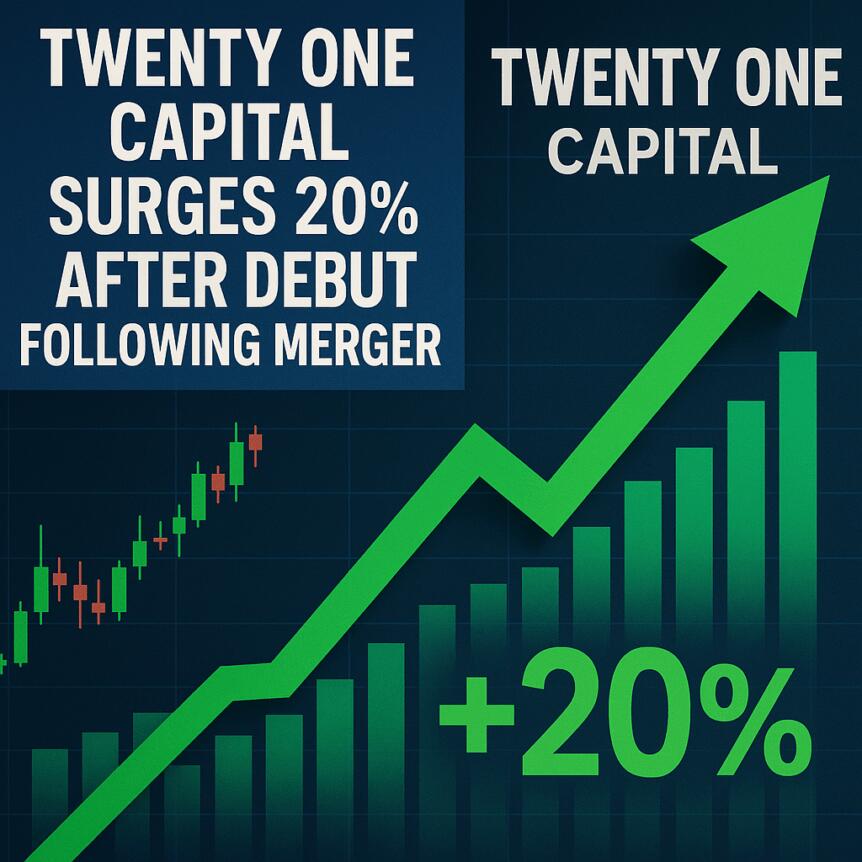
Twenty One Capital Surges 20% After Debut Following Merger

Twenty One Capital Surges 20% After Debut Following Merger

Twenty One Capital Faces First-Day Decline After NYSE Listing Shares of Twenty One Capital, a newly formed cryptocurrency treasury company in the United States, fell sharply during its debut trading session. The company, which merged with the blank-check firm Cantor Equity Partners, experienced a 20% decline on its first day, highlighting the volatile reception to [...]

Author: Crypto Breaking News
Massive 750 Million ADA Transfer to Binance: What This Whale Movement Means for Cardano

Massive 750 Million ADA Transfer to Binance: What This Whale Movement Means for Cardano

BitcoinWorld Massive 750 Million ADA Transfer to Binance: What This Whale Movement Means for Cardano In a move that has sent ripples through the cryptocurrency community, blockchain tracker Whale Alert reported a staggering transaction: 750,000,000 ADA, valued at approximately $347 million, was transferred from an unknown wallet to the Binance exchange. This colossal ADA transfer to Binance immediately raises critical questions about market sentiment and potential price volatility for Cardano. […] This post Massive 750 Million ADA Transfer to Binance: What This Whale Movement Means for Cardano first appeared on BitcoinWorld.

Author: bitcoinworld
Bullish on risk assets in a fractured world

Bullish on risk assets in a fractured world

Written by: @arndxt_xo Compiled by: AididiaoJP, Foresight News In short: I am bullish on risk assets in the short term because AI capital expenditure, consumption driven by the wealthy, and still relatively high nominal growth are all structurally favorable to corporate profits. To put it more simply: when borrowing costs are low, “risky assets” usually perform well. But at the same time, I have serious doubts about the story we're currently telling about what all this means for the next decade: Sovereign debt problems cannot be resolved without a combination of inflation, financial repression, or unforeseen events. Fertility rates and population structure will implicitly limit real economic growth and quietly amplify political risks. Asia, especially China, will increasingly become a key definer of both opportunities and tail risks. Therefore, the trend continues, and we should continue to hold those profit-generating engines. However, building a portfolio requires recognizing that the road to currency devaluation and demographic restructuring will be fraught with difficulties, not smooth sailing. The Illusion of Consensus If you only read the opinions of major institutions, you might think we live in the most perfect macro world: Economic growth is “resilient,” inflation is sliding toward the target, artificial intelligence is a long-term tailwind, and Asia is a new engine for diversification. HSBC’s latest Q1 2026 outlook clearly reflects this consensus: stay in the equity bull market, overweight technology and communication services, bet on AI winners and Asian markets, lock in investment-grade bond yields, and use alternative and multi-asset strategies to smooth out volatility. I actually partially agree with that view. But if you stop there, you'll miss the really important story. Beneath the surface, the reality is: A profit cycle driven by AI capital expenditures is far more powerful than people imagined. A monetary policy transmission mechanism that has become partially ineffective due to the massive public debt piling up on private balance sheets. Some structural time bombs—sovereign debt, a collapse in birth rates, and geopolitical restructuring—are irrelevant to the current quarter, but crucial to what “risk assets” themselves mean a decade from now. This article is my attempt to reconcile these two worlds: one is a glamorous and easily marketable story of "resilience," and the other is a chaotic, complex, and path-dependent macro reality. 1. Market consensus Let's start with the general view of institutional investors. Their logic is simple: The stock market bull run continues, but volatility has increased. A diversified sector portfolio is recommended: overweight technology and communications, while also allocating to utilities (electricity demand), industrials, and financials to achieve value and diversification. Use alternative investments and multi-asset strategies to cope with downturns—such as gold, hedge funds, private credit/equity, infrastructure, and volatility strategies. Focus on profit opportunities: Because the interest rate spread is already very narrow, funds are being shifted from high-yield bonds to investment-grade bonds. Increase investment in emerging market hard currency corporate bonds and local currency bonds to capture interest rate spreads and yields with low correlation to equities. Utilize infrastructure and volatility strategies as sources of income to hedge against inflation. Using Asia as the core of diversity: Overweight in China, Hong Kong, Japan, Singapore, and South Korea. Topics of interest: Asia's data center boom, China's leading innovative companies, improved returns for Asian companies through buybacks/dividends/mergers and acquisitions, and high-quality Asian credit bonds. Regarding fixed income, they are clearly optimistic: Global investment-grade corporate bonds offer higher spreads and the opportunity to lock in yields before policy rates fall. Overweight emerging market local currency bonds to capture interest rate spreads, potential currency gains, and low correlation with equities. Slightly underweight global high-yield bonds due to their high valuations and some credit risks. This is a textbook example of a "late-cycle but not yet over" portfolio allocation: go with the flow, diversify your investments, and let Asia, AI, and yield strategies drive your portfolio. I believe this strategy will be largely correct over the next 6-12 months. But the problem is that most macroeconomic analyses stop here, while the real risks begin from here. 2. Cracks beneath the surface From a macro perspective: US nominal spending growth is around 4-5%, directly supporting corporate revenue. But the key question is: Who is consuming? Where does the money come from? Simply discussing a declining savings rate ("consumers have no money") misses the point. If wealthy households draw on their savings, increase credit, and realize asset gains, they can continue to consume even with slowing wage growth and a weak job market. Consumption exceeding income is supported by the balance sheet (wealth), not the income statement (current income). This means that a large portion of marginal demand comes from wealthy households with large balance sheets, rather than from broad-based real income growth. This is why the data looks so contradictory: Overall consumption remained strong. The labor market is gradually weakening, especially for low-end jobs. Income and asset inequality has intensified, further reinforcing this pattern. Here, I depart from the mainstream narrative of "resilience." Macroeconomic aggregates look good because they are increasingly dominated by a small group at the top of the income, wealth, and capital acquisition levels. This remains a positive for the stock market (profits don't care whether the income comes from one rich person or ten poor people). But for social stability, the political environment, and long-term growth, it's a slowly escalating threat. 3. The Stimulating Effect of AI Capital Expenditure The most underestimated dynamic at present is artificial intelligence capital expenditure and its impact on profits. In short: Investment expenditures are the income of others today. The associated costs (depreciation) will be reflected slowly over the next few years. Therefore, when AI hyperscale enterprises and related companies significantly increase their total investment (e.g., by 20%): Revenue and profits will receive a huge and immediate boost. Depreciation increases slowly over time, roughly in sync with inflation. Data shows that the best single indicator for explaining profits at any given time is total investment minus capital consumption (depreciation). This leads to a very simple, yet contrary-to-consensus, conclusion: during the ongoing wave of AI capital expenditure, it stimulates the business cycle and maximizes corporate profitability. Do not try to block this train. This aligns perfectly with HSBC's overweighting of technology stocks and its theme of "evolving AI ecosystem." They are essentially laying the groundwork for the same profit logic in advance, albeit in a different way. I am more skeptical of the narratives about its long-term impact: I don't believe that AI capital expenditure alone can usher us into a new era of 6% real GDP growth. Once a company's free cash flow financing window narrows and its balance sheet becomes saturated, capital expenditures will slow down. As depreciation catches up, this "profit incentive" effect will fade; we will return to the underlying trend of population growth plus productivity gains, which is not particularly high in developed countries. Therefore, my position is: Tactically: As long as total investment data continues to surge, remain optimistic about the beneficiaries of AI capital expenditure (chips, data center infrastructure, power grids, niche software, etc.). Strategically: view this as a cyclical profit boom, rather than a permanent reset of the trend growth rate. 4. Bonds, liquidity, and the transmission mechanism of semi-ineffectiveness This part got a little weird. Historically, a 500-basis-point interest rate hike would severely impact the private sector's net interest income. However, today, trillions of dollars in public debt lie as safe assets on private balance sheets, distorting this relationship: Rising interest rates mean higher interest income for holders of government bonds and reserves. Many businesses and households have fixed-rate debt (especially mortgages). Final result: The net interest burden of the private sector did not worsen as macroeconomic forecasts predicted. Therefore, we face the following: A Federal Reserve caught in a dilemma: inflation remains above target, while labor market data is weakening. A volatile interest rate market: The best trading strategy this year is to buy bonds at the mean reversion rate, buy after panic selling, and sell after a rapid rise, because the macro environment remains unclear as to whether there will be a clear trend of "significant rate cuts" or "another rate hike". Regarding "liquidity," my view is quite straightforward: The Federal Reserve's balance sheet now resembles a narrative tool; its net changes are too slow and too small relative to the entire financial system to serve as an effective trading signal. The real changes in liquidity occur on private sector balance sheets and in the repurchase market: who is borrowing, who is lending, and at what interest rate spread. 5. Debt and Population Sovereign debt: The outcome is known, but the path is unknown. The international sovereign debt problem is a decisive macroeconomic issue of our time, and everyone knows that the "solution" is nothing more than: By devaluing the currency (inflation), the debt-to-GDP ratio can be brought back to a manageable level. The path remains undecided: Orderly financial repression: Maintain a nominal growth rate > nominal interest rate. Tolerating inflation slightly above target, Slowly eroding the actual debt burden. Chaotic crisis events: Markets panicked due to the out-of-control fiscal trajectory. The term premium suddenly surged. A currency crisis occurs in a weaker sovereign nation. Earlier this year, we already experienced this when market concerns about fiscal policy caused yields on long-term U.S. Treasury bonds to surge. HSBC itself noted that the narrative of a "deteriorating fiscal trajectory" peaked during budget discussions and subsequently subsided as the Federal Reserve shifted its focus to growing concerns. I believe this drama is far from over. Fertility Rate: A Slow-Moving Macroeconomic Crisis The global fertility rate has fallen below replacement level, a problem not only in Europe and East Asia, but now also spreading to Iran, Turkey, and gradually affecting parts of Africa. This is essentially a far-reaching macroeconomic shock masked by demographic figures. Low birth rate means: A higher dependency ratio (an increase in the proportion of people in need of support). Lower long-term real economic growth potential. The long-term social distribution pressure and political tension caused by the fact that capital returns have consistently outpaced wage growth. When you combine AI capital expenditure (a shock of capital deepening) with declining fertility rates (a shock of labor supply), You will get a world like this: The capital owners nominally performed exceptionally well. The political system has become more unstable. Monetary policy is caught in a dilemma: it must support growth while avoiding inflation that could trigger a wage-price spiral when labor finally gains bargaining power. This will never appear in an institution's 12-month outlook slides, but it is absolutely crucial for an asset allocation perspective of 5-15 years. China: A Key Variable That Has Been Overlooked HSBC's view on Asia is optimistic: it is bullish on policy-driven innovation, the potential of AI and cloud computing, governance reforms, higher corporate returns, low valuations, and the tailwinds brought by widespread interest rate cuts across Asia. My opinion is: From a 5-10 year perspective, the risk of having no allocation to the Chinese and North Asian markets is greater than the risk of having moderate allocation. From a 1-3 year perspective, the main risks are not macroeconomic fundamentals, but rather policy and geopolitics (sanctions, export controls, and capital flow restrictions). You could consider allocating assets related to Chinese AI, semiconductors, and data center infrastructure, as well as high-dividend, high-quality credit bonds. However, you must determine the allocation size based on a clear policy risk budget, rather than simply relying on historical Sharpe ratios.

Author: PANews