Lending

Lending protocols form the backbone of the decentralized money market, allowing users to lend or borrow digital assets without intermediaries. Using smart contracts, platforms like Aave and Morpho automate interest rates based on supply and demand while requiring over-collateralization for security. The 2026 lending landscape features advanced permissionless vaults and institutional-grade credit lines. This tag covers the evolution of capital efficiency, liquidations, and the integration of diverse collateral types, including LSTs and tokenized RWAs.

15985 Articles
Created: 2026/02/02 18:52
Updated: 2026/02/02 18:52
PBOC sets USD/CNY reference rate at 7.0733 vs. 7.0754 previous

PBOC sets USD/CNY reference rate at 7.0733 vs. 7.0754 previous

The post PBOC sets USD/CNY reference rate at 7.0733 vs. 7.0754 previous appeared on BitcoinEthereumNews.com. The People’s Bank of China (PBOC) sets the USD/CNY central rate for the trading session ahead on Thursday at 7.0733 compared to the previous day’s fix of 7.0754 and 7.0554 Reuters estimate. PBOC FAQs The primary monetary policy objectives of the People’s Bank of China (PBoC) are to safeguard price stability, including exchange rate stability, and promote economic growth. China’s central bank also aims to implement financial reforms, such as opening and developing the financial market. The PBoC is owned by the state of the People’s Republic of China (PRC), so it is not considered an autonomous institution. The Chinese Communist Party (CCP) Committee Secretary, nominated by the Chairman of the State Council, has a key influence on the PBoC’s management and direction, not the governor. However, Mr. Pan Gongsheng currently holds both of these posts. Unlike the Western economies, the PBoC uses a broader set of monetary policy instruments to achieve its objectives. The primary tools include a seven-day Reverse Repo Rate (RRR), Medium-term Lending Facility (MLF), foreign exchange interventions and Reserve Requirement Ratio (RRR). However, The Loan Prime Rate (LPR) is China’s benchmark interest rate. Changes to the LPR directly influence the rates that need to be paid in the market for loans and mortgages and the interest paid on savings. By changing the LPR, China’s central bank can also influence the exchange rates of the Chinese Renminbi. Yes, China has 19 private banks – a small fraction of the financial system. The largest private banks are digital lenders WeBank and MYbank, which are backed by tech giants Tencent and Ant Group, per The Straits Times. In 2014, China allowed domestic lenders fully capitalized by private funds to operate in the state-dominated financial sector. Source: https://www.fxstreet.com/news/pboc-sets-usd-cny-reference-rate-at-70733-vs-70754-previous-202512040115

Author: BitcoinEthereumNews
Does Hyperliquid's popularity mean Arbitrum is "winning by default"?

Does Hyperliquid's popularity mean Arbitrum is "winning by default"?

Recently, the Hyperliquid HIP3 protocol has become incredibly popular, with stocks, gold, and even Pokémon cards and CS skins now available for trading. This has made Hyperliquid incredibly successful, but many people have overlooked the fact that Arbitrum's liquidity has also seen a significant surge in the past. Is it true that the more popular Hyperliquid becomes, the more Arbitrum can "quietly make a fortune"? Why is that? 1) A fundamental fact is that most of the USDC held by Hyperliquid is bridged from Arbitrum. Whenever Hyperliquid launches a TSLA stock contract or a gold perp, a massive amount of USDC flows in from Arbitrum. This connection is not incidental, but a structural dependency. These bridging activities directly contributed to Arbitrum's daily transaction volume and ecosystem activity, propelling Arbitrum to maintain its leading position in layer 2. 2) Of course, some might say that Arbitrum is merely a stepping stone for Hyperliquid's funding, a one-way street where funds simply pass through. Then why doesn't Hyperliquid choose Solana or Base, but instead deeply integrates with Arbitrum? The reasons are as follows: 1. Lowest technical adaptation cost: Hyperliquid requires a liquidity entry point with good EVM compatibility to securely accept stablecoins, while Arbitrum's Nitro architecture can keep bridging latency within 1 minute and the gas fee is less than $0.01, so users can hardly feel the friction cost. 2. Unparalleled Liquidity Depth: Arbitrum's native USDC circulating supply reaches $8.06 billion, the highest among all Layer 2 platforms. Furthermore, Arbitrum has mature protocols like GMX and Gains that have formed a complete closed loop encompassing lending, trading, derivatives, and yield aggregation. Essentially, Hyperliquid's choice of Arbitrum is not merely about a bridging channel, but about accessing a mature liquidity network. 3. The synergistic effect of the ecosystem is irreplaceable: Some of the new stock PERP, gold PERP, and even government bond tokens launched in HIP3 already existed on Arbitrum as RWA assets, and were used for lending and farming through DeFi protocols such as Morpho, Pendle, and Euler. This allows users to stake RWA assets as collateral on Arbitrum to borrow USDC, and then bridge to Hyperliquid to trade stock PERP with 5x or even 10x leverage. This isn't just a one-way transfer of funds; it's a cross-ecosystem liquidity aggregation. 3) In my view, the relationship between Hyperliquid and Arbitrum is not a simple liquidity "parasitic relationship," but rather a strategic complementarity. Hyperliquid, as the application chain of Perp Dex, continues to stimulate transaction activity, while Arbitrum provides a continuous influx of liquidity. For Arbitrum, it also needs phenomenal applications like Hyperliquid to overcome the lack of product dynamism in the Ethereum ecosystem. This reminds me of when Arbitrum was promoting the Orbit layer3 framework, its main selling point was the "general layer2 + specialized application chain" approach. Orbit allowed any team to quickly deploy their own Layer3 application chain, enjoying Arbitrum's security and liquidity while customizing performance parameters according to business needs. While Hyperliquid chose a path of building its own layer 1 and deeply binding with Arbitrum, which seems different from directly deploying layer 3, a closer analysis of the relationship between the HIP-3 ecosystem and Arbitrum reveals an interesting conclusion: the HIP-3 ecosystem has, to some extent, become the de facto layer 3 application chain of Arbitrum. Ultimately, the core logic of Layer 3 is to maintain its own performance advantages while outsourcing security and liquidity to Layer 2. Clearly, Hyperliquid cannot currently offer the liquidity advantages of the HIP3 ecosystem, but Arbitrum can. Isn't this just a variant of the layer 3 operating mode?

Author: PANews
MSTR Stock Targets $484? Traders Debate Peak

MSTR Stock Targets $484? Traders Debate Peak

The post MSTR Stock Targets $484? Traders Debate Peak appeared on BitcoinEthereumNews.com. Key Insights Mizuho reaffirmed an Outperform rating and $484 price target for MSTR (MicroStrategy) Stock after a Q&A with Strategy CFO Andrew Kang. Trader XO argued the stock topped at $455 in May 2025, sharing charts that showed MSTR Stock never reclaimed that level. BoDoggos co-founder Pio predicted MSTR Stock could reach $1,000 or higher despite recent volatility. Mizuho’s Dan Dolev reiterated an Outperform rating and $484 price target for MSTR Stock on December 3 following a Q&A session with Strategy (formerly MicroStrategy) CFO Andrew Kang. The firm raised $1.44 billion to strengthen its USD reserves and secure 21 months of preferred dividend coverage without selling Bitcoin. Kang told Dolev that the company planned to expand reserves when mNAV exceeded 1 while avoiding new convertible notes in favor of perpetual preferred equity. He noted that Strategy could operate for over three years at current BTC prices, with Bitcoin sales serving only as a last resort. Monetization options such as lending and covered calls remained exploratory, while the capital strategy remained focused on the mNAV ratio. MSTR Stock Might Have Topped at $455 Trader XO took a contrarian stance to Mizuho’s bullish outlook when he shared analysis on May 22, suggesting the run had topped around $455. His chart displayed resistance around $425 to $455, where the stock reached a local peak, with price action consolidating below those levels through mid-2025. MSTR daily price chart | Source: XO / TradingView On December 1, XO revisited his call, updating the chart caption to “it is what it is,” noting that the price never again touched the $455 area. The updated chart showed MSTR Stock had plummeted to $157.53 after breaking below the $325 support zone, representing a decline of more than 60% from the May peak and contributing to the stock’s year-to-date…

Author: BitcoinEthereumNews
AI Data Transparency Is Rewriting Brand–Manufacturer Dynamics

AI Data Transparency Is Rewriting Brand–Manufacturer Dynamics

The post AI Data Transparency Is Rewriting Brand–Manufacturer Dynamics appeared on BitcoinEthereumNews.com. An electronics assembly line. Instrumental Inc. Talk to the people building the world’s favorite devices—from smartphones to wireless mice—and they’ll tell you the real revolution happening in electronics manufacturing right now is in the relationships – not the technology. AI is changing the information that brands demand from their manufacturing partners, information that could give brands powerful ammunition to put downward cost pressure on manufacturers. The technology can provide powerful benefits to both sides, and is forcing leaders to rethink what manufacturing partnerships look like in the AI Age. The Relationship Between Brands and Their Manufacturing Partners Most electronics brands contract with manufacturing partners to support the manufacture of their devices – some even get engineering support. Electronics manufacturing is considered a commodity, with relatively low margins. Andrew Scheuermann, CEO of Arch Systems, which provides software to electronics manufacturers, notes, “Margins can be as low as two percent. If [factories] were to share the whole [production] dataset carte blanche, it could be used to cut down cost—and that’s existential to their business.” Many contracts are negotiated based on a “costs plus” model, which reflects the actual costs of producing a device. This creates an incentive not to share information that might reveal hidden cost savings, which a brand might want to renegotiate. Other incentives are also misaligned – a brand wants to deliver the best possible customer experience, while the manufacturer wants to maximize their margins without triggering returns. Scheuermann’s company, Arch Systems, is used by tier-one electronics factories worldwide – including Flex, Jabil, Plexus, and Sanmina – to provide both brands and factory teams with real-time production visibility. For many manufacturers, sharing that kind of data with their customers makes them uneasy. Scheuermann explains, “They think, I’m doing a great job, but if I share this dataset, you might…

Author: BitcoinEthereumNews
Bitcoin flywheel fails, how can Strategy recover its losses?

Bitcoin flywheel fails, how can Strategy recover its losses?

Author: Chloe, ChainCatcher Since October, MSTR has fallen by about 50%. After reaching a high of $457 last year, it has fallen sharply and far underperformed the market. MarketBeat data shows that the 12-month low is about $155.61 and the high is over $450. It has now entered a relatively undervalued low level and is extremely volatile. Why has MSTR's stock price remained sluggish for months, significantly underperforming the broader market and even worse than Bitcoin itself? This has led the market to question whether the Bitcoin flywheel effect has failed. Enjoy double the joy in a bull market, and suffer double the pain in a bear market. The sharp drop in Bitcoin prices was the most direct trigger. Bitcoin has fallen by about 31% since its peak on October 6th, and Strategy, holding approximately 650,000 Bitcoins (3.1% of the total supply), was naturally not spared. MarketWatch further calculated that the correlation between BTC and MSTR is close to 0.97, meaning that the two are almost in a one-to-one linkage. However, due to the leverage effect, the volatility of MSTR was further amplified; while Bitcoin fell by 31%, MSTR fell by more than 50%. The market is also questioning whether MSTR's flywheel model, on which it relies, is failing. Strategy's mNAV is currently 1.15. According to CryptoSlate, the market is only willing to pay a 15% premium to its Bitcoin holdings for MSTR. Once mNAV falls below 1.0, further share issuance will become extremely dilutive. Bloomberg also points out that with Strategy's market capitalization only slightly above its Bitcoin holdings, the premium has been severely compressed, and this positive feedback loop is failing. Furthermore, Strategy purchased only 130 bitcoins between November 17th and November 30th, spending $11.7 million, a negligible amount for a company holding approximately 650,000 bitcoins. This suggests that Strategy recognized that at the current premium level, a large-scale issuance of shares would harm rather than enhance shareholder interests, and therefore proactively applied the brakes. The Financial Times also noted that after its peak, MSTR's share price has begun to underperform Bitcoin itself, raising questions about whether an equity vehicle can still generate more value than simply holding BTC. Especially with the launch of Bitcoin spot ETFs, allowing investors easier access to Bitcoin, why should they bear the debt burden, management risks, and potential equity dilution associated with MSTR? Furthermore, Strategy has financed its Bitcoin purchase program this year by issuing a large number of convertible bonds and high-yield preferred shares, creating a heavy fixed-payment burden. A Seeking Alpha analysis indicates this will increase the annual preferred stock dividend burden to hundreds of millions of dollars; CryptoSlate estimates this figure could reach as high as $750 million to $800 million annually, not including convertible bond interest. The problem is that while MSTR's traditional software business still generates over $100 million in revenue each quarter, it cannot independently support this ever-increasing preferred stock dividend burden. This is the core reason why the company announced the establishment of a $1.44 billion cash reserve. To address concerns about cashing out through cryptocurrency sales, Strategy has established a US dollar reserve. On Monday, Strategy announced the establishment of a $1.44 billion dollar reserve specifically for paying preferred stock dividends and interest on existing debt, in an effort to address concerns that Strategy might "sell cryptocurrency to raise cash" to pay preferred stock dividends. According to Strategy's press release, the $1.44 billion came from proceeds from the sale of Class A common stock under its market offering plan. The company currently plans to maintain reserves sufficient to cover at least 12 months of dividend payments and intends to gradually increase these reserves, with the ultimate goal of building a buffer pool capable of covering dividend payments for 24 months or more. This time, Strategy invested most of the funds raised from the stock sale into its US dollar cash reserves, instead of buying Bitcoin like it had in the past. It can be said that even Saylor had to find a more defensive financial strategy in the face of volatile cryptocurrency prices. However, even with the release of the reserve fund news, the market reaction remained lukewarm, with MSTR falling more than 11% intraday, marking its fourth consecutive month of decline. With the company's mNAV remaining close to 1 for an extended period, it signifies that the initial "sell stocks, buy crypto" flywheel strategy has officially become ineffective. CEO Phong Le has previously admitted that if funding runs out, the company may ultimately consider selling its Bitcoin holdings. Reserves temporarily alleviated market concerns, but risks related to capital structure remain. According to independent researcher Spreek, mNAV has declined across the board, and Bitcoin strategies have encountered bottlenecks. Saylor had already begun to turn to debt instruments as a new financing channel earlier this year. These instruments have less direct correlation with stock prices and are intended to avoid further depressing MSTR prices and mNAV. Spreek stated that STRC targets retail investors directly, emphasizing stability and high returns, but neglecting underlying risks. "STRC is more like Luna and UST than MSTR's previous products." However, MSTR's balance sheet is still much stronger than Luna's back then, but the reflexivity mechanism still exists: every time Strategy raises the product interest rate, the annual cash dividend payout increases significantly, and it may only be a matter of time before they consider selling Bitcoin to raise funds. According to research predictions, Strategy has roughly three predictable trajectories. First, it will choose to reduce leverage, adopt a conservative stance, cease issuing large amounts of STR series preferred stock or debt, reduce the scale and speed of Bitcoin purchases, maintain reserves as much as possible, and refrain from selling BTC, even if this means the stock price will remain below mNAV for a long time, and this is essentially a default end to the Bitcoin flywheel, with MSTR trading at a discount for an extended period. Another path relies on external macroeconomic drivers, such as liquidity injections from the Federal Reserve or political factors reigniting the Bitcoin craze, allowing Saylor to temporarily escape the mire and restart its old strategy: using the stock price recovery to issue more shares and convertible bonds, and then adding to its Bitcoin holdings at higher prices. However, this will likely only postpone the end result, because the structural flaws in the company's cash inflows mean that always buying at the peak will keep Saylor at the edge of profitability, even if its direction is correct. From Bitcoin's perspective, this is the most favorable development in the near term, as it can alleviate selling pressure and support prices. The third path involves rapidly expanding preferred shares such as STRCs to maintain operations, attracting retail investors by raising yields and pushing debt to billions or even tens of billions of dollars. In the short term, this seems superior to directly selling stocks or Bitcoin, avoiding immediate market shocks and allowing the flywheel to temporarily recover. However, the previously mentioned reflexivity mechanism is likely to be amplified: as payment obligations swell—currently nearly $750 million in annual dividends, potentially doubling in the future—the company will face a heavy burden of dollar debt, and selling Bitcoin to raise funds for repayment may ultimately become a last resort. According to a recent Bloomberg report, Strategy CEO Phong Le stated that Strategy is considering lending out some of its tokens. This implies that Strategy hopes to gain a new revenue stream through lending, with annual interest rates typically between 3-5%, but this is still a long way from being implemented. Strategy's decision to release $1.4 billion in reserves may be a concession to its strategy of not selling Bitcoin. However, in the face of reality, Strategy has also simultaneously lowered its full-year financial forecast and key performance indicators, setting the year-end price of Bitcoin between $85,000 and $110,000. The full-year book value target for Bitcoin in US dollars has also been significantly reduced from the original $20 billion to $8.4 billion to $12.8 billion. Furthermore, Strategy predicts that the full-year net profit will fall within a huge range of a loss of $5.5 billion to a profit of $6.3 billion, a significant reduction from the original forecast of $24 billion for the full-year net profit.

Author: PANews
Understanding APR and APY: The Real Language of Interest

Understanding APR and APY: The Real Language of Interest

As per experts, APR shows the simple annual interest rate without compounding, while APY includes compounding and reflects the true yearly return.

Author: Blockchainreporter
Solana Price Prediction, Next Crypto to Explode

Solana Price Prediction, Next Crypto to Explode

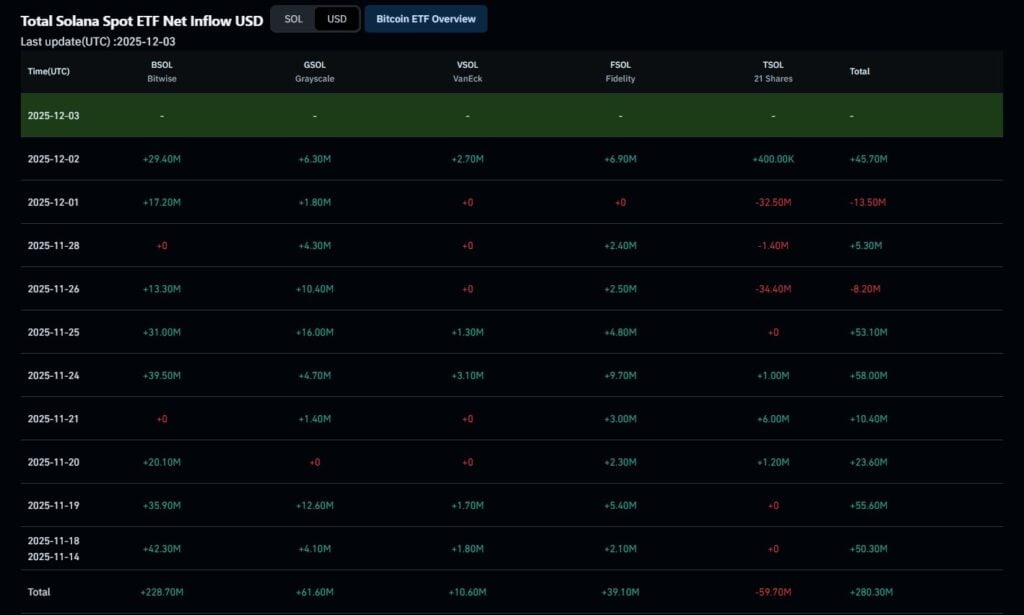
The post Solana Price Prediction, Next Crypto to Explode appeared on BitcoinEthereumNews.com. Solana continues to sit at the center of market attention as traders monitor its structure, short-term outlook, ETF flows, and long-term targets. The past week delivered fresh volatility for SOL, but the latest rebound, combined with new ETF inflows, brings renewed strength to the chart. With momentum returning, many traders now look at Solana alongside the best crypto to buy now as they plan their next moves. This update breaks down the current setup, the reaction to key levels, the latest ETF developments, and what traders should prepare for in the coming days. While SOL offers a high-performance Layer 1 opportunity, smart money is also rotating into high-alpha presale plays centered on the Bitcoin Layer 2 narrative for potentially outsized returns. Bitcoin Hyper (HYPER) has emerged as a top candidate for the next crypto to explode, already raising around $28.9 million in its presale. Source – Cilinix Crypto YouTube Channel Solana Sees Major ETF Rebound After Vanguard Sparks New Inflows The Solana ETF narrative took a hit last week when the Bitwise Spot Solana ETF recorded its first outflows. That tone shifted yesterday when new inflows doubled the prior week’s losses. Solana brought in roughly $45 million in fresh inflows in a single day, showing that momentum has turned strongly positive again. This reversal likely came after news that Vanguard, the world’s second-largest asset manager, will open its brokerage platform to allow trading of select third-party crypto ETFs. Vanguard controls enormous capital, so any move that expands access to crypto ETFs can influence flows across the entire market and boost credibility for the asset class. Data from SolanaFloor and several dashboards show the scale of this surge and highlight strong institutional demand. Total cumulative inflows for Solana ETFs now sit above $280 million and are rapidly approaching $400 million, with…

Author: BitcoinEthereumNews
North Korean crypto hackers got caught live — by fake laptops

North Korean crypto hackers got caught live — by fake laptops

The post North Korean crypto hackers got caught live — by fake laptops appeared on BitcoinEthereumNews.com. North Korean operatives were caught on camera, live, after security researchers lured them into a booby-trapped “developer laptop,” capturing how the Lazarus-linked crew tried to blend into a US crypto job pipeline using legitimate AI hiring tools and cloud services. The evolution in state-sponsored cybercrime was reportedly captured in real time by researchers at BCA LTD, NorthScan, and the malware-analysis platform ANY.RUN. Catching the North Korean attacker Hacker News shared how, in a coordinated sting operation, the team deployed a “honeypot,” which is a surveillance environment disguised as a legitimate developer’s laptop, to bait the Lazarus Group. The resulting footage offers the industry its clearest look yet at how North Korean units, specifically the Famous Chollima division, are bypassing traditional firewalls by simply getting hired by the target’s human resources department. The operation began when researchers created a developer persona and accepted an interview request from a recruiter alias known as “Aaron.” Instead of deploying a standard malware payload, the recruiter steered the target toward a remote employment arrangement common in the Web3 sector. When the researchers granted access to the “laptop,” which was actually a heavily monitored virtual machine designed to mimic a US-based workstation, the operatives did not attempt to exploit code vulnerabilities. Instead, they focused on establishing their presence as seemingly model employees. Building trust Once inside the controlled environment, the operatives demonstrated a workflow optimized for blending in rather than breaking in. They utilized legitimate job-automation software, including Simplify Copilot and AiApply, to generate polished interview responses and populate application forms at scale. This use of Western productivity tools highlights a disturbing escalation, showing that state actors are leveraging the very AI technologies designed to streamline corporate hiring to defeat them. The investigation revealed that the attackers routed their traffic through Astrill VPN to mask their…

Author: BitcoinEthereumNews
Secret laptop footage exposes North Korean spies infiltrating US companies

Secret laptop footage exposes North Korean spies infiltrating US companies

North Korean operatives were caught on camera, live, after security researchers lured them into a booby-trapped “developer laptop,” capturing how the Lazarus-linked crew tried to blend into a US crypto job pipeline using legitimate AI hiring tools and cloud services. The evolution in state-sponsored cybercrime was reportedly captured in real time by researchers at BCA […] The post Secret laptop footage exposes North Korean spies infiltrating US companies appeared first on CryptoSlate.

Author: CryptoSlate
Best Crypto to Buy Now: Solana Price Prediction, Next Crypto to Explode

Best Crypto to Buy Now: Solana Price Prediction, Next Crypto to Explode

Solana continues to sit at the center of market attention as traders monitor its structure, short-term outlook, ETF flows, and long-term targets. The past week delivered fresh volatility for SOL, but the latest rebound, combined with new ETF inflows, brings renewed strength to the chart. With momentum returning, many traders now look at Solana alongside […]

Author: The Cryptonomist