Liquidation

Liquidation occurs when a trader’s collateral is no longer sufficient to cover their leveraged position’s losses, triggering an automated forced closure by the exchange's liquidation engine. It is a critical risk-management mechanism that ensures the solvency of lending protocols and derivative platforms. In 2026, the focus has moved toward MEV-resistant liquidation models that protect users from predatory "cascades." This tag provides essential information on maintenance margins, health factors, and how to avoid liquidation in high-volatility environments.

14708 Articles
Created: 2026/02/02 18:52
Updated: 2026/02/02 18:52
Massive $707.5M Plunge Rocks Market, ETH Takes The Lead

Massive $707.5M Plunge Rocks Market, ETH Takes The Lead

The post Massive $707.5M Plunge Rocks Market, ETH Takes The Lead appeared on BitcoinEthereumNews.com. Crypto Liquidation Event: Massive $707.5M Plunge Rocks Market, ETH Takes The Lead Skip to content Home Crypto News Crypto Liquidation Event: Massive $707.5M Plunge Rocks Market, ETH Takes the Lead Source: https://bitcoinworld.co.in/crypto-liquidation-event-impact/

Author: BitcoinEthereumNews
Hyperliquid now has the largest AVAX long position, with a floating profit of $1.43 million

Hyperliquid now has the largest AVAX long position, with a floating profit of $1.43 million

PANews reported on September 23rd that according to Yu Jin, a single address had opened a long position worth $ 21.4 million in AVAX on Hyperliquid since 11:00 PM last night, becoming the platform's largest AVAX position. The average opening price was $ 32.2 , and the liquidation price was $ 27.1 . AVAX subsequently rose 10% , and the address currently has a floating profit of $ 1.43 million.

Author: PANews
UK FCA Speeds Up Crypto Approvals, Cut Wait Time by 70%

UK FCA Speeds Up Crypto Approvals, Cut Wait Time by 70%

UK’s FCA cuts crypto approvals time by 70%, aiming for efficient regulation as firms await clearer 2026 rules amid fewer applications. The United Kingdom has reduced the time it takes to approve crypto registrations, with regulators signaling a more efficient process. The Financial Conduct Authority confirmed that the average wait time has dropped by 69% […] The post UK FCA Speeds Up Crypto Approvals, Cut Wait Time by 70% appeared first on Live Bitcoin News.

Author: LiveBitcoinNews
UAE Joins Global Crypto Tax Reporting Agreement

UAE Joins Global Crypto Tax Reporting Agreement

UAE joins OECD’s crypto tax reporting framework, CARF, aiming for 2027 rollout to boost transparency and align with global standards. The United Arab Emirates has taken a major step toward aligning its digital asset rules with global standards. The Ministry of Finance informed that the country has signed the Multilateral Competent Authority Agreement, which is […] The post UAE Joins Global Crypto Tax Reporting Agreement appeared first on Live Bitcoin News.

Author: LiveBitcoinNews
Crypto markets reel after $1.7B wipeout: Bitcoin, Ethereum, and Dogecoin struggle to recover

Crypto markets reel after $1.7B wipeout: Bitcoin, Ethereum, and Dogecoin struggle to recover

The post Crypto markets reel after $1.7B wipeout: Bitcoin, Ethereum, and Dogecoin struggle to recover appeared on BitcoinEthereumNews.com. Bitcoin steadies near $112,574 after flash crash wipes $1.7B in leverage. Ethereum trades at $4,198, struggling to recover momentum. Macro worries, Fed policy, and liquidations keep traders cautious. Cryptocurrencies continue to be defensive this Tuesday, September 23, as investors lick their wounds from the carnage that hit markets barely 24 hours ago. After a high-stakes selloff erased over $1.7 billion in leverage overnight, even the biggest digital coins haven’t found their footing. The mood? Anxious, with traders bracing for more bumps ahead as macro jitters and regulatory headlines swirl. Bitcoin, Ethereum, and friends: Cautious trade after the crash The fallout from Monday’s sharp drop is still echoing across exchanges. Bitcoin, still the market’s north star, is trying to pick itself up after dropping under $112,000. As of this morning, it’s hovering around $112,574, just a fractional move higher that does little to erase the pain of the previous session. Ethereum, too, is feeling the weight. The second-largest crypto by market cap changed hands at $4,198, a modest but underwhelming move after Monday’s slide to below $4,100. Solana is faring no better, sitting at $219 while technical analysts debate whether buyers will step in or a further drop is in store. XRP slipped to $2.84 as well, breaking a weeks-long upswing. Meanwhile, Dogecoin is trading at $0.24, down 3.79%, offering little consolation to holders who have already seen the token shed more than 14% since its last peak. The culprit? Monday’s flash crash was driven by a perfect storm: technical breakdowns, surging Treasury yields in the US, ongoing macroeconomic worries, and a rush of forced liquidations that left hundreds of thousands of traders on the wrong side of the trade. There’s little appetite for bold bets as risk aversion lingers and volumes thin out. Beyond prices: Policy shifts and broader market…

Author: BitcoinEthereumNews
Bitcoin, Ethereum, XRP, Dogecoin Tumble As Crypto Liquidations Hit $1.5 Billion: Analytics Firm Warns 'Sticky Inflation' Could Push BTC Lower

Bitcoin, Ethereum, XRP, Dogecoin Tumble As Crypto Liquidations Hit $1.5 Billion: Analytics Firm Warns 'Sticky Inflation' Could Push BTC Lower

Leading coins diverged from stocks on Monday as ‘Fear’ sentiment gripped the cryptocurrency market.read more

Author: Coinstats
Crypto Market Suffers 2% Drop As Bitcoin Tumbles and $1.7B Liquidations Mount

Crypto Market Suffers 2% Drop As Bitcoin Tumbles and $1.7B Liquidations Mount

The crypto market lost altitude on Tuesday, slipping 2% to about $3.9 trillion as Bitcoin fell toward $112,000 and erased the week’s gains, with roughly $1.7 billion in liquidations accelerating the sell-off as leveraged positions unwound. Bitcoin was last down about 1.8% near $112,561, while Ethereum fell 3.3% to $41,197, BNB dropped 4% to $991.3, and Solana slid 6.2% to $219.03. In the past 24 hours, about $1.7b of mostly long positions were wiped out, the largest long liquidation event this year, Coinglass said. Macro Boost Meets Micro Headwinds, FTX Cash Returns And Sentiment Sours Flows into crypto funds remained a bright spot last week. Spot Ethereum ETFs recorded $556m in net inflows, lifting total net assets to $29.6b, according to SoSoValue. Over the same period, spot Bitcoin ETFs attracted $886.6m, taking total net assets to $152.31b. Macro signals set the stage. The Federal Reserve cut rates by 25 basis points last week to a target range of 4.00% to 4.25%, and signaled two more possible cuts this year. That first move initially buoyed altcoins, which rallied into the weekend. Momentum faded on Monday. Sentiment cooled shortly after the defunct crypto exchange FTX said it will begin its third distribution on Sept. 30, returning about $1.6b to holders of allowed claims as part of its Chapter 11 process. Social gauges turned more cautious. Analysts at Santiment noted on Sunday that more traders are now “betting that the price of Bitcoin will go down, as opposed to betting that Bitcoin’s price will go up,” and said they were seeing a “much more negative narrative forming across social media.” Liquidation Spike Signals Possible Local Low As Funding Turns Negative Positioning also shifted. 10X Research said that sharp liquidation spikes often mark local lows and can raise the odds of a rebound, a view supported by negative funding rates that show faster traders are net short. The note urged traders to weigh positioning, technical signals and how the market is priced into October before buying dips. Industry executives framed the sell-off as a leverage flush rather than a fundamental break. Maja Vujinovic, CEO and co-founder of Digital Assets at FG Nexus, said, “Roughly $1.7B in liquidations reflects excess leverage, not failing fundamentals. Overheated funding post-Fed left traders exposed; once Bitcoin rolled over, forced unwinds hit ETH and alt-books hard.” “But history shows that these ‘leverage washes’ often mark a healthier base. With spot demand, ETF flows, and stablecoin rails intact, we’re more likely heading into consolidation than capitulation and that typically precedes the next sustained leg higher,” she added. Liquidations Drive ‘Margin Call Avalanche,’ Traders See Healthy Reset Traders echoed that view on market structure. Doug Colkitt, initial contributor to Fogo, said, “This is crypto’s version of a margin call avalanche. When Bitcoin sneezes, the entire market catches leverage flu. $1.7B in liquidations isn’t fundamentals breaking—it’s over-levered traders getting rinsed. Leverage is always highest at the top, and when prices roll over, the cascade feeds on itself.” “These flushes are brutal, but they’re also healthy. They reset leverage, shake out weak hands, and clear the runway for the next leg. If you’ve been around crypto long enough, then you already know the cold hard truth: liquidations are the feature, not the bug,” he said. Others pointed to Bitcoin’s relative resilience. Mike Maloney, CEO at Incyt, said, “The $1B+ liquidation wave was driven by long liquidations. The exuberance following an ATH, the anemic Fed cut, and a mismatch of reporting and risk creates a breakdown. The real capture here is that BTC is still the king of crypto markets: despite weathering the worst liquidation, BTC decline and volatility are a fraction of other assets. This suggests to me that the market will bounce up strongly on the back of BTC’s liquidity.” As September draws to a close, traders are watching funding, ETF flows, and the pace of redemptions from bankruptcy estates. For now, the market has reset leverage and attention turns to whether dip buyers step in ahead of October

Author: CryptoNews
Urgent Analysis: Four Key Factors Behind Bitcoin’s Recent Alarming Price Drop

Urgent Analysis: Four Key Factors Behind Bitcoin’s Recent Alarming Price Drop

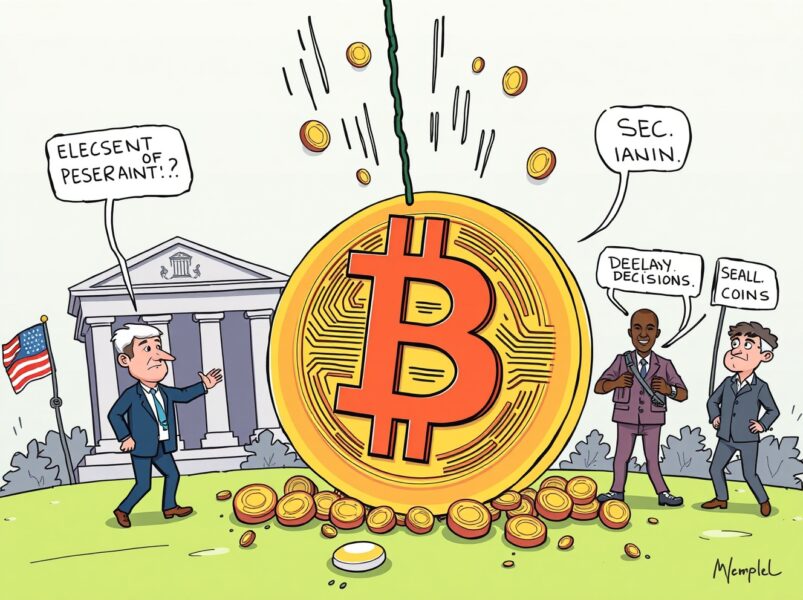
BitcoinWorld Urgent Analysis: Four Key Factors Behind Bitcoin’s Recent Alarming Price Drop The cryptocurrency world recently witnessed a significant event: a sharp 2% plunge in Bitcoin’s value over just 12 hours. This sudden Bitcoin price drop has naturally sparked concerns and questions among investors and enthusiasts alike. What exactly caused this swift downturn? An in-depth analysis by XWIN Research Japan, a respected CryptoQuant contributor, points to a confluence of four critical factors that collectively pushed Bitcoin lower. Macroeconomic Headwinds: The Fed’s Stance and the Bitcoin Price Drop One primary driver of the recent Bitcoin price drop stems from the U.S. Federal Reserve’s hawkish monetary policy. While the Fed did implement a 0.25 percentage point interest rate cut in September, Chair Jerome Powell’s subsequent signals indicated a reluctance towards further monetary easing. This stance has significant implications for risk assets like Bitcoin. The Fed’s position led to an increase in U.S. Treasury yields. It also strengthened the dollar’s value against other currencies. Historically, a stronger dollar and higher yields tend to make riskier investments less attractive. In stark contrast, gold, often seen as a safe-haven asset, surged to an all-time high of $3,745 per ounce during this period. Regulatory Roadblocks and Investor Sentiment: Impact on Bitcoin Price Drop Adding to the market’s woes, the U.S. Securities and Exchange Commission (SEC) announced delays on decisions for several cryptocurrency exchange-traded funds (ETFs). These postponements naturally dampened short-term investor sentiment. Such regulatory uncertainty often creates a hesitant environment for potential buyers. Furthermore, spot BTC ETFs, which had previously seen significant inflows, recorded net outflows during this period. Although large-scale investors were observed “buying the dip,” their purchasing activity was not enough to counteract the immediate supply-demand imbalance. This imbalance further contributed to the downward pressure on Bitcoin’s price. Miner Sell-Offs: A Key Contributor to the Bitcoin Price Drop On-chain data provides another crucial piece of the puzzle regarding the Bitcoin price drop. It revealed a notable trend: miner holdings have decreased by approximately 9% in recent months. Miners are often forced to sell their newly minted or held Bitcoin on exchanges. This selling activity is typically driven by the need to cover rising operational costs. These costs include electricity, hardware maintenance, and other infrastructure expenses. When a significant portion of miners sell their assets, it increases the available supply in the market, pushing prices lower. Futures Market Volatility: Accelerating the Bitcoin Price Drop The futures market played a dramatic role in accelerating the recent Bitcoin price drop. Roughly $1.7 billion in liquidations occurred over a 24-hour period, with the vast majority consisting of long positions. A liquidation happens when a trader’s leveraged position is forcibly closed due to insufficient margin to cover potential losses. When long positions are liquidated, it involves forced selling, which can rapidly amplify downward price movements. The analysis also highlighted the Spent Output Profit Ratio (SOPR), an on-chain indicator that gauges the overall profitability of Bitcoin holders. The SOPR approached a value of one, suggesting that many investors were selling at break-even or even at a loss, indicating widespread capitulation. In summary, the recent Bitcoin price drop was not a singular event but rather the culmination of multiple interconnected factors. From the macroeconomic pressures exerted by the Federal Reserve’s hawkish stance and regulatory delays from the SEC, to significant selling pressure from miners and a cascade of liquidations in the futures market, each element played a role. Understanding these drivers is essential for investors navigating the volatile cryptocurrency landscape and preparing for future market movements. Frequently Asked Questions About the Recent Bitcoin Price Drop What were the main factors contributing to the recent Bitcoin price drop? The primary factors included the U.S. Federal Reserve’s hawkish stance, SEC delays on crypto ETF decisions, significant miner sell-offs, and large liquidations in the futures market. How did the Federal Reserve’s actions impact Bitcoin? The Fed’s reluctance towards further monetary easing led to higher U.S. Treasury yields and a stronger dollar, making risk assets like Bitcoin less attractive to investors. Why did Bitcoin miners sell off their holdings? Miners sold off approximately 9% of their holdings to cover rising operational costs, such as electricity and hardware maintenance, increasing the supply of Bitcoin on exchanges. What role did the futures market play in the price decline? The futures market saw about $1.7 billion in liquidations, predominantly of long positions. These forced sales rapidly accelerated the downward price movement of Bitcoin. What is the SOPR indicator, and what did it suggest during the price drop? The Spent Output Profit Ratio (SOPR) is an on-chain indicator showing holder profitability. During the drop, it neared a value of one, indicating that many investors were selling at break-even or even at a loss. Did you find this analysis helpful in understanding the recent Bitcoin price drop? Share this article with your network on social media to help others grasp the complex dynamics influencing the crypto market! To learn more about the latest crypto market trends, explore our article on key developments shaping Bitcoin price action. This post Urgent Analysis: Four Key Factors Behind Bitcoin’s Recent Alarming Price Drop first appeared on BitcoinWorld.

Author: Coinstats
Digital Asset Funds Pull in $1.9bn After Fed’s “Hawkish” Rate Cut

Digital Asset Funds Pull in $1.9bn After Fed’s “Hawkish” Rate Cut

Digital asset funds drew US$1.9bn after the Fed’s rate cut, pushing AuM to US$40.4bn as Bitcoin and Ethereum led inflows and institutional interest rebounded.

Author: Blockchainreporter
Machi bulls suffered losses exceeding $20 million and were forced to partially close their positions.

Machi bulls suffered losses exceeding $20 million and were forced to partially close their positions.

PANews reported on September 23rd that, according to Onchain Lens, Machi (singer Huang Licheng) has suffered floating losses exceeding $20 million on his long positions in ETH (15x leverage), HYPE, and PUMP (5x leverage) during the market downturn. To avoid forced liquidation, Machi has partially closed these positions at a loss.

Author: PANews