NFT

NFTs are unique digital identifiers recorded on a blockchain that certify ownership and authenticity of a specific asset. Moving past the "PFP" craze, 2026 NFTs emphasize utility, representing everything from IP rights and digital fashion to RWA titles and event ticketing. This tag explores the technical standards of digital ownership, the growth of NFT marketplaces, and the integration of non-fungible tech into the broader Creator Economy and enterprise solutions.

12528 Articles
Created: 2026/02/02 18:52
Updated: 2026/02/02 18:52
Crypto News Today: Key Events and Market Highlights

Crypto News Today: Key Events and Market Highlights

The cryptocurrency market experienced notable developments today as traders and investors closely monitored price movements and regulatory updates. Several key events across the crypto sector highlight ongoing trends and challenges faced by the industry in 2023. Market Overview and Price Movements Bitcoin’s price saw moderate fluctuations today, maintaining its position above the $30,000 mark amid [...]

Author: Crypto Breaking News
Sony Pushes Deeper Into Web3 With New On-Chain Reputation System

Sony Pushes Deeper Into Web3 With New On-Chain Reputation System

The post Sony Pushes Deeper Into Web3 With New On-Chain Reputation System appeared on BitcoinEthereumNews.com. Blockchain Sony’s Layer-2 blockchain network, Soneium, has unveiled a new feature called Soneium Score, a reputation and reward system aimed at measuring real user participation across its ecosystem. According to the announcement, Soneium Score assigns points to users based on their blockchain activity, such as staking, token swaps, and NFT transactions. The framework evaluates four main categories: daily streaks, liquidity provision, NFT holdings, and bonus tasks linked to featured ecosystem partners. Soneium said the goal is to tackle two common challenges in Web3: the absence of a consistent way to measure user reputation, and the difficulty projects face in sustaining engagement. By quantifying participation, the system is designed to encourage long-term involvement rather than short bursts of activity. Season 1 With Ecosystem Partners The program’s first season launches in collaboration with a group of DeFi, gaming, and NFT projects, giving users immediate opportunities to build reputations while earning rewards. “Season 1 launches with prominent ecosystem partners to offer users immediate opportunities to build their reputations while exploring diverse applications,” Soneium said. Sony’s Blockchain Push Soneium is an Ethereum Layer-2 developed by Sony Block Solutions Labs, a joint venture between Sony Group Corporation and Startale Labs. The network went live in January following a test phase that saw more than 14 million wallets participate. With Soneium Score, Sony is adding a new layer of gamification and identity-building to its blockchain, as on-chain scoring systems gain traction across the industry. The information provided in this article is for informational purposes only and does not constitute financial, investment, or trading advice. Coindoo.com does not endorse or recommend any specific investment strategy or cryptocurrency. Always conduct your own research and consult with a licensed financial advisor before making any investment decisions. Author Alex is an experienced financial journalist and cryptocurrency enthusiast. With over 8…

Author: BitcoinEthereumNews
DeFi Development Corp. boosts its Solana holdings by 29% with a $77 million purchase

DeFi Development Corp. boosts its Solana holdings by 29% with a $77 million purchase

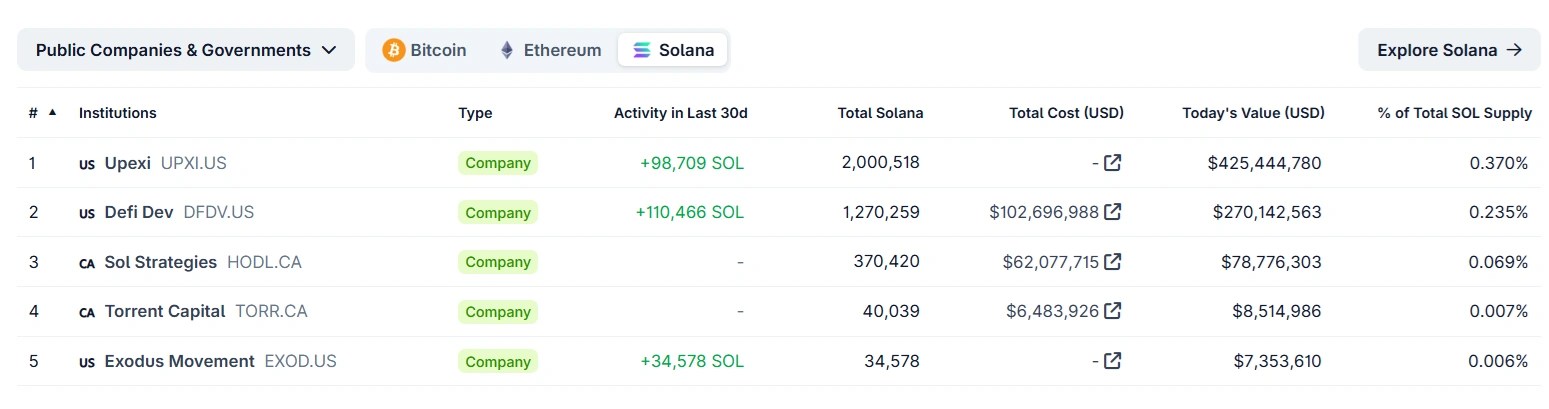
The post DeFi Development Corp. boosts its Solana holdings by 29% with a $77 million purchase appeared on BitcoinEthereumNews.com. DeFi Development Corp. has doubled down on its bet on Solana, scooping up 407,247 SOL, worth about $77 million at current prices. The latest acquisition takes the company’s total holdings to more than 1.83 million SOL, roughly $371 million, and strengthens its claim as one of the largest institutional Solana treasuries in the market.  The buy was fueled by fresh capital from a recent equity raise, and DeFi Development still has over $40 million from the same raise set aside for future purchases. DeFi Development’s treasury rose by 29% as a result of this purchase, which has put it in touching distance of the top spot among corporate SOL holders. DeFi Development opens purse for Solana buys Before this acquisition, DeFi Development held 1.42 million SOL. The new haul brings its exposure up by nearly a third, pushing its Solana-per-share (SPS) ratio to 0.0864, which equates to $17.52 worth of SOL per share outstanding. The company currently has around 21 million shares in circulation, though it acknowledged that once warrants from its equity raise are factored in, the figure could rise to roughly 31 million. Even so, the company mentioned that the SPS ratio should remain comfortably above the previously flagged 0.0675 threshold, meaning shareholders can expect their proportional Solana exposure to hold steady despite future dilution. The Solana treasury race heats up DeFi Development’s aggressive move comes as the corporate race to build Solana treasuries gains momentum. Publicly listed firms now hold more than $800 million worth of SOL combined, with names such as Upexi, SOL Strategies, and Torrent Capital, among others, leading the way. Sharps Technology has also signaled plans to join the fray, outlining a $400 million Solana treasury initiative. Solana treasury rankings as of August 28, with DeFi Development’s yet to be updated. Source: Coingecko Meanwhile,…

Author: BitcoinEthereumNews
U.S. Government Taps Pyth Network for Onchain Economic Data

U.S. Government Taps Pyth Network for Onchain Economic Data

The post U.S. Government Taps Pyth Network for Onchain Economic Data appeared on BitcoinEthereumNews.com. In a landmark move, the U.S. Department of Commerce has selected Pyth Network to verify and distribute official economic data onchain. The goal: greater transparency, real-time access, and a public record that can’t be altered. Today’s announcement, made by Howard Lutnick and Donald Trump, signals a major leap for decentralized tech in public data infrastructure. It also validates Pyth’s reputation as a trusted data provider in global finance. The U.S. Department of Commerce has selected Pyth Network to verify & distribute economic data onchain 🏛️ Today’s announcement by @howardlutnick & @realDonaldTrump marks a landmark step for the adoption of decentralization & validates Pyth’s role as a trusted data source 🧵 ⬇️ pic.twitter.com/cOvw8lDNhP — Pyth Network 🔮 (@PythNetwork) August 28, 2025 A Historic Collaboration Pyth has been working closely with the Department of Commerce for months. Now, as the official data source for this initiative, the network will power the verifiable publication of economic stats onchain. Howard Lutnick’s push for data innovation has positioned the U.S. to lead the world in financial transparency. And Pyth is at the center of that vision. With 100+ blockchains and 600+ apps already relying on its data feeds, Pyth combines openness, security, and speed in ways few protocols can match. That made it the ideal choice for the government’s first big onchain data experiment. Why This Move Matters For decades, economic data has been siloed behind agencies, websites, and slow distribution channels. By putting it onchain, the Department of Commerce is ensuring anyone, anywhere, can access the same official numbers at the same time—no middlemen, no delays, no doubts. This move unlocks new opportunities: Transparency: Immutable records remove questions about revisions or data tampering. Access: Developers and businesses can integrate official stats directly into applications. Trust: Onchain publication makes economic data verifiable by design. As Howard…

Author: BitcoinEthereumNews
PSG1 Solana, portable Web3 console with hardware wallet

PSG1 Solana, portable Web3 console with hardware wallet

The post PSG1 Solana, portable Web3 console with hardware wallet appeared on BitcoinEthereumNews.com. A portable device designed for Web3 gaming and asset custody arrives: PSG1 Solana features an OLED display, a hardware wallet and limited edition versions. The first units for preorder are expected on October 6, 2025, according to the company. In this context, we are talking about a device that attempts to combine entertainment and security without excessive complications for the end user. Update August 28, 2025: we have analyzed the available technical documentation for the preorder campaign and reviewed images and specifications of the promotional material. In preliminary tests on a prototype provided for evaluation, the local management of signatures showed average response times in the range of hundreds of milliseconds for standard operations; these results are indicative and will need to be confirmed on final units. Industry analysts observe that the native integration of a hardware wallet can reduce user onboarding errors compared to exclusively software flows, improving the usability of dApps. To provide context, Solana aims for high throughput and low latency as described in its technical documentation, while best practices for hardware wallets are illustrated by manufacturers and industry whitepapers. What changes: console and cold wallet in the same device PSG1 Solana is designed to combine gaming, token management, and NFT access to dApp on the Solana ecosystem. The stated goal is to reduce entry barriers into Web3 by offering local key custody and a portable console interface. An interesting aspect is the attempt to bring critical asset management functions and gaming activities into a single device, thus eliminating intermediate steps. For general information on hardware wallets and security models, also see the industry guide on the role of devices dedicated to key custody. Main Specifications (in brief) Chipset: Rockchip RK3588S octa-core Wikipedia RAM: 8 GB LPDDR4X Storage: 128 GB eMMC OLED Screen: 3.92″, 1240×1080 Connectivity: Wi‑Fi…

Author: BitcoinEthereumNews
American Rap Star Shouts Out XRP During Performance, Says It’s Not Too Late To Buy

American Rap Star Shouts Out XRP During Performance, Says It’s Not Too Late To Buy

A video clip from a Detroit event has been stirring discussion across social media platforms, showing Grammy-nominated rapper Big Sean urging his audience to take a chance on cryptocurrencies. The moment occurred at the Stand With Crypto event in Michigan for its digital asset community, where Big Sean delivered an energetic show.  However, a call […]

Author: Bitcoinist
PEPETO Price Prediction 2025: The Ethereum Memecoin Set to Beat Solana and Cardano

PEPETO Price Prediction 2025: The Ethereum Memecoin Set to Beat Solana and Cardano

With Bitcoin’s halving complete and a fresh cycle beginning, investors are searching for the projects that combine timing, fundamentals, and […] The post PEPETO Price Prediction 2025: The Ethereum Memecoin Set to Beat Solana and Cardano appeared first on Coindoo.

Author: Coindoo
BlockDAG, Ethereum, Solana, and Avalanche Stand Out

BlockDAG, Ethereum, Solana, and Avalanche Stand Out

The post BlockDAG, Ethereum, Solana, and Avalanche Stand Out appeared on BitcoinEthereumNews.com. With major events like Token2049 Singapore drawing in thousands of blockchain insiders and builders, the second half of 2025 has become a proving ground for the most promising crypto projects. From big-name layer 1s continuing to evolve, to fresh entrants making noise with high-ROI offers, the race is heating up. Among the top cryptos to watch, one project has moved with calculated intensity, BlockDAG, whose limited-time 2049% bonus is making waves right before the industry’s largest stage. Here’s a breakdown of the coins currently turning heads in August 2025.  BlockDAG (BDAG) BlockDAG’s 2049% presale bonus isn’t just a promotion, it’s a declaration. By aligning this bold offer with Token2049 Singapore, BlockDAG isn’t waiting for attention; it’s claiming it.  The project has already raised $385 million, sold over 25.5 billion coins, and entered batch 30 at $0.03. Early buyers from batch 1 ($0.001) are sitting on a 2,900% ROI, while new participants can still target a 1,566% return based on the $0.05 projected launch price. But this is more than numbers. The 2049% bonus is proof of intent, BlockDAG wants mindshare, and it’s executing a playbook designed to secure it. The network combines a DAG-based structure with a PoW mechanism, making it both scalable and secure.  On top of that, BlockDAG is integrating features like its X1 mobile miner, an expanding DApp ecosystem, and real-world brand partnerships. With a timed presence at Web3’s most visible event and a presale closeout designed to convert attention into action, BlockDAG isn’t asking for recognition. It’s earning it. Solana (SOL) Solana continues to hold its place as one of the top cryptos to watch going into Q4 2025. After the successful rollout of its Firedancer validator client, Solana has seen a boost in transaction throughput and stability. Its DeFi ecosystem has rebounded significantly since early…

Author: BitcoinEthereumNews
AI-Generated Content: Will Smith’s Shocking Crowd Video Sparks Authenticity Debate

AI-Generated Content: Will Smith’s Shocking Crowd Video Sparks Authenticity Debate

BitcoinWorld AI-Generated Content: Will Smith’s Shocking Crowd Video Sparks Authenticity Debate In the rapidly evolving digital landscape, where blockchain aims for verifiable truth and NFTs promise unique digital ownership, the line between reality and fabrication is increasingly blurred. This challenge is starkly highlighted by recent events involving none other than Hollywood icon Will Smith, whose latest social media post has ignited a fiery debate about AI-generated content and the very nature of authenticity online. For those in the crypto and tech spheres, this incident offers a compelling look at the public’s immediate reaction to perceived digital manipulation, a crucial lesson for any project built on trust and transparency. Will Smith AI Video: A Digital Mirage or Reality? Will Smith recently shared a video from his European tour, showcasing vast crowds of adoring fans. His caption, "My favorite part of the tour is seeing you all up close," aimed to convey genuine connection. However, keen-eyed viewers quickly spotted disturbing inconsistencies: distorted faces, unnatural finger placements, and oddly augmented features. This immediate visual discord led to widespread accusations that the footage was created using AI, turning what was meant to be an uplifting post into a source of fresh cringe. The Will Smith AI video quickly became a prime example of how quickly public perception can shift when digital fakery is suspected. The visual anomalies included: Digitally-mangled faces in the crowd. Nonsensical finger placements on fans’ hands. Oddly augmented features across various clips. While some fans held up genuine signs expressing their love, including one claiming his music helped them survive cancer, the overall presentation raised significant red flags for a discerning online audience. The Generative AI Controversy: Why It Matters The initial assumption that the crowd footage was entirely AI-generated sent ripples through social media. For a public figure like Will Smith, still navigating reputational recovery post "the slap," such an accusation is particularly damaging. The idea that a celebrity might fabricate fan interactions, or even spin up stories of fans using his music to cope with cancer treatment, strikes a deeply inauthentic chord. This incident underscores a growing Generative AI controversy: the ethical dilemmas surrounding the creation of hyper-realistic but potentially misleading content. While the full extent of AI usage in Smith’s video remains debated, the immediate public reaction highlights a strong societal aversion to perceived digital deceit. The implications extend beyond celebrity PR: Erosion of Trust: When content creators use AI to enhance reality, it risks undermining audience trust. Misinformation Spread: The difficulty in discerning AI-generated content fuels a nightmare of misinformation online. Ethical Quandaries: Questions arise about the moral responsibility of creators to disclose AI usage. Unpacking the Truth: Is All AI-Generated Content Deceptive? As tech blogger Andy Baio pointed out, the situation is more nuanced. Smith’s team has previously posted genuine photos and videos from the tour featuring some of the same fans and signs. The contentious video appears to be a collage of real footage blended with AI-generated elements, likely using real crowd photos as source material. This hybrid approach makes it incredibly difficult to definitively label it as purely ‘fake’ or ‘real.’ Compounding the issue, YouTube’s recent testing of a feature to ‘unblur, denoise, and improve clarity’ on Shorts inadvertently made Smith’s video look even more synthetic on that platform, sparking further outrage before YouTube offered an opt-out. This incident serves as a stark reminder of the challenges in identifying and regulating AI-generated content, especially when it’s skillfully interwoven with authentic material. Consider the spectrum of digital manipulation: Tool/Technique Public Perception Impact on Authenticity Traditional Video Editing Generally accepted Minimal, if used for narrative flow Photoshop/Retouching Accepted with caveats (e.g., models) Moderate, if used to alter reality Autotune (Voice) Often criticized, but common High, if used to mask poor talent Generative AI (Fake Crowds) Highly resistant, seen as deceptive Extreme, seen as fabricating reality Social Media Authenticity: The Public’s Shifting Trust Regardless of the technical intricacies, the court of public opinion delivered a swift verdict: Will Smith posted a ‘fake’ video. Most social media users won’t delve into past posts to verify authenticity. What sticks is the perception of deception. This reaction reveals a critical shift in public tolerance. While tools like Photoshop and auto-tune have long been accepted, generative AI evokes a stronger resistance. Fans expect a certain level of truthfulness from artists; relying on AI to create fan interactions feels like a breach of trust. The incident highlights the fragile nature of social media authenticity, where a single misstep can erode years of built-up goodwill. The core issue isn’t just the use of AI, but the intent behind it. If the goal is to present fabricated interactions as real, it crosses a line. This is analogous to a pop star whose recordings are heavily auto-tuned but cannot perform live, or an advertisement for facial moisturizer that photoshops acne off a model’s face. In both cases, the audience feels duped. Rebuilding Celebrity Trust in the AI Era The Will Smith video saga is a cautionary tale for all public figures and content creators navigating the AI landscape. While the temptation to enhance content with generative AI is understandable for visual appeal, the risk to Celebrity trust is immense. When an artist breaks their audience’s trust – whether through heavily auto-tuned vocals that don’t match live performances or seemingly fabricated fan interactions – it’s incredibly difficult to win back. Transparency and clear disclosure regarding the use of AI in creative work will become paramount. As AI tools become more sophisticated, the onus will be on creators to maintain an honest relationship with their audience, ensuring that the ‘Fresh Prince’ of digital content remains genuinely fresh, not artificially enhanced. The Will Smith crowd video, whether fully AI-generated or a clever blend of real and synthetic, serves as a powerful case study in the evolving relationship between celebrities, technology, and their audience. It underscores the public’s growing skepticism towards AI-enhanced content and the critical importance of authenticity in the digital age. As generative AI becomes more pervasive, the challenge for creators will be to leverage its power without compromising the trust that forms the bedrock of their connection with fans. To learn more about the latest AI news, explore our article on key developments shaping AI features and institutional adoption. This post AI-Generated Content: Will Smith’s Shocking Crowd Video Sparks Authenticity Debate first appeared on BitcoinWorld and is written by Editorial Team

Author: Coinstats
Pepenode ($PEPENODE) Nears $500k In Presale – Is This The Next Big Meme Utility Token?

Pepenode ($PEPENODE) Nears $500k In Presale – Is This The Next Big Meme Utility Token?

For far too long, the meme coin market has been flooded with a countless number of presales that offer neither engagement, utility, nor innovation.  Even after launch, most of these projects still relegate early participants to passive investors, and as a result, they often fade into obscurity quickly.  Pepenode, however, stands apart from the crowd, […]

Author: The Cryptonomist