NFT

NFTs are unique digital identifiers recorded on a blockchain that certify ownership and authenticity of a specific asset. Moving past the "PFP" craze, 2026 NFTs emphasize utility, representing everything from IP rights and digital fashion to RWA titles and event ticketing. This tag explores the technical standards of digital ownership, the growth of NFT marketplaces, and the integration of non-fungible tech into the broader Creator Economy and enterprise solutions.

13304 Articles
Created: 2026/02/02 18:52
Updated: 2026/02/02 18:52
Conflux price prediction 2026-2032: Can CFX price lead China’s crypto market?

Conflux price prediction 2026-2032: Can CFX price lead China’s crypto market?

Explore Conflux (CFX) price prediction and evaluate the future CFX market sentiment and impact on the Chinese crypto market.

Author: Cryptopolitan
Bitcoin Hyper Presale Hits $28M: Next Crypto To Explode?

Bitcoin Hyper Presale Hits $28M: Next Crypto To Explode?

Quick Facts: ➡️ Bitcoin’s thesis is shifting from pure price action to real scalability and DeFi utility, with Layer-2 infrastructure taking center stage. ➡️ Bitcoin Hyper will use ZK rollups, an SVM execution layer, and a canonical $BTC bridge to deliver fast, low-fee, Bitcoin-secured DeFi and dApps. ➡️ As expected, the $HYPER presale just crossed […]

Author: Bitcoinist
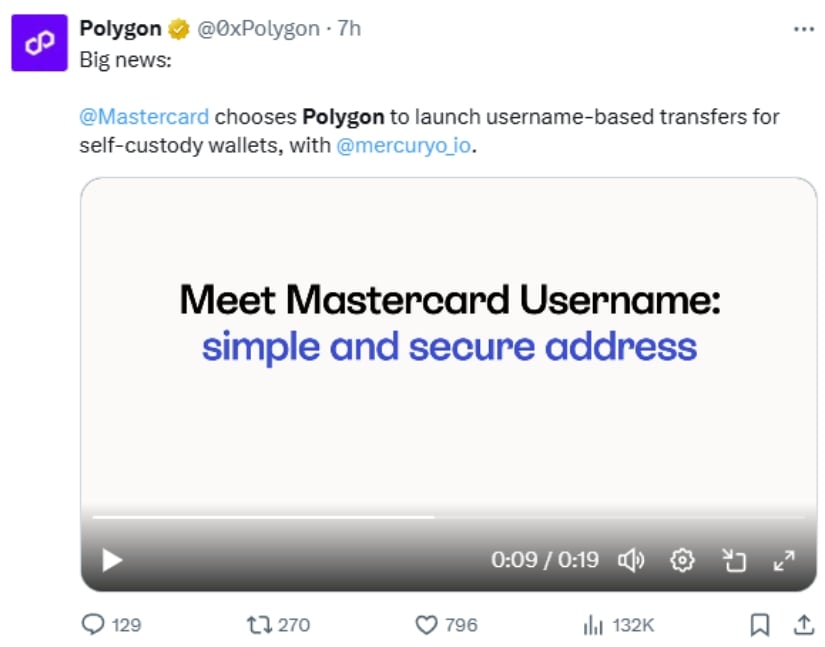
Mastercard Partners with Polygon to Replace Complex Wallet Addresses with Simple Usernames

Mastercard Partners with Polygon to Replace Complex Wallet Addresses with Simple Usernames

Mastercard has chosen Polygon as the first blockchain network to support verified username transfers for self-custody crypto wallets.

Author: Brave Newcoin
LivLive ($LIVE) Breaks Into Top 2025 Crypto Picks After Raising $2.1M While Nexchain (NEX) and Unstaked ($UNSD) Report Strong Stage Activity

LivLive ($LIVE) Breaks Into Top 2025 Crypto Picks After Raising $2.1M While Nexchain (NEX) and Unstaked ($UNSD) Report Strong Stage Activity

The search for the best crypto presales in 2025 has intensified as early buyers chase life changing upside. Many new […] The post LivLive ($LIVE) Breaks Into Top 2025 Crypto Picks After Raising $2.1M While Nexchain (NEX) and Unstaked ($UNSD) Report Strong Stage Activity appeared first on Coindoo.

Author: Coindoo
What Happened in the Crypto Market Today? Nvidia Earnings, Bitcoin Dominance, and BlackRock Crypto ETF

What Happened in the Crypto Market Today? Nvidia Earnings, Bitcoin Dominance, and BlackRock Crypto ETF

The post What Happened in the Crypto Market Today? Nvidia Earnings, Bitcoin Dominance, and BlackRock Crypto ETF appeared first on Coinpedia Fintech News Good morning! The US market woke up today to a mix of anxiety and curiosity as the crypto charts flashed red almost across the board. So let’s walk through everything that unfolded overnight from price action to ETF flows to the biggest headlines of the last 12 hours. Crypto Market News – Asian Hours Recap …

Author: CoinPedia
YRAL announces an Exclusive Networking Event in Dubai

YRAL announces an Exclusive Networking Event in Dubai

YRAL, an AI-powered Social Media app built on Web3, is thrilled to announce an Exclusive Networking Event in Dubai.

Author: Crypto Breaking News
How does 1inch's Aqua, a shared liquidity protocol, revitalize dormant DeFi capital?

How does 1inch's Aqua, a shared liquidity protocol, revitalize dormant DeFi capital?

For a long time, fragmented liquidity and idle capital have been two major challenges that the DeFi sector has been trying to overcome. There are tens of thousands of liquidity pools in the market, but most of the billions of dollars are just dormant in the protocols and are difficult to pool together. On November 17, 1inch, a leading DEX aggregator, announced the launch of its liquidity protocol Aqua, aiming to play the role of "awakener" and drive the transformation of DeFi towards more refined liquidity management. Aqua has transitioned from an aggregator to an infrastructure provider and is now open to developers. The launch of Aqua marks a turning point in 1inch's recent strategic transformation. Initially, 1inch was known for its DEX aggregation capabilities, focusing on integrating optimal trading links and prices across DEXs for users. However, in recent years, 1inch's strategic focus has been shifting from pure retail aggregation services to becoming a B2B infrastructure provider. This initial release of Aqua wasn't directly aimed at general retail users; instead, it primarily focused on providing developer tools, including the SDK, libraries, and technical documentation. This developer-first strategy indicates that 1inch positions Aqua as a foundational protocol. Aqua employs a novel shared liquidity model that allows assets to be accessed and invoked concurrently and dynamically across multiple DeFi protocols, rather than being locked in separate liquidity pools as in traditional models. When announcing the agreement, 1inch co-founder Anton Bukov emphasized Aqua's core value to market makers: "Aqua addresses the liquidity fragmentation problem for market makers by stimulating the multiplier effect of effective capital. From now on, the only limit to capital efficiency will be the strategy itself." Another co-founder, Sergej Kunz, positions Aqua as "a scalable, capital-efficient underlying architecture for DeFi." Traditional DeFi capital efficiency is usually defined as the ability to pool capital within a single liquidity pool, but Aqua is attempting to elevate efficiency to a higher dimension: the ability to perform concurrent calls across protocols and policies. It features a self-custodied AMM, allowing liquidity to no longer be locked up. Before Aqua, mainstream AMM (Automated Market Maker) models widely adopted a "pooled custody" design, which required LPs (Liquidity Providers) to deposit and lock their assets in the protocol. However, this design caused two structural inefficiencies: Idle capital: Locked user funds can only execute a single strategy. According to data disclosed in the Aqua white paper, up to 85% of LP capital is idle, passively waiting for transactions to occur or price fluctuations to occur. Utility depletion: Once assets are locked, they cannot be used simultaneously for other DeFi activities, resulting in high opportunity costs. Limited partners (LPs) must make trade-offs between different DeFi activities, leading to the depletion of capital utility. Aqua introduced a new metric: TVU (Total Value Unlocked), which means that user funds will no longer be physically locked within the DeFi protocol, but will instead be dynamically managed through a licensing mechanism. Unlike traditional pooled custody systems, user funds remain in their own wallets at all times. They are only transferred or used according to pre-defined permissions when actual transactions or strategy execution occur. Aqua aims to leverage a self-custodial model to generate a multiplier effect on capital. User funds, while remaining in self-custodial, can be authorized to participate in multiple DeFi activities. For example, the same asset can simultaneously provide liquidity for an AMM, participate in DAO governance voting within a protocol, and act as collateral in lending protocols. This design significantly improves capital efficiency and application scenarios, creating a multiplier effect when used in combination. Aqua's core technological innovation is its registry authorization system, a design that decouples asset ownership and usage rights. Aqua itself does not directly hold assets; instead, it allocates virtual balances to LPs across different DeFi strategies within an internal registry. These virtual balances determine the share of underlying assets each strategy can access. This design allows different DeFi applications (such as AMMs, lending, or stablecoin liquidity pools) to simultaneously access the same underlying capital, achieving shared liquidity without requiring LPs to split or transfer funds across pools. For limited partners (LPs), this mechanism also provides granular permissions and risk control. They can set clear authorization and capital caps for each strategy, thereby limiting the use of funds. Once the strategy parameters are set, they are immutable, which helps improve code security and integration reliability, keeping risks within the specific, authorized policy scope. Unlike leading DEX protocol Uniswap V3, Aqua primarily focuses on addressing cross-strategy liquidity fragmentation. Uniswap V3's centralized liquidity model allows LPs to concentrate liquidity deployments within specific price ranges to improve capital efficiency in the pool, resulting in lower slippage for trades near those price intervals. However, V3 still requires funds to be locked in a position represented by an NFT (non-fungible token), which means liquidity remains fragmented and locked. If V3 solved the problem of "how to use capital more efficiently in a pool", then Aqua solved the problem of "how to provide liquidity to multiple pools with the same capital at the same time". The two are fundamentally different technical approaches. Innovation also has multiple limitations, and tokens have not yet benefited. Despite Aqua’s numerous technological innovations, its architectural design has also introduced new risks and variables. First, there are issues with transaction complexity and latency. Unlike the complexity of traditional AMM single-strategy transactions, Aqua's shared liquidity model involves interaction with multiple strategies, leading to increased transaction complexity. This can result in transaction latency, especially in large or high-frequency transactions, impacting the user experience. Secondly, there is path-dependent loss. When multiple strategies call the same underlying asset at the same time, but the actual balance of the wallet is lower than the sum of the virtual balances promised by all strategies, the transaction will be rolled back. However, Aqua will not automatically pause the strategy quotes, which may lock in unfavorable exposures during price fluctuations, similar to amplified gratuitous losses. LPs need to monitor in real time and manually cancel the strategy. Thirdly, there are security vector risks: 1) Since the registry relies on ERC-20 authorization and is immutable, the policy parameters cannot be modified once deployed. Initial configuration errors will be irreversible, meaning that 100% auditing must be performed correctly before going live, otherwise it will run with defects indefinitely; 2) Although self-hosting reduces the single point of failure risk of smart contract vulnerabilities, malicious or buggy policies may still steal funds within the scope of user authorization. Finally, there's the lack of token value capture. The white paper emphasizes that Aqua will support 1inch products and deepen ecosystem liquidity. As an inflection point in 1inch's infrastructure transformation, Aqua may indirectly increase 1inch's usage by increasing aggregator calls, thereby supporting the demand for the 1INCH token. However, the white paper doesn't mention 1INCH's direct role, such as fee burning or direct revenue sharing, which may limit the token's appreciation potential. Aqua points out a direction for DeFi liquidity management: shifting from "how much is locked" to "how much is used," but the unknown direction also means difficulties in implementation. After the front-end goes live in Q1 2026, the market will verify the real data to see if it is a feast of capital efficiency or just another narrative dragged down by complexity. Before the answer is revealed, rational approach and bold experimentation are currently the safest approach.

Author: PANews
Bitget – Allora (ALLO): Mạng AI phi tập trung tự cải thiện

Bitget – Allora (ALLO): Mạng AI phi tập trung tự cải thiện

Allora là mạng AI phi tập trung, tự cải thiện, khai thác các mô hình máy học do cộng đồng [...] The post Bitget – Allora (ALLO): Mạng AI phi tập trung tự cải thiện appeared first on VNECONOMICS.

Author: Vneconomics
Bitcoin Is 80% Into The Bear Market, Analyst Reveals What Will Confirm It 100%

Bitcoin Is 80% Into The Bear Market, Analyst Reveals What Will Confirm It 100%

The post Bitcoin Is 80% Into The Bear Market, Analyst Reveals What Will Confirm It 100% appeared on BitcoinEthereumNews.com. Scott Matherson is a prominent crypto writer at NewsBTC with a knack for capturing the pulse of the market, covering pivotal shifts, technological advancements, and regulatory changes with precision. Having witnessed the evolving landscape of the crypto world firsthand, Scott is able to dissect complex crypto topics and present them in an accessible and engaging manner. Scott’s dedication to clarity and accuracy has made him an indispensable asset, helping to demystify the complex world of cryptocurrency for countless readers. Scott’s experience spans a number of industries outside of crypto including banking and investment. He has brought his vast experience from these industries into crypto, which allows him to understand even the most complex topics and break them down in a way that is easy for readers from all works of life to understand. Scott’s pieces have helped to break down cryptocurrency processes and how they work, as well as the underlying groundbreaking technology that makes them so important to everyday life. With years of experience in the crypto market, Scott began to focus on his true passion: writing. During this time, Scott has been able to author countless influential pieces that have drawn in millions of readers and have shaped public opinion across various important topics. His repertoire spans hundreds of articles on various sectors in the crypto industry, including decentralized finance (DeFi), decentralized exchanges (DEXes), Staking, Liquid Staking, emerging technologies, and non-fungible tokens (NFTs), among others. Scott’s influence is not just limited to the countless discussions that his publications have sparked but also as a consultant for major projects in the space. He has consulted on issues ranging from crypto regulations to new technology deployment. Scott’s expertise also spans community building and contributes to a number of causes to further the development of the crypto industry. Scott is an…

Author: BitcoinEthereumNews
Bitget – Solana Saga kết thúc: Điều gì sẽ xảy ra tiếp theo với điện thoại tiền điện tử? Hướng dẫn đầy đủ về Solana Seeker & Điện thoại Trump

Bitget – Solana Saga kết thúc: Điều gì sẽ xảy ra tiếp theo với điện thoại tiền điện tử? Hướng dẫn đầy đủ về Solana Seeker & Điện thoại Trump

Trong một động thái gây chấn động cộng đồng tiền điện tử và công nghệ, Solana Mobile đã chính thức [...] The post Bitget – Solana Saga kết thúc: Điều gì sẽ xảy ra tiếp theo với điện thoại tiền điện tử? Hướng dẫn đầy đủ về Solana Seeker & Điện thoại Trump appeared first on VNECONOMICS.

Author: Vneconomics